This post contains affiliate links. We may earn a small commission when you buy through our links — at no extra cost to you.
The first time a mandoline takes a slice off your knuckle, you learn two things: how fast it happens, and what you’d have paid for a glove that morning. A cut-resistant glove is cheap insurance for anyone who cooks — not an admission of clumsiness, just a barrier between your fingertips and the sharpest things in the kitchen: the grater, the oyster shell, the boning knife.
A glove only helps if you keep it on, and that’s the real tension here. Steel mesh and high-density knits can stop a blade, but the stiff ones feel like chopping in oven mitts, and a loose glove is its own hazard. Cut ratings like Level 5 or ANSI A9 are a starting point; wet grip and an honest size range decide whether it stays on through a whole chicken.
We spent three months with 14 pairs, slicing, shucking, filleting, and washing them more times than we’d like to admit. The keepers separated on fit, wet grip, and how they held up after a few rounds in the sink — and those are the ones we reached for without thinking.
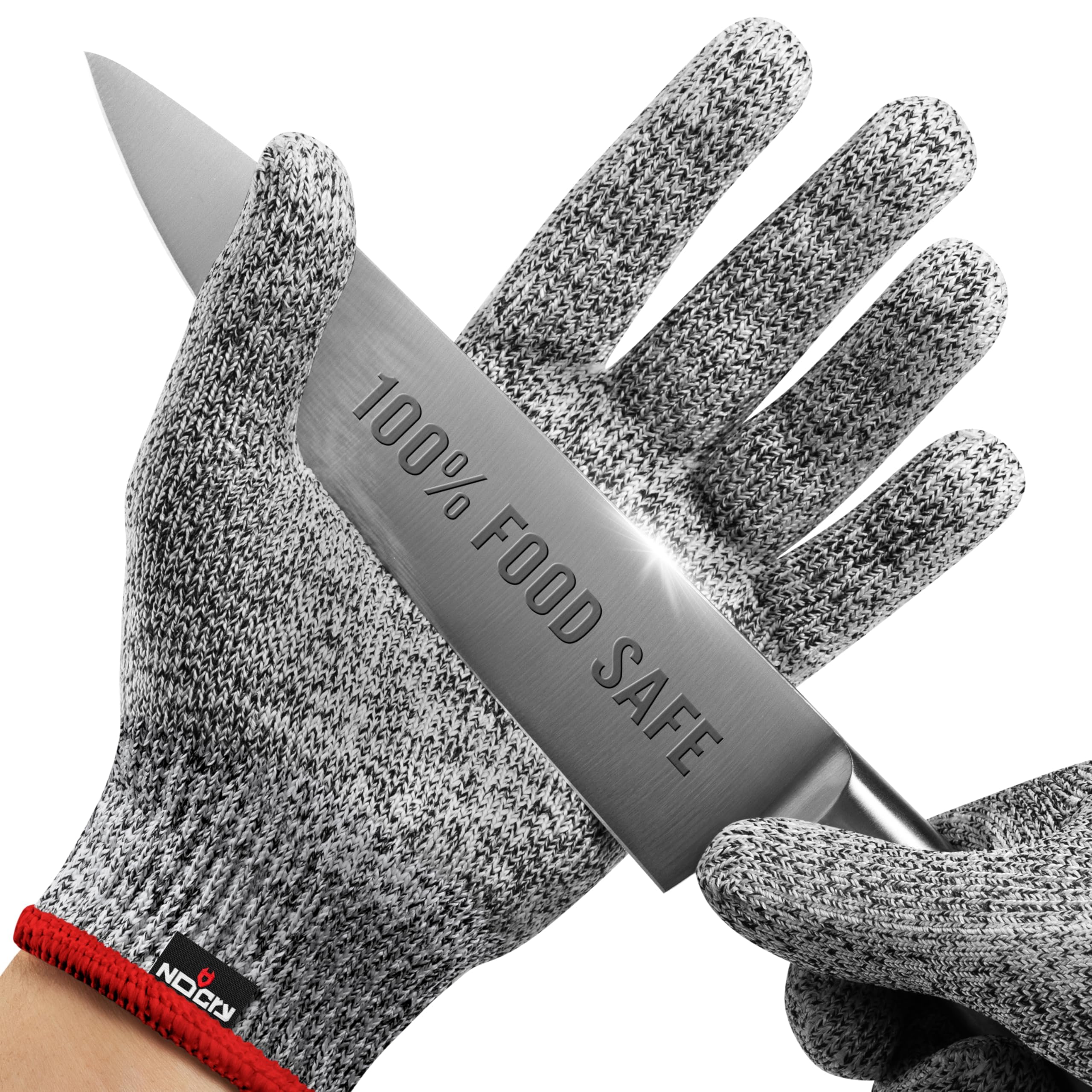


Best for Everyday Prep
NoCry Premium Cut Resistant Gloves
Key Features
- Care: Machine washable
- Weight: 1.39 oz
- Material: Polyethylene, glass fiber, nylon, polyester, spandex
- Cut level: Level 5
- Price: Budget
The original NoCry pair is the least expensive glove we recommend, and it is still the one we press into the hand of anyone who has never worn a cut glove before. The knit is thin — 1.39 ounces of polyethylene, glass fiber, nylon, polyester and spandex — and it pulls on like a sock rather than a piece of equipment.
Level 5 protection is the headline, and it is worth knowing what that does and does not cover. The yarn resists a blade drawn across it, which is the mandoline pass and the knife that slips off a carrot, while staying flexible enough that you keep a normal grip on the food. It will not stop a heavy, deliberate chop, and neither will anything else in this guide.
Ambidextrous construction earns its keep in a working kitchen: one glove on the hand that holds the onion, the other free for the knife, and the same pair works either way when the job changes. Both go through the washing machine, which is the difference between a glove that gets used daily and one that stays damp at the back of a drawer.
The medium runs close to a true medium, with enough stretch across the knuckles to pull on without a fight. If you are between sizes, take the larger one for the hand that holds the food, because a cuff that pinches is what makes people quietly stop wearing a glove.
Our call: this is the glove we recommend to almost everyone, because the protection is real and the interference is not — you work at close to normal speed, with the food in your hand instead of under a towel. Keep it on the board rather than in a drawer; a glove you have to go and find is a glove you skip on a Tuesday night.
Pros
- Level 5 knit that still lets you feel the food
- Ambidextrous, so either hand works
- Machine washable
- Least expensive glove we recommend
Cons
- Fingertips fray with steady use
We recommend the original NoCry to anyone who wants real cut protection without losing the feel of the knife; it is the least expensive glove here and the least fussy.
Best for Wet, Slippery Food
NoCry Cut Resistant Gloves With Grip Microdots
Key Features
- Care: Machine washable
- Grip: Silicone palm dots
- Weight: 0.96 oz
- Cut level: Level 5
- Price: Midrange
Silicone dots across the palm are the reason to choose this NoCry pair over the plain one. A dry onion does not need them; a wet tomato, a peeled squash or the slick side of a fillet does, and the dots hold where bare knit slides.
Everything else is the glove we already recommend: level 5 knit, ambidextrous, machine washable, and light enough at 27 grams to forget you have it on. The dots sit on the palm side, which is where the food rests, so the fingers stay thin and you keep the feel of the blade through them.
The fit runs generous in the medium, so size down if your hands are narrow rather than living with a loose cuff. Where the dots pay for themselves is the wet half of dinner — tomatoes, fish, potatoes sliding in their own starch. We keep this pair for that work and the plain ones for everything dry.
Pros
- Silicone palm dots grip wet, slippery food
- Same level 5 knit as the plain NoCry
- Ambidextrous and machine washable
Cons
- Costs more than the plain NoCry pair
The grip-dot NoCry is for anyone whose cutting board gets wet: the silicone palm holds a tomato steady while the knife comes down.
Best for Sensitive Skin
Schwer SlicePro Cut Resistant Gloves
Key Features
- Care: Machine washable
- Material: HPPE, polyester, stainless steel wire
- Cut level: ANSI A9
- Price: Midrange
Most knit gloves here are built with glass fiber, the yarn that supplies much of their cut resistance and, for some people, an itch that builds over a long prep session. The Schwer SlicePro leaves it out: the blend is HPPE, polyester and stainless steel wire, with no glass fiber in the knit.
That, plus an ANSI A9 rating, is why it is our pick for anyone whose skin reacts to fiberglass or who wears a glove for hours at a stretch. A9 is the highest stated cut level among the knit gloves in this guide, and it still behaves like a knit: thin, ambidextrous, machine washable.
The construction is denser than the NoCry knit, with a low-stretch yarn that keeps the palm where you put it instead of creeping across your hand mid-slice. It has held its shape through repeated washing, which is more than we can say for the thinnest gloves here.
Sizing is the thing to get right, because this one runs small and the fingers come up short before the palm does. Order a size up unless your hands are narrow; the rest of the fit is a matter of taste, and a glove that starts snug is a glove that stays put.
Pros
- No glass fiber for reactive skin
- A9 is the highest stated knit level here
- Dense knit holds its shape through washes
Cons
- Costs more than the basic NoCry knit
Our pick for sensitive skin: A9 protection without glass fiber, in a dense knit that stays where you put it.
Best for Oyster Shucking
Schwer 2 PCS Steel Mesh Gloves
Key Features
- Care: Dishwasher safe
- Material: 316L stainless steel wire
- Cut level: ANSI A9
- Gloves per pack: 2
- Price: Premium
316L stainless steel wire, knitted into a glove: this is the piece that stops an oyster knife rather than merely slowing it down. It is heavier than any knit here and feels it — stiff across the back of the hand, cool against the skin, and nothing like fabric.
Coverage runs across the palm and the back of the hand at ANSI A9, the wire is non-PFAS and contains no fiberglass, and two ambidextrous gloves come in the pack, so one covers the holding hand and the other waits as a spare. Sizing is the weak point: the fit is inconsistent enough that measuring against Schwer’s own chart matters more than ordering your usual size.
We put this on for oyster knives, primal cuts, and any job where the blade is long and the angle is awkward. It is clumsy for dicing an onion — that is what the knits are for — and it is dishwasher safe, which means oyster liquor and fish slime rinse out instead of sitting in the sink until morning.
Pros
- A9 coverage across palm and back
- Two gloves in every pack
- Dishwasher safe
Cons
- Stiff and clumsy for fine knife work
Our pick for oyster knives and butchery: full-hand A9 steel mesh, two gloves to a pack, and enough protection that a slip stays a scare.
Best for Smaller Hands
Glove Station Cut Resistant Gloves
Key Features
- Care: Machine wash cold, tumble dry low
- Size: Medium
- Material: Polyethylene, glass fiber, spandex, stainless steel
- Cut level: ANSI A5
- Price: Midrange
If most one-size gloves hang off the ends of your fingers, start here. The Glove Station medium is cut for a narrower hand, and it is the glove in this set that sits closest on smaller hands without pulling across the knuckles. The hi-viz orange turns out to matter more than it should: you can find this glove in a drawer full of dark utensils.
Under the color it is an ANSI A5 knit — a step below the A9 picks, with a 13-gauge construction that keeps the fingers flexible. The fingertips also work on a touchscreen, so you can stop a timer or answer a call without peeling the glove off, which sounds like a gimmick until your hands are covered in flour.
Wash it cold and dry it low; heat is what shortens the life of a knit with spandex in it. Where it stops being enough is heavy work — bone, oyster shells, a long session with a cleaver — and that is when the steel mesh earns its place in the drawer.
Pros
- Snug on smaller hands
- Hi-viz orange is easy to spot
- Touchscreen-friendly fingertips
Cons
- Thin knit wears through at the fingertips
For narrower hands, the Glove Station is the closest fit in this guide, with A5 protection and a color you can actually find.
Best for Shared Kitchens
THOMEN 4 PCS Cut Resistant Gloves
Key Features
- Cut level: Level 5
- Sizes included: Medium and large
- Gloves per pack: 4
- Price: Budget
One size never fits both people who cook, so most kitchens end up with a glove that swims on one cook and pinches the other. The THOMEN pack answers that directly: four gloves split between medium and large in a single order.
This is the pack we recommend for a shared kitchen. Two cooks get a size each, one cook gets a clean glove while the other is in the wash, and a lost glove is an inconvenience rather than a reorder. Per glove, nothing else in this guide comes close on cost.
The sizing runs generous. If you normally sit between a medium and a large, the medium in this pack is the one that will fit, and the large is best left for genuinely large hands — order your usual size and you may end up with two gloves that swim.
In practice the four gloves get used as a rota: one on the hand, one drying, and the next one clean when the mandoline comes out. That rota is the real argument for four rather than two — the glove is there when you reach for it.
Pros
- Two sizes in one pack
- Four gloves keep a clean one in reach
- Lowest cost per glove here
Cons
- Wears through with steady use
Our multi-pair pick: four gloves split across medium and large, so a shared kitchen stops negotiating over who gets the good pair.
Best for Dry Prep
Dowellife Level 5 Cut Resistant Gloves

Key Features
- Care: Hand or machine wash
- Size: Large
- Material: HPPE, polyester, stainless steel wire
- Cut level: EN 388 level 5
- Price: Budget
This is the glove that shows why grip deserves its own line on the box. The knit is comfortable, level 5, and slick: on a dry onion it is fine, but put a wet tomato in that hand and the food turns under your fingers while the knife comes down.
There is plenty to like otherwise. The blend is HPPE, polyester and stainless steel wire, the knit is thin enough to feel a blade through, both hands work, and there is a small hang loop at each wrist — the storage detail most gloves here skip, and the reason this pair dries instead of souring in a drawer.
It earns its place as a first pair for dry work and a spare for everything else: onions, bread, cheese, a pile of carrots. Once the board gets wet, the grip-dot NoCry is the better glove, and that is the honest boundary here.
Pros
- Level 5 knit at the low end of the price range
- Wrist loops for hanging dry
- Machine washable
Cons
- Wears through at the fingertips
A comfortable, inexpensive level 5 knit for dry prep — we keep it for onions and bread, and reach for something with grip once the board gets wet.
Best for Fish and Oysters
Dowellife ANSI A9 Metal Mesh Glove

Key Features
- Care: Machine washable
- Material: 316 stainless steel wire, HPPE
- Cut level: ANSI A9
- Touchscreen: Yes
- Price: Premium
An adjustable strap at the wrist is the difference between a mesh glove you wear and one you fight. This one cinches over the cuff so the steel does not ride up mid-shuck, and it releases one-handed when you are done.
The glove is 316 stainless steel wire and HPPE at ANSI A9, machine washable, and built for fish, oysters and butchery. Against a knit it is stiff and slow to pull on, and there is no pretending otherwise.
The surprise is in the fingertips: they work on a touchscreen, so you can check a recipe or stop a timer without taking the glove off. That gets used more than expected once a phone is sitting next to a bowl of oysters.
We keep this one for fish and shellfish, where the blade is short, pointed and unforgiving, and where the knits feel underdressed. For a cook who mostly dices vegetables it is more glove than the job needs. Wash it, hang it by the strap, and it comes back the same — which is not true of any knit here.
Pros
- A9 protection in 316 stainless wire
- Adjustable wrist strap
- Touchscreen-friendly fingertips
Cons
- Sizing runs small
- Most expensive glove here
The glove we reach for with oysters and fish: A9 steel mesh, an adjustable wrist strap, and a fit that runs small enough to size up.
Best for Color Choices
Evridwear Cut Resistant Gloves

Key Features
- Care: Machine or hand wash
- Sizes: Four, teen to adult
- Material: HPPE with glass fiber
- Cut level: ANSI level 5; EN 388
- Price: Budget
Three colorways is a small thing that turns out to be useful: pink, green and gray mean each cook in a shared kitchen can claim a shade, and a glove in a color you picked is a glove you keep track of.
Underneath the color it is an ANSI level 5 knit in high-performance polyethylene with glass fiber, EN 388 and CE certified, ambidextrous, and machine or hand washable. It is thin — about a tenth of an inch — and the stretch is medium, so it goes on without a fight.
Size is the part to check: four sizes run from teen to adult, so measure around the palm rather than guessing from the size you take in a winter glove. Air dry it and the shape holds; heat is what takes the spandex out of a knit.
It is the pick for a house where one glove gets shared, and for smaller hands that a single-size glove leaves flapping. If you wear one for hours every day, a denser knit will outlast it.
Pros
- Four sizes, teen to adult
- Three colors keep pairs apart
- EN 388 and CE certified
Cons
- Frays at the fingertips with heavy use
Our pick when color and a real size range matter: level 5 protection in four sizes, in a knit thin enough for smaller hands.
How We Chose and Tested the Cut-Resistant Gloves
We started by pulling every food-grade glove we could find with a published cut rating, then filtered out anything with no stated size range, anything that couldn’t be washed, and anything that read like a repackaged hardware glove. That left 14 pairs, both knit and steel mesh, which we rotated through three months of actual cooking.
Testing happened where these gloves live: Sunday meal prep, breaking down whole chickens, filleting fish at the counter, shucking oysters on the back porch, and one long, humbling session with a mandoline and a bag of potatoes. To judge protection, we ran a knife edge and a mandoline blade across the palm under light pressure and noted whether the blade caught, skated, or dug in.
Grip got tested wet, with a slick chicken and a tomato on a soaked board, and we noted when a glove slid on the handle or the food slid out of the glove. Each pair also went on for a 45-minute prep session so we could judge fit and dexterity: whether fingertips bunched, whether the cuff rolled, whether we could still pick up a single clove of garlic. Because hands sweat, we checked how breathable each one felt after an hour of wear.
Finally, durability and cleaning. Every pair went through repeated washes per its own instructions, and we watched for loose threads, cracked coatings, and food trapped in the mesh, plus whether garlic and onion smells lingered after a wash.
How to Choose Cut-Resistant Gloves for Cooking
The glove with the highest cut rating is not automatically the one that keeps your fingers intact — it is the one you keep wearing, which is why fit, grip, and feel carry as much weight here as the number on the label.
Match the Glove to the Blade You Are Afraid Of
A mandoline and a chef’s knife cut differently. A mandoline drives a blade straight down through whatever sits on the rail; a knife slips, usually at an angle, usually when your hand is wet. A level 5 or A5 knit handles both of those everyday moments, and that is what most of this guide is made of. For an oyster knife, a cleaver, or a long session breaking down large cuts, the blade is pointed and the force is behind it — that is mesh territory.
One trap: level 5 is printed on two different scales. EN 388 level 5 and ANSI A5 are not the same claim, and ANSI A9 sits above both. Compare the standard named on the label rather than the number alone, since a mandoline glove billed as level 5 can mean either one.
Knit or Steel Mesh
Knit gloves are the ones you forget you are wearing: thin, stretchy, machine washable, and inexpensive enough to own two pairs. They resist a sliced blade and they wear out at the fingertips. Steel mesh is the opposite trade — stiff, heavier, dishwasher safe, and the only thing here that a point is likely to skate off.
Buy knit if you cook most days and want a mandoline glove that actually stays on your hand. Buy mesh if the work is oysters, fish, or butchery, and accept that you will be slower with a paring knife.
Fit Is Where Most Buys Go Wrong
A knit glove has little stretch, so a finger that is half an inch too long puts a fold of loose yarn exactly where the blade lands. Measure around the palm and check the maker’s chart instead of picking your usual size; several gloves here run a full size off in one direction or the other.
Two details worth knowing. Most of these are ambidextrous, so both hands get the same size — fit the hand that holds the food, since that is the one in the blade’s path. And if you are between sizes, go up in a knit and follow the mesh chart closely, because mesh does not give at all.
Look at the Palm: Grip and Fiberglass
The palm is where the food sits, so the palm is where grip matters. A plain knit is fine for dry work and turns slick the moment a tomato is wet; silicone dots are the simplest fix in this set. If your skin reacts to glass fiber — a common itch after an hour of prep — look for a knit that leaves it out.
Neither feature changes the cut rating. Both change whether you keep the glove on for the second half of the prep, which is the part that actually protects you.
Care, and When to Retire a Pair
Knit gloves go through the washing machine on a normal cycle and air dry; mesh gloves tolerate the dishwasher. Heat is what shortens the life of the spandex in a knit, so skip the dryer or keep it low, and hang gloves rather than balling them up damp.
Retire a glove at the first hole, pulled yarn, or fuzzy fingertip. The protection lives in the fiber — once it is worn thin, the glove still looks like a glove and stops behaving like one.
Frequently Asked Questions
Are cut-resistant gloves safe to use directly with food?
Yes, if the glove is sold as food grade. Every pick here is marketed for direct food contact, and most are machine washable, so wash them before the first use and again after handling raw meat or fish.
Skip any glove sold only for workshop or industrial use. The cut resistance can be identical while the finish, dyes, and coating are not intended for a cutting board.
Can I use a cut-resistant glove as an oven mitt?
No. These gloves are built for blades, not heat: the HPPE yarn and the stainless mesh both pass heat straight through, and a glove that saves your fingers from a knife can leave you with a burn from a sheet pan.
Keep a real mitt within reach and treat the cut glove as a cutting-board tool only.
Is a cut-resistant glove worth it if I am already careful with a knife?
It earns its place at the mandoline, the grater, and the oyster, where the food is wet and the blade is fixed and unforgiving — not because you are careless, but because wet hands slip. A pair costs less than an urgent-care visit and lives in the drawer instead of the first-aid kit.
If you only buy one glove, buy it for the mandoline.
Final Verdict
We recommend the original NoCry pair for most kitchens. It is the least expensive glove here, it is ambidextrous and machine washable, and level 5 protection in a 1.39-ounce knit means you can still feel the food and the blade — which is what keeps a glove on your hand past the first carrot.
If your cutting board is usually wet, step up to the grip-dot version of the same glove. If you shuck oysters or break down large cuts, the Schwer steel mesh is the one that turns a slip into a scare rather than a scar.