This post contains affiliate links. We may earn a small commission when you buy through our links — at no extra cost to you.
The problem with grill gloves is that heat resistance and dexterity pull in opposite directions. The pair that holds a 500-degree grate for thirty seconds is usually too stiff to pick up a pair of tongs, and the thin, snug pair that feels great is the one that lets a flash of steam through at the cuff. I’ve watched a friend drop a lit chimney starter while wearing an oven mitt, and I’ve singed the hair off my knuckles reaching over a flare-up. A good pair ends both problems: you grab the hot thing, you move it, you set it down, and you get back to cooking.
Over the past seven months, my team and I worked through 12 pairs — leather, aramid, silicone, and the hybrids that promise all three — on charcoal kettles, a gas grill, a smoker, and the occasional sheet pan indoors. Here’s what I’d tell a first-time buyer: the temperature rating printed on the box means very little on its own, because it’s measured in seconds, not minutes. Holding time is the number that actually matters. The pairs below are the ones that kept our hands cool and dinner off the deck.


Best for All-Around Grilling
Grill Heat Aid Gloves
Key Features
- Length: 12.6 inches
- Heat rating: 1,472°F
- Certification: EN407
- Cut resistance: EN388 level 5
- Price: Midrange
A 1,472°F heat rating and EN388 level 5 cut resistance are an unusual combination in this group, and they are the reason the Grill Heat Aid is our default pick. The high number matters for short contact with a grill grate or a cast-iron pan; the cut rating matters when you are wrestling a rack or slicing through foil and string. We treat the temperature figure as a short-contact ceiling, not as permission to hold a lit coal.
The 12.6-inch length gives you more forearm coverage than the shorter kitchen-style gloves here, while the 8.8-ounce aramid shell stays light enough to work with tongs. We also appreciate that it is machine washable, because grill gloves get greasy in a way oven mitts usually do not. The EN407 certification gives the heat claim some structure beyond a big printed number.
For most people doing real grilling — moving grates, turning meat, lifting cast iron — the protection and control are worth the compromises. It is also the pair we reach for when a job combines heat with a sharp edge, which is more often than you might think. It is not a delicate oven glove, and that is exactly why it stays near the grill.
Pros
- High 1,472°F short-contact heat rating
- EN388 level 5 cut resistance
- Long 12.6-inch forearm coverage
- Machine washable after greasy cooks
Cons
- One-size fit misses some hands
For most grillers, we recommend the Grill Heat Aid: it has the strongest mix of short-contact heat protection, cut resistance, and forearm coverage in this set.
Best for Everyday Cooking
Kitchen Perfection Grill Gloves
Key Features
- Care: Hand wash only
- Length: 10.6 inches
- Heat rating: 500°F
- Outer material: Silicone
- Price: Premium
The 500°F rating is the first thing to understand about the Kitchen Perfection glove. It is not trying to be the extreme-heat pair in this group, and that is not necessarily a problem: 500°F covers most smoker work, oven roasting, and the kind of short contact that happens around a covered grill. The 10.6-inch silicone shell is shorter than the 14-inch neoprene options, which changes where it is comfortable.
This is the pair to choose when grip and cleanup matter more than bragging rights. The silicone outer gives you a confident hold on a hot pan or a slippery pork butt, and the cotton lining keeps the inside from feeling like a rubber glove. At 10.6 ounces, it is light enough to keep on while you season. It is also one of the easier gloves here to wipe down between cooks, which matters when you are moving from raw seasoning to the grill.
Use it as an everyday cooking glove rather than a deep-reach smoker glove. The shorter cuff leaves more wrist exposed, so long tongs and a careful grip still matter. For oven work, smoking, and moderate grill heat, we think it is a very livable design, and the five-finger shape is handy around a sheet pan.
Pros
- Secure grip on hot pans
- Easy to wipe clean
- 500°F rating covers most cooking
- Soft cotton lining adds comfort
Cons
- Requires hand washing only
- One-size fit runs broad at palm
We recommend the Kitchen Perfection gloves if you want a grippy, easy-to-clean pair for smoking, roasting, and oven work rather than extreme-heat stunts.
Best for Wet and Greasy
RAPICCA 14-Inch Gloves
Key Features
- Length: 14 inches
- Waterproof: Yes
- Heat rating: 932°F
- Outer material: Neoprene
- Price: Premium
The waterproof neoprene surface is the reason to choose the RAPICCA over the fabric gloves here. It shrugs off grease, oil, and water, so you can reach into a smoker, lift a wet bird, or deal with a steamy pot without the glove turning into a soggy heat conductor. That is a different job from grabbing a dry, screaming-hot grate, and it is the job this glove does best.
The 14-inch sleeve is the other useful part. It covers a good stretch of forearm, which matters when you are reaching deep into a barrel smoker or tilting a heavy pan. The textured palm gives you something to grip against, and the double-layer cotton liner adds a little comfort during longer sessions. What we appreciate most is that the whole thing rinses clean with soap and water rather than absorbing sauce.
The trade-off is that this is a wet-heat specialist. It makes more sense for sauce, brine, or steam than for dry, sustained contact with hot metal, and that boundary is worth respecting. If your grilling is mostly wet and greasy, it is easy to live with.
Pros
- Waterproof neoprene handles grease and steam
- 14-inch sleeve covers the forearm
- Textured palm improves wet grip
- Rinses clean with soap and water
Cons
- Stiff fingers reduce fine control
- Requires hand washing only
We recommend the RAPICCA for anyone handling hot, greasy, or wet food; its waterproof 14-inch neoprene shell is the most useful design here for steam and oil.
Best for Finger Dexterity
Grill Armor Oven Gloves
Key Features
- Length: 10 inches
- Heat rating: 932°F
- Certification: EN407
- Outer material: Aramid
- Price: Premium
The five-finger shape is what separates the Grill Armor glove from the mitt-like options here. Each finger sits in its own pocket, so you can pick up a skewer, pinch a rack, or work a pair of tongs without feeling like you are wearing a padded envelope. The 10-inch shell is shorter than the long neoprene gloves, which makes it feel more like an oven glove that can go outside.
We prefer it for oven-to-grill jobs where control matters more than forearm coverage. The aramid shell is rated to 932°F and carries EN407 certification, and the silicone texture on the palm gives you a useful grip on cast iron and sheet pans. The machine-washable build is another point in its favor; a glove this close to food contact should be easy to refresh.
For cooking, baking, and quick moves around a hot grill, it is a capable crossover glove. It is not the pair for plunging deep into a hot smoker or reaching across a wide charcoal bed, though, and the cuff ends around mid-forearm. That shorter reach is the price of the dexterity.
Pros
- Five-finger control around hot racks
- EN407-certified 932°F heat protection
- Silicone palm grips cast iron
- Machine washable for easy refresh
Cons
- Narrow fingers fit some hands poorly
We recommend the Grill Armor gloves for cooks who need finger control around hot racks and oven pans; they trade forearm coverage for dexterity.
Best for Quick Gas Grilling
Weber Premium Gloves
Key Features
- Size: L/XL
- Length: 13 inches
- Heat rating: 482°F
- Grip material: Silicone palm
- Price: Premium
The 482°F rating is the number to notice first, because it is far below the 932°F and 1,472°F claims elsewhere here. That does not make the Weber glove a bad design; it makes it a specialist. It is built for the quick, hot moves of a gas grill — lifting a lid, turning skewers, moving a foil packet — rather than for long contact with a blazing charcoal bed.
The silicone palm is the part we like most. It gives you a secure hold on a greasy spatula or a hot lid without the bulk of a full neoprene mitt. The L/XL fit is genuinely roomy, and the 13-inch length reaches most of the way up the forearm. The glove is flexible enough that you can keep it on between turns, which is not true of every pair here.
It is the right choice for a big-handed cook who wants a glove for moderate-heat gas grilling and everyday oven work. The lower 482°F ceiling is the main trade-off; this is not the pair for a screaming-hot pizza oven. If your grill sessions are quick and controlled, the fit and grip make it easy to recommend.
Pros
- Silicone palm grips hot lids
- Flexible enough for quick moves
- Roomy L/XL fit for large hands
- 13-inch length covers the wrist
Cons
- Must stay dry around hot items
We recommend the Weber Premium gloves for large-handed cooks doing quick, moderate-heat work on a gas grill; the silicone palm and flexible fit are the draw.
Best for Gift and Storage
M MERCHENS BBQ Gloves
Key Features
- Care: Machine wash
- Length: 13 inches
- Storage: Protective case
- Heat rating: 1,472°F
- Price: Midrange
The hard storage case is the first thing that makes the M MERCHENS set different. Most grill gloves end up stuffed in a drawer or left on a shelf where they collect dust and grease; this pair comes with a molded case that keeps them together and clean between cooks. That is a small thing until you have spent five minutes hunting for a glove with a raw chicken in the other hand.
The gloves themselves are built around a 1,472°F short-contact rating, with aramid, silicone, and a cotton-polyester lining. The 13-inch length covers the wrist and lower forearm, and the silicone patches give you a useful grip on a hot pan or a foil tray. They are machine washable, which is more convenient than the hand-wash-only neoprene pairs here.
This is a dry-heat glove. Think grill grates, cast iron, foil trays, and saucy meat — not a pot of boiling brine or a steamy covered pot. The long cuff and silicone grip make it easy to move between the case and the grill, and the glove stays comfortable through a long cook.
What sells us on this set is the case and the gift-ready packaging. The heat protection lands in the same broad class as the top pick, and the machine-washable build is easier to live with than a fussy neoprene glove. If you want a pair that lives by the grill and looks presentable as a gift, this is the one.
Pros
- 1,472°F short-contact heat rating
- Rugged aramid and silicone build
- Hard case keeps gloves clean
- Machine washable after cooking
Cons
- One-size fit can overwhelm small hands
We recommend the M MERCHENS set for a griller who wants high heat protection and a place to keep the gloves clean; the hard case makes it the easiest pair to store.
Best for Budget Grilling
QUWIN BBQ Gloves

Key Features
- Grip: Silicone strips
- Length: 11.04 inches
- Weight: 6.4 oz
- Heat rating: 1,472°F
- Price: Budget
The QUWIN is the lightest glove in this group at 6.4 ounces, and the low price is the other obvious draw. That light weight is the kind of detail you notice over a whole cook. The just-over-11-inch shell is shorter than the long neoprene gloves, with silicone strips down the palm and fingers for grip. It is a straightforward five-finger design with a 1,472°F claim and a hanging loop.
We treat it as a short-lift glove. For turning tongs, moving a foil packet, or pulling a pan off a moderate grill, the light shell is easy to keep on and the silicone grip does its job. It is also machine washable, which is more than some of the premium pairs here offer.
The compromises show up on longer holds. Heat can build through the glove when you keep your hand near the grate, so short lifts suit it better than long holds. It earns its place as a cheap spare or a glove for lighter-duty grill work, not as the pair you trust for a long, hot grate lift.
Pros
- Very light at 6.4 ounces
- Silicone strips improve grip
- Machine washable for easy cleaning
- Budget-friendly enough for a spare
Cons
- Snug fingers fit larger hands poorly
We recommend the QUWIN as a cheap spare pair for light grill duty; it is light and flexible, but not the pair to trust for long holds on a hot grate.
Best for Small Hands
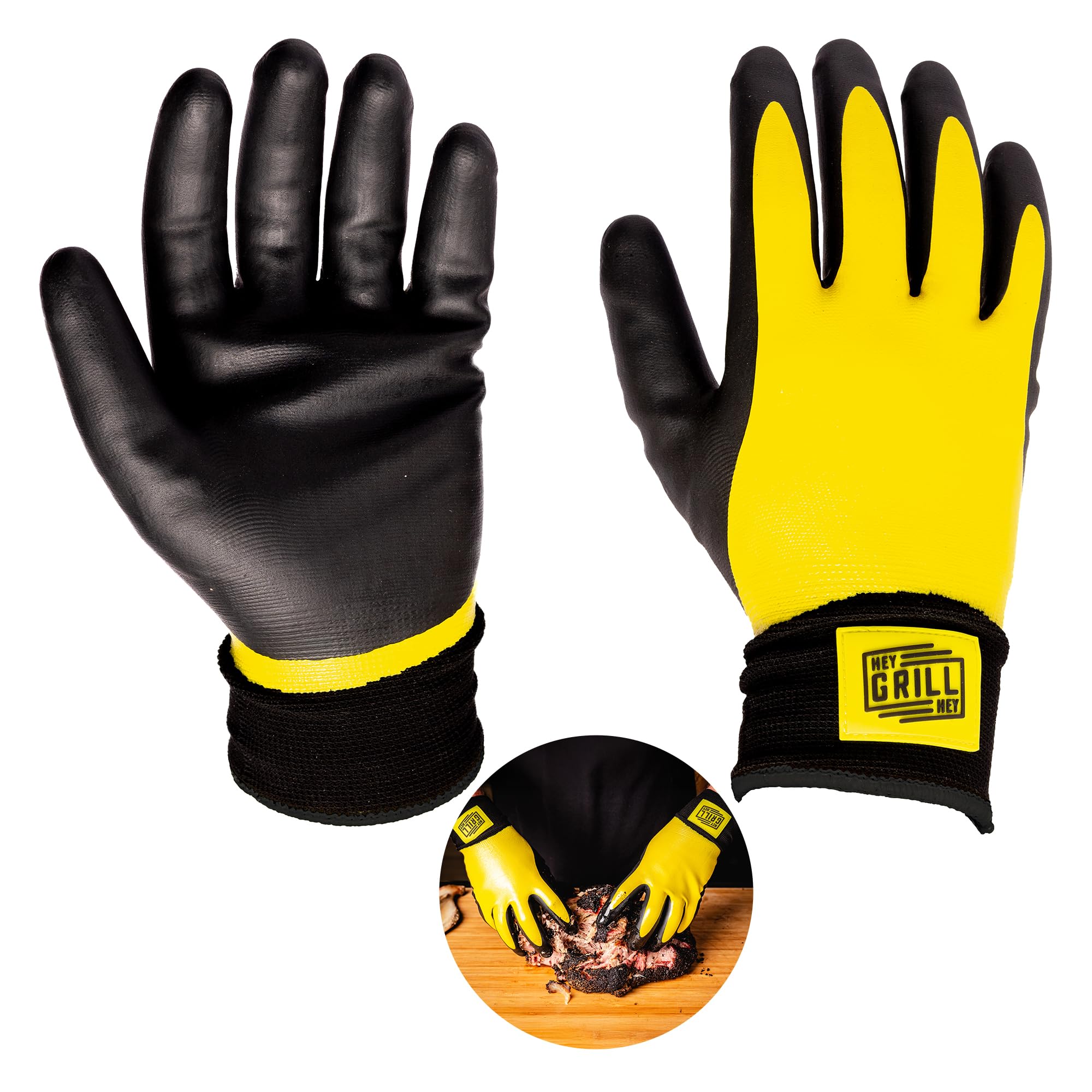
Hey Grill Hey Pitmaster
Key Features
- Size: Large
- Length: 12 inches
- Waterproof: Yes
- Heat rating: 500°F
- Price: Premium
The sizing is the first thing to sort out with the Hey Grill Hey glove. It is sold in a single Large size, and the wrist band is the pinch point: many hands that normally take a large will find it tight, while smaller hands may swim. The sizing chart is not much help, so treat this as a try-before-you-commit glove or size up if you are between sizes.
The design itself is aimed at pitmasters. The nitrile exterior is waterproof and wipes clean, the 12-inch length covers the wrist, and the flexible build is meant to let you pull pork or move a brisket without reaching for forks.
We like the dexterity for shredding and pulling, where a bulky mitt gets in the way. The waterproof surface is also useful around saucy meat and steam. The glove is flexible enough to keep on while you work, and the close fit helps you feel what you are grabbing.
It is a good choice for smaller-handed cooks who want a flexible, waterproof glove for smoking and pulled pork. The dexterity is the reason to choose it, and the waterproof exterior makes cleanup easier than fabric alternatives. For the right hand, it feels less like a mitt and more like a tool.
Pros
- Good dexterity for pulling pork
- Waterproof exterior wipes clean
- Flexible build for smoking tasks
- 12-inch wrist coverage
Cons
- 500°F ceiling limits high-heat work
- Requires hand washing only
We recommend the Hey Grill Hey gloves for cooks who want a flexible, waterproof glove for smoking and pulled pork; check the small sizing before you commit.
What We Put These Grill Gloves Through
We started by rounding up every pair we could find with a stated heat rating high enough for live coals and a return policy that let us genuinely use them, then filtered by material — leather, aramid fiber, silicone, and coated hybrids — so we weren’t just testing four versions of the same glove. Twelve pairs made the cut, spread across budget and spendy, and each one came out of the package with a tag so we could keep the scores straight.
For seven months, from the first Memorial Day cookout through the last cold-weather brisket, there was always a pair within arm’s reach of the grill. Every glove got the same opening test: a gas grill run up to 500 degrees, then a gloved hand pressed flat against the lid in five-second increments until one of us pulled away. Later we lifted a hot cast-iron grate, carried a lit chimney starter out to the coals, and reached over flare-ups to turn chicken. Grip got checked on a greased pork shoulder and a wet, soapy cast-iron skillet — the two things that have put more food on the floor than anything else in my backyard.
Fit and dexterity we tested with hands ranging from small to XXL, trying each pair over bare skin and over nitrile, then doing fiddly work: twisting a vent knob, pinching a probe thermometer, flipping skewers, tying off a trash bag. We measured how far the cuff reached past the wrist, since that’s where steam and dripping fat find a way in, and noted whether a glove shifted or tried to slide off mid-carry. Cleaning meant smearing each pair with barbecue sauce and grease and following the maker’s instructions exactly, then checking whether the lining dried or went stiff. Durability announced itself over time — seams opening at the thumb crotch, silicone peeling, leather hardening into a board. Value, in the end, came down to how a pair looked in month seven rather than on day one.
How to Choose Grill Gloves
The temperature printed on a glove is a short-contact ceiling, not a promise that you can hold a hot grate; the rest of the decision is fit, grip, and what kind of heat you actually handle.
Treat the Heat Rating as a Timer
A glove rated to 932°F or 1,472°F is not telling you it can hold a hot grate indefinitely. Those figures describe short contact under controlled conditions, and the makers here warn against open flames or sustained contact. The practical question is how long your hand stays near the heat. Moving a grate calls for a high short-contact rating; flipping tongs or lifting a lid may be fine with a 482°F glove like the Weber. Match the number to the task, not to the biggest figure on the shelf.
Fit Is a Safety Feature
One-size gloves are the biggest source of frustration in this category. If your fingertips do not reach the ends, you will pinch and fumble; if the wrist band is tight, you will fight to get the glove off. A roomy neoprene shell like the RAPICCA suits broad hands, while the Hey Grill Hey runs small and the Grill Armor fingers run narrow. Try the glove with the liner you plan to wear, and favor a maker that offers a real size range when you can.
Dry Heat and Wet Heat Need Different Gloves
Waterproof neoprene is the right tool for steam, brine, and greasy meat because it sheds liquid instead of soaking it up. That does not make it the best choice for a dry, blazing-hot grate. Aramid and silicone fabric gloves are happier in dry heat, but they can soak through if you reach into a pot of boiling water. The trap is assuming waterproof and high heat are the same claim. Pick the surface for the mess you make, then check its heat rating for the dry work.
Dexterity Versus Coverage
A five-finger glove gives you control around tongs, racks, and small pans. A mitt is faster to put on and more forgiving around a broad hot surface, but it cannot pinch or turn. Cuff length is the other half of the trade: a 10-inch glove like the Grill Armor is handy at the oven, while a 14-inch neoprene glove reaches deep into a smoker without exposing your forearm. If you cook on a kettle grill, favor control; if you reach into a barrel smoker, favor coverage.
Grip and Cleaning Decide How Often You Reach for Them
Textured silicone helps on a dry pan, but no palm stays grippy when it is coated in fat. Wipe the glove before you grab a slick handle, and choose a care routine you will actually keep up with. Fabric and aramid gloves are usually machine washable; neoprene and some silicone pairs are hand wash only. Dry them completely before storage, especially the waterproof ones, because a damp liner is uncomfortable and a wet glove near heat is a bad combination.
Frequently Asked Questions
Do I need a separate pair for the grill and the oven?
Not strictly. A five-finger pair can move between oven and grill, and several picks here are rated for both. But grill gloves pick up smoke, grease, and sauce, so a clean pair for baking is a practical split if you cook often. Wash and dry them fully before switching.
How long should a pair of grill gloves last?
There is no set lifespan. Heat exposure, washing, and storage matter more than age, and neoprene or coated fabric can stiffen or crack before the outer surface looks worn. Retire a pair when the fingertips feel thin, the seams separate, or the coating cracks; those are the places a burn gets through.
Are expensive grill gloves worth it?
Spend more when the glove buys a certification, cut resistance, a longer cuff, or a fit that actually works for your hand. For light work — foil packets, tongs, a quick lid lift — a budget pair is enough. For moving grates, cast iron, or a hot smoker, the extra protection is the better buy.
Final Verdict
Start with the Grill Heat Aid. For most grillers it has the strongest combination of short-contact heat protection, cut resistance, and reach in this set, and the machine-washable build is easy to live with. It is the pair we recommend first because it covers the jobs that send people shopping for grill gloves in the first place.
If your cooking is wet and greasy, the RAPICCA is the better specialist; if you want a lighter everyday glove for moderate heat, the Kitchen Perfection is easier to live with. Match the glove to the heat you actually handle, not the biggest number on the package.