This post contains affiliate links. We may earn a small commission when you buy through our links — at no extra cost to you.
A countertop oven is what you buy when you want a second oven without tearing out a cabinet — or when you’d rather not heat an entire kitchen to make toast. The catch is that a small cavity is a fussy one: heat crowds into the corners, the element sits close to the food, and a model that looks tidy on the counter can scorch one edge of a sheet pan while the other edge stays pale. It also has to physically fit — under your upper cabinets, and around a 9-by-13 pan. What you’re really buying here is steadiness.
Over the past eight months, my team and I cooked in 12 of these ovens — frozen fries, chicken thighs, sheet-pan vegetables, toast, reheated leftovers — and the ones that earned permanent counter space all hit their temperature fast and then held it. One thing I learned the hard way: the dial lies by 15 or 20 degrees on most of them, so a cheap standalone oven thermometer tells you more about a model than its spec sheet does. Below are the ones that survived that scrutiny.


Best for Everyday Baking
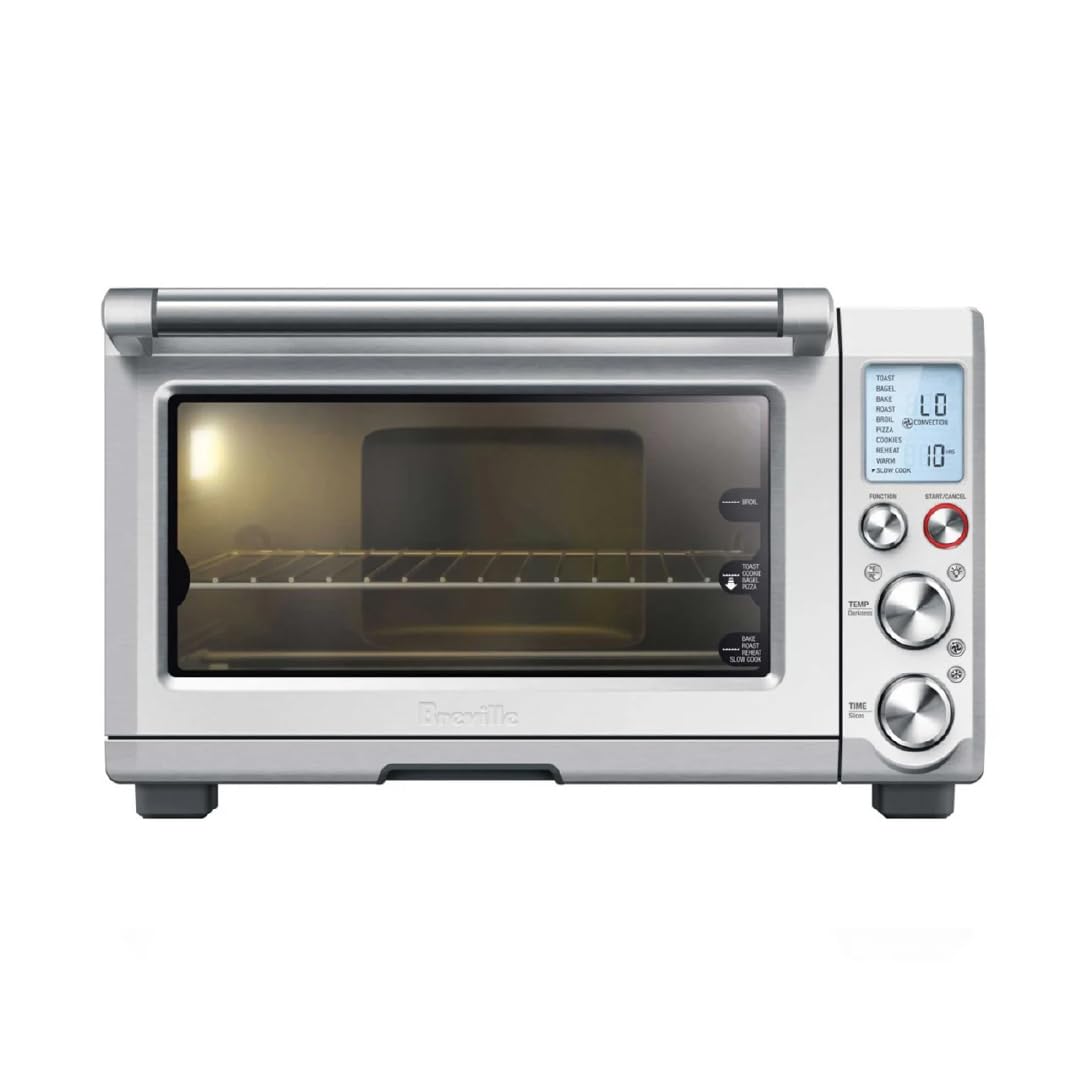
Breville Smart Oven Pro BOV845BSS
Key Features
- Wattage: 1800 W
- Capacity: 0.49 cu ft
- Footprint: 18.94 x 15.91 in
- Cooking functions: 10
- Price: Premium
Toast is the honest test of a countertop oven, and this Breville passed it on the first slice: even color edge to edge, no scorched corner where the element sits closest. That set the pattern for everything else we cooked. Five quartz elements and the Element iQ system move power around instead of blasting from one spot, so a frozen pizza, a tray of cookies and a salmon fillet all came out as if they had been in a real oven. It is the one we kept coming back to.
Capacity is 0.49 cubic feet, which in practice means the 13-inch pizza pan Breville includes, a 12-by-12-inch baking pan, or four slices of toast. One rack, so one tray at a time — that is the honest limit of this size, and the main reason to look at the larger Breville below. At 18.94 inches wide and 15.91 deep it still wants a few inches behind it for the door and the vents.
Controls are a dial and a small display, and that counts as a feature: turn to a function, turn to a temperature, turn to a time. Ten functions cover toast, bagel, bake, roast, broil, pizza, cookies, reheat, warm and slow cook, and the convection fan cuts cooking time by up to 30 percent by Breville’s figure — our cookies beat the box time comfortably. Slow cook is the sleeper, holding low heat for hours, which is the one job most toaster ovens cannot do at all.
The 22.8-pound body sits still when you pull the door down instead of sliding toward you, which sounds minor until you are holding a hot tray with one hand and reaching for the rack with the other.
Pros
- Bakes and toasts evenly across the rack
- Dial controls and presets are quick to learn
- Convection noticeably shortens cooking time
- Slow cook adds a job toaster ovens skip
Cons
- Premium price for a 0.49 cu ft oven
- Convection fan is the part that fails first
Five quartz elements and ten functions in a body that behaves like a small oven rather than a big toaster — this is the countertop oven we point most people to first.
Best for Large-Batch Cooking
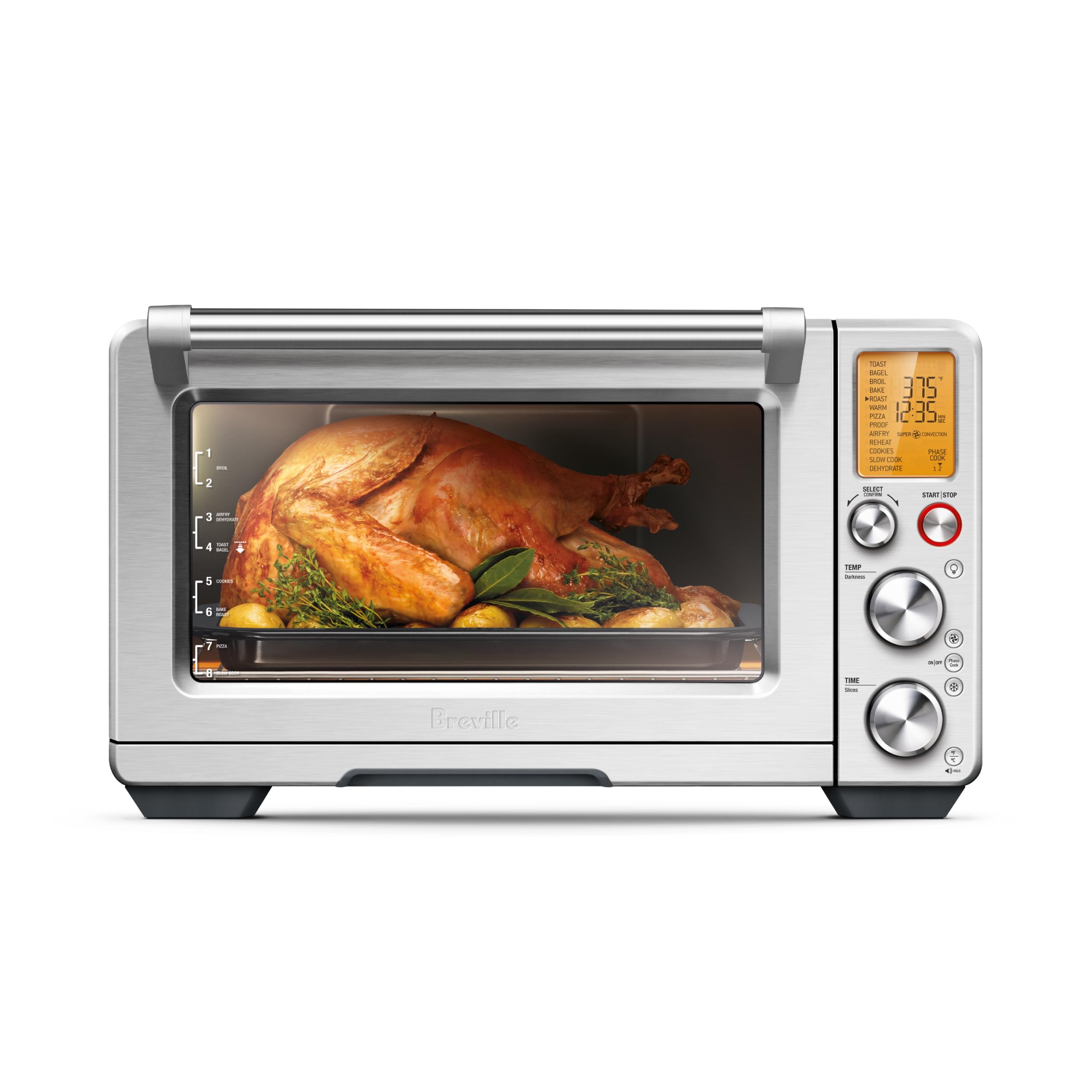
Breville Smart Oven Air Fryer Pro
Key Features
- Capacity: 1 cu ft
- Footprint: 21.5 x 17.5 in
- Cooking functions: 13
- Temperature range: 80–480 °F
- Price: Premium
Our top pick does everything in half a cubic foot. This one does it in a full cubic foot, with two racks instead of one, and that single difference is most of the argument. Same five quartz elements, same Element iQ brain, same two-speed super convection fan, plus a temperature range that starts at 80 °F for proofing dough and tops out at 480 °F.
For a household of three or four, the extra room is worth both the money and the counter. Two racks of cookies at once, a 9-by-13 broiling pan holding a whole chicken, a 13-inch pizza with space around the edge — this is the one that replaces the big oven on a weeknight rather than supplementing it. Add air fry, dehydrate and proof and you have the widest set of jobs in this group.
It is a large appliance: 21.5 inches wide, 17.5 deep, 30.2 pounds. Measure the slot and check what hangs above it before you order, because this one does not tuck. The air frying earns its billing, though — the mesh basket lets air under the food, and fries come out crisp without the mid-cook shake that flat trays demand.
Pros
- Two racks and a full cubic foot inside
- Thirteen functions including air fry and dehydrate
- Wide 80–480 °F range for proofing and broiling
- Even results from five independent quartz elements
Cons
- Toasting is slower than a slot toaster
- Exterior gets hot during long roasts
The family-sized Breville: two racks, a cubic foot of space and air frying that actually crisps, as long as the counter can spare the room.
Best for Family Meals
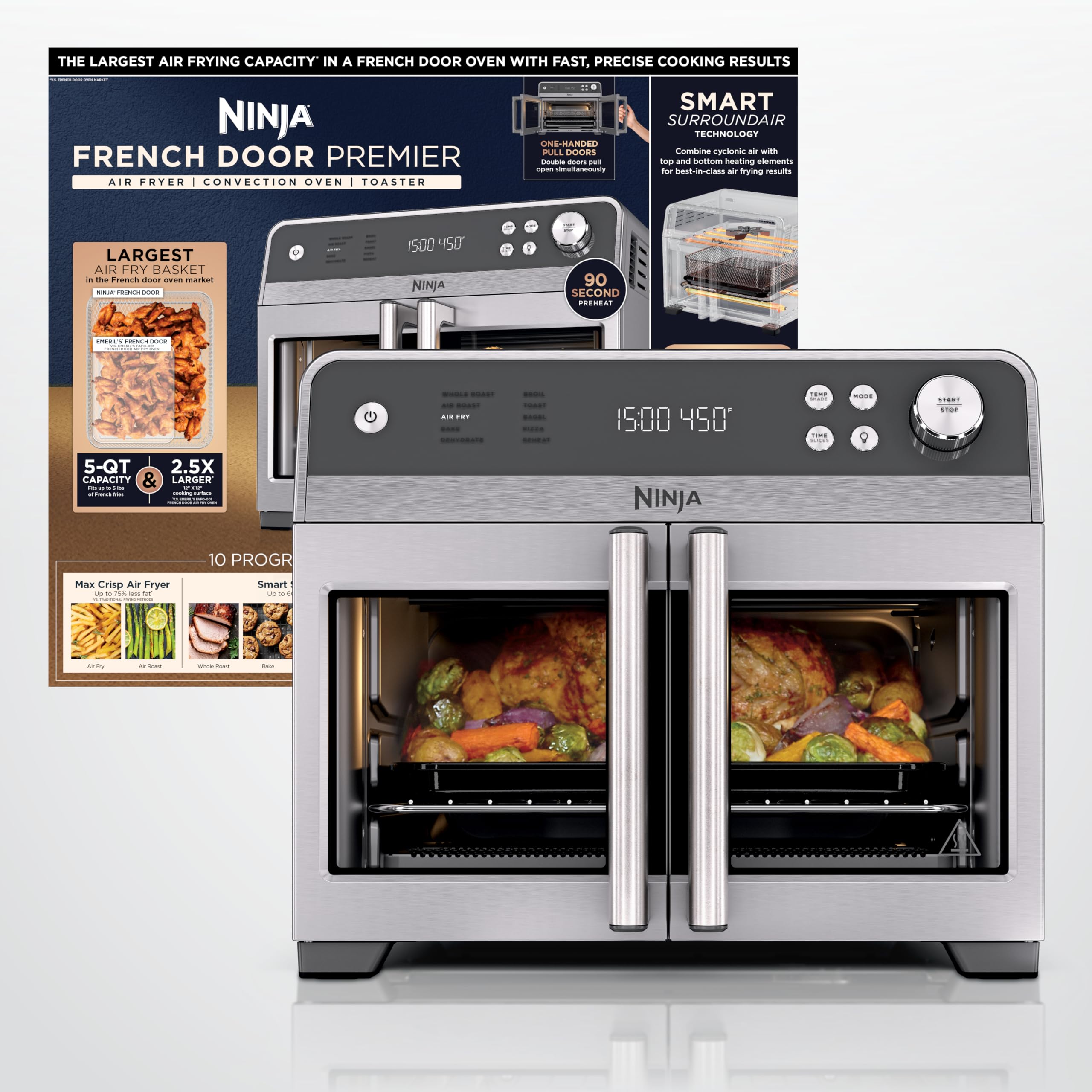
Ninja French Door Premier FO101
Key Features
- Footprint: 16.53 x 15.8 in
- Air fry basket: 5 qt
- Max temperature: 450 °F
- Cooking functions: 10
- Price: Midrange
Ninety seconds is the number that reframes this oven. That is the preheat, near enough that you stop planning around it, and it turned a machine we expected to use for dinner into the thing we used for everything — leftover pizza, a bagel, a handful of frozen fries at nine at night.
The 5-quart air fry basket is the other half of the pitch. It takes up to five pounds of fries, and its deep basket shape leaves more space between pieces than the flat trays most of these ovens ship with, which is exactly why the results come out crisp rather than steamed. A full-size frozen pizza fits on the rack, so dinner for four is one appliance and one load.
French doors change how you use it more than you expect. Both panels open with one pull, or just the left one when your other hand is full, and you reach in from the front instead of over a hot drop-down door. Ten functions, 450 °F cyclonic air, and no rotating needed for bake, pizza or whole roast.
Two things to know. The exterior runs hot during a long roast, so leave clearance around it. And put a tape measure on the spot before you order rather than trusting the published figures, which have not matched what arrives for everyone. It is also a newer design than the Brevilles, with less of a track record on how it ages.
Pros
- 90-second preheat keeps weeknight cooking quick
- Deep 5-quart basket fits a family portion
- French doors open one at a time
- Fits a full-size frozen pizza
Cons
- Exterior gets hot to the touch
A fast, family-sized French-door oven: it preheats in about the time it takes to load a tray, and the big air fry basket earns its space.
Best for Small Kitchens
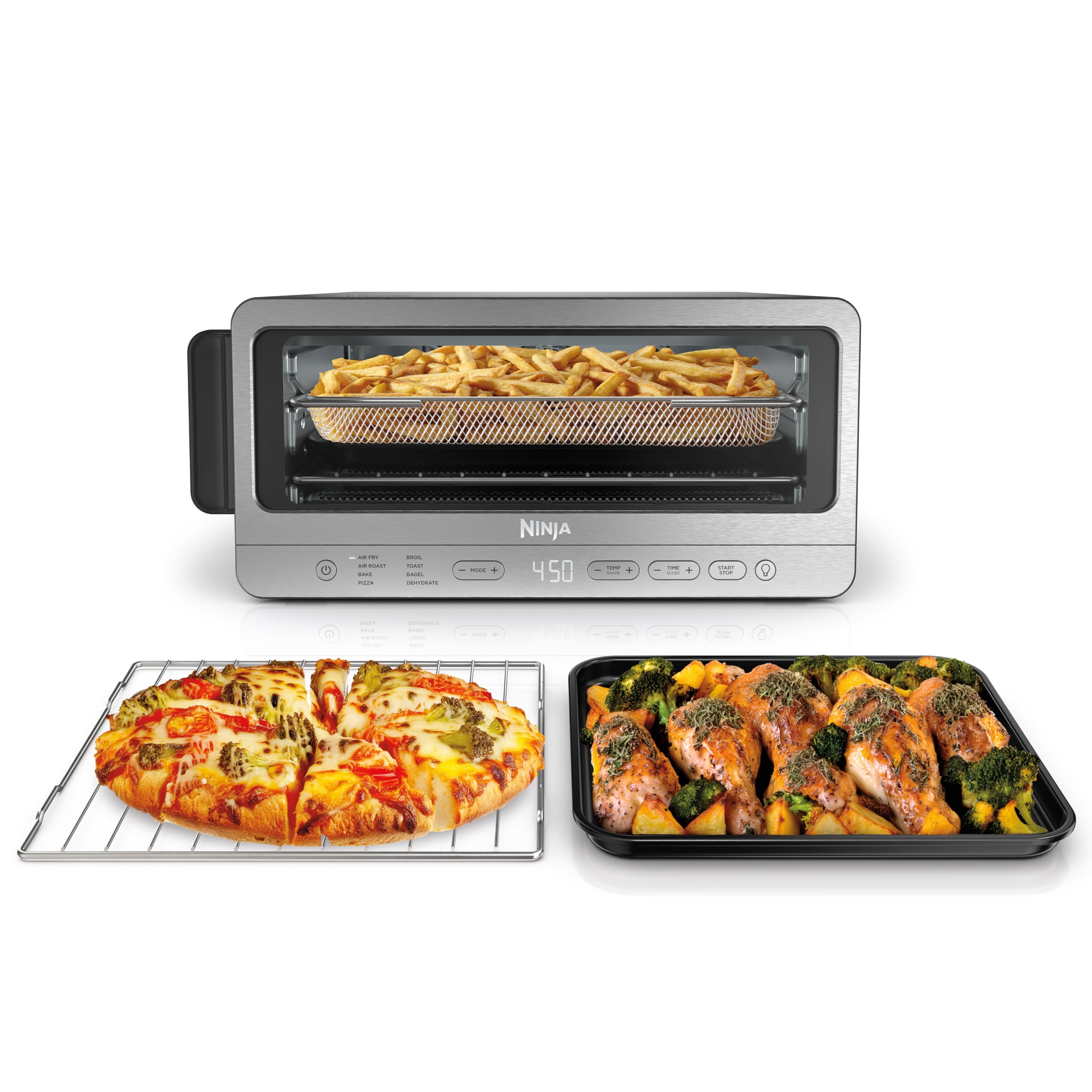
Ninja Flip Toaster Oven SP151
Key Features
- Wattage: 1800 W
- Footprint: 15.75 x 17.01 in
- Cooking functions: 8
- Temperature range: 85–450 °F
- Price: Midrange
The flip is the whole idea, and it lives or dies on clearance. Folded up against the backsplash, this oven frees about half the counter depth a normal one takes — but only if nothing is mounted low above the counter and the wall behind it is clear. Without that gap you have bought an ordinary toaster oven with an extra hinge.
Given the clearance, it is the best answer here for a small kitchen. Eight functions, 1800 watts, 85 to 450 °F, and a side-swing door that needs no room in front of it, so you load from the side rather than reaching over a hot drop-down panel. The display reads ‘flip’ once it is cool enough to fold, which is the detail that makes the mechanism safe to live with rather than a nuisance.
A 12-inch pizza, six slices of toast, four pounds of air-fried food, six chicken breasts: honest capacity for a body this narrow. OvenCrisp pairs infrared heat with a circulating fan, and it browns faster than the size suggests. Cleaning is the part we minded — only the air fry basket is dishwasher safe, while the sheet pan and wire rack are hand wash.
Pros
- Folds upright to free roughly half the counter depth
- Side-swing door needs no front clearance
- Fast, even browning from infrared plus fan
- Fits a 12-inch pizza in a narrow body
Cons
- Handle only pulls from the left side
For a kitchen where counter is the scarce resource, this is the one: it folds out of the way and still bakes a 12-inch pizza.
Best for Grilling and Roasts
Nuwave Bravo XL Pro with Grill
Key Features
- Capacity: 30 qt
- Footprint: 20.04 x 16.57 in
- Cooking functions: 12
- Temperature range: 50–500 °F
- Price: Midrange
There is a ceramic grill plate in the box, and it earns its space. A steak set on it comes off with diamond char marks and a crust no basket gives you, and it is the only oven on this list that grills at all.
Behind the plate sits a 30-quart cavity with four rack positions, 1800 watts and a 50 to 500 °F range — 500 °F is the highest here, and it is what makes both the grill and the pizza work. A temperature probe is included, so a roast comes out on temperature instead of on guesswork, and the top and bottom elements dial separately when you want more browning above or a gentler base.
We think it is the most useful single appliance in this group for anyone who cooks meat often, and the trade-off is complexity. The preset library runs long, the panel has more buttons than the rest of these put together, and it takes a session or two before the thing stops feeling like a control panel. Once we settled on four or five functions we actually use, the rest stopped mattering.
At 17.8 pounds it is lighter than 30 quarts suggests, and the grill plate, racks and basket are dishwasher safe. Cleanup is the part we expected to be worse: the crumb tray pulls out flat and the grill plate wipes down after a short soak.
Pros
- Ceramic grill plate leaves real char marks
- 500 °F maximum is the highest in this group
- 30-quart cavity with four rack positions
- Temperature probe takes guesswork out of roasts
Cons
- Exterior gets very hot during long cooks
The only oven here that genuinely grills, with a probe and 30 quarts behind it — worth the learning curve if meat is the point.
Best for Budget French Doors
Gourmia GTF7460 French Door Oven
Key Features
- Presets: 17
- Wattage: 1700 W
- Capacity: 25 qt
- Temperature range: 90–450 °F
- Price: Budget
French doors usually cost more than this, and that is the whole reason the Gourmia is here. Two panels, one hand to open them, a 13-pound body you can slide out of the way when the counter has to do something else — the money you save does not show up in the hardware.
Twenty-five quarts handles a 12-inch pizza, a whole chicken or six slices of toast, and 17 presets cover air fry, bake, broil, roast, dehydrate and toast. At 1700 watts with a 90 to 450 °F range and one-touch presets, it is quicker to get cooking on than the knob ovens here, and the digital panel is easy to read from standing height.
The compromise sits at the seam between the doors, where heat leaks out. Food still cooks and the oven recovers, but the cabinet above will feel warm during a long roast — push it back, keep the gap clear of anything that should stay cool, and the leak costs you a little efficiency rather than results. Given how much cheaper it is than the other French-door ovens here, that trade is why it earns a place.
The interior takes more scrubbing than the stainless boxes, though the basket, pan and rack are all dishwasher safe, which several of these cannot claim. For a first countertop oven, a rental kitchen or a cabin, it is the sensible spend.
Pros
- French doors at the lowest price here
- Light enough to move at 13 pounds
- Basket, pan and rack are dishwasher safe
- 25 quarts fits a 12-inch pizza or a whole chicken
Cons
- Interior takes more scrubbing than stainless models
French doors, 17 presets and 25 quarts for the least money in this group — the sensible first countertop oven.
Best for Tight Budgets
Toshiba 10-in-1 Convection Oven
Key Features
- Capacity: 25 L
- Footprint: 19 x 14 in
- Cooking functions: 10
- Temperature range: 150–450 °F
- Price: Budget
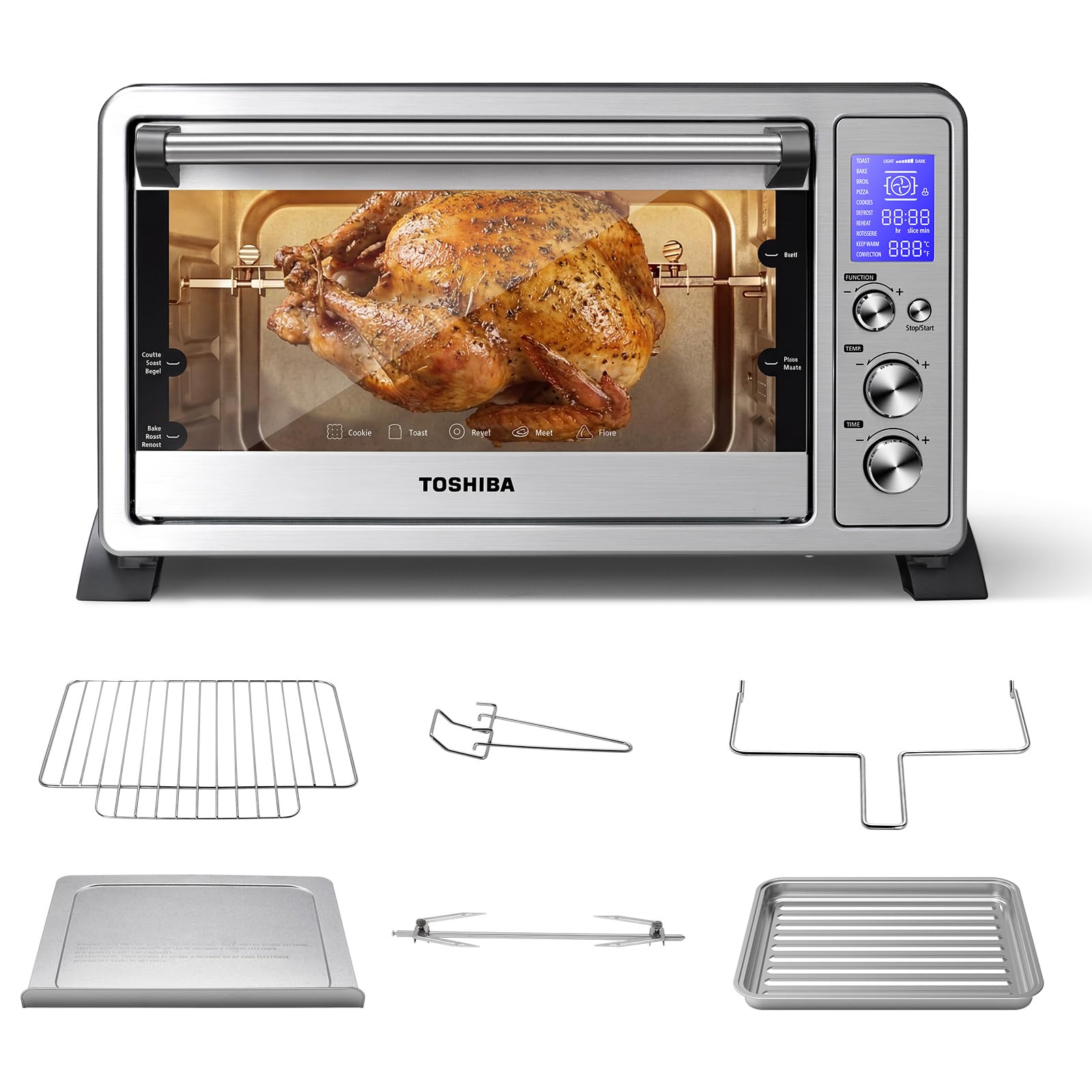
A rotisserie kit comes in the box — spit, forks, lifter and rack clamp — and at this end of the price range that is genuinely unusual. A four-pound chicken turns while it browns, so the skin crisps all the way around rather than just across the top.
The rest is a plain convection oven done reasonably well: 1500 watts, 150 to 450 °F, ten functions including bake, broil, pizza, cookies, defrost, reheat, keep warm and rotisserie, and a fan that moves air for faster roasting. At 14.6 pounds and about 19 inches wide it slots into gaps the French-door models cannot.
Read the manual once. Three knobs and an LCD handle function, temperature and time, and the logic is not obvious until you have done it a few times; after that it is quick and the child lock is easy to reach. Skipping the manual is the fastest way to end up fighting the timer.
At the lowest price here, this is the one for a first oven, a dorm room or a cabin, and the rotisserie alone justifies it if roast chicken is a regular meal. It is the least refined oven in this group and the only one that does rotisserie for the money, which is a fair summary of what you are buying.
Pros
- Rotisserie kit included at this price
- Convection fan speeds up roasting
- Compact 19-inch width fits narrow gaps
- Ten functions including pizza and cookies
Cons
- Runs hot against the dial setting
A real convection oven with rotisserie hardware at the lowest price here — the right first countertop oven if you will read the manual.
Best for Stainless Interiors
Midea Flexify 26.4 QT
Key Features
- Capacity: 26.4 qt
- Footprint: 16.9 x 13.7 in
- Cooking functions: 10
- Temperature range: 100–450 °F
- Price: Midrange
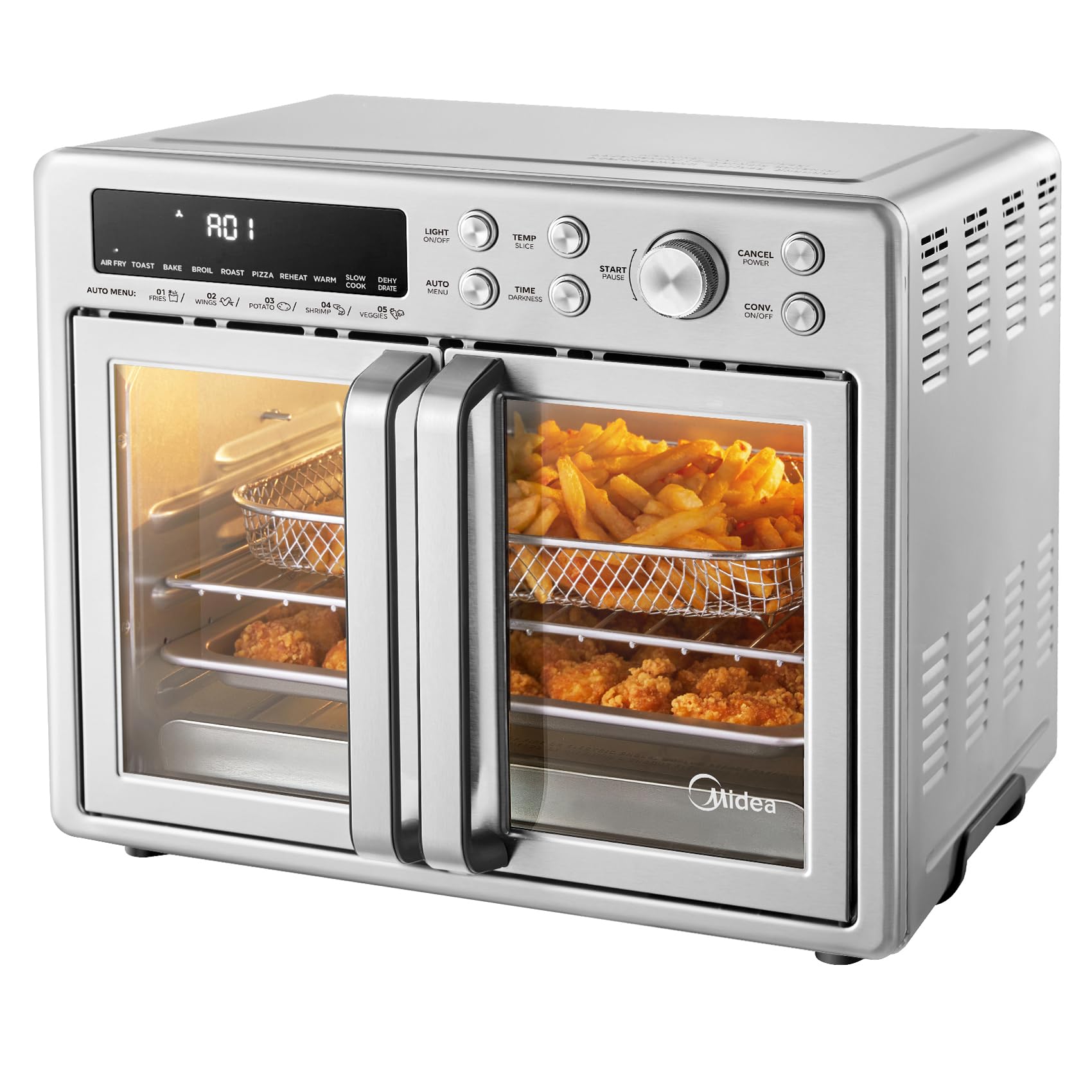
The inside is all flat stainless — no plastic trim, no exposed aluminum — which is the sort of detail listings skip and the first thing you notice when something spatters. It wipes clean in a couple of passes, and the crumb tray slides out from the front.
26.4 quarts holds a 12-inch pizza, six slices of toast or 14 chicken wings, and the controls adjust in 5-degree and one-minute steps. That is finer than any knob oven here: if a recipe says 375 °F, you can set 375 °F rather than something between the marks, which is the difference between following a recipe and approximating it.
It is also the shallowest of the French-door ovens here at 13.7 inches of depth, which matters on a standard-depth counter where you still need clearance behind. Two baking racks come in the box, so a tray of wings and a tray of vegetables can go in at once, and the double doors stay cooler to the touch than the plain panels on the Gourmia.
It is a good oven that loses two close fights: the Gourmia does French doors for less, and the Ninja preheats faster. What it has that neither does is the stainless interior and the 5-degree control — for someone who cooks fish and vegetables at specific temperatures, that is the reason to pick it.
Pros
- All-stainless, flat interior wipes clean
- 5-degree temperature steps give fine control
- Shallower than the Breville ovens
- Fits a 12-inch pizza, six slices or 14 wings
Cons
- Knobs and buttons get hot during long bakes
A well-finished French-door oven with a stainless interior and 5-degree control, though it does not beat the picks above on price or speed.
How We Tested These Countertop Ovens
We began with roughly 40 models sold by major retailers and cut that down to 12 using a fairly blunt filter: would it hold a 9-by-13 pan or a 12-inch pizza, does the element layout make sense for baking and not just broiling, are the extra functions actually usable, and can you get parts and service if something breaks in year two. Price factored in, but only against what each oven could do — a smaller cavity that heats fast and evenly beats a big one that doesn’t.
Every oven then lived on a kitchen counter for eight months, doing real work rather than staged tests. In the first week we timed how long each took to reach 350 degrees using a standalone thermometer instead of the display beep, then watched how far the temperature drifted across a 30-minute bake. We toasted bagels, roasted a full sheet of vegetables, baked a dozen cookies on a single pan to see which corners browned first, air-fried frozen fries, and reheated cold leftovers to check whether anything came out soggy in the middle and leathery on top.
Fit and function got checked with a tape measure and a lot of shuffling. We measured each footprint against standard under-cabinet clearance, opened the door with a wall close by, and noted whether the racks and crumb tray slid smoothly or caught. Heat output showed up in the small things — whether the exterior got too hot to touch mid-roast, whether the fan was audible from the next room.
Reliability is the part you can only learn by keeping the thing plugged in. After months of daily use we rechecked hinges, knobs, and enamel coating, listened for new rattles, and paid attention to whether the controls ever misread a temperature they’d previously nailed. The ovens that made the list are the ones still behaving in month eight the way they did in week one.
How to Choose a Countertop Oven
The right countertop oven is the one that fits your counter and the pans you already own, so measure the slot before you read another capacity claim.
Measure the slot, not the spec sheet
Three clearances decide whether an oven works in your kitchen: behind it for the vents, above it for heat and steam, and in front for the door. A drop-down door takes roughly the oven’s own depth of counter space when it is open, which is why a deep model on a shallow counter leaves you reaching over a hot panel.
French doors swing sideways instead of forward and free up that depth, and the Ninja Flip goes further by standing up against the backsplash, provided nothing is mounted low above the counter. Take the tape measure to the actual spot, not to the brochure.
Capacity is not the same as what fits
Quarts and cubic feet tell you less than the pan you plan to put inside. A half-cubic-foot oven like the Breville Smart Oven Pro takes a 12-by-12-inch pan or a 13-inch pizza, which covers most of what a two-person kitchen cooks. Interior height matters too: a tall model fits a whole chicken standing up; a shallow one does not.
The step to a full cubic foot buys a second rack, and that is the real dividing line between a toaster oven and a second oven. If you bake two trays at once, pay for the rack.
Even heat and an honest thermostat
Two things brown food properly: where the elements sit and how the air moves. Quartz elements spread across the cavity are more even than a single bar, and a convection fan shortens cooking and evens the result. Air frying is that same fan plus a basket that lets air underneath the food, which is why the basket shape matters more than the label.
What no listing tells you is whether the dial tells the truth. An inexpensive oven thermometer settles it in one bake; if yours runs hot, note the offset and you stop burning the top rack.
Doors, controls and cleaning
French doors make a hot tray easier to handle and save counter depth, though heat can escape at the seam between the panels. Knobs are faster with wet hands; digital panels give finer temperature steps, and 5-degree increments are worth having if you cook fish and vegetables at specific temperatures.
For cleaning, look for a crumb tray that slides out and trays that survive the dishwasher. It varies more than you would expect: on the Ninja Flip only the air fry basket qualifies, while the Gourmia’s basket, pan and rack all do.
What it costs to keep
Most of these draw 1500 to 1800 watts, which is roughly a hairdryer and far less than heating a full-size oven for a tray of rolls. It also means close to a 15-amp circuit’s limit, so share the outlet with nothing else.
Warranties run one year on most models here and two on the Breville Air Fryer Pro. Elements and fans are what fail, so register the oven and keep the receipt; that paperwork is the whole remedy if a fan seizes in year three.
Frequently Asked Questions
Can a countertop oven replace a full-size oven?
For most weeknight cooking, yes. It preheats in a fraction of the time, uses less energy for small loads, and a full-cubic-foot model handles a chicken, a 12-inch pizza or a casserole without complaint.
What it cannot do is volume: two racks is the practical ceiling, and the broiler does not have the punch of a full-size element. Keep the big oven for holidays and for baking two trays at once.
Do you have to preheat a countertop oven?
For baking, roasting and pizza, yes — five to ten minutes, and a model with a preheat signal makes that easy to judge. For toast and reheating, skip it; the element is close to the food and the extra minutes just dry the bread out.
Fast preheating is a genuine reason to choose one oven over another. The Ninja French Door Premier reaches temperature in about 90 seconds, which changes how often you bother using it.
Do I need special pans for a countertop oven?
No. Ordinary metal baking pans, sheet pans and foil are all fine. The one rule is keeping foil and parchment off the elements, which sit close to the top rack on every oven here.
Start with the pan and rack in the box, then choose anything else so it leaves an inch or two of clearance on all sides. Air has to move around the food or you get pale sides.
Will a countertop oven trip a breaker?
It can if it shares a circuit. These draw 1500 to 1800 watts, close to the 15-amp limit of a standard kitchen circuit, so running one alongside a kettle or a second oven on the same line is what trips it.
Use an outlet of its own where you can, and skip the extension cord — the current these pull makes one a genuine weak point.
Final Verdict
The Breville Smart Oven Pro is the countertop oven we recommend without a caveat about the cooking: five quartz elements, ten functions and a dial that makes all of them easy to use. It bakes, roasts and toasts better than anything else in this group at a size most kitchens can spare.
If you need two racks and air frying, the Smart Oven Air Fryer Pro is the same idea with double the room. If the counter is the constraint, the Ninja Flip is the one — provided you have clear wall above it to fold it up against.