This post contains affiliate links. We may earn a small commission when you buy through our links — at no extra cost to you.
A percolator boils water up a stem and rains it back down through the grounds, over and over, and that cycle is either the whole charm or the whole problem. Get it right and you have hot, bracing coffee that stays hot without a glass carafe, and that keeps working when the power doesn’t. Get it wrong and you have a pot that’s been stewing since breakfast, a handle you can’t hold, and a glass knob that chips the first time it hits the dish rack. We’ve spent the past six months brewing with 11 electric and stovetop models to find the ones that get it right.
What first-time buyers don’t realize is that the number of passes matters more than the wattage — every cycle through the grounds pulls a little more out of them, so the line between rich and bitter is often a minute and whether the machine lets you stop it. And nobody warns you that coffee oils cling to the stem and basket, so a pot that doesn’t come fully apart will taste like last Sunday by week three. Below are the percolators that earned permanent counter space, sorted by what they’re actually good at.



Best for Everyday Home Brewing
Farberware Yosemite 12-Cup
Key Features
- Filter: Permanent metal basket
- Capacity: 12 cups
- Cleaning: Dishwasher safe
- Material: Stainless steel
- Price: Budget
Two things sold us on this pot before anyone tasted the coffee: there’s no paper filter to buy or fish out, and the whole thing — basket, stem, knob and all — is dishwasher safe. Farberware builds the Yosemite from stainless steel with a mirror finish and a clear knob on the lid so you can watch the first bubbles break. Twelve cups covers a family breakfast with enough left for a second round, and this is the percolator we point most people to.
Percolating is an old ritual and it rewards doing it properly. Fill to the mark, load the basket with a coarse grind — a drip grind silts straight through the holes — then set it over heat and wait for the knob to show color. Turn the burner down as low as it will go and give it about ten minutes. Done that way the cup is round and strong without the scorched edge that comes from boiling grounds. Done in a hurry, it isn’t.
Small things decide how the pot feels by the tenth morning. The fill marks are stamped inside, where they’re genuinely hard to read in a dim kitchen, and the little spring under the strainer will vanish down the drain if you rinse the basket in pieces — keep it assembled. Neither is a dealbreaker; they’re the sort of thing you learn in a week.
What keeps it at the top is range. It works on a burner or over a campfire, it doesn’t care whether the power is on, and it costs less than the electrics here. If you’ll stand at the stove for those ten minutes, no other pot in this group gives you as much for the money. If you won’t, that’s the one job it can’t take off your hands.
Pros
- No paper filters to buy or rinse out
- Fully immersible and dishwasher safe
- Full-bodied coffee without bitterness
- Works on a burner or a campfire
Cons
- Lid knob is the part that fails first
We recommend the Yosemite to most people because it’s the easiest route to a genuinely good cup: no filters to buy, nothing to plug in, and a pot that goes in the dishwasher.
Best for Hands-Off Daily Coffee
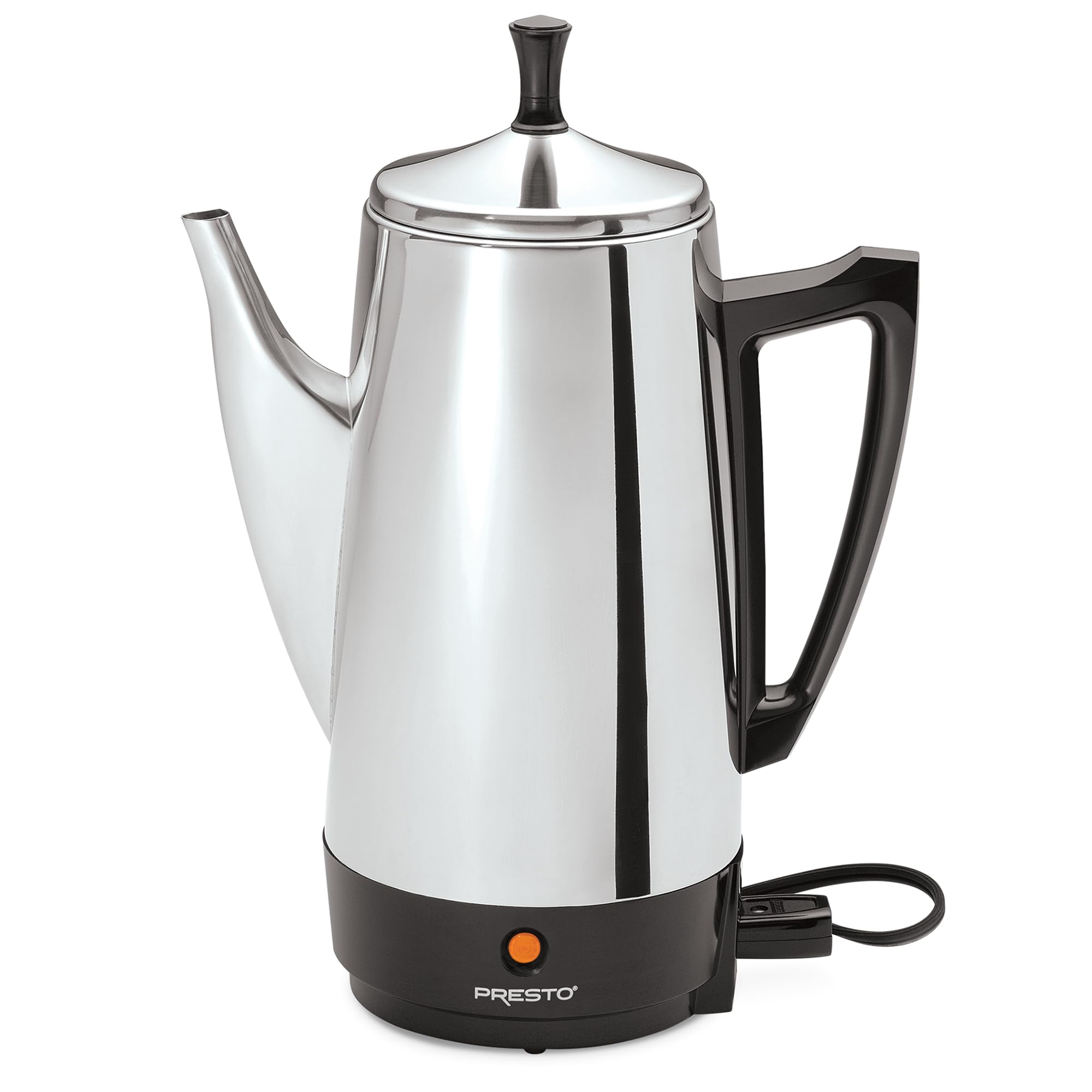
Presto 02811 12-Cup Electric
Key Features
- Power: Electric, 800 watts
- Weight: 2.9 lb
- Capacity: 12 cups
- Cleaning: Hand wash only
- Price: Premium
A signal light instead of a glass knob tells you most of what this pot is about. Load the basket, fill the well, plug it in, and walk away: the Presto brews at roughly a cup a minute up to 12 cups and then holds the coffee at serving temperature on its own. There’s no flame to nurse and no perk to watch.
That hands-off stretch is what we valued most, and it’s why this is the electric we recommend before the others here. The stainless body and basket wipe down easily. The one habit to build is pulling the plug — there’s no auto shut-off, so the pot keeps warming whatever is left in it long after the coffee has given up.
Capacity is the other argument in its favor. The same pot brews anywhere from two cups to twelve, which suits a house where the morning headcount changes, and the easy-pour spout and stay-cool handle make serving simple. Durability is the honest caveat: the steel outlasts the electronics, and electrical faults are what eventually end these pots. At the top of this group’s price range, you’re paying for the thermostat and the convenience.
Pros
- Brews about a cup a minute, up to 12 cups
- Keeps coffee hot with no input from you
- Brews anywhere from 2 to 12 cups
- Stainless body wipes clean
Cons
- Not dishwasher safe; the pot is hand washed
The Presto is the electric percolator we reach for when the pot has to make itself: a cup a minute, 12 cups, and a thermostat that keeps them hot.
Best for Campfire and Cabin
COLETTI Bozeman 12-Cup
Key Features
- Weight: 2 lb
- Capacity: 12 cups (60 oz)
- Cleaning: Dishwasher safe
- Material: Stainless steel, glass top
- Price: Midrange
No cord, no plastic in the brew path, no paper filter — the Bozeman is a stainless pot with a glass view top, and that’s the whole appeal when you’re cooking over a fire. It holds 60 ounces, which is 12 small cups or about five mugs, and at 2 pounds it goes into a pack without much argument. Of the stovetop pots here, this is the one we take outdoors.
The glass top earns its place at camp, where you can’t dial a flame down with any precision: you watch the color come up and pull the pot off before the coffee turns harsh. Use a coarse grind and keep the heat low, because a fine grind silts through the basket and puts grit in the last cup. The disc filter that comes in the box helps if you like a cleaner pour.
At home it behaves like any good stovetop pot — the parts rinse clean, they’re dishwasher safe, and the body sits on a normal burner without overhanging it. What it isn’t is a small-batch pot. Sixty ounces is a lot to get through with two of you, and a two-person household will be pouring some of it away.
Pros
- No plastic anywhere in the brew path
- 60 ounces for a group, 2 pounds to carry
- Glass top lets you watch the brew color
- Dishwasher safe back at home
Cons
- Sixty ounces is more than a couple gets through
For camp coffee, the Bozeman is the one we pack: stainless and glass with no plastic in the brew path, dishwasher safe at home, and 60 ounces for a group.
Best for Singles and Couples
BLACK+DECKER 4-Cup
Key Features
- Power: Electric, 1000 watts
- Capacity: 4 cups (20 fl oz)
- Keep warm: Automatic
- Dimensions: 8 x 5.3 x 8.8 in
- Price: Midrange
Four cups — 20 ounces — is the point of this one, not a shortfall. It makes two generous mugs and stops, which is right for a single drinker or a couple and wrong for a family. The footprint is small enough to leave out on the counter, at 8 inches deep and under 9 tall, and it brews in a few minutes rather than the ten a full pot needs.
We think it’s the most sensible electric for one or two coffee drinkers, and the keep-warm base means the second cup isn’t cold. Handling is the weak spot: the lid can be stiff to lift while the pot is hot, which is precisely when you’re doing it, so set it down and use a cloth rather than fighting it at the spout.
The coffee is as good as the grind you give it, and a short perk makes the grind matter more rather than less. The basket and stem lift out in one piece for a quick rinse, and the stainless wipes down without a brush. That’s the sort of thing you appreciate at six in the morning, when the alternative is dismantling a machine.
Pros
- Twenty ounces makes two mugs, no leftovers
- Small footprint stays on the counter
- Automatic keep-warm holds the second cup
Cons
- Electronics fail well before the steel does
If you drink two mugs and hate pouring the rest away, this is the percolator to buy: 20 ounces, a few minutes, and a keep-warm base.
Best for Parties and Offices
West Bend 12-Cup Electric
Key Features
- Power: Electric, 950 watts
- Capacity: 12 cups (96 fl oz)
- Keep warm: Automatic
- Level gauge: Handle-mounted
- Price: Midrange
Ninety-six ounces is the number that matters — 12 cups, enough to fill a row of mugs at a brunch and still leave some in the pot. It brews in about ten minutes and then switches to keep-warm on its own. The gauge set into the handle is the detail we appreciate most: you can see how much is left without tilting a full pot.
Serving was clearly the design brief. The cord detaches so the pot can travel to the table, the stem, basket and spreader are stainless, and the pour is clean enough that you aren’t wiping the counter afterwards. The chrome-finished body looks at home on a buffet, which is more than you can say for most appliances in this group.
For a household of two this is more pot than you need, and that’s the honest limit of it: 12 cups is a deliberate choice, not a default. Where it earns its place is a kitchen that serves a crowd — holidays, an office, a big family — and it does that for less money than the Presto. Measure the cupboard first: at almost 12 inches tall with the lid on, it wants headroom.
Pros
- Twelve cups in about ten minutes
- Automatic keep-warm holds serving temperature
- Detachable cord for carrying to the table
- Coffee-level gauge built into the handle
Cons
- Loud, churning percolating noise
- Plastic sight glass in the lid fails first
Think of the West Bend as serving equipment: 12 cups brewed fast, held hot, and easy to carry to a table full of people.
Best for Group Camping
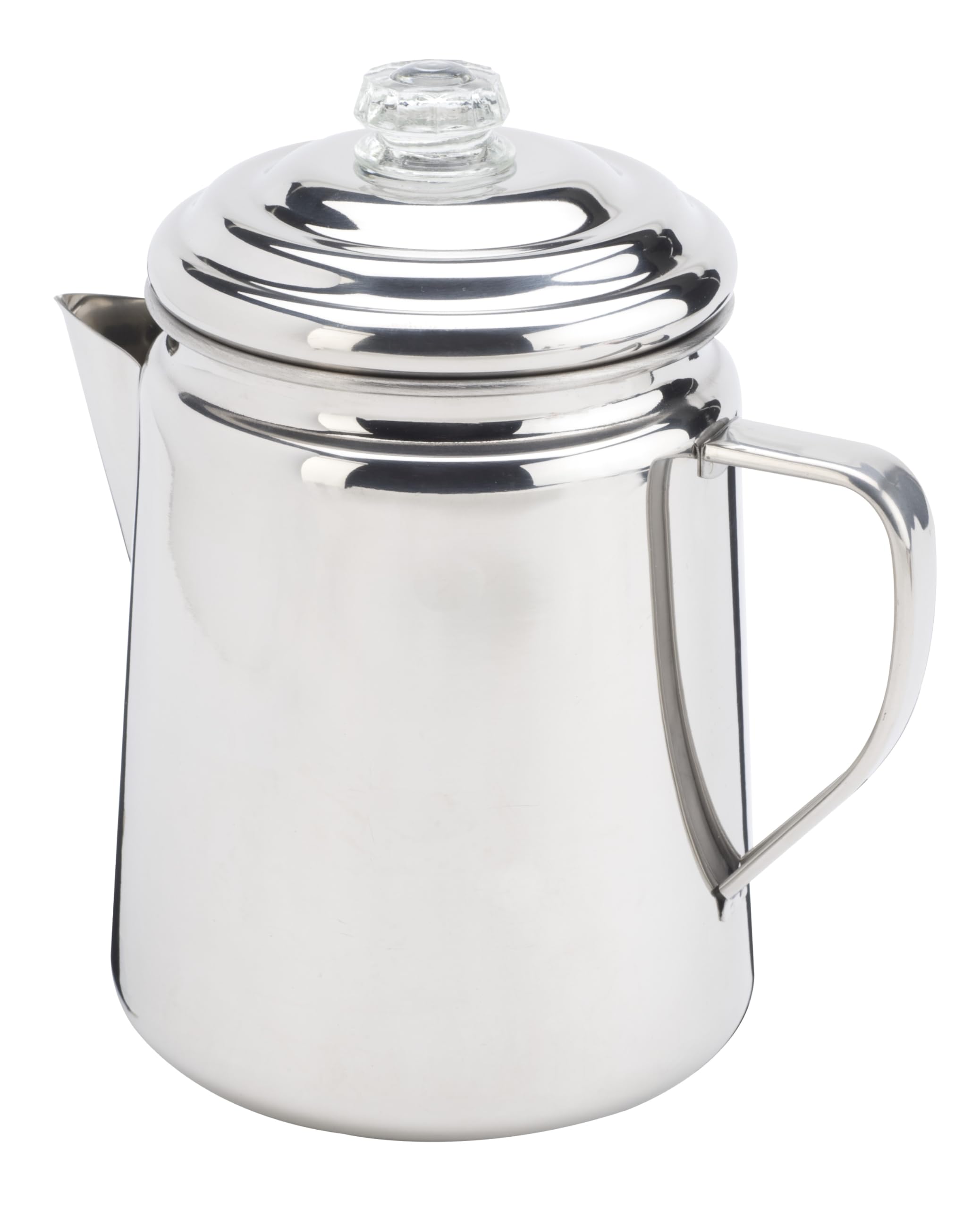
Coleman 12-Cup Stainless
Key Features
- Weight: 2.2 lb
- Capacity: 12 cups
- Material: Stainless steel
- Dimensions: 13 x 7 x 4.63 in
- Price: Premium
Where the Farberware stands tall on a burner, this Coleman sits wide and low — 13 inches long, under 5 inches tall — so it’s steadier on a camp grate and easier to balance on a grill side burner. It’s stainless, holds 12 cups, needs no filters, and weighs a little over 2 pounds.
Coffee is where it earns its keep. The stainless basket and tube turn out a smooth, full-bodied pot, and it works over propane, a campfire, or a kitchen burner without complaint. It’s a big pot for one or two people, though: a full batch is 12 cups, so a couple will either drink more than they meant to or pour some away.
The handle is the thing to plan for. Over an open fire it gets hot enough to need a glove or a folded towel, which is normal for a steel handle but worth knowing before you grab it bare-handed. As an outdoor pot for a group it’s excellent, and it’s the one here most at home on a grill.
Pros
- Wide, low body is stable on a camp grate
- Smooth, full-bodied coffee from a stainless basket
- Works over propane, campfire, or a burner
Cons
- Glass lid knob is the fragile part
Our pick when the pot has to survive a campfire and feed a group: wide, stable, stainless, and happy on a grill side burner.
Best for Camping and Travel
Eurolux 9-Cup

Key Features
- Capacity: 9 cups
- Cleaning: Dishwasher safe
- Includes: Paper filters and guide
- Material: Stainless steel
- Price: Budget
Nine cups, a booklet, and a stack of paper disc filters in the box — the Eurolux is the only pot here that assumes you’ve never percolated before and tries to help. The stainless body has its volume marks stamped inside where you can see them while filling, and at 1.9 pounds it moves between kitchen and camper without complaint.
The disc filters are the practical part. Drop one under the basket and the last cup pours clean instead of gritty, which is the usual gripe about percolator coffee. It’s dishwasher safe, which isn’t true of every pot here, and the basket, stem and lid come apart without tools.
Nine cups is a small batch by this group’s standards — closer to five mugs — so it suits a couple or a small camper rather than a family. It’s happiest making a full pot for two, and the stainless wipes clean while it’s still warm.
The trade is simple: less capacity than the 12-cup pots and a shorter record behind it, in exchange for included filters, dishwasher-safe parts, and the lowest price in this group. For a first percolator, or a second one that lives in the camper, that’s a sensible place to start.
Pros
- Ships with paper filters and a brewing guide
- Dishwasher-safe stainless body
- Light 1.9 pounds to move or pack
- Lowest price in this group
Cons
- Nine cups is a small batch for more than two
This is the pot we hand to a first-time percolator buyer: light, dishwasher safe, and shipped with filters and instructions.
How We Tested (and Lived With) 11 Percolators
We started with roughly 30 percolators sold in the U.S., both electric and stovetop, in the 6- to 12-cup range, then cut the list by capacity, wattage, whether the basket and stem come apart for cleaning, and build quality — riveted handles and flimsy glass knobs got flagged early. Eleven made the cut, and we’ve been brewing with them for six months.
Every pot got the same three runs: a full batch on a Sunday morning for a house of four, a small weekday batch, and one deliberately forgotten pot left on the heat so we could taste what happens at the ten-minute mark. We timed first perk to last gurgle, took the temperature of the coffee in the pot at 15, 30, and 45 minutes, and tasted side by side with the same beans and grind — three of us, noting whether the second cup was still sweet or already woody. Price came in at the end, when we asked whether the spendier pots actually brewed better or just looked better on the counter.
Then came the parts you live with. We disassembled each one, scrubbed the stem with a bottle brush, checked whether the basket fit in a dishwasher, and smelled the stem after a week of daily use to catch anything holding onto old oils. We started each pot from the next room to hear how far the gurgle carried, grabbed handles bare-handed straight off a full cycle, and knocked the glass tops around the sink and dish rack on purpose. After six months we went back through cords, base plates, hinges, and finishes to see what had scorched, clouded, or loosened.
How to Choose a Coffee Percolator
A percolator is a simple pot, so the decision comes down to three things: how many mugs you actually pour, whether you want to watch a flame or plug something in, and how much breakable hardware you’re willing to live with.
Stovetop or Electric: Pick by Attention, Not by Coffee
The difference between the two isn’t the flavor — it’s the ten minutes. A stovetop pot needs someone to catch the first perk and turn the heat down; an electric pot handles that itself, holds the coffee warm afterwards, and gives up the ability to work when the power doesn’t. If your morning already involves standing near a stove, buy stovetop and get a pot that goes camping too. If you want to press a button and leave the room, pay for the thermostat.
Consider how the pot ends its life, too. Electric models fail at the cord, the switch or the thermostat; stovetop pots fail at the knob on the lid. Both are ordinary wear, and both are easier to live with when you know which part to watch.
What 12 Cups Actually Means
A percolator’s cup is about five ounces — the same measure as the markings on a drip machine, not a 12-ounce mug. A 12-cup pot fills roughly five generous mugs; a 4-cup pot makes two. Buy for the mugs you pour, not the number on the box, because an oversized pot wastes coffee and leaves the tail end of the brew sitting on heat, while a small one is a nuisance the moment guests arrive.
Grind, Baskets, and the Grit in the Last Cup
Perking recirculates water through the same grounds for ten minutes, which is why the grind matters more here than in a drip machine. Coarse is right: a drip grind slips through the basket holes and ends up in your teeth. Once the pot starts bubbling, keep the heat low and control strength by how long you let it perk rather than by adding more coffee.
If you like a clean last sip, a paper disc under the basket is the easy fix — one pot here ships with filters for exactly that reason.
Material, Weight, and Your Burner
Stainless is the safer long-term choice. It doesn’t react with coffee, it shrugs off being knocked about, and most stainless pots here are dishwasher safe. Aluminum is lighter and cheaper but softer, quicker to dent, and fussier about acidic coffee; glass looks wonderful until it meets a tile floor. If you cook on induction, check the maker’s compatibility statement before you buy — a magnet is the quick test, because the base has to be magnetic to heat at all.
The Parts That Break First
Every pot in this group has a wear part, and it’s almost always the knob or sight glass on the lid, followed by the handle on a cheap pot and the thermostat on an electric one. Before you commit, confirm that replacements are sold and that the model has been around long enough for parts to exist. Wash the basket assembled — the small spring on the stem is easy to lose and hard to replace.
Frequently Asked Questions
Why use a percolator instead of a drip machine?
Percolating gives you a hotter, stronger, fuller-bodied cup, needs no paper filters, and works on any heat source — which is why these pots turn up in camp kitchens and in houses that lose power. The price is attention: ten minutes at the stove, or a thermostat doing the watching for you.
If you want to load a machine the night before and wake up to coffee already made, a drip machine is still the better tool.
How do I clean a percolator so it doesn’t taste stale?
Wash it after every use. Coffee oils go rancid in the stem and basket, and that is where a stale taste comes from. Take the stem, basket and spring apart, wash in hot soapy water, and put the parts in the dishwasher only if the maker rates them for it.
For the brown film inside the pot, soak with a little white vinegar and water and it lifts without scrubbing.
Can I leave coffee on the keep-warm setting all morning?
You can, but the flavor flattens as it sits, because the grounds stay in the basket and keep steeping. Lift the basket out when the brew finishes if the pot lets you, or pour what you aren’t drinking into a thermos and unplug the pot.
A pot with an exposed warming plate will also cook the coffee at the bottom of the pot, so a thermos beats a hotplate every time.
Final Verdict
For most kitchens, the Farberware Yosemite is the percolator to buy: 12 cups, stainless, no paper filters, dishwasher safe, and the most consistently liked coffee in this group. It also happens to be one of the least expensive pots here, which makes the choice easier still.
The one requirement that changes our answer is attention. If you won’t stand at the stove for ten minutes, the Presto brews the same 12 cups on its own and holds them hot — you pay more for it, and you hand over the watching.