This post contains affiliate links. We may earn a small commission when you buy through our links — at no extra cost to you.
A bench scraper looks like the simplest tool in the drawer, which is exactly why the bad ones are so frustrating. A dull edge skids across an onion instead of slicing through it, a flimsy blade flexes the moment you lean on it, and a handle that felt fine in the store turns into a blister by the third batch of cookies. I’ve used everything from cheap pastry cutters to heavy-duty dough knives in my own kitchen, and the difference between a scraper you reach for daily and one that lives at the back of the drawer comes down to a handful of things: how sharp the edge arrives, how it holds up, and whether it feels secure in a wet hand. The right one chops, scoops, lifts, and cleans up a counter in a single motion — and once you have it, you’ll wonder how you managed with a knife and a cupped palm.
We spent the better part of a year putting 14 bench scrapers through real cooking — not just posing them next to a cutting board. Some arrived razor-sharp and stayed that way; others dulled after a few weeks of squash season. What surprised me most is how much handle shape matters on a tool this small: a scraper you grip for five seconds at a time still has to feel balanced when you’re pressing down hard to lift sticky dough. Value mattered too, since plenty of inexpensive models outperformed pricier ones. Below are the ones that earned a permanent spot on my counter.



Best for Everyday Scraping
Amazon Basics Bench Scraper
Key Features
- Item weight: 5.76 oz
- Blade length: 6.02 inches
- Handle material: Plastic
- Measurement marks: 1/4 inch increments
- Price: Budget
Quarter-inch increments sound like a nothing detail until you are dividing a batch of dough into twelve rolls and want them the same size. The marks run the length of this blade in 1/4-inch steps, and they are the part we reach for most; the blade itself is a broad, square-edged rectangle of stainless that lies flat on the counter and lifts a whole mess of flour in one pass.
That combination is why it is our top pick. The steel is stamped and the handle is plain contoured plastic rather than rubber or wood, but at 5.76 ounces it has enough weight to stay steady under a wet hand without tiring your wrist, and the 6.02-inch blade is long enough to span a sheet of pastry. It also goes straight into the dishwasher with nothing to dry or oil afterward, which is more than the wooden-handled scrapers here can say.
The honest limitation is the edge. It is square rather than honed, so it portions soft dough and scrapes dried flour, but it will not shave nuts or fine-dice an onion, and anyone arriving from a knife will be disappointed. Judge it as a scraper that cuts dough and it does that job without complaint.
The one place it gives ground is grip: the handle is contoured and secure, but with wet dough on your hands the OXO below feels more planted. That is the step up to take if you bake most weekends. For occasional loaves, pizza night, and everyday counter cleanup, nothing here is easier to live with.
Pros
- Quarter-inch marks along the full edge
- Broad square blade sits flat and scoops clean
- Dishwasher safe with no wood to oil
- Enough heft to stay steady in a wet hand
Cons
- Edge is square, not honed for chopping
Our top pick because the quarter-inch marks make even portions easy, the blade sits flat, and it survives the dishwasher without any upkeep.
Best for Sticky, Wet Dough
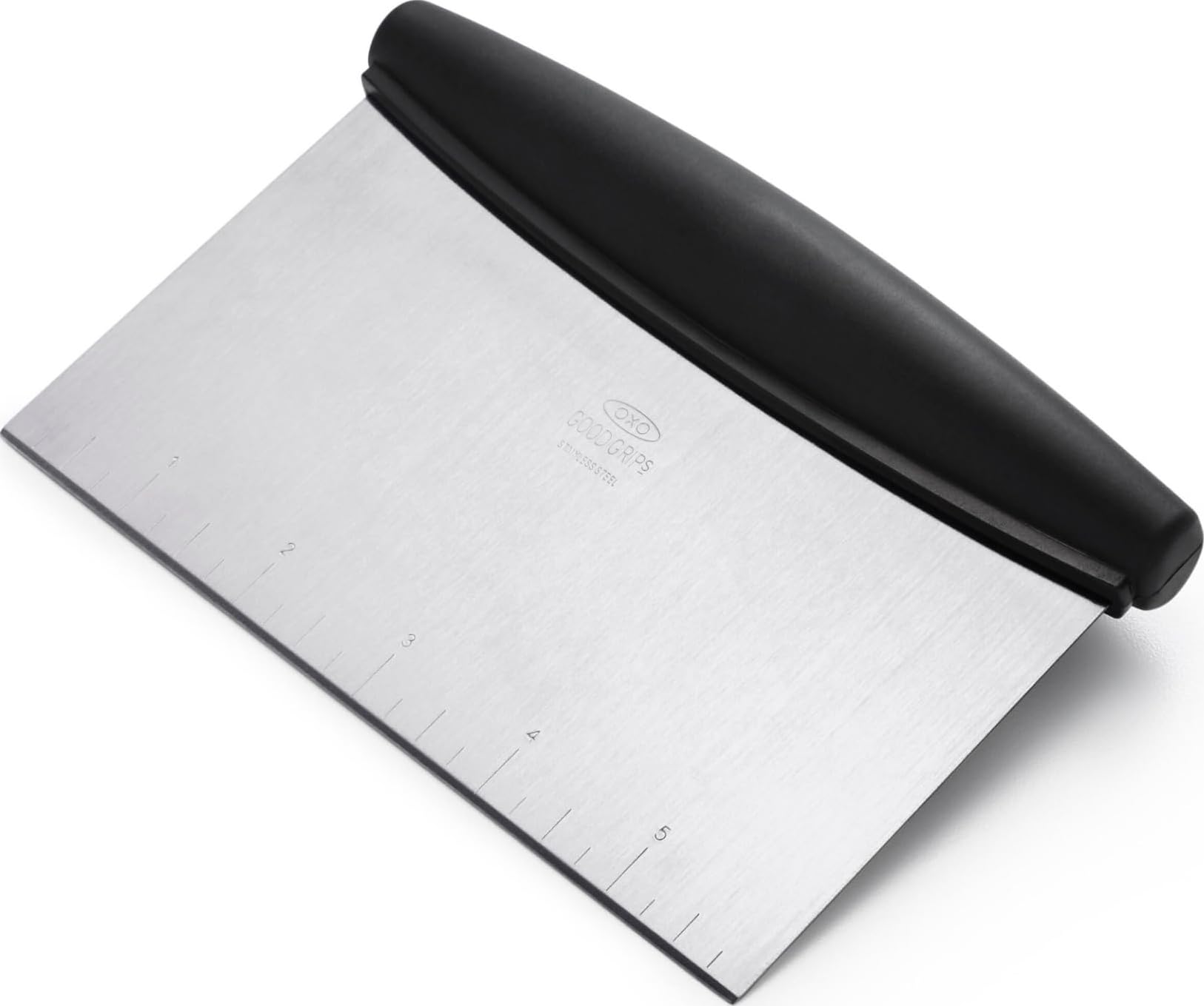
OXO Good Grips Scraper
Key Features
- Blade length: 6 inches
- Handle material: Soft non-slip grip
- Measurement marks: 1 inch increments
- Overall dimensions: 6.25"L x 4"W x 1.75"H
- Price: Premium
Grip is the whole argument for the OXO. Where most scrapers here hand you a hard plastic or steel grip, this one wraps a soft, rubbery coating around the handle, and the difference shows the moment your palms are sticky: the tool stays where you put it instead of rotating as you press down.
The blade is 6 inches of stainless, beveled along the bottom and of a consistent thickness, which is what keeps a cut running straight through a stiff dough instead of wandering. On build, it is the most solid of the home-kitchen scrapers here; there is no flex when you lean on it. The measurement ticks are engraved rather than printed, so a decade of dishwasher cycles will not take them off.
Those ticks sit an inch apart, though, and that is where it gives ground to our top pick: dividing a batch into eight or twelve even pieces is easier in quarter-inch steps, and no amount of grip fixes that. If you portion by weight on a scale, the spacing will never bother you.
So this is the best grip in the set, and the one we point to for enriched doughs, laminated pastry, and anyone whose hands ache after a long mix. What the extra money over the top pick buys is comfort, not capability. Store it edge-down at the back of a drawer rather than loose among the utensils, because the blade is sharp enough that you will not want to grope for it.
Pros
- Soft non-slip handle holds in wet hands
- Sturdiest blade of the home scrapers here
- Engraved markings survive dishwasher cycles
Cons
- Thick grip can feel bulky in large hands
The best grip in this group, and the one we point to for wet, sticky dough and long mixing sessions.
Best for Heavy Daily Use
Dexter-Russell 19783 Dough Cutter
Key Features
- Blade size: 6" x 3"
- Certification: NSF certified
- Blade material: High-carbon stainless steel
- Handle material: Textured polypropylene
- Price: Premium
There is no gap between blade and handle on the Dexter-Russell. The steel runs into a molded polypropylene grip with an impervious seal, so there is nowhere for flour, dough, or dishwater to collect and go sour. On a tool you press into wet dough several times a week, that seam is the difference between clean and not.
The blade is 6 by 3 inches, shorter in height than most of the home scrapers here. That is a deliberate trade: less scoop volume when you are moving chopped vegetables, more control and less leverage lost when you are portioning a dense dough. The handle is textured and slip-resistant, rated for hot and cold, and the whole thing goes in the dishwasher.
We point to this one for serious volume and for cooks who want commercial hygiene standards at home: the NSF certification is a checkable third-party mark rather than a marketing line. It sits at the top of the price range here, and what the money buys is build and sanitation rather than features. Nothing on it is decorative, which is the point. The corners are sharp out of the box, so do not reach into a drawer blind.
Pros
- Sealed blade-to-handle joint leaves no crevice
- NSF certified for commercial kitchen use
- Textured handle grips when wet or floured
Cons
We point to this one for anyone baking in volume: a sealed, NSF-certified tool built to be washed hard and used every day.
Best for Griddle and Dough
Anmarko Bench Scraper
Key Features
- Item weight: 6.7 oz
- Scale marking: Inch marks
- Blade thickness: 1/32 inch
- Overall dimensions: 6"L x 4.72"W
- Price: Midrange
Flat-top griddles and dough boards do not usually share a tool, but this one earns a place on both. The blade is 1/32 inch thick with tapered edges, so it slides under a crust of burger grease as readily as it separates a proofed loaf, and the bevel is fine enough that it takes an edge if you want one.
What we noticed first is how much the tapered corners do: a pile of chopped onion comes up in one lift instead of three, and the inch scale along the blade handles the rest. The steel is stiff enough to hold a straight cut and thin enough to follow a slight dip in a pan, where a heavier blade skips over the low spot and leaves a film behind.
It is the pick here for anyone cooking on a griddle as well as baking, and the chunky handle stays grippy with greasy hands. It is not the most refined tool in this group: the blade flexes a little under a hard press compared with the Dexter-Russell, and the taller profile takes up drawer space. As the scraper that lives by the stove and comes out for pizza night, nothing here fits better.
Pros
- Thin tapered blade scrapes a flat-top clean
- Works as dough cutter and griddle scraper
- Inch scale along the blade for portions
Cons
- Tall blade takes more drawer space
Our pick if you cook on a flat-top: it portions dough on the board and scrapes the griddle just as well.
Best for Two Kitchens
Ourokhome 2-Pack Bench Scraper
Key Features
- Pack size: 2 pack
- Blade length: 5.9 inches
- Scale marking: Laser-etched
- Overall dimensions: 5.9"L x 4.9"W
- Price: Midrange
The case for two is simpler than it looks: a bench scraper is the sort of tool that migrates between kitchens, and a spare means the baking drawer does not empty out while one is in the dishwasher. Both blades are 5.9 inches of 430 stainless with a scale laser-etched into the steel rather than printed on top.
That etching is the detail we appreciate most, because printed markings are the first thing a dishwasher destroys. There is a conversion chart on the blade too, which earns its keep the first time a recipe jumps between cups and milliliters. Add a hanging hole, a patterned handle that grips through flour, and a genuinely sturdy feel, and this is the pack we suggest for a first scraper or a second kitchen. At 5.9 inches the blade runs a fraction short of the 6-inch standard, which only matters if you work at the far end of the scale.
Pros
- Two scrapers for the price of one good one
- Laser-etched scale and conversion chart
- Hanging hole and dishwasher-safe steel
Cons
- Hard handle runs small for large hands
- Blade is shorter than the 6-inch standard
Our two-pack pick: etched markings that will not wear off, sturdy blades, and a spare for the second kitchen.
Best for Scooping Chopped Veg
Rachael Ray Bench Scrape
Key Features
- Item weight: 6.4 oz
- Blade material: Stainless steel
- Handle material: Ribbed composite
- Overall dimensions: 6"L x 5"W
- Price: Midrange
Chop an onion, then try to get it into the pan with a flat scraper and you will chase half of it across the board. This one has low side walls running up both edges of the blade, turning it into a shallow scoop: the pile stays put through the transfer instead of avalanching off the end.
The bottom edge is eased rather than razor-square, and that is deliberate. It slides over a wooden board without scoring it, and it still cuts cleanly through a cucumber or a sheet of pastry. The ribbed composite handle stays sure in a wet hand, and at 6 by 5 inches the blade is one of the largest here, which is exactly what makes the scooping work.
For prepping vegetables for a stew or a stir-fry, this is the one we reach for, and it is the scraper to hand someone who cooks more than they bake. The width gives it away as a prep tool first, and the purple handle at least makes it easy to find in a crowded drawer.
Pros
- Side walls carry chopped food to the pan
- Eased edge is kind to wooden boards
- Ribbed handle stays secure when wet
Cons
- Eased edge has less bite on dried-on bits
The best of these for moving chopped food: side walls keep onions on the blade all the way to the pot.
Best for All-Steel Build
MS WGO Dough Scraper

Key Features
- Item weight: 5.44 oz
- Blade material: Stainless steel
- Handle material: Stainless steel
- Overall dimensions: 5.75"L x 5.74"W
- Price: Budget
There is no plastic anywhere on this one: blade and handle are a single run of stainless steel, so there is nothing to crack or stain. That is why it stays in the rotation. It comes out of the dishwasher looking like new, it feels solid under a firm press rather than flexing away from the board, and it takes the sort of pressure that separates a stiff dough without complaint.
The handle is an open loop, though, and dough works its way into the gap, so a bottle brush earns its keep where a rinse will not do. Otherwise there is little to think about: at 5.44 ounces it is light enough to use all afternoon, and the edge bevel is slight enough to cut butter into flour, which is the job most of us actually have.
Pros
- One-piece stainless with no plastic to stain
- Dishwasher safe and comes out clean
- Rigid under a firm press
Cons
- Edge will not cut through baked goods
Steel handle and all, this is the scraper that never looks grubby, and an easy pick if plastic handles put you off.
Best for First Scraper
ALLTOP Bench Scraper

Key Features
- Item weight: 7.76 oz
- Handle material: Plastic
- Measurement marks: 1/4 inch increments
- Overall dimensions: 6.3"L x 3.9"W
- Price: Budget
If you are not sure you need a bench scraper, this is a low-risk way to find out. The quarter-inch marks are laser-engraved along the blade, the cutting edge is beveled rather than blunt, and the handle is shaped like an olive so it sits in the hand without rotating.
It is the best budget scraper in this set, and the reason is that nothing about it feels improvised: the bevel is even, the scale will survive the dishwasher, and the plastic handle is comfortable for what it is. For pizza dough, brownies, and counter cleanup, it covers the same ground as the picks above at the entry price.
Pros
- Laser-engraved quarter-inch scale
- Beveled edge cuts dough cleanly
- Comfortable olive-shaped handle
Cons
- Shallower blade scoops less than taller models
The one to buy if you are curious but not committed: etched quarter-inch marks and a sharp bevel for very little.
Best for Light Pastry Work
Winco DSC-3 Dough Scraper

Key Features
- Blade size: 6" x 3"
- Item weight: 1.6 oz
- Model number: DSC-3
- Handle material: Wood
- Price: Budget
Wood is the whole personality of this one: a smooth, riveted handle on a 6-by-3-inch blade, and at 1.6 ounces the lightest tool in the group. It looks like it came from a bakery, and it handles like it too, with thin steel, a straight cut, and no bulk in the hand.
The catch is care. The listing calls it dishwasher safe, but unfinished wood and a dishwasher are not friends: repeated cycles dry the grain, roughen it, and eventually split it. Wash it by hand, dry it straight away, and rub a little mineral oil into the handle every few months, and the wood will outlast the plastic grips here.
The lightest scraper here is also one of the simplest, and it is the one to buy if you want a thin blade for pastry, bar cookies, and soft dough, and you do not mind ten seconds at the sink afterward. It is also the least expensive tool in this group by a wide margin, and it still cuts a straight line.
Pros
- Lightest scraper here at 1.6 ounces
- Thin blade cuts soft dough cleanly
- Handsome riveted wood handle
Cons
- Edge too dull for chopping
A light, wooden-handled scraper for anyone who wants a thin blade for pastry and does not mind hand washing.
How We Tested the Bench Scrapers
We started by pulling together the models that show up most often in kitchen shops and reader recommendations, then filtered the list by blade material, handle construction, edge type, and price so we had a spread of styles rather than a shelf of lookalikes. That left us with 14 scrapers, which we rotated through everyday cooking over the course of a year.
Each scraper went through the same run of jobs. We diced onions and minced garlic to see whether the edge bit in cleanly or slid over the top, and we chopped nuts and chocolate to check for flex under pressure. For lifting, we used them to scoop cut vegetables into a pan and to transfer chopped herbs without leaving half the pile on the board. Dough was the real test: we used each one to cut butter into flour, portion cookie dough, and lift sticky bread dough off the counter, noting whether the blade dug in or skated and whether the handle stayed comfortable when we pressed down with real force.
Ease of use got checked in the middle of actual cooking, with wet and floury hands, and we paid attention to grip, weight, and whether the handle stayed put or twisted. We ran every scraper through the dishwasher when the maker allowed it and washed the rest by hand, watching for rust, loose rivets, or handles that swelled or cracked. Sharpness was the axis we tracked longest, since a blade that arrives keen but dulls after a month of squash and sweet potatoes isn’t much of a bargain — we re-checked each edge periodically and noted which ones still sliced a tomato cleanly at the end.
At the close of testing we weighed all of it against price, since several of the strongest performers were also among the least expensive. The ones that made the list are the ones we kept reaching for when nobody was taking notes.
How to Choose a Bench Scraper
The blade’s contact with the counter and the grip in a floured hand decide whether a scraper gets used or lives in the drawer; length matters far less than either.
The blade has to sit flat
A scraper earns its keep along the last half inch of the blade, so the edge needs to meet the board along its whole length. Stamped blades can arrive with a slight curve, so lay the tool on your counter and look for daylight underneath before you commit. If it rocks, it pushes flour into a ridge instead of scooping it.
Thickness is a preference, not a grade. Thin stock flexes to follow a surface, as the Anmarko’s 1/32-inch blade does, while heavier steel such as the Dexter-Russell holds a straighter line through a stiff dough but skips over slight dips.
Think about what is on your hands
Most scrapers here have a contoured plastic handle, which is fine for dry hands and dough that behaves. High-hydration bread and long mixing sessions change the calculation: a soft rubberized grip such as the OXO’s stays put when your palm is wet, and that is the difference we notice first.
Wood, as on the Winco, looks better than it behaves in a dishwasher: plan on hand washing, drying it straight away, and oiling it now and then. All-steel handles, like the MS WGO’s, avoid both problems but feel harder under a firm press.
Measurement marks: spacing and how they are applied
A quarter inch is the useful spacing. One-inch marks, as on the OXO, are fine for cutting a block of butter and coarse for dividing a batch of rolls, so weigh that against the handle you prefer. How the marks are applied matters more over time, because printed scales wear off in the dishwasher while laser-etched ones do not; the Ourokhome pair and the ALLTOP both use etched scales. If you portion dough on a scale, skip this entirely and buy on grip.
Blade height decides what you can carry
A 6-by-3-inch blade is nimble, gives a straight cut with less leverage, and takes up little room. The taller 4.5- to 5-inch blades on the Rachael Ray and the Anmarko carry a pile of chopped onions or herbs from the board to the pan without a second pass. Taller also means more drawer space and, for some hands, less control when you press down hard. Buy the short blade if you mostly portion dough; buy the tall one if you prep vegetables.
It is not a knife, and that is the point
Most bench scrapers arrive with a square or lightly beveled edge that separates dough and slides under flour, not a honed edge that dices an onion. Marketing that calls one a chopper sets up the disappointment. An eased edge, like the Rachael Ray’s, is kind to a wooden board but has less bite on dried-on bits; a square edge scrapes harder and can mark a soft board. If chopping is what you want, buy a bench knife with a proper bevel.
Frequently Asked Questions
What is the difference between a bench scraper and a bowl scraper?
A bench scraper is rigid steel with a straight edge, built for flat work: portioning dough, lifting flour, and clearing a board. A bowl scraper is a flexible plastic or silicone curve with no handle, made for getting the last of the dough out of a mixing bowl. They do not substitute for each other. If you bake bread, buy the bench scraper first and add a bowl scraper when scraping with a spatula gets tiresome.
Will a bench scraper scratch my countertop?
On wood, plastic, laminate, and stainless work surfaces, no. On polished stone such as granite or quartz, the corner of a steel blade can leave a light mark, especially if you press hard on a stray grain of salt. Keep the blade flat rather than tipped onto a corner, and test in a hidden spot if your counters are new.
Why does dough keep sticking to my bench scraper?
Usually because the blade is dry and the dough is wet. For stiff dough, dust the blade lightly with flour and cut straight down instead of dragging sideways. For high-hydration dough, a quick dip of the blade in water helps more than flour. Scrape the blade clean between batches, since a film of dough left on it grabs the next piece.
Final Verdict
The Amazon Basics is the scraper we tell most people to buy, and the quarter-inch marks are the reason: they turn an inexpensive tool into one you can portion with, and the blade sits flat enough to clear a board in a single pass. Step up to the OXO if your hands are in wet dough most weekends and grip is what you are missing, or to the Dexter-Russell if you bake in volume and want a sealed, NSF-certified tool you can wash hard.