This post contains affiliate links. We may earn a small commission when you buy through our links — at no extra cost to you.
A stainless steel kitchen looks pristine in the showroom and smudged about ten minutes after you move in. The finish hides a lot but holds onto every fingerprint, water spot, and grease splatter, and the wrong cleaner leaves a cloudy film that’s worse than the mess you started with. What a good cleaner buys you is a surface that looks even and brushed instead of blotchy — and holds up past the next round of prints.
I’ve been the person scrubbing a refrigerator door with a damp rag and calling it done, so I know how fast that goes sideways. Over the past four months, my team and I worked through 14 stainless steel cleaners — aerosol foams, pump sprays, cream polishes, wipes — on appliances that were genuinely dirty, not just smudged. One thing I’d tell a first-timer: more product isn’t the answer; a thin layer buffed along the grain does more for shine than a heavy soak. The picks below are the ones I’d buy again.




Best for Appliance Touch-Ups
Weiman Stainless Steel Wipes
Key Features
- Rinse: No rinsing needed
- Also for: Cooktops, sinks, grills
- Wipe count: 30 wipes
- Safe finishes: All stainless, including black stainless
- Price: Budget
A canister of pre-moistened wipes is the least ambitious product in this roundup, and it is the one we reach for first. Each wipe carries enough moisture to do a fridge door and the freezer underneath, then it goes in the bin: no bottle to aim, no cloth to rinse, no second step. The label clears it for every stainless finish, black stainless included, and that is the sentence that decides it in a lot of kitchens.
The streak-free claim deserves a caveat. Wiped on and left alone, the residue dries into a faint haze; wiped on and buffed dry with a clean microfiber, the same door comes up even and smudge-free. The cloth does as much of the work as the chemistry here, and with a wipe the buff is quick because there is so little liquid to chase.
What surprised us was the range. Glass cooktops, a stainless sink rim, the front of a microwave, a grill lid in summer: one product handles all of it without a second bottle appearing. It is also the easiest thing to put in the hand of a teenager who has been asked to clean the kitchen, which counts for something in a house where nobody volunteers.
What wipes cannot do is the heavy lifting. A hard-water ring in the sink bowl or the black ring on a pan bottom needs a powder, moisture, and pressure, and no amount of wiping gets you there. Keep the canister for the doors and a tub of powder under the sink for everything the wipes would only smear around.
Pros
- One wipe does a whole appliance
- Safe on every finish, including black stainless
- No rinsing and no cloth to wash
- Also handles cooktops, sinks, and grills
Cons
- Perfumed scent lingers after use
For everyday appliance upkeep, these wipes are what we hand people first: one pass, one buff, no bottle or rag to deal with afterward.
Best for Whole-Kitchen Polish
Therapy Bulk Refill 64 oz
Key Features
- Finish: Polished, fingerprint-resistant
- Use on: Appliances, grills, sinks
- Volume: 64 fl oz
- Formula: Plant-based with coconut oil
- Price: Premium
Sixty-four ounces is a serious amount of stainless polish, roughly four spray cans’ worth in one jug from a brand that assumes you will decant it into something smaller. What is in it matters too: plant-based cleaning agents with coconut oil, which is why a single pass cleans and polishes instead of leaving you to buff a second product over the top.
For a kitchen with a lot of stainless, fridge, range, dishwasher, hood, plus a grill outside, we think this is the most sensible way to buy polish. You are paying the largest single outlay in this group, and what the money buys is volume and fewer plastic bottles rather than a low shelf price. Used lightly it lasts through a long stretch of weekly cleaning, which is the only way a bulk jug earns its space under the sink.
The coconut oil is the part to understand before you buy. It leaves a film, and that film is the fingerprint resistance; it is also why a heavy hand turns into streaks you will chase with a dry cloth. A light mist and a dry buff gives the finish that reads as showroom-new, while too much product doubles your wiping time. The scent is light and genuinely pleasant, which is rare among the sprays and aerosols here.
Pros
- Cleans and polishes in one pass
- Refill size covers a whole kitchen
- Light, pleasant scent
- Less packaging waste than cans
Cons
- Largest up-front cost in this group
Buy the jug when your kitchen has a lot of stainless to keep up: one product that cleans and polishes, with a finish that stays ahead of fingerprints.
Best for Burnt Cookware
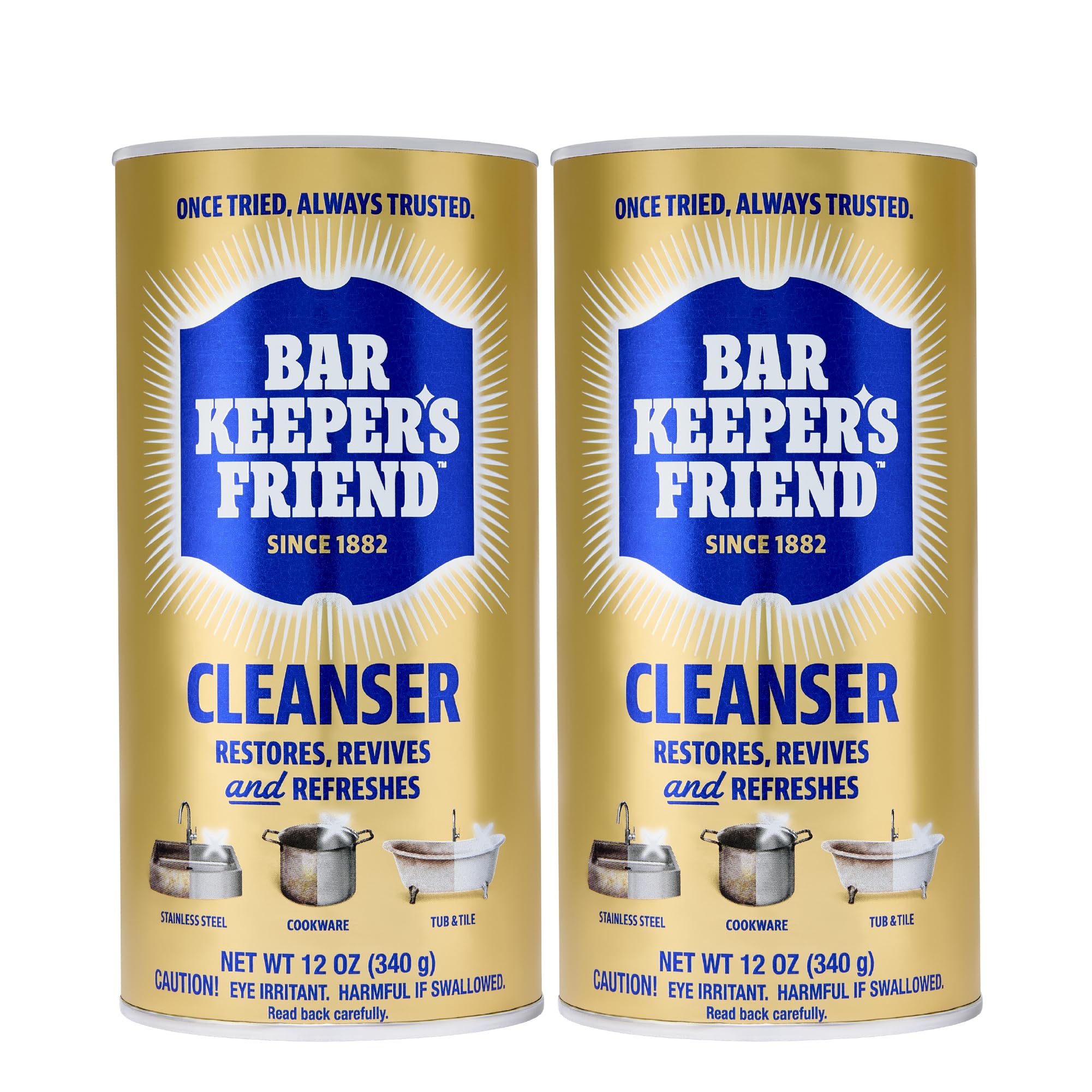
Bar Keepers Friend Powder
Key Features
- Form: Powder, 12 oz, 2-pack
- Scent: Unscented
- Removes: Rust, hard water, burnt-on grease
- Also for: Copper, ceramic, porcelain, glass
- Price: Midrange
A pan that has gone black across the middle after a forgotten sear is a different problem from a smudged door, and this is the product here that solves it. Dampen the pan, shake on the powder, work it into a paste with a cloth, and the burnt ring lifts with less scrubbing than we expected. It is the only pick in this group that earns its place by what it removes rather than what it leaves behind.
The same powder handles the stainless problems people give up on: rust blooms around a sink drain, hard-water rings in the bowl, the brown scorch on the outside of a pan, soap scum on a tile surround. It is unscented, which matters in a small kitchen with the window shut, and a shake or two does a pan, so the two tubs last a long time.
What it is not is an appliance polish. This is an abrasive, and working it into a brushed door is how you end up with a dull patch that no amount of buffing brings back. Keep it for the sink, the cooktop, and the inside of pots, and rinse well afterward, because powder left to dry leaves a film of its own.
Pros
- Lifts burnt-on food and scorch marks
- Removes rust and hard-water rings
- Unscented, with no fumes
- Two tubs go a long way
Cons
- Abrasive enough to dull brushed appliance panels
When the mess is carbonized rather than smudged, this is the can we reach for: cookware, sinks, and hard-water rings, never the fridge door.
Best for Quick Wipe-Downs
Sprayway Water-Based Cleaner
Key Features
- Drips: Won’t drip
- Volume: 15 fl oz
- Formula: Water-based foam
- Also for: Chrome, trim, kick plates
- Price: Budget
Sprayway’s water-based can is a simple product with a short list of claims, and that is part of the appeal. It foams on contact, it will not drip, it promises no streaks, and the label sends you from appliance doors to window frames, trim, and kick plates. There is no rinse step, which matters on a vertical surface where anything runny ends up on the floor instead of the steel. It is also the least expensive can in this group, and for something you reach for weekly that is most of the argument.
The foam is the useful part. It sits where it lands, so a fridge door can be worked top to bottom without runoff reaching the floor, and fingerprints and light kitchen grease come off in one pass. We kept the can under the sink for touch-ups between deeper cleans, and it did everything we asked of a routine spray: quick, even, and gone, leaving clean steel and no film behind. It has no abrasive in it, so a scorched ring or a baked-on splatter is somebody else’s job.
Pros
- No-drip foam stays where it is sprayed
- No rinse and no streaks
- Least expensive spray here
Cons
- No grit for burnt-on or baked-on soil
The cheapest way into the job: a no-drip foam for fingerprints and light grease, with nothing to rinse and nothing to buff out.
Best for Sinks and Hoods
Bar Keepers Friend Liquid
Key Features
- Form: Liquid, 13 oz, 2-pack
- Formula: Micro-abrasive, bleach-free
- Also for: Ceramic, copper, tile, glass
- Contains: Oxalic acid
- Price: Midrange
Same brand, same approach, different physics. Where the powder wants a damp surface and some pressure, the liquid arrives as a soft cream that stays where you put it, which is what makes it useful on a sink wall, a range hood, or the back panel of a cooktop, where anything runny ends up on the floor before it works.
It is a micro-abrasive with oxalic acid, bleach-free, and it does the everyday version of what the powder does on the hard jobs: water spots, mineral film, the dull grey that collects in a sink bowl. There is no dust and no mixing, and it rinses clean rather than leaving the chalky residue a powder can. On a stainless sink with a hard-water ring, a short dwell and a wipe handled it without any scrubbing.
This is the one we keep filled for sinks and hoods, and the powder stays in the cupboard for pans. The thing to respect is the acid: oxalic acid is unfriendly to bare hands, so wear gloves, and rinse until the water runs clear rather than wiping it dry.
Pros
- Clings to vertical surfaces without running
- No dust or mixing, unlike a powder
- Rinses clean on sinks and cooktops
Cons
- Abrasive enough to mark a polished appliance front
Sinks, cooktops, and the hood above them are where this version earns its keep; it stays where you spray and rinses without a film.
Best for Fingerprint Protection
Magic Stainless Steel Cleaner
Key Features
- Volume: 17 oz aerosol
- Coating: Transparent protective layer
- Also for: Aluminum and chrome
- Protects against: Dirt, dust, fingerprints
- Price: Midrange
Magic’s pitch is the most specific in this group: an aerosol that leaves a transparent protective coating behind, so the next handprint lands on the coating instead of the steel. The company calls it Stay Clean Technology, and the practical promise is a surface you wipe less often, which is the only kind of stainless protection that matters to anyone with children.
The difference between protected and greasy is how much you spray. A light coat buffed with a dry microfiber leaves a slick, even finish; a heavy one goes on thick and takes a long time to wipe down, and that is the version that convinces people the product is oily. Two short bursts per appliance section is plenty.
Over the following weeks the stainless we treated stayed presentable between proper cleans. Prints still landed, but they came off with a dry cloth rather than a fresh wipe, which is the entire point of a coating. The shine is good too: deep and slightly glossy rather than the flat clean a water-based spray leaves.
For a house where the fridge door doubles as a noticeboard, this is the can we hand over. It asks more of you than a water-based spray, a light hand and a proper buff, and repays that with a surface that holds its looks longer. If you want a product that goes on and disappears, this is the wrong pick; the trade here is a film you have to learn to apply thinly.
Pros
- Protective coating slows fingerprint buildup
- Prints wipe off with a dry cloth between cleans
- Also works on aluminum and chrome
- Deep, slightly glossy shine
Cons
- Spray nozzle can work loose from the can
If fingerprints reappear faster than you can wipe them, try this one: a protective coat that buys quiet days between cleans.
Best for Cookware Shine
All-Clad Stainless Cleaner

Key Features
- Form: Powder, 12 oz
- Safe on: Brushed and polished exteriors
- Keep off: Hard-anodized, copper, nonstick
- Made with: Natural minerals
- Price: Budget
The most useful thing on this label is the list of what it will not touch: hard-anodized aluminum, copper, nonstick. That is a narrower brief than the Bar Keepers Friend powder, and it tells you what the product is, a polish for the outside of stainless cookware, brushed or polished, rather than a cleaner for whatever else is in the cupboard.
Used as intended, it does the job a cookware polish should. Mixed to a paste with a little water, it takes the rainbow heat discoloration and the cooked-on film off a pan exterior and leaves a brushed surface looking even again. It is made of natural minerals and arrives in a press-close tub that keeps the powder dry, which sounds trivial until you have fought with a cardboard canister that has absorbed a kitchen’s worth of steam.
We keep it as the specialist: the tub that comes out when someone wants a pan’s outside to look like it did on the day it was unboxed. What holds it back is the price for the size, since the Bar Keepers Friend powder costs less and gives you twice the volume. For a sink full of hard-water rings it is the wrong tool; for the pan you spent real money on, it is the one that will not cost you the finish.
Pros
- Gentle on brushed and polished exteriors
- Lifts heat discoloration from pan exteriors
- Press-close tub keeps powder dry
Cons
- Not for hard-anodized, copper, or nonstick
- Small tub for the price
A cookware specialist for stainless pans you want looking new again, provided you read the not-for list before you start.
Best for Pots and Sinks
Cameo Aluminum & Stainless

Key Features
- Pack: Two 10 oz cans
- Purpose: Clean and polish
- Also for: Chrome
- Surfaces: Aluminum and stainless
- Price: Budget
Cameo’s remit runs wider than the keyword. It is a powder for aluminum and chrome as well as stainless, and we like it for households where the same shelf holds an aluminum baking sheet, a stainless sauté pan, and a chrome kettle. Mixed to a paste with water, it works as a polish rather than a spray, so it suits a sink bowl and a stockpot better than a fridge door.
On pots and sinks it does what the label promises. The shine comes back, water spots lift, and a stained sink bowl looks markedly better after a few minutes of work. It is gritty, though, and grit like that can leave fine scratches on a polished surface if you bear down, so a brushed appliance panel is not the place for it and neither is anything with a mirror finish. Work it thin with water, rinse thoroughly, and save it for the metals it was built for. Two tubs make it easy to keep one under the sink, and the shine it puts back on a tired saucepan is why it stays there.
Pros
- Cleans aluminum, chrome, and stainless
- Restores shine to pots and sinks
- Two tubs per order
Cons
- Gritty powder can scratch polished surfaces
- Takes real scrubbing on set-in stains
A good tub to have if your kitchen mixes aluminum and stainless, as long as you keep the grit off polished appliance fronts.
How We Tested 14 Stainless Steel Cleaners
The shortlist came from a fairly plain process. I read formulation and use claims across sprays, foams, creams, polishes, and pretreated wipes, dropped anything that duplicated another product’s formula, and set aside the ones priced like a specialty purchase rather than an everyday restock. What survived was 14 cleaners that went through four months of ordinary kitchen life.
Testing happened where stainless steel actually lives: refrigerator doors, a range hood that collects real grease, a dishwasher panel, and the microwave. On a Saturday deep clean I let fingerprints and splatter build up on purpose, then timed each cleaner from first spray to fully wiped and counted how many passes it took to clear cooked-on grease off the hood. The daily test was the after-dinner wipe-down, done the way you’d do it, followed by a look at the finish on a tilt in window light to see what film or streaks were left behind.
Shine and appearance got their own pass, since several products looked fine straight on and went cloudy at an angle. For scratching, I used every cleaner on both a brushed door and a polished trim piece, then ran a flashlight across the surface to catch new fine marks. I also tracked how many appliances each can or bottle covered before it ran out, whether the nozzle clogged or spat, and how much buffing each one demanded — the gap between a thirty-second wipe and two minutes of scrubbing is the whole ballgame on a weeknight.
How to Choose a Stainless Steel Cleaner
The most useful decision you can make is which surface you are cleaning: appliance doors want a wipe or a foam, while pans and sink bowls want something with grit.
Start with the surface, not the label
Stainless in a kitchen is really two materials. A brushed fridge door is a cosmetic panel that shows every smear, while a pan or a sink bowl takes actual soil: carbonized food, rust spots, hard-water rings. A water-based spray or a pre-moistened wipe is built for the first job. A powder or a cream is built for the second.
The trap is trying to buy one product for both. An abrasive powder worked into a brushed door leaves a dull patch that no polish brings back, and a spray will not touch a scorched pan however long you let it sit. Two products used in their own lanes cost less than replacing a panel, and it takes less cupboard space than people expect.
Decide whether you want a film
The other fork is whether the product leaves anything behind. Water-based foams clean and vanish, which is what you want on a door touched mostly by clean hands. Oil-based aerosols and coconut-oil formulas leave a thin coating that slows fingerprints down; that is the reason to buy them and also the reason to use less than feels right. A heavy coat goes on greasy and takes a lot of buffing to even out.
If anyone in the house is sensitive to perfume, judge the scent before committing to a whole kitchen’s worth. The aerosols here range from nearly neutral to distinctly perfumed, and a scent you dislike on a cloth is worse on a surface you stand next to.
Wipes, foams, creams, powders
Form decides whether the product gets used at all. A canister of wipes lives in a cupboard and comes out for a thirty-second pass, which is why we think it is the right format for appliance exteriors. A spray can is a little cheaper and a little more effort. Creams and powders sit at the other end: they want a damp surface, some pressure, and a rinse, and they are the only thing that works on burnt-on or rust.
In between sits a liquid cream that clings to a vertical surface. That is worth having for sink walls and range hoods, where a runny product ends up on the floor before it has done anything.
Read the not-for list
Every powder and cream here names surfaces it will damage, and those lines matter more than the marketing above them. Hard-anodized aluminum, copper, and nonstick are the usual exclusions, and black stainless is worth checking specifically, because not every powder or cream is cleared for it.
Find the finish of the thing you most want to clean and match it against the label before you order. If the label does not name that finish, test a patch where nobody looks, such as behind a handle or under a sink rim, before you work across a whole door.
Frequently Asked Questions
Can I just use dish soap and water instead?
For grease, yes. A drop of dish soap in warm water lifts kitchen film off stainless as well as anything else does. What it does not do is finish the surface: soapy water air-dries into a haze, and there is nothing in it to slow the next round of fingerprints.
If you are happy buffing the door dry with a microfiber every time, soap is enough. If you want the shine to hold between cleans, that is the step a dedicated stainless product adds.
Why do I keep getting streaks?
Almost always too much product plus air-drying. Use less than feels right, wipe along the grain, meaning the direction the brushed lines run, and finish with a clean, dry microfiber instead of letting the steel dry on its own.
On a vertical door, work top to bottom in overlapping passes so any runoff lands on steel you have already done. That second dry buff takes seconds and is what removes the last of the haze.
Is it safe to use these on pots and sinks I cook and wash in?
The powders and creams are made for exactly that, as long as you rinse. Work them into the pan or sink, scrub, then rinse with plenty of water until the surface runs clear, because residue left to dry is what dulls a sink bowl and can leave a taste in a pot.
Wear gloves with oxalic-acid products such as Bar Keepers Friend, and keep the pre-moistened wipes and aerosols for exterior panels rather than food-contact surfaces.
Final Verdict
For most kitchens the answer is Weiman’s wipes. Not because a wipe is the most powerful thing here, but because it is the one that gets used: one pass, one dry buff, safe on every finish including black stainless, with nothing to rinse. On an appliance door, frequency beats power every time.
Where the mess is carbonized, buy the Bar Keepers Friend powder instead, and add the liquid cream if your sinks and hood do most of the showing. If fingerprints are the entire problem, Therapy’s refill and Magic’s aerosol both leave a film that slows them down; pick between them on how much polish you get through in a year.