This post contains affiliate links. We may earn a small commission when you buy through our links — at no extra cost to you.
A mandoline has scared me exactly twice: the first time I watched a potato turn into paper-thin rounds in under a minute, and the first time my thumb got within an inch of the blade while doing it. That’s the bargain this tool offers, and it’s why the good ones are worth hunting for. What a mandoline actually fixes is prep — the cabbage for slaw, the potatoes for a gratin, the cucumbers that need to be identical — finished in minutes instead of half an hour, and even enough to look like the photo.
Over the past six months my team and I have cooked with 10 of them, folding plastic models and heavy stainless ones alike, and the gaps between them show up fast. The thing nobody tells a first-time buyer is that the hand guard matters as much as the blade: if it’s fiddly to snap on, you’ll skip it, and that’s how people end up in the ER on a Sunday night. A slicer that makes you lift the blade out to change thickness is one you’ll leave in the cabinet. Below are the ones that earned the drawer space.




Best for Everyday Adjustable Slicing
Mueller 5-Blade Mandoline
Key Features
- Setup: Folding legs, free-standing
- Blades: 5, with storage case
- Cleaning: Hand wash only
- Thickness: 1–9 mm; julienne 6–9 mm
- Price: Midrange
Nine millimetres is a proper slice of potato; one millimetre is a cucumber you can see through. The Mueller moves between them with a quarter turn of a knob, and that dial is why it sits at the top of this list. Most mandolines here make you choose between three fixed settings or a blade swap, while this one dials in the thickness a recipe actually asks for. Five blades cover straight slicing, two julienne widths and a grater, and they live in a case rather than loose in a drawer where the edges get knocked about.
We used it on potatoes, onions, cucumbers and cabbage and kept coming back to it for one reason — it doesn’t move. The foot grips a damp counter, the legs unfold to stand the frame over a bowl or a board, and the food holder pinches a half onion without crushing it. Of the counter-top models here, this is the one that felt most like a tool and least like a gadget.
Two things to know before you buy. The dial has no thickness numbers beside it, so you learn the settings by eye and by counting clicks — mildly annoying, never a real problem. And the care guidance contradicts itself: one part says top-rack dishwasher safe, another says hand wash only. Treat it as hand wash; the blade carriage lifts out and rinses clean in less time than it takes to load a dishwasher anyway.
If you slice once a week and want it to be quick and even, this is the one. If the slicer has to disappear into a drawer between uses, the OXO is the better fit; if you want a design that keeps your hands away from the edge entirely, that’s the Dash. For the widest range of cuts with the least fuss, this is what we reach for.
Pros
- Continuous 1–9 mm dial beats fixed settings
- Folds to stand over a bowl or board
- Five blades stored in a case
- Strong record on ease of use and versatility
Cons
- Care guidance conflicts; treat as hand wash only
- Changing cut style means swapping blades
Our pick for most kitchens: the 1–9 mm dial and five blades handle everything from cucumber salad to potato gratin, and it stays put while you work.
Best for Small Kitchens
OXO Good Grips Handheld
Key Features
- Type: Handheld
- Cleaning: Dishwasher safe
- Placement: Board, plate or bowl rim
- Thickness settings: 1 mm, 2.5 mm, 4 mm
- Price: Budget
Of everything here, this is the one we hand to people who have never used a mandoline. It’s just under a foot long, slim enough for a utensil drawer, and there’s nothing to assemble: three settings at 1 mm, 2.5 mm and 4 mm, a large non-slip handle, and a small window in the deck so you can see how much you’ve sliced before it slides off the end.
The handle is the good bit. It hooks over the rim of a bowl, so cucumber goes straight into the salad and the counter stays clear, and on a board it sits at an angle that keeps the blade away from your knuckles. The food holder grips properly and the last slice is safe to finish, which isn’t true of every slicer in this guide.
The limits are real: this is a narrow deck, so a big onion has to be halved before it fits — a small extra cut you notice every single time. Neither does it help that 4 mm is as thick as it goes, which rules out thick-cut chips and sturdy slaws. Neither matters if your usual jobs are cucumbers, radishes, apples and onions for a salad. It’s dishwasher safe, and that’s the difference between using it on a Tuesday and saving it for weekends.
Pros
- Hooks over a bowl or sits on a board
- Window shows how much you’ve sliced
- Dishwasher safe and drawer-sized
Cons
- Topped out at 4 mm, so no thick slices
Buy this if you want a mandoline that lives in a drawer and comes out daily — it’s the simplest handheld here, as long as you’re not slicing huge onions.
Best for First Mandoline
Fullstar Pro 6-in-1
Key Features
- Blades: 6 interchangeable
- Safety: Glove and finger guard
- Cleaning: Top-rack dishwasher safe
- Catch container: 5 cups
- Price: Budget
Six blades, a five-cup catch container, a cleaning brush and a cut-resistant glove, all for roughly what the OXO handheld costs. That’s the Fullstar Pro’s pitch, and it’s a good one if you’re buying your first mandoline and don’t yet know what you’ll use it for.
The container is what makes it. Slices fall into the cup instead of spreading across the board, and the cup doubles as the case for the blades, so the whole thing travels to the sink in one piece. We didn’t expect to care about that and now we do. The glove is the other surprise: it actually fits, which is more than most included gloves manage, and it’s why we reach for this one with a pile of potatoes.
Precision is where it slips. The blade sits in a plastic frame with some give to it, so wafer-thin tomato slices are a gamble, and the six-inch blade leaves wide things like cabbage leaves hanging off the side. Buy it as a first mandoline, a gift, or the one that goes to a rental kitchen; when the slice itself is the point, step up to the Mueller.
Pros
- Catch cup doubles as blade storage
- Usable cut-resistant glove in the box
- Six blades cover slicing and grating
Cons
- Blades dull with steady use
- Six-inch blade is narrow for cabbage
The cheapest way to find out whether you’re a mandoline person: six blades, a catch cup and a glove, with cut quality that’s good rather than great.
Best for Hands-Clear Safety
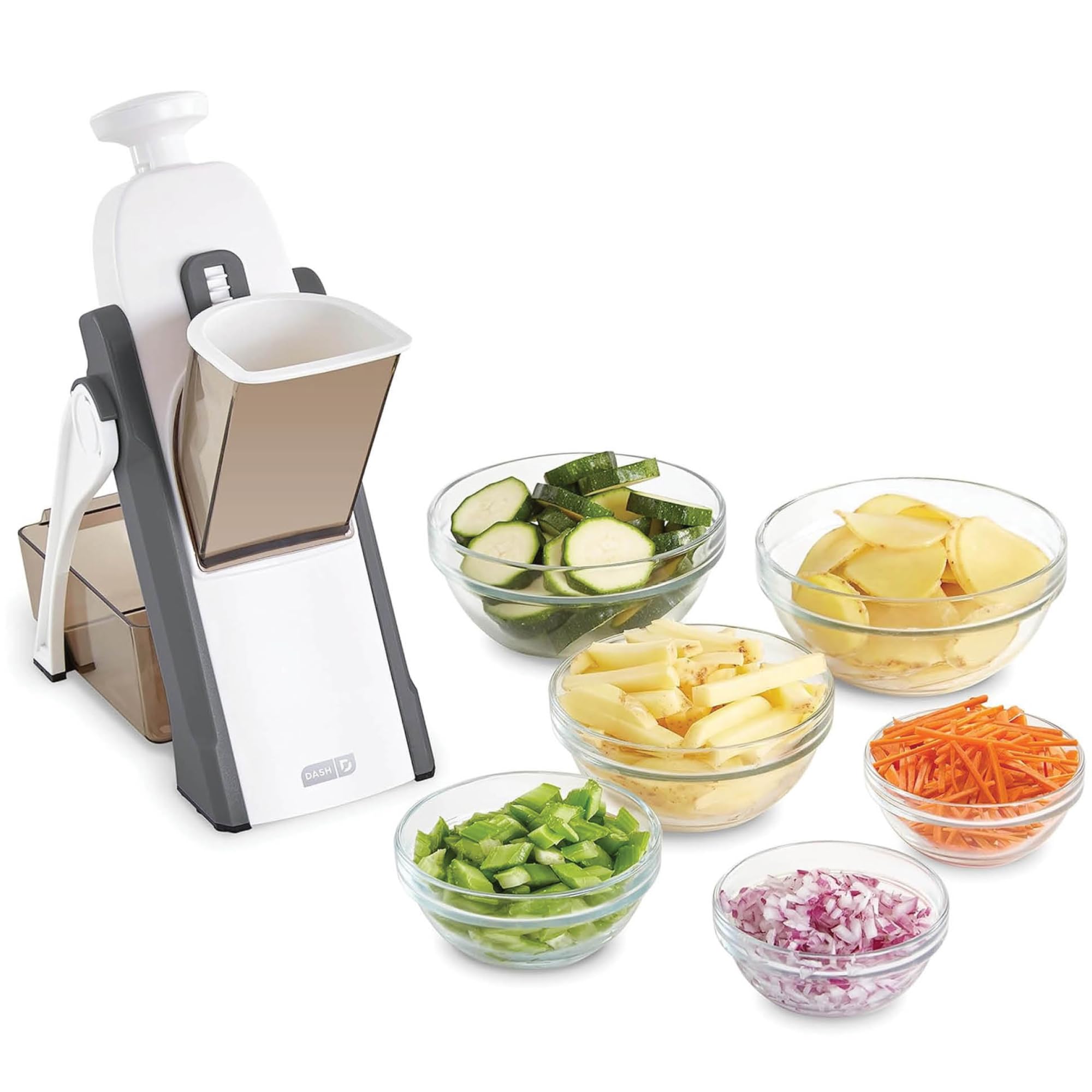
Dash Safe Slice
Key Features
- Cleaning: Hand wash only
- Cut options: 30+ presets
- Blade access: Enclosed chute
- Thickness range: 1–8 mm
- Price: Midrange
The Dash is the answer for anyone who has looked at an exposed mandoline blade and quietly decided to keep using a knife. There’s no blade to run a vegetable across: you load the chute, press the handle, and the cutting happens underneath, out of reach of your fingers. We think that’s worth more than any single feature on the other models here.
The rest of the package is better than a safety-first design needs to be. Thickness runs from 1 mm to 8 mm, the same chute handles straight slices, julienne and matchsticks, and the whole thing folds flat enough to stand on its edge in a cupboard. Speed is decent, too — you’re pushing a lever rather than sawing, and an onion takes seconds.
Dense vegetables are where it works you. Carrots and potatoes need real force through the chute, and a long carrot has to be cut down before it fits. Softer things go through cleanly, and that’s most of what a mandoline is for: cucumbers, zucchini, onions, peppers, apples.
Then there’s the washing up. Food packs into the chute and the slots around the blade, so it’s a brush job rather than a rinse. Rinse it before anything dries and the included brush does the rest; leave it in the sink overnight and you’ll be picking bits out with a skewer.
Pros
- Hands never touch the blade
- 1–8 mm with 30-plus cut presets
- Folds flat for cupboard storage
Cons
- Food lodges in the chute and blade slots
- Hand wash only, with no dishwasher cycle
We recommend it to anyone who has ever flinched at a mandoline: your hands never go near the blade, and the 30-plus cut options are a genuine bonus.
Best for Paper-Thin Slices
Benriner Japanese Mandolin
Key Features
- Blades: 3 julienne inserts
- Cleaning: Hand wash only
- Thickness: Adjustable up to 0.63 cm
- Dimensions: 12.25"L x 3.5"W x 1.25"H
- Price: Midrange
No handle, no container, no glove, no rubber foot: the Benriner is a plastic frame, a very sharp blade and a pair of screws, and it makes the thinnest, most even slices of anything in this guide. Restaurant kitchens keep them in a drawer for exactly that reason — nothing sits between the vegetable and the edge.
Thickness is set by a screw at each end, up to about 0.63 cm, and three interchangeable blades produce fine, medium and coarse julienne. The screws are the part to understand: get one end tighter than the other and your slices taper. Set it level once and it holds, and the blade lifts out for washing.
Everything else is on you. There’s no non-slip base, so it walks across a dry counter unless you stand it on a damp towel or bridge it over a bowl, and the last inch of a cucumber is yours to manage carefully. We kept it anyway, because the cut is that good — it’s a second mandoline at most, or a first one for someone careful by nature.
Storage is the quiet win. At 12.25 inches by 3.5, it slides in beside the chopping boards and takes up less room than any counter-top model here. For paper-thin radishes, cucumber for pickles, or anything that needs to look like a restaurant plate, we haven’t used anything here that cuts thinner.
Pros
- Thinnest, most even slices in this set
- Screws set any thickness you like
- Slides into a drawer beside boards
Cons
- No hand guard in the box
- Hand wash only
For paper-thin, restaurant-even slices there’s nothing sharper here — but it’s a tool for careful cooks, not a beginner’s first slicer.
Best for Big-Batch Prep
ONCE FOR ALL Safe Mandoline Plus
Key Features
- Storage: Collapses flat
- Cleaning: Dishwasher safe
- Cut modes: Slice, julienne, matchstick, dice
- Thickness range: 0.1–8 mm
- Price: Premium
The feed port is the reason to pay for this one. It’s wide enough to take a whole peeled potato or a quartered cabbage without trimming first, and the handle presses the vegetable down onto a hidden blade, so nothing sharp is ever pointed at your hand.
It’s also the most complete chute slicer here: four modes covering straight slices, julienne, matchstick and dice, a dial from 0.1 mm to 8 mm, a catch container underneath, and a frame that collapses flat with the blade still inside. It’s dishwasher safe — the Dash isn’t — and the two-year warranty is the longest in this guide.
Two things to know. The dice mode is a bonus rather than a reason to buy: it works, but it’s the fussiest setting and not what this tool is best at. And the container and the slicer holder are the parts to be gentle with; they’re plastic, and they take the strain when you press hard.
We liked it most for big jobs: a tray of potatoes for gratin, a pile of onions, a week of lunches at once. For a single cucumber it’s more machine than the job needs, and rinsing the chute takes longer than the OXO takes for the whole vegetable. If your prep is large and occasional, this is the best of the chute models; if it’s small and daily, it isn’t.
Pros
- Generous feed port takes whole vegetables
- Dishwasher safe, unlike most chute slicers
- Four cut modes with a 0.1–8 mm dial
Cons
- Container and slicer holder are the fragile parts
Worth the premium if you prep in bulk: a wide feed, four cut modes, a hidden blade and dishwasher cleanup add up to the least painful way to process a pile of vegetables.
Best for Budget Hidden-Blade Safety
SupMaKin Safe Mandoline

Key Features
- Cleaning: Dishwasher safe
- Feed port: 3 inches
- Blade access: Built-in, hidden
- Thickness range: 0.1–8 mm
- Price: Midrange
Take the chute-and-handle idea, strip out the extras, and you get the SupMaKin: a hidden blade, a push handle, a dial running from 0.1 mm to 8 mm, a catch container and a cleaning brush. On paper the specification sits very close to machines that cost noticeably more, and it folds flat for storage.
What we can tell you is what the build promises: an ABS body with stainless blades, a three-inch feed port, and a pound and a half of weight that moves easily with one hand. It’s dishwasher safe, which is rarer in this style than it should be, and the two-year warranty is generous at this price. That’s a sensible package for a tool you use in short bursts.
The three-inch port is the catch. It’s plenty for cucumbers, zucchini, onions and apples; a big potato or a head of cabbage has to be cut down first, which puts it in the same territory as a handheld for the chunkiest jobs. We think that’s an easy trade for anyone who wants hidden-blade safety and a dishwasher cycle, and a reason to look at the ONCE FOR ALL if you prep whole potatoes by the tray.
Pros
- Hidden blade and a push-down handle
- Dishwasher safe and folds flat
- Two-year warranty
Cons
- Three-inch port limits whole potatoes and cabbage
A sensible, safe slicer at a fair price; just check that a three-inch feed port suits the vegetables you actually cut.
Best for Mess-Free Counter Prep
Fullstar Safer Mandoline

Key Features
- Cuts: Slice, julienne, dice
- Safety: Chute, pusher, hand guard
- Cleaning: Top-rack dishwasher safe
- Thickness range: 1–8 mm
- Price: Midrange
The container is the whole idea here. Slices drop into a lidded tub that goes straight into the fridge or next to the pan, and the frame sits over it so nothing ends up spread across the counter. If your objection to mandolines is the mess, this one answers it directly.
It’s a chute slicer like the Dash, with a pusher and a hand guard, thickness from 1 mm to 8 mm, and straight, thin or thick julienne and diced cuts. The parts that touch food lift out and go in the top rack, and the folded stand locks so it stores on its side.
Where it gives ground is solidity. The folding stand has some flex, and leaning on the pusher makes the whole rig shift rather than bite. That’s fine for a family’s worth of prep in one go and less pleasant if you’re slicing for hours, which is not what this one is for.
Set against the Fullstar Pro, this one contains the mess better and feels less rigid, and it costs more. Our call: buy it if clean counters are what stop you using a mandoline at all; buy the Pro if you want the cheapest way to find out whether you’ll use one; buy the Mueller if you want the dial and the steadier frame.
Pros
- Catch container keeps the counter clear
- Chute, pusher and hand guard included
- Slice, julienne and dice from one dial
Cons
- Plastic frame is the first thing to show wear
- Strong-coloured vegetables can stain the frame
The catch container makes this the tidiest slicer here; pick it for mess-free prep and accept that the plastic won’t take the same abuse as the metal-framed models.
How We Tested the Mandoline Slicers
We started by rounding up every mandoline we could find that included a hand guard and some form of thickness adjustment, then trimmed the list by blade material, footprint, and whether replacement blades were sold separately. Ten slicers made the final cut, and we cooked with them for six months.
Most of that time was Sunday prep. We sliced potatoes for gratin, cucumbers and radishes for salads, cabbage for slaw, onions, apples, and the occasional block of cheese, counting how many pieces each blade got through before it started dragging instead of gliding. We measured real slice thickness with calipers on three settings per slicer and noted whether the adjustment moved in useful increments or jumped straight from thick to translucent.
Ease of use came down to seconds: we timed setup from box to first slice, then tried the hand guard on a wet potato half and a soft tomato to see whether it gripped or spun. After each session we washed everything by hand and looked for food trapped between blade and platform, water pooling inside the pusher, and juice stains on plastic that wouldn’t rinse off. Slicers claiming dishwasher safety went through a full cycle, and we checked afterward for warped frames, stiff hinges, and blades that had lost their edge.
Versatility and value came last. We ran the julienne and matchstick inserts, set the folding legs up on a crowded cutting board to see how much counter they really needed, and asked whether the extra blades were genuinely usable or just padding the box. A slicer only earns its space if you reach for it on a Tuesday, not just for holiday cooking.
How to Choose a Mandoline Slicer
Every slicer here will get through a cucumber; the decision is really about how the vegetable reaches the blade, how you change thickness, and how much of your evening the washing up takes.
Handheld or counter-top, decided by where it lives
A handheld like the OXO is under a foot of plastic that lives in a drawer and hooks over a bowl. It’s the right answer if you slice a cucumber or an onion most days and resent giving up counter space. A counter-top model with folding legs and a catch container suits batch work — a tray of potatoes for gratin, a pile of onions — and generally takes a wider deck, which is what lets a whole onion through in one piece.
Buy for the job you do most weeks, not the one you imagine. If a slicer has to be assembled and found a home before it can be used, it stays in the cupboard.
How you change thickness matters more than the range
Three fixed settings, a continuous dial, or a screw at each end of the blade are genuinely different tools day to day. Fixed settings are the fastest to use and the least flexible: 1, 2.5 and 4 mm covers salads and gratins, and nothing thicker than a potato chip. A dial running from 1 mm to 9 mm lets you match a recipe exactly, which earns its keep if you bake, fry or pickle.
Screws, as on the Benriner, give you any thickness you like but ask you to level both ends by eye — get one side tighter and the slices taper.
Safety is a design choice, not an accessory
Any mandoline can cut you; the question is how much blade you can reach. A chute model — Dash, ONCE FOR ALL, SupMaKin, Fullstar Safer — keeps the blade enclosed and your hand on a handle, and that is the design to choose if you have cut yourself before or cook with children in the room. An open deck with a food holder is faster and more precise, but it depends on you using the holder every time, including for the last inch.
Cleaning, storage and the width trap
Food lodges around the blade and inside chutes, and a tool that needs twenty minutes at the sink stops getting used. Top-rack dishwasher-safe parts are worth paying for; the Dash and the Benriner are hand wash only, so weigh that against how often you cook.
Watch the width claim. Compact usually means it fits a drawer, not that it takes a whole cabbage, and a three-inch feed port means halving potatoes before they fit.
Frequently Asked Questions
Can a mandoline replace a food processor?
No. A processor chops, purées and mixes; a mandoline does one thing — even slices at a consistent thickness — and does it faster and more cleanly than a blade in a bowl. If most of your prep is diced onion for a sauce, a knife or a chopper is quicker than assembling and washing a slicer.
Keep both if you have the room. If you don’t, buy the mandoline only if slicing is what you actually do most nights.
Do mandolines work on tomatoes and other soft produce?
Yes, but only with a genuinely sharp blade and one firm stroke. A dull edge skates and squashes rather than cutting. Test yours on a ripe tomato: if the skin tears instead of parting cleanly, the blade is done, and pressing harder makes it worse rather than better.
Firm fruit like apples and pears are easy on any of these. Bread and soft cheese are not worth the cleanup.
Do I need to buy a cut-resistant glove separately?
It depends on the model. Both Fullstar slicers include a cut-resistant glove, and the chute designs — Dash, ONCE FOR ALL, SupMaKin — keep your fingers out of reach by design. The open-deck models (OXO, Benriner, Mueller) rely on the food holder or pusher in the box.
If yours doesn’t come with a glove, buy one. It is the cheapest safety upgrade in the kitchen and it makes the last inch of an onion a non-event.
Final Verdict
The Mueller is the mandoline we point most people to. The 1–9 mm dial covers everything from a see-through cucumber to a proper potato slice, five blades handle julienne and grating, and the frame stays where you put it — which is more than several slicers here manage.
If you want one that lives in a drawer, get the OXO; if the blade itself is what stops you, get the Dash. Neither is a compromise on the job, only on the volume you can do in one sitting.