This post contains affiliate links. We may earn a small commission when you buy through our links — at no extra cost to you.
Every manual apple peeler promises to turn a bushel of apples into pie-ready spirals in seconds. But ask anyone who’s used one for more than a single pie, and the conversation quickly shifts to the base: suction cups that lose grip halfway through a batch, clamps that require a perfect counter edge, or plastic bodies that wobble under pressure.
The real divide in this category isn’t speed or slicing consistency — it’s how the device stays put. Suction-based models are easy to set up but demand smooth, clean countertops and occasional re-seating. Clamp-based models offer rock-solid stability but only fit counters with a flat overhang at least 1.5 inches thick.
This guide focuses on the one choice that matters most: matching the attachment method to your kitchen surface and how often you work with apples. Get that right, and the rest falls into place.



Best for Home Bakers, Families
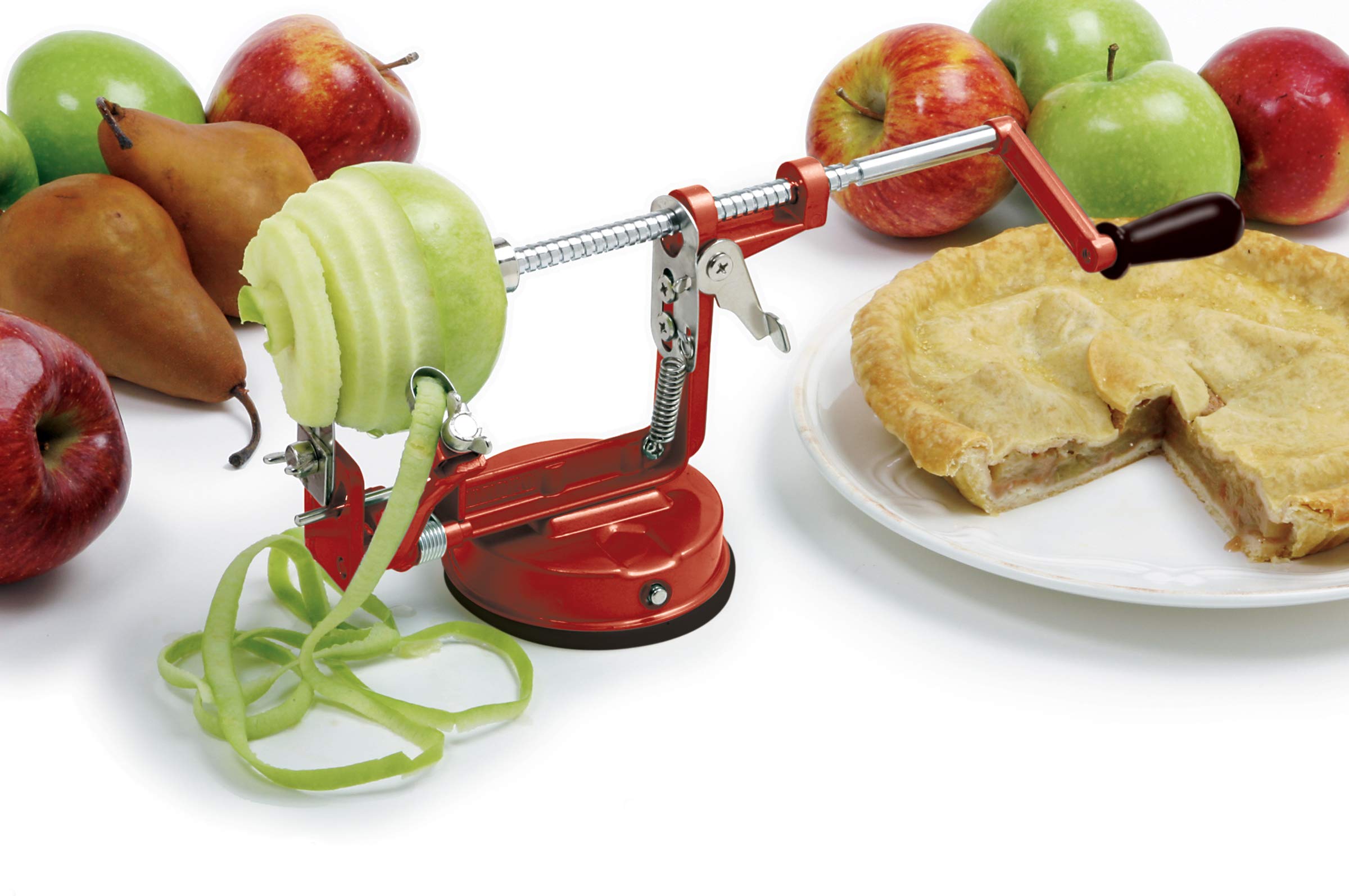
tigwin Apple Peeler Corer
Key Features
- Material: Chrome Cast Magnesium Alloy
- Base Type: Suction Cup
- Operation: Manual
- Blade Material: Stainless Steel
- Price: $
The tigwin Apple Peeler Corer is built around the classic manual crank setup: mount the apple, turn the handle, and let the blade, corer, and slicer work together. Its strongest appeal is speed. For pie filling, applesauce, dehydrated apple rings, or kid-friendly snacks, it cuts down repetitive knife work without moving into electric-appliance pricing.
The chrome cast magnesium alloy body gives it a sturdier feel than plastic-heavy budget peelers, and the stainless steel blades handle the core slicing task cleanly when the fruit is reasonably firm and centered. The manual operation also keeps the learning curve low; once the apple is aligned, the process is more about steady cranking than hand skill.
This is the better fit for home bakers, families, and first-time buyers who want a combined apple peeler, corer, and slicer without spending much. The main boundary is the suction base: it works best on smooth, non-porous counters and may weaken over time on textured surfaces. If your counter has an accessible edge and stability matters more than convenience, a clamp-based model is the better comparison.
Pros
- Processes apples quickly for pies, sauce, snacks, or dehydrating batches.
- Easy crank operation suits beginners, seniors, and supervised kids.
- Metal construction gives it a sturdier feel than plastic-heavy budget options.
- Slices and cores evenly when apples are firm and centered.
Cons
- Textured counters may reduce suction hold, so the base needs a smooth work surface.
- Oddly shaped or soft apples can leave strips of peel behind.
The tigwin is the default manual apple peeler/corer/slicer for budget-conscious kitchens that prep apples in batches. Choose a clamp model instead if your counter surface gives suction bases little to grip.
Best for Frequent Bakers, Canners
Johnny Apple Peeler
Key Features
- Material: Cast Iron
- Base Type: Clamp (up to 1-5/8")
- Operation: Manual
- Blade Material: Stainless Steel
- Price: $$
The Johnny Apple Peeler’s cast iron body and clamp base remove the guesswork of suction pads — it stays put on any counter edge up to 1-5/8 inches thick. The tradeoff is that the clamp may loosen during use, especially on irregular or slippery surfaces, and needs a quick re-tighten now and then.
This design suits bakers who process apples by the bushel and have a counter with a flat overhang. The sturdy build handles consistent use, but occasional clamp adjustment is part of the routine. Those without a suitable clamping edge should look to suction-based models.
Pros
- Cleans up apple peeling and coring in one crank; produces consistent slices.
- Cast iron construction gives a heavy, non-slip platform that doesn’t rely on suction.
- Quick to set up and operate, making short work of large batches.
Cons
- Clamp may loosen on some counter edges and require retightening during a session.
- Prongs or peeling arm can break under heavy use, though most units hold up fine.
A solid clamp-based option for those with the right counter edge; occasional clamp tightening is a small price for suction-free stability.
Best for Budget Buyers, Occasional
femedo Apple Peeler
Key Features
- Material: Ultra-Strong Die Cast Alloy
- Base Type: Suction Cup
- Operation: Manual
- Blade Material: 304 Stainless Steel
- Price: $
The femedo peeler costs around $21, making it a low-risk option for anyone who peels apples a few times a year. Its metal build and stainless steel blades deliver quick results on small to medium apples, and the crank mechanism is simple to operate. Batch processing speeds up noticeably compared to hand-peeling.
This model suits cooks with smooth countertops who don’t mind checking the suction base occasionally during a session. The peeling blade can sometimes gouge irregular fruit, so it’s best for uniform apples. If you need a tool for heavy weekly baking or unpredictable surfaces, a clamp-based peeler or the top pick’s more consistent suction may be a better fit.
Pros
- Works efficiently, especially with small to medium apples
- Easy to use and quick to set up
- Significant time saver for batch processing
Cons
- On smooth countertops the suction cup may need occasional re-seating during use
- Peeling blade can gouge the fruit when apples are irregular in shape
For the occasional baker or someone making a few pies a year, the femedo gets the job done without a big investment — just be ready to check the suction and peel quality as you go.
Best for Spare Blade Collectors
ACOTUM Peeler 7 Blades
Key Features
- Material: Die Cast Alloy
- Base Type: Suction Cup
- Operation: Manual
- Blade Material: Stainless Steel
- Price: $$
Where the top pick earns its place with sheer review volume and consistent performance, the ACOTUM stakes its claim on generous accessories: seven total blades—more than the typical two or three—and a lifetime warranty that removes long-term risk. The die-cast alloy body is sturdy enough for kitchen tasks, and cleaning is straightforward with a quick rinse. Blade changes are tool-free, so you can swap a dull peeler without delay.
This suits light, occasional apple prep where you don’t mind spending a few minutes dialing in the peeling blade. The suction base can be less dependable on textured surfaces, and the adjustment mechanism sometimes needs finesse to track evenly. Buyers who value warranty assurance and spare blades over a polish-it-and-forget-it experience will find the tradeoff acceptable. Those planning weekly bushels of apples should look to a clamp-based alternative.
Pros
- Peels and slices apples and potatoes cleanly once the blade is dialed in.
- Die-cast alloy construction feels solid for its price range.
- Quick to set up, operate, and rinse clean.
Cons
- Suction base may not grip securely on textured, porous, or less-than-perfect countertops.
- The handle or internal mechanism may break within the first few weeks of use, indicating inconsistent durability.
If you’re willing to trade a bit of out-of-box polish for spare blades and a safety-net warranty, this ACOTUM set makes sense for light-duty apple prep.
Best for Flexible Base Users
Norpro Apple Master
Key Features
- Material: Aluminum body
- Base Type: Vacuum base + clamp
- Operation: Manual
- Blade Material: Stainless Steel
- Price: $$
The Norpro Apple Master stands apart from most single-base peelers by including both a vacuum base and a clamp. This dual attachment system gives you options: use the suction cup on smooth, clean counters, or flip to the clamp when you have a counter edge and want extra hold. Performance with apples and potatoes is effective – the blade peels thinly, the coring prongs align well, and the slicing action is consistent for pie and canning prep.
This model suits home cooks who value flexibility over a one-size-fits-all base, and who mainly process moderate batches of fruit for baking or preserving. The tradeoff is that durability reports are mixed – some units may develop issues after repeated use, so this is better suited for frequent but not heavy daily volume. If you have a counter edge and prefer a fixed clamp that never weakens, the dedicated clamp-only model (the Johnny Apple Peeler alternative) offers more predictable stability.
Pros
- Dual base options (suction + clamp) handle both smooth counters and counter edges.
- Peeling is effective, with thin, even strips on apples and potatoes.
- Slicing and coring produce uniform results for canning or pie fillings.
Cons
- The device may shift during use on certain counter surfaces, especially with the suction base alone.
- Longevity can vary; some units may not hold up under moderate-volume use over time.
A capable mid-range choice if you need both attachment options, but be aware that durability consistency is a known variable – pair it with moderate, not daily-heavy, use.
Best for Metal Build, Moderate
Qyestad Apple Peeler
Key Features
- Material: Die Cast Aluminum Alloy
- Base Type: Suction Cup
- Operation: Manual
- Blade Material: Stainless Steel
- Price: $
The Qyestad Apple Peeler’s die-cast aluminum alloy body gives it a noticeably sturdier feel than many budget models. A lifetime warranty backs the metal construction, adding peace of mind for those who keep kitchen tools for years.
This peeler handles apples and pears effectively, with a manual crank that saves time over hand-peeling. The suction base, however, may lose its grip after a few uses—especially on textured countertops. Buyers who prepare fruit occasionally and don’t mind resetting the suction will find this a cost-conscious option. For heavy batch processing, a clamp-base model like the top pick avoids this adjustment.
Pros
- Works well on apples and pears – effective peeling and coring.
- Good build quality with metal construction.
- Easy to use and time-saving.
Cons
- Suction cup may stop holding after several uses.
Worth considering for budget shoppers who prioritize metal build over suction convenience.
Best for Occasional Bakers
Pautou 3-in-1 Peeler

Key Features
- Material: Die Cast Magnesium
- Base Type: Suction Cup
- Operation: Manual
- Blade Material: Stainless Steel
- Price: $
The Pautou 3-in-1 includes three spare blades, giving it an edge over similarly priced single-blade peelers. Its stainless steel blades and die cast magnesium body feel substantial for occasional apple prep. However, the suction cup may not hold securely on all countertops, requiring reapplication during use—a limitation shared with other budget suction-base models. Performance on apples is good for making applesauce or pies, but for frequent use the top pick’s more consistent suction is preferable.
Pros
- Three extra blades included for the price of a single-blade peeler
- Stainless steel blades and sturdy magnesium body hold up to occasional use
Cons
- Suction cup may lose grip on textured or uneven counters during operation
A good pick for occasional bakers who want spare blades and can work with a suction base that may need re-seating on less-smooth surfaces.
Best for Light Use, Budget
VEELAM Apple Peeler

Key Features
- Material: ABS + Stainless Steel
- Base Type: Suction Cups
- Operation: Manual
- Blade Material: Stainless Steel
- Price: $
The VEELAM Apple Peeler peels apples quickly when the suction base holds, and the included spare blades, slicer, and cutting board add convenience at a budget-friendly price. The prongs and build quality may not hold up to regular use, making this a better fit for occasional apple peeling rather than weekly baking sessions.
Pros
- Peels apples quickly and smoothly when suction holds
- Great value for the price with extra accessories
Cons
- Prongs may lose grip on larger apples after moderate use
A good match for someone who needs an inexpensive apple peeler for occasional baking or pie making, and values the extra accessories.
Best for Multi-Mode Users
tatida 5-in-1 Peeler

Key Features
- Material: Die Cast Alloy
- Base Type: Suction Cup
- Operation: Manual
- Blade Material: 304 Stainless Steel
- Price: $$
This 5-in-1 peeler offers peel-only, core-only, slice-only, and combination modes, making it more adaptable than many fixed-function models. The die-cast alloy body and stainless steel blades feel solid for its mid-range price. However, the suction base can lose grip on textured or uneven countertops, which may require a clamp backup for stability. Its track record is still short, so long-term durability under regular use is less certain than more established options. For occasional use on smooth surfaces, the multiple modes are a clear advantage.
Pros
- Peel, core, slice, or combine tasks with a single tool.
- Stainless steel blades and die-cast alloy body offer solid construction at a mid-range price.
Cons
- On textured or uneven countertops, the suction base may not hold as securely, affecting stability during use.
Ideal for occasional apple prep on smooth countertops when you need peel-only or core-only options.
Best for Brand Loyalists
Pampered Chef Peeler

Key Features
- Material: Alloy Steel
- Base Type: Clamp
- Operation: Manual
- Blade Material: Alloy Steel
- Price: $$$
The Pampered Chef peeler/corer/slicer has the sturdy feel you’d expect from the brand, and it handles apples efficiently out of the box. The catch is the price: it costs more than twice as much as models that do the same job, and some units may experience blade dulling or wear sooner than anticipated. This makes sense as a gift for brand loyalists or for kitchens where the brand name carries weight, but less so for anyone prioritizing value or long-term heavy use.
Pros
- Saves time on peeling and slicing when first used
- Solid, premium-feeling construction
Cons
- Blade dulling can occur sooner than expected in some units
- Premium price with no clear performance advantage over models costing half as much
Best suited for Pampered Chef brand loyalists or as a gift where the name matters — not for buyers seeking the best value.
Best for Infrequent Use
Dormercy Apple Peeler

Key Features
- Material: Plastic + Metal Blades
- Base Type: Suction Cups
- Operation: Manual
- Blade Material: Stainless Steel
- Price: $
For the rare occasion you need to peel a single apple, this budget-friendly peeler handles hard fruit without binding. The suction cups, however, require constant downward pressure to stay put, and some units show inconsistent fit of the fork assembly. Its build and anchoring make it unsuitable for any regular baking or prep work.
Pros
- Cuts through hard apples and pears without straining the arm.
- Priced low enough to replace without regret if it wears out.
Cons
- Suction base won’t hold on standard counter surfaces without manual pressure.
- Build quality varies between units; some arrive with loose parts.
Only fits the buyer who peels apples once a month and doesn’t mind holding the device in place.
Best for Thick Counters
Norpro Apple Mate 3

Key Features
- Material: Aluminum
- Base Type: Clamp (up to 2")
- Operation: Manual
- Blade Material: Stainless Steel
- Price: $$
The Norpro Apple Mate 3 peels and cores effectively when functioning, and its multiple attachments add flexibility for different prep styles. However, the tool can stop working after limited use, making it a gamble for anyone who needs consistent performance. Only consider this if your counter edge is thicker than what most clamp models accept, and you’re prepared for possible early breakdown.
Pros
- Peels and cores apples in a single pass.
- Includes attachments for peel-only, core-only, and combined modes.
Cons
- The tool may become non-functional after several uses.
Only worth picking up if your countertop is thicker than the standard 1.5-inch clamp can handle, and you’re okay with a tool that may not last through many apple seasons.
Best for Budget Norpro
Norpro Apple Mate 2

Key Features
- Material: Aluminum
- Base Type: Clamp (up to 1.75")
- Operation: Manual
- Blade Material: Stainless Steel
- Price: $$
The Norpro Apple Mate 2 peels, cores, and slices apples in one manual crank operation, and assembly is fairly quick. However, the prongs, clamp, and peeling blade have been noted to stop working within the first few uses — the peeling blade may stall mid-apple, and the clamp can loosen during operation. This model is outclassed by newer options with more consistent performance, making it a gamble even for light kitchen tasks.
Pros
- Works on apples when functioning, saving time.
- Easy to assemble and use.
Cons
- Prongs or clamp can break within the first few uses.
- Peeling blade may stop working mid-apple, requiring a reset.
Only consider this peeler if you need a very occasional, single-apple tool and are prepared to work around possible malfunctions or early replacement.
Best for Extremely Light Use
EZMO Apple Peeler

Key Features
- Material: BPA-free Plastic, Stainless Steel Blades
- Base Type: Suction Cups (dual)
- Operation: Manual
- Blade Material: Stainless Steel
- Price: $
The EZMO peeler works better than expected for the price when used for a small batch. It peels, cores, and slices in one turn and cleans up easily. However, the suction cups rarely hold on standard countertops, requiring the user to hold the device down manually. The plastic components may not endure repeated use, and the peeling blade sometimes skips patches. For any regular apple prep, these compromises are too significant.
Pros
- Convenient for light, infrequent apple prep
- Easy to clean after each use
Cons
- Suction cups require manual stabilization on most surfaces
- Plastic components may show wear after limited use
Only worth considering if you need an occasional apple peeler for a single batch and don’t mind holding the base steady.
How to Choose
The single most important decision is whether your kitchen works best with a suction base or a clamp — every other spec follows from that choice.
Suction vs Clamp Base
Suction bases are convenient on smooth, non-porous surfaces like laminate or stainless steel. They require a clean, dry countertop and may need re-seating after several apples, especially on granite or textured quartz. Dampening the cup before pressing helps but doesn’t guarantee a permanent hold.
Clamp bases provide rock-solid stability but need a counter edge at least 1.5 inches thick with a flat overhang. They’re ideal if you process large batches routinely, but they can loosen during use on rounded or thin edges. Check your counter before choosing.
Material and Build Quality
Die-cast alloys (magnesium, aluminum) offer a good balance of weight and durability for home use. Cast iron is heavier and more resistant to cracking, but adds cost and can be overkill for occasional bakers. Plastic-bodied peelers are lighter and cheaper but flex under pressure, leading to uneven peeling and shorter lifespan.
The prongs that hold the apple are a common failure point. Metal prongs on die-cast or cast iron frames last significantly longer than plastic ones. If you plan to use the peeler weekly, choose a model with a metal frame and metal prongs.
Blade Material and Replacement
Stainless steel blades resist rust and stay sharp longer than carbon steel. 304-grade stainless is standard and sufficient for home use. Some peelers come with extra blades — a useful feature because the peeling blade dulls after 20–30 apples, causing it to skip or gouge fruit.
Replacement blades are often proprietary, so check availability before buying. Models that include 2–7 spare blades in the box offer immediate convenience, but always verify that replacements are sold separately for long-term use.
Apple Centering and Alignment
A centered apple ensures even peeling and clean coring. Most peelers use a three-prong fork that pierces the fruit’s core. If the prongs are misaligned or the fork doesn’t hold the apple straight, the blade may cut too deeply or leave large patches of skin.
Look for a design with adjustable or spring-loaded prongs that accommodate oddly shaped apples. Some models allow you to shift the peeling arm height, which helps when working with pears or potatoes. Test alignment on a few apples before committing to a batch.
Durability and Warranty Coverage
Warranties range from 1 year to lifetime. A 5-year or lifetime warranty suggests the manufacturer expects the device to hold up under regular use. However, warranty claims often require proof of purchase and can be slow, so online reputation matters more than the warranty length alone.
Reading recent reviews for breakage reports is the best gauge of real-world durability. Common failure points include the crank handle, the peeling blade arm, and the suction cup’s rubber seal. Models with a high volume of positive reviews over time are safer bets.
FAQ
Why does my apple peeler suction cup stop working after a few uses?
Suction cups lose grip as the rubber seal loses elasticity from repeated compression and exposure to heat or moisture. On textured surfaces like granite or quartz, the seal can’t form a tight vacuum. Cleaning the cup with soapy water and pressing it down while pushing a lever (if available) can restore grip temporarily, but eventual replacement is common.
Is a clamp or suction base better for an apple peeler?
Clamp bases are better if you have a suitable counter edge (flat overhang, at least 1.5 inches thick) and process large batches regularly — they won’t slip mid-use. Suction bases are better for renters or anyone without a usable overhang, but expect to re-seat the cup occasionally on smooth counters. If your counter is granite or quartz, a clamp is the more reliable choice.
Can I use an apple peeler corer slicer on potatoes and pears?
Yes, most manual peelers work on firm, round fruits and vegetables like potatoes, pears, and even cucumbers. Soft or misshapen produce may not center properly, leading to uneven peeling. Adjust the blade arm if your model allows, and avoid overly soft or sprouted potatoes that can break on the prongs.
How do I fix an apple peeler that won’t peel evenly?
Uneven peeling usually means the blade is dull or the apple isn’t centered on the prongs. Replace the peeling blade (many models include spares). Check that the fork is straight and the apple is pushed firmly onto all three prongs. If the blade arm is adjustable, try lowering it to increase contact pressure. Irregularly shaped apples may need a quick trim to create a flat entry point.