This post contains affiliate links. We may earn a small commission when you buy through our links — at no extra cost to you.
A mixing bowl should be the least dramatic thing in your kitchen, but the wrong one makes itself known fast: it slides while you whisk, the lid pops off in the fridge, or it feels too heavy once full of dough. You want a bowl that stays put, holds the right amount, feels good in your hands, cleans up easily, looks decent enough to leave out, and feels worth the money. I have burned enough batches to be picky about sturdiness and lid fit, and our team put 14 mixing bowl sets through six months of real cooking to find the ones that earn their cabinet space.
The material changes almost everything about quality and weight: stainless steel is light and nearly indestructible but shows scratches; glass lets you see whether butter and sugar are combined but gets heavy when full; ceramic looks lovely and then chips if you look at it wrong. The sets I kept reaching for had a stable base, comfortable rim, sensible size spread, and lids that sealed with a clear click, not a hopeful press.




Best for Everyday Mixing
Pyrex Essentials Glass Mixing Bowls
Key Features
- Material: Borosilicate glass
- Set contents: 1, 1.5, and 2.5 qt bowls
- Heat and care: Oven, microwave, freezer, dishwasher safe
- Price: Budget
A one-quart bowl for dressing, a one-and-a-half for batter, and a two-and-a-half for cookie dough: Pyrex picked three sizes that cover most of what a home cook mixes. The bowls are round with a broad base, and the thick rim gives you something to grip when the mixture gets heavy. We used the smallest for eggs and vinaigrette, the middle for pancake batter, and the largest for a single batch of cookies; that rotation covers a lot of ordinary cooking.
Glass earns its place because it does not take on the smell of garlic or the stain of tomato sauce. We like being able to melt butter in the same bowl we later use for batter, and the set moves from microwave to freezer without a separate container. The clear sides also make it easy to see whether flour is fully mixed in, which is a small thing that makes a bowl pleasant to use.
Cleanup is straightforward: the bowls are dishwasher safe, and baked-on batter loosened after a short soak. They nest into a reasonably compact stack, though the largest bowl still takes up cabinet space. The glass is heavy when full, and we handle it more carefully than plastic; that is the cost of a bowl that stays put and does not flex under a whisk.
Our verdict is that this is the set to buy first. It handles the everyday jobs—mixing, melting, prepping, serving—with less fuss than plastic or thin metal. If you regularly make double batches of bread, choose a larger set; for most cooking, this is the one we reach for. It is also the set we trust with a hot butter mixture.
Pros
- Three sizes cover everyday mixing
- Oven, microwave, freezer, and dishwasher safe
- Glass resists stains and odors
- Broad base stays stable
Cons
- No lids included
The Pyrex set is the default we point home cooks to: three glass bowls that mix, microwave, and serve, with no plastic aftertaste to worry about.
Best for Non-Slip Mixing
OXO Good Grips 3-Piece Mixing Bowl Set
Key Features
- Material: Plastic
- Pour spout: Wide grip and spout
- Set contents: 1.5, 3, and 5 qt bowls
- Non-slip base: Yes
- Price: Midrange
A bowl that slides across the counter turns whisking into a two-hand job. The OXO set fixes that with a grippy base and a wide, textured rim that gives you something to hold while the other hand works. We like this set for everyday mixing because it stays planted on a granite or laminate counter, and the 5-quart bowl is deep enough for a full batch of cookie dough.
The three sizes—1.5, 3, and 5 quarts—cover small prep through family batches, and each bowl has a wide pour spout. The plastic is light enough to lift with one hand, which matters when the bowl is full, and the set nests into a compact stack. The material also means you should keep it away from the stove; this is a mixing bowl, not an oven dish.
What we do not get is a lid, so the OXO set is for mixing and serving rather than fridge storage. If you want a bowl that can go from counter to refrigerator, Bellemain’s lidded stainless set is the better fit. For the daily job of mixing without chasing the bowl, though, this is the plastic set we choose.
Pros
- Non-slip base keeps the bowl planted
- Wide grip and pour spout
- Three sizes include a 5-quart bowl
- Light enough to lift with one hand
Cons
This is the set we reach for when a bowl keeps sliding: OXO’s non-slip base and 5-quart bowl make everyday mixing calmer.
Best for Big-Batch Prep
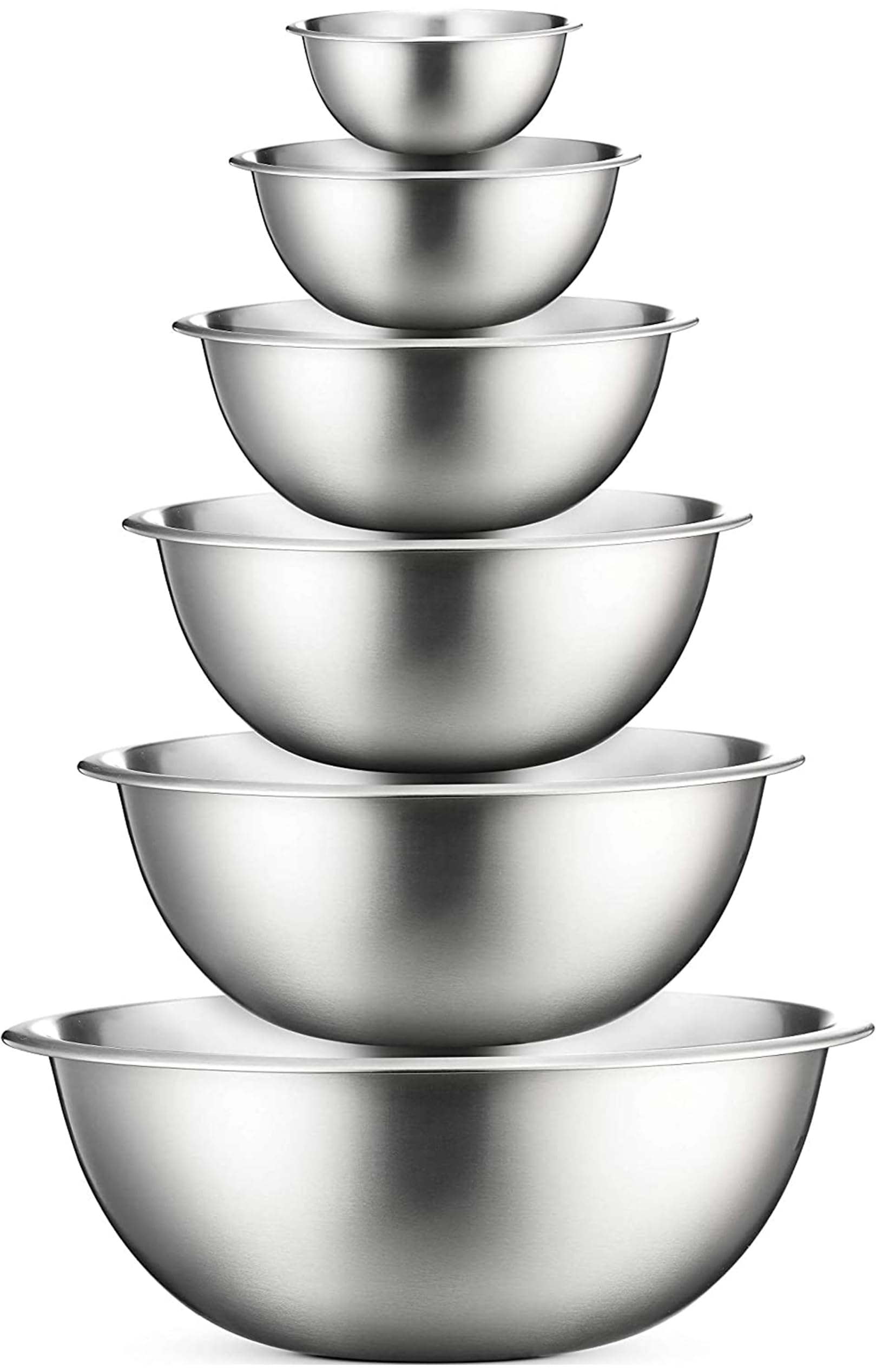
FineDine Stainless Steel Mixing Bowls
Key Features
- Finish: Mirror finish
- Material: Stainless steel
- Set contents: 0.5, 1, 2, 3, 4, and 5 qt bowls
- Dishwasher safe: Yes
- Price: Midrange
Six bowls, from half a quart to five quarts, is more range than most kitchens need—until you are prepping several things at once. The 5-quart bowl is the one we reach for with bread dough or a double batch of muffins, while the small bowls handle eggs, spices, and a quick vinaigrette. The half-quart bowl looks almost like a ramekin, but it is the one we use for a spice blend or a single egg. They nest into one stack, so the extra sizes do not necessarily cost you a cabinet shelf.
We keep FineDine in the rotation for big-batch cooking and prep-heavy afternoons. The stainless steel is light, the rolled rims pour cleanly, and the mirror finish wipes down easily. The bowls are also shatterproof, which makes them a relaxed choice around kids or a busy counter. It is not the set we choose for heavy-duty kneading or for a lifetime of rough handling; the steel is on the thin side, and a hard knock can leave a dent. If you need a lot of bowls for the money, this is the set; if you want heft, choose Bellemain or glass.
Pros
- Six sizes from 0.5 to 5 quarts
- Nests into one compact stack
- Lightweight stainless is easy to handle
- Rolled rims pour cleanly
Cons
- No lids included
We keep FineDine in the rotation for big batches and several prep jobs at once; its light steel is better for mixing than for long-term abuse.
Best for Lightweight Baking
KitchenAid Classic 5-Piece Mixing Bowls
Key Features
- Material: Plastic
- Pour spout: Yes, on each bowl
- Set contents: 1.5, 2.5, 3.5, 4.5, and 5.5 qt bowls
- Non-slip base: Yes
- Price: Premium
The whole five-piece set nests into roughly the footprint of its largest bowl, which is the first thing we noticed in a small kitchen. The bowls are plastic, light enough to lift with one hand, and colored in a soft pistachio that looks less industrial than a stainless stack. The nesting is tidy enough that we leave the set out rather than burying it in a cupboard.
Sizes run from 1.5 to 5.5 quarts, so there is a bowl for a single dressing and one for a big batch of dough. Each has a pour spout and a non-slip base, and the bases do their job: the bowl stays put while you whisk. The plastic is also easy to clean by hand or in the dishwasher, and the wide rims make it comfortable to carry.
For everyday baking, we like this set more than the OXO because the extra sizes and the 5.5-quart bowl give you more room, and the price is still reasonable for five bowls. If you want glass or metal, look at Pyrex or Bellemain, but for a lightweight plastic set that disappears into the cabinet, this is the one.
Pros
- Five sizes up to 5.5 quarts
- Non-slip bases keep bowls steady
- Pour spout on every bowl
- Nests into a small footprint
Cons
- Not oven-safe
For pour spouts and a stable base without lifting glass, we like KitchenAid’s five-piece set for everyday baking.
Best for Pourable Batter
Anchor Hocking 2-Quart Batter Bowl
Key Features
- Lid: Red lid included
- Capacity: 2 qt
- Material: Glass
- Measurements: Etched markings
- Price: Midrange
Some bowls are for everything; this one is for the job of getting batter into a pan without dribbling it down the side. The Anchor Hocking batter bowl has a pointed lip, etched measurement lines, and a red lid, so it can go from mixing pancake batter to chilling cookie dough. The 2-quart capacity is right for a family batch of waffles or a boxed cake mix, and the glass is thick enough to feel stable on the counter. The wide mouth leaves room to whisk without sloshing over the rim.
We keep this bowl for pourable jobs rather than as our only mixing bowl. The etched markings are a liquid guide, not a substitute for a scale when you are baking by weight. That is a fair trade-off for a single bowl that pours cleanly and looks good enough to bring to the table. It takes up more cabinet room than a nesting bowl, but it earns that space if pancakes or waffles are a weekend habit. If you need a set for everything, start with Pyrex; if you make batter often, this is the one we recommend. The red lid is easy to spot in a crowded fridge.
Pros
- Etched measurements for liquids
- Pointed lip pours cleanly
- Tight red lid for chilling
- Thick glass feels stable
Cons
- Heavy when full
Pancakes and pourable batter are why we keep this Anchor Hocking bowl around; the spout and lid make it more useful than a plain bowl.
Best for Budget Kitchens
Glad 3-Piece Mixing Bowl Set
Key Features
- Material: BPA-free plastic
- Small bowl: 1.2 qt
- Set contents: 3 bowls
- Non-slip base: Silicone
- Price: Budget
This is the set that proves a mixing bowl does not need to be heavy, expensive, or complicated to earn its place. The Glad bowls are light plastic with a silicone base, a molded pour spout, and a shape that nests into a small stack. We keep them for simple mixing and prep because they are easy to grab, easy to clean, and stable enough for whisking eggs or folding batter.
The three bowls cover small-to-medium jobs, and the non-slip base is the detail that makes them feel less disposable than they are. The plastic is BPA-free and dishwasher safe, but it is still plastic: it will not go in the oven, and it is better for cool or warm mixing than for hot cooked fillings. For a first apartment, a vacation kitchen, or a set you can hand to a child, that is a reasonable trade. It does not come with lids, so storage is not its job. We still reach for the smallest one for a quick egg wash.
Pros
- Inexpensive enough for a starter kitchen
- Silicone base resists sliding
- Molded pour spout on each bowl
- Light and dishwasher-safe
Cons
We hand the Glad set to new bakers and kids: light, non-slip, easy to clean, and inexpensive enough to buy without agonizing.
Best for Mix and Store
Bellemain Stainless Steel Mixing Bowls with Lids
Key Features
- Lids: Airtight, BPA-free
- Material: Stainless steel
- Set contents: 1.5, 3, and 5 qt bowls
- Non-slip base: Silicone
- Price: Midrange
A lid is the difference between a mixing bowl and a storage container, and it is the first thing we check on a stainless set. Bellemain includes an airtight lid for each of its three bowls, plus a silicone base that keeps the bowl from sliding while you whisk. The stainless is thicker than the thin, dent-prone sets we have used, and the mirror finish looks tidy enough to bring to the table.
The sizes are 1.5, 3, and 5 quarts, which cover sauces, everyday mixing, and a large batch of dough. The bowls nest, so the set takes up less room than three separate bowls with mismatched covers. We like the 3-quart bowl as the everyday one; it is deep enough for a hand mixer and still easy to lift when full.
We choose Bellemain when mixing needs to turn into fridge storage. The bowls feel sturdy, the bases stay put, and the lids make leftovers less of a production. The one thing to check is the smallest lid; it is the fussiest of the three and the most likely to need a careful seat. If you mainly need mixing bowls without lids, Pyrex is simpler; if you want stainless that can go from counter to fridge, this is the set.
Pros
- Three sizes with airtight lids
- Non-slip silicone bases
- Thicker stainless resists dents
- Nests compactly
Cons
We choose these Bellemain bowls when mixing needs to become fridge storage; they feel sturdy, nest neatly, and come in three useful sizes.
How We Tested 14 Mixing Bowl Sets
We started by pulling together a shortlist of widely available mixing bowl sets, then narrowed it by material, size range, lid design, and whether the bowls came in useful combinations rather than padded with a tiny bowl nobody needs. We checked care instructions and replacement-piece availability before buying anything. The final field was 14 sets, and we used them for six months in the same kitchen where I bake bread on weekends, make pancake batter on Sunday mornings, toss salads and dressings on weeknights, and mix marinades for the grill.
We weighed each bowl empty and full, carried it across the kitchen, and noted whether the rim bit into my hand or the base felt tippy. To check sturdiness, we stirred thick cookie dough and stiff bread dough and watched whether the bowl walked across the counter. We fitted every lid, filled bowls with soup and dressed salad, and turned them on their sides in the fridge to see whether the seal held without leaking. For durability, we ran the sets through the dishwasher repeatedly, whisked and scraped with metal utensils, and checked for scratches, chips, cloudiness, and loose handles after months of use.
We also noted capacity and nesting, cleaned every bowl by hand and in the dishwasher, and looked for dried dough or grease that needed extra soaking. We compared what each set included against what it cost, and whether the most-used sizes were the ones you actually got. To judge appearance and overall quality, we kept one set on the counter for the whole test and watched how the finish held up to daily life. The sets that rose to the top shared a broad, grippy base; a comfortable rim; lids that sealed with a clear sense of contact; and a size spread that covered small prep and big dough batches without a useless extra.
How to Choose Mixing Bowls
The right mixing bowl is the one that stays put while you work and empties cleanly when you are done; material and size decide almost everything else.
Size the set to the batch, not the cabinet
A 1.5- to 3-quart bowl covers most cake, cookie, and pancake batches. Step up to 5 quarts for bread dough, double batches, or folding a whole cabbage salad. Small bowls under a quart are for eggs, dressings, and measured prep. If you cook for two and rarely bake, two bowls may be enough. If you prep several dishes at once, a six-piece set such as FineDine earns its space; otherwise, a three-piece set is easier to store.
Choose the material around your heat and handling
Glass is our default for microwaving, melting butter, and serving because it does not hold odors or stains. Stainless is lighter and nearly unbreakable under normal mixing, but thin steel can dent; thicker steel costs more. Plastic is the lightest and often the most comfortable to hold, with non-slip bases that keep it planted. None of these materials is best at everything: glass is heavy, plastic stays out of the oven, and thin metal needs gentle handling.
Stability and pouring matter more than the label
A wide base and a non-slip ring do more for everyday mixing than an extra feature. We look for a bowl that stays put when we whisk one-handed, and a rim that gives us a place to grip. Pour spouts help, but only when the lip is wide and clean; a narrow spout on a thick batter can still dribble. If you mostly scoop rather than pour, a simple round rim is easier to clean.
Treat lids as a separate purchase decision
Lids turn a mixing bowl into fridge storage, which is useful for dough, marinades, and leftovers. But lid fit is the most inconsistent part of this category: a cover that seals on day one can warp or loosen after dishwasher cycles. Check the seal when the bowl is dry, press the lid down evenly, and hand-wash lids if the maker says so. Buy a lidded set for storage, not because it looks more complete.
Plan for the cabinet and the cleanup
Nesting matters more than the number of bowls. A set that nests into the footprint of its largest bowl is easy to keep; one with thick rims or handles can turn into a cabinet puzzle. Check the largest bowl’s height against your shelf, especially with a 5-quart model. Dishwasher-safe bowls save time, but glass and stainless usually fare better than plastic over years of hot cycles.
Frequently Asked Questions
Do stainless steel mixing bowls rust?
Stainless is rust-resistant, not rust-proof. Acidic or salty mixtures left overnight, plus prolonged damp storage, are what shorten its life. Rinse and dry promptly, and follow any hand-wash instruction; if a bowl does show surface staining, treat it before putting the bowl away.
Can I use a hand mixer in a plastic mixing bowl?
Yes, if the bowl is deep enough and feels rigid. Use the lowest speed to combine, keep the beaters off the side, and choose a bowl with a non-slip base so it does not spin. Very thin plastic can flex under a heavy hand mixer; a 5-quart bowl is the safer size for dough and thick batters.
Can mixing bowls go in the freezer?
Glass and stainless bowls generally can, and many plastic bowls are freezer-safe too. Leave an inch or two of headroom for expansion, cool food before freezing, and check that the lid is rated for freezer use. A glass bowl that has been in the freezer should not go straight into a hot oven.
Final Verdict
We start most kitchens with the Pyrex Essentials set because it covers mixing, microwaving, and serving in three useful sizes, and it stays put without the flex of thin plastic. The missing lid is the one gap; if storage matters, Bellemain’s lidded stainless set is the better buy. If you routinely mix five-quart batches, FineDine’s size range earns the space.