This post contains affiliate links. We may earn a small commission when you buy through our links — at no extra cost to you.
Many immersion blenders promise ‘smooth soups’ but deliver splatters, stalled motors, or broken plastic gears within months. The problem isn’t a lack of power on paper – it’s that peak wattage numbers often hide plastic drive shafts that can’t handle continuous use.
The real difference lies in how a blender handles thick loads. Some rely on high-wattage motors and metal drives to power through frozen chunks; others use flexible blades or pressure-sensitive speed control to fine-tune texture without stalling.
Which approach works best for you depends on whether you prioritize brute-force reliability or precision texture. Below are the models that actually deliver on their promises, from budget-friendly to premium.


Best for Quality-Focused Cooks
Vitamix 5-Speed
Key Features
- Motor Wattage: 625W
- Blade Material: 4-prong stainless
- Speed Control: 5 speeds
- Pan Guard: Yes
- Price: $$$
The Vitamix 5-Speed’s 625-watt motor drives a four-prong stainless steel blade through heavy mixtures that bog down lesser hand blenders. The metal drive shaft and bell guard resist the warping and cracking that plastic components develop over time, which is why owners report these units still running smoothly after years of regular soup-making. A 3-year warranty backs the build, far exceeding the typical one-year coverage found on mid-range alternatives.
The bell guard’s shape reduces suction against pot bottoms, so you can blend directly in a saucepan without the wand sticking or scratching cookware. Five speeds give fine control — start low to avoid splatter, then ramp up to handle chunks of potato or carrot. The ergonomic handle keeps one-handed operation comfortable even when you’re blending a full pot of butternut squash soup. Owners consistently note that it processes frozen berries or fibrous kale with zero hesitation, producing smooth results in seconds.
This immersion blender suits anyone who makes soup several times a week and wants a tool that won’t need replacing after a season or two. It’s a premium investment — the upfront cost is higher than entry-level models — but the combination of metal internals and a three-year warranty means lower long-term expense for frequent users. Buyers who need a whisk or mini chopper will have to purchase those attachments separately, since only the blending wand comes in the box. For pure soup duty, the wand alone is all you need.
Pros
- 625-watt motor blends frozen fruit, thick soups, and fibrous vegetables without stalling.
- Stainless steel shaft and metal drive components resist wear far longer than plastic alternatives.
- Ergonomic handle and balanced weight make one-handed operation comfortable during long blending sessions.
- Three-year limited warranty provides coverage well beyond the typical one- to two-year plans.
Cons
- No whisk or chopper included — these accessories require a separate purchase.
- Higher initial cost than many immersion blenders, especially for buyers who blend only occasionally.
For anyone who blends soups multiple times a week and wants a tool that will outlast cheaper options, the Vitamix 5-Speed delivers consistent power and long-term durability without compromise.
Best for Texture Perfectionists
Braun MQ7035X MQ7
Key Features
- Motor Wattage: 500W
- Blade Material: Stainless w/ milling
- Speed Control: SmartSpeed pressure
- Pan Guard: Yes
- Attachments: Beaker, chopper, whisk
- Price: $$$
The ActiveBlade technology is the core differentiator here: a stainless steel shaft that flexes as it rotates, adding a vertical cutting motion to the standard spin. This creates roughly 250% more cutting surface contact with ingredients, which translates to velvety soups with fewer visible chunks — especially noticeable with fibrous vegetables like leeks or celery. The pressure-sensitive SmartSpeed trigger lets you ramp power smoothly without preset buttons, giving one-hand control that feels natural during long blending sessions.
SplashControl reduces suction against the pot bottom, so you won’t get sprayed when blending near the surface. The included 20-ounce beaker and 2-cup chopper add versatility for small-batch tasks. Compared to the top pick’s rigid shaft and higher wattage, the Braun prioritizes texture refinement over raw torque — it handles thick butternut squash soup easily, though very dense frozen chunks may need a few extra passes.
This immersion blender suits home cooks who regularly make creamy vegetable soups and want the smoothest possible result without a countertop blender. The tradeoff: some units have shown hairline cracks in the handle or a gradual loss of blending speed after extended use — not universal, but worth considering if you tend to be rough on tools. Treat the wand gently and avoid soaking the motor housing, and the metal build should serve well for years.
Pros
- ActiveBlade flexible shaft creates a finer, silkier texture in soups than rigid blades.
- Pressure-sensitive trigger gives smooth, one-hand speed control without clicking through presets.
- SplashControl reduces mess when blending in deep pots or near the surface.
- Metal wand and high-quality materials support a premium feel
Cons
- In some cases, the handle has developed cracks or the motor has lost speed after months of use
- Plastic beaker scratches readily when used with the blender attachment
If the smoothest possible soup texture is your priority and you’re comfortable handling the wand with care, this Braun delivers its strength in exchange for a higher risk of occasional material fatigue.
Best for Budget Shoppers
Turelar 1100W 5-in-1
Key Features
- Motor Wattage: 1100W
- Blade Material: Stainless + nylon guard
- Speed Control: Trigger variable (5)
- Pan Guard: Yes
- Attachments: Whisk, frother, chopper, beaker
- Price: $
The Turelar 1100W immersion blender delivers serious blending torque for a price that undercuts most competitors. Its full copper motor powers through thick winter squashes and potato-leek soup without bogging down, and the trigger variable-speed dial gives you fine control from a gentle stir to full-speed puree. The included chopper, whisk, and frother expand its utility beyond soups — useful for chopping onions or whipping cream. Where the top pick (Vitamix 5-Speed) offers longer continuous runtime and a longer warranty, the Turelar provides comparable raw power for less than half the cost.
This blender suits home cooks who make large batches of soup regularly but want to keep spending under control. The 600ml beaker and 500ml food processor handle moderate prep tasks, and the scratch-resistant blade guard protects nonstick pots. However, the motor can overheat if run nonstop — the manual recommends 1 minute on, then a rest. That makes it less ideal for continuous blending of multiple gallons or for those who prefer a lightweight, compact tool for occasional use.
Pros
- 1100W copper motor powers through dense soups and crushes ice with ease.
- Trigger variable-speed dial gives precise control from low stir to full speed.
- Includes chopper, whisk, and frother — covers blending, chopping, and whisking.
- Nylon blade guard minimizes splashing and protects cookware from scratches.
Cons
- Frozen fruits or very hard ice cubes may damage the blade or motor.
- Continuous blending beyond one minute risks motor overheating; a rest period is required.
For budget-conscious soup makers who pause between batches, the Turelar packs impressive power and a full accessory set into a cost-effective package.
Best for Thick Soup Users
Ninja CI201ND
Key Features
- Motor Wattage: 750W
- Blade Material: Stainless steel arm
- Speed Control: 4 speeds
- Pan Guard: Yes
- Attachments: Whisk, blending pitcher
- Price: $$
A 750W motor with SmartTorque technology maintains speed through dense mixtures—thick lentil soups or frozen fruit blends without stalling. The included 4-cup pitcher and whisk attachment expand what you can do with one tool, from smooth soups to whipped cream.
This immersion blender is best for home cooks who routinely tackle chunky vegetables or frozen ingredients and want a single device for both blending and whisking. The weight (3.2 lbs) is noticeable during longer prep sessions, and some owners report that the blending arm or whisk attachment can break after a few months of regular use—a limitation less likely to matter for lighter, occasional tasks. Compared to the top pick, the Ninja offers more power at a lower price, but the durability gap makes the Vitamix a better long-term investment for daily soup makers.
Pros
- 750W motor handles thick soups and frozen ingredients without stalling.
- Includes a whisk attachment and 4-cup pitcher for blending and whipping.
- SmartTorque maintains consistent speed under load.
- Dishwasher-safe parts simplify cleanup.
Cons
- After a few months of regular use, the blending arm or whisk attachment may break.
- At 3.2 lbs, it’s heavier than some alternatives—noticeable during longer prep sessions.
If you need strong blending power for thick soups and occasional whisking, the Ninja delivers—just be prepared for possible component wear within a year of frequent use.
Best for Everyday Soup Maker
Braun MQ505 MQ5
Key Features
- Motor Wattage: 350W
- Blade Material: Stainless, ultra-hard
- Speed Control: 2 speeds + turbo
- Pan Guard: Yes
- Attachments: Whisk, beaker
- Price: $$
The Braun MQ505 distinguishes itself with a PowerBell-shaped blending head that minimizes suction and splashing while you work directly in a pot. This design, combined with a 350-watt motor, handles most soup veggies and soft fruits smoothly — but it’s not built for thick frozen chunks or dense root vegetables. The two-speed slider plus turbo button give enough control for varying textures, and the stainless steel blade stays sharp through regular use.
In practice, the blender produces consistent results on cooked soups, sauces, and smoothies made with non-frozen ingredients. The included whisk attachment works for light cream whipping but its thin metal construction flexes under heavier batter. A small number of units have been reported to cease functioning after a few months, so longevity can vary. The 20-ounce beaker is narrow but adequate for small batches.
This blender suits home cooks who make soup a few times a week and want a no-fuss clean-up — the shaft rinses clean in seconds. Avoid it if you regularly blend frozen fruit or thick vegetable soups, as the motor may bog down. For the price, it delivers predictable performance for its intended use case, though the whisk attachment feels less durable than the main unit.
Pros
- PowerBell shape reduces splashing and suction when blending in a pot.
- Blends cooked soups and soft fruit smoothies with a consistently smooth texture.
- Blending shaft rinses clean quickly under running water, saving time.
Cons
- 350W motor can struggle with frozen fruit, thick vegetable chunks, or dense purees.
- Whisk attachment uses thin metal that may flex under heavy cream or stiffer batters.
For cooks who make soups and sauces from fresh or thawed ingredients, the Braun MQ505 delivers consistent blending without the price of higher-watt models.
Best for High Power Users
Ganiza 1000W 5-in-1
Key Features
- Motor Wattage: 1000W
- Blade Material: 4-leaf 304 stainless
- Speed Control: 16 + turbo
- Attachments: Beaker, chopper, whisk, frother
- Price: $$
The Ganiza 5-in-1 immersion blender packs a 1000W motor and 16 speed options into a kit that includes an 800ml beaker, 600ml chopper, whisk, and milk frother – a feature set that rivals blenders costing twice as much. While premium models focus on build quality and warranty, the Ganiza prioritizes raw power and versatility at a mid-range price.
This blender suits buyers who prioritize motor strength and attachment variety over long-term durability. Some units have shown blade or motor issues after light use, so it’s best for those comfortable with the possibility of needing a replacement within a couple of years. The 3-pound body may also cause arm fatigue during longer blending sessions.
The 16-speed dial plus turbo mode gives precise control for different tasks – from gentle folding to vigorous blending. The detachable shaft is dishwasher safe, simplifying cleanup after use.
Pros
- 1000W motor powers through thick soups, frozen fruit, and tough vegetables without stalling.
- 16 speed settings plus turbo mode allow precise adjustment from light whisking to heavy blending.
- Complete kit with chopper, whisk, and frother handles tasks beyond blending – a cost-effective replacement for multiple tools.
- Tool-free detachable shaft is dishwasher safe, making cleanup simple.
Cons
- In some units, the blade or motor may stop working after only a few uses – a durability gamble for those wanting a long-term appliance.
- The 3-pound body can cause arm fatigue during extended blending sessions, especially when holding it over a pot.
For home cooks who want high blending power and a full accessory set without spending over $100, the Ganiza delivers impressive performance – just be prepared for the possibility of a shorter lifespan than premium alternatives.
Best for Light Use
Mueller Ultra-Stick 500W

Key Features
- Motor Wattage: 500W
- Blade Material: Stainless steel
- Speed Control: 8 + turbo
- Attachments: Whisk, frother, beaker
- Price: $
This Mueller immersion blender offers a wide attachment set – blending shaft, whisk, and milk frother – plus a turbo boost, making it a versatile tool for light soup preparation and occasional frothing. Customer reports confirm it works well for soups, and the stainless steel blade and dishwasher-safe parts simplify cleanup. However, the plastic internal gears are a known limitation: they may wear out within a year of use, particularly if the blender is used regularly or for thick mixtures. The motor can also overheat during extended blending sessions.
Pros
- Works well for soups and smoothies at a low price
- Includes whisk and frother for light mixing and frothing tasks
- Blending shaft, whisk, and frother are dishwasher-safe for easy cleaning
Cons
- Plastic internal gears may wear out within a year under regular use
- Motor can overheat if used continuously for thick soups or heavy-duty tasks
A solid entry-level choice for occasional soup making or as a backup blender, but not suited for frequent or heavy use due to durability limits.
Best for Light Soup
UTALENT 5-in-1

Key Features
- Motor Wattage: 250W
- Blade Material: 4-blade stainless
- Speed Control: 8 + turbo
- Attachments: Whisk, frother, chopper, beaker
- Price: $
The UTALENT 5-in-1 includes a blending wand, whisk, milk frother, and a 500ml food chopper — a full toolset for under $40. For light soup making and baby food purees, it blends smoothly and is easy to clean. However, the 250W motor is underpowered for thicker blends, and some owners have noted that the unit may not last beyond a year with regular use. This makes it best suited as a starter or backup blender for rare use rather than daily heavy lifting.
Pros
- Very good value for a complete 5-in-1 set
- Versatile attachments make it useful for many kitchen tasks
- Easy to use and clean
Cons
- During soup making with chunky or frozen ingredients, the 250W motor may not blend as thoroughly as higher-watt models.
- For users who blend frequently, the plastic internal components may wear out sooner than expected.
Ideal for occasional soup making, baby food prep, or as a backup blender — not for daily use.
Best for Tight Budget
Bonsenkitchen 2-Speed

Key Features
- Motor Wattage: 300W
- Blade Material: 4 sharp stainless
- Speed Control: 2 speeds
- Price: $
This budget-friendly stick blender handles light soup blending with ease, thanks to its sharp stainless steel blades and lightweight design. However, the motor is designed for just one minute of continuous use before requiring a 30-minute rest, making it unsuitable for any batch larger than a single cup. Many units also show wear after a few months of occasional use. For students or temporary kitchens where blending happens at most once a month, this price is hard to beat. For anyone making soup even weekly, the risk of motor burnout or mechanical failure is too high.
Pros
- Extremely affordable for light blending tasks
- Lightweight and easy to handle
- Detachable shaft makes cleaning quick
Cons
- In a typical soup session needing more than one minute of blending, the motor overheats and requires a long 30-minute rest period
- With weekly use, the blender may become unusable after a few months
This blender is a viable choice only if your need is occasional, light blending — think a single cup of soup once a month — and you’re willing to treat it as a disposable tool.
Best for Light Blending
KitchenAid Go Cordless

Key Features
- Blade Material: 4-point stainless
- Speed Control: Variable trigger
- Pan Guard: Yes
- Price: $$
The KitchenAid Go Cordless offers genuine freedom from outlet constraints – you can blend soups at the stove, over a bowl, or anywhere within reach. Its variable speed trigger provides good control for light blending tasks. However, for regular soup making, the motor lacks the torque of a corded model, slowing down when faced with thick vegetable purees. Additionally, the blade guard and motor have exhibited durability concerns over time, making this a better fit for occasional use when cordless convenience matters more than raw blending power.
Pros
- Blending without a cord means no outlet restrictions in the kitchen.
- A single charge covers multiple soup blending sessions without interruption.
- Variable trigger control lets you adjust speed with finger pressure.
Cons
- When blending thick soups, the motor can lose speed compared to corded models.
- The blade guard can detach over extended use, and motor longevity has been inconsistent.
This cordless blender suits light, occasional blending when outlet mobility is the priority – not for frequent thick soup making.
Best for Moderate Soup
SHEANLAH 1000W 25-Speed

Key Features
- Motor Wattage: 1000W
- Blade Material: Titanium head
- Speed Control: 25 speeds
- Pan Guard: Yes
- Price: $$
This model delivers fast blending through thick soups thanks to its 1000W motor and 25-speed dial. The anti-splash guard and scratch-resistant shaft add convenience during pot use. However, some units have shown internal plastic parts wearing out after several months of use, which makes the long-term reliability a consideration for daily heavy blending. The 5-year warranty provides a safety net, but early durability reports keep it from competing with more established options for regular, high-volume soup making. It suits occasional to moderate use where raw power and warranty coverage are prioritized over a proven track record.
Pros
- 1000W motor powers through chunky soups and frozen ingredients quickly.
- Anti-splash bell guard and scratch-resistant shaft keep countertops clean and pots undamaged.
Cons
- Plastic internal components may wear down after several months of moderate use.
- Larger motor housing occupies more space in drawers or cabinets compared to compact models.
A good pick for budget-conscious cooks who want high power and a long warranty for occasional soup making, provided they accept the possibility of early component wear.
Best for Occasional Soup
Vitamix 2-Speed + Whisk

Key Features
- Motor Wattage: 350W
- Blade Material: 2-prong stainless
- Speed Control: 2 speeds
- Attachments: Whisk
- Price: $$$
The Vitamix 2-Speed brings the brand’s known build quality and ease of use in a lighter hand blender, plus a whisk attachment for whipping cream. However, its 350W motor is less powerful than other Vitamix models, so very thick soups require more effort. Some units have experienced motor issues after a few months, making long-term durability uncertain. This suits occasional soup making where brand trust outweighs raw power or a long track record.
Pros
- Vitamix brand build quality and consistent operation.
- Easy to use and clean with simple controls.
- Included whisk attachment adds versatility for whipping cream.
Cons
- Motor issues have been reported in some cases after a few months of use.
- 350W motor may struggle with very thick or frozen soups.
A fit for Vitamix loyalists who want a lighter, simpler model for occasional soups and don’t need maximum power or a long durability track record.
Best for Light Soup
KitchenAid KHBV83
Key Features
- Speed Control: Variable trigger
- Pan Guard: Yes
- Attachments: Pitcher, whisk, chopper
- Price: $$
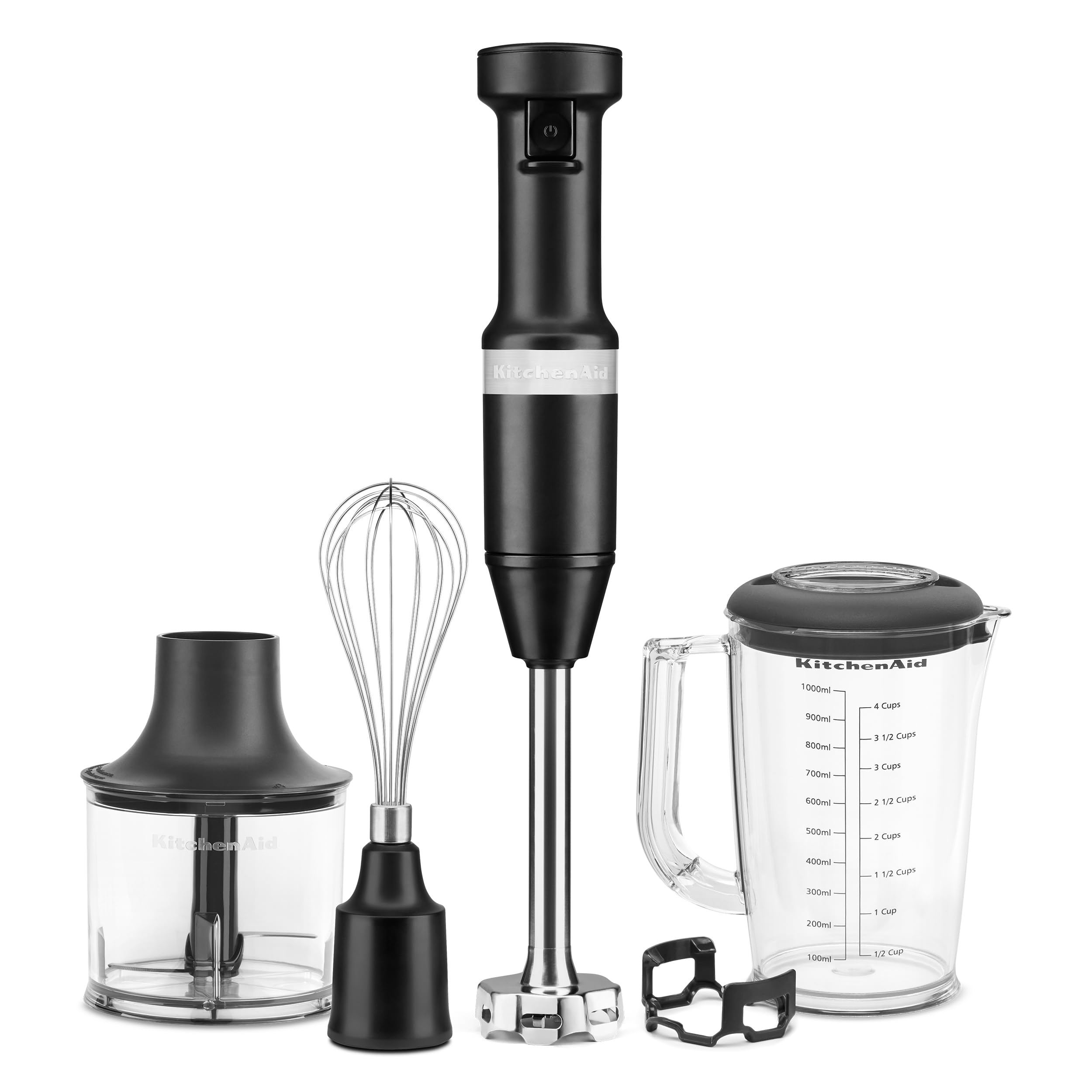
This KitchenAid hand blender ships with a whisk and a small chopper bowl, making it a practical choice if you occasionally whip cream or chop herbs alongside blending. The variable-speed trigger and pan guard work as expected, and cleanup is quick. However, the motor—likely around 180W—lacks the torque needed for thick squash or potato soups, and the whisk attachment can loosen under heavy use. If your soup routine stays mostly broth-based and you value having extra attachments in one box, this is a convenient option; for serious cream-of-soup thickness, look to a higher-wattage model.
Pros
- Includes whisk and chopper attachments for tasks beyond blending
- Easy to use and clean with smooth variable-speed control
- Solid build quality and consistent performance for light-duty blending
Cons
- Low-wattage motor can’t handle thick soups or frozen ingredients
- Whisk attachment may loosen or warp with dense mixtures
Choose this if you mostly make thin soups and want the convenience of a whisk and chopper in one package, but accept that it lacks the power for hearty, thick blends.
How to Choose
The most overlooked feature in an immersion blender is the pan guard – it prevents scratches and reduces splashing, saving your cookware and your countertop.
Motor Wattage
Wattage determines how easily the blender handles thick, chunky, or frozen ingredients. Higher wattage (600W+) lets you puree dense soups without stalling, but it often comes with a heavier motor and a shorter duty cycle.
Lower-wattage models (300–400W) are lighter and quieter but struggle with fibrous vegetables or frozen fruit. They are best for cooked, soft ingredients. The trade-off is that a high-wattage motor with plastic internals may fail faster than a moderate one with metal gears.
Blade Material
Stainless steel blades are standard and resist corrosion, but the shape matters more. Four-prong blades provide more cutting edges for smoother results, while blades with extra milling fins (like Braun’s ActiveBlade) increase surface area for ultra-fine purees.
Look for a blade that is fully encased in a metal bell guard – this protects both the blade and your pot. Some budget models use plastic guards that can crack under heat or impact.
Speed Control
Variable speed triggers give you precise control – you can start slow to avoid splashing, then ramp up to break down chunks. Fixed speeds (2 or 3) are simpler but offer less finesse, especially for delicate tasks like frothing.
Pressure-sensitive speed control (like Braun’s SmartSpeed) lets you adjust speed by how hard you press the trigger, making one-handed operation intuitive. This is a genuine advantage when blending hot soup in a deep pot while holding the ladle.
Pan Guard
A bell-shaped pan guard does more than protect non-stick cookware from scratches. It also reduces suction that can cause the blender to stick to the bottom of the pot, which leads to splashing and uneven blending.
Models without a guard require you to tilt the blender while running, which is awkward and messy. If you use enameled or non-stick pots, a pan guard is non-negotiable.
Attachments
Extra attachments like a whisk, frother, or chopper turn the immersion blender into a multi-tool. This is valuable if you have limited storage or want to avoid buying separate appliances for whipping cream or chopping nuts.
However, attachments add cost and complexity. Many budget blenders include them but use plastic components that break under heavy use. Consider whether you actually need them before paying extra.
FAQ
Why does my immersion blender keep splashing hot soup everywhere?
Splashing happens when the blender bell creates suction against the pot bottom, especially with a wide flat bell. Submerge the blender completely before starting, use a model with a slotted bell guard, and keep the blade fully covered. If you have a pan guard, it reduces this issue significantly.
Can I use an immersion blender directly in a hot pot without damaging it?
Yes, most immersion blenders are designed to handle hot liquids up to around 212°F. Avoid submerging the motor housing – only the shaft should enter the liquid. Never run the blender for longer than the recommended cycle (usually 1-2 minutes) to prevent motor overheating.
What is the best wattage for an immersion blender to handle thick soups?
For thick soups with chunky vegetables or frozen ingredients, look for 600W or more. Lower wattage (300-400W) works fine for thin, cooked soups but will struggle with density. However, wattage alone isn’t enough – a metal drive shaft and proper duty cycle matter more for longevity.
How do I clean the inside of the blending shaft without getting water in the motor?
Detach the shaft from the motor (most models allow this). Rinse the shaft under warm water and use a bottle brush to clean the blade area. Alternatively, blend warm soapy water in a beaker for 30 seconds. Never submerge the motor housing or run it under a faucet.