This post contains affiliate links. We may earn a small commission when you buy through our links — at no extra cost to you.
A countertop oven is either the hardest-working appliance in your kitchen or a very expensive bread box, and the difference has surprisingly little to do with how many presets it claims. What you’re actually buying is heat: a small cavity that comes up to temperature in minutes, holds steady once it’s there, and doesn’t turn the kitchen into a sauna in July. That’s the part I pay attention to now.
The features worth comparing are narrower than the boxes suggest. Air frying is table stakes at this point, and a probe thermometer you can leave in a roast does more for "smart" cooking than a touchscreen does. Size is the other fork in the road — a 25-quart oven fits a whole chicken but eats a chunk of counter, while a compact model has to earn its footprint back one slice of toast at a time.
My team and I cooked with 12 of these over eight months, from compact models to big convection combos, tracking how evenly each one browned, how fast it reached temperature, and how much scrubbing it took afterward. The picks below are the ones we’d plug in again.
Best for All-Around Cooking
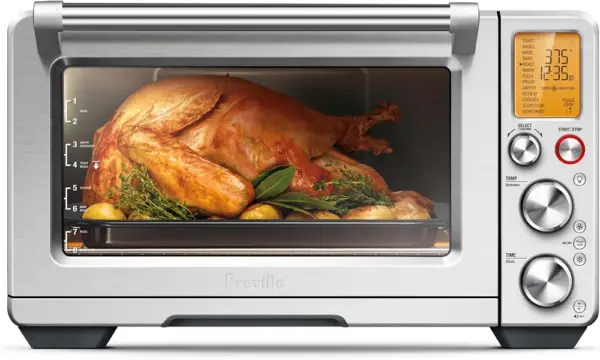
Breville Smart Oven Air Fryer Pro
Key Features
- Capacity: 1 cu ft
- Dimensions: 17.5"D x 21.5"W x 12.7"H
- Cooking functions: 13
- Temperature range: 80-480 °F
- Price: Premium
The test we cared about most was whether we could stop using the wall oven, and two weeks in, the answer was mostly yes. The cavity is a full cubic foot, big enough for a 9-by-13 pan, a 13-inch pizza or a whole chicken, which is the point where a countertop oven stops being a toast machine and becomes the appliance you reach for first. Thirteen functions is more than anyone needs, but the useful ones, toast, bake, roast, pizza, air fry, proof, dehydrate, are all here.
Element iQ is the smart part, and it’s smart in the least annoying way: five quartz elements that the oven switches and dims depending on the preset, with no app, no account, nothing to pair. We paid close attention to super convection, because airflow is what separates real air frying from a fan pushing warm air around. Frozen fries came out browned and crisp rather than pale and chewy, and the 80 °F floor let us proof dough overnight without turning the kitchen into a sauna. Toast, honestly, is the weakest preset, browning a little unevenly and taking longer than a slot toaster.
What gives us pause is longevity. Heating elements, and in some units the door glass, are the failures that show up on this model over time, which is why the two-year warranty matters more here than on a cheaper oven. Register it the day it lands, keep the receipt, and buy from somewhere with an easy return window. That isn’t a reason to skip it; it’s a reason to be deliberate about the first month.
The dial-and-LCD interface is the other quiet win. One knob cycles the functions, the display shows temperature, and nobody in the house needs the manual to make toast. In a category that keeps adding screens, that’s the design decision that won us over.
Pros
- Fits a 9-by-13 pan or a 13-inch pizza
- 13 functions include air fry, proof and dehydrate
- Super convection crisps rather than just blowing heat
- Two-year warranty on a category that often stops at one
Cons
- Large counter footprint
- Heavy at 30.2 pounds
Our default for most kitchens: a full cubic foot of usable space, 13 functions people actually use, and convection strong enough to make air frying worth doing.
Best for Searing and Browning
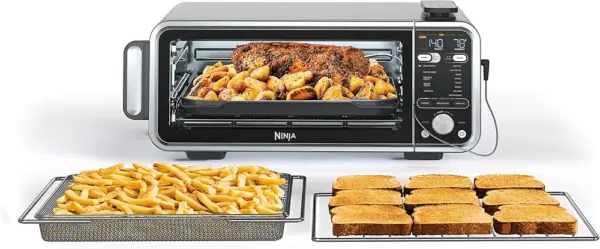
Ninja Foodi Smart Dual Heat Oven
Key Features
- Weight: 21.5 lb
- Smart control: Foodi Smart Thermometer
- Max temperature: 500 °F
- Cooking functions: 13
- Price: Premium
The hinge is the first thing we noticed and the reason this oven can live on a small counter. When it’s off, the whole unit pivots up and back against the wall and most of the footprint it took goes back to being prep space. In a kitchen where the counter does double duty, that single mechanism decides whether a countertop oven is a permanent resident or a nuisance you shift twice a day.
Under the party trick sits the most interesting cooking hardware here. The SearPlate is heated directly rather than by air, so it reaches 500 °F on its own while the fan drives 500 °F air across the top: sear underneath and crisp on top at the same time, which is why Sear Crisp and Griddle aren’t just two more buttons on a long list. The Foodi Smart Thermometer is the other half. You choose rare through well done, leave the probe in, and the oven stops at the target. We expected the probe to be a gimmick and it turned out to be the feature we trusted most with a pork loin.
Cleaning is where it asks for patience. The basket, rack and crumb tray come out, but grease that reaches the interior walls takes real scrubbing, and that’s the one thing to accept going in. Everything else about living with it is easy: 21.5 pounds is light enough for one person to flip, and it’s ready to cook in about a minute, which is why it gets used on nights when a skillet feels like too much.
Thirteen functions is a lot of buttons. The three we actually use, air fry, Sear Crisp and bake, justify the whole thing, and the griddle setting has quietly replaced a stovetop pan for weekend breakfasts.
Pros
- Flips up against the wall when it’s off
- SearPlate sears at 500 °F under the food
- Leave-in probe stops at the doneness you set
- Ready to cook in about 60 seconds
Cons
- Interior grease takes real scrubbing
- Needs about 20 inches of depth when lowered
The one to buy if browning matters most: a heated searing plate and a leave-in probe do work no other oven in this group can match.
Best for Small Kitchens
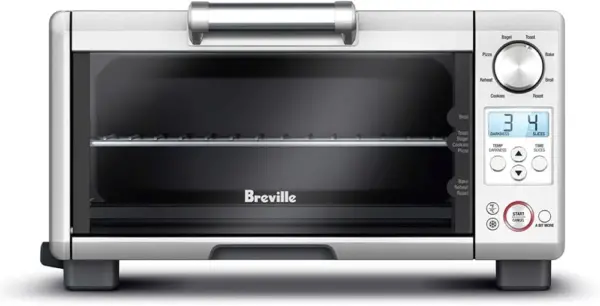
Breville Mini Smart Oven
Key Features
- Weight: 10.7 lb
- Interior: 11 x 10 x 4 inches
- Dimensions: 13.6"D x 16"W x 8.8"H
- Cooking functions: 8
- Price: Budget
There’s no air fry basket, no convection fan and no probe in this box, and at this size we didn’t miss any of them. The Mini is 13.6 inches deep and 10.7 pounds, so it fits where nothing else here will: a narrow counter, a camper, the one clear stretch of counter in a studio apartment. What you give up is crispness. What you keep is everything a toaster oven is actually for.
Eight functions run on the same Element iQ logic as our top pick, five quartz elements steered by the preset, so toast, bagels and pizza come out consistent instead of lucky. The interior is 11 by 10 by 4 inches: four slices, a six-cup muffin tray, an 11-inch pizza. Three rack positions let you crowd the top element for broiling or drop low for a pan of brownies, and the LCD with its single dial is the least confusing control panel in this group.
It gets hot on top, hotter than the bigger Breville does, so leave a couple of inches of air on every side and don’t park anything plastic up there. That’s the trade for a body this small with an 1800-watt element inside it.
We kept coming back to it for the jobs nobody plans: reviving leftover pizza so the crust comes back, toasting four slices at once, baking a small batch of cookies without heating a whole oven for twenty minutes. That last one is the entire argument for a second oven, and it doesn’t take an app to make it.
Pros
- 10.7 pounds and 13.6 inches deep
- Element iQ across eight cooking functions
- Holds four slices, a muffin tray and an 11-inch pizza
Cons
- Four-inch interior height limits roasts
For a small kitchen, this is the smart oven to get: 10.7 pounds, eight dependable functions, and a footprint that fits where the others won’t.
Best for Family Batches
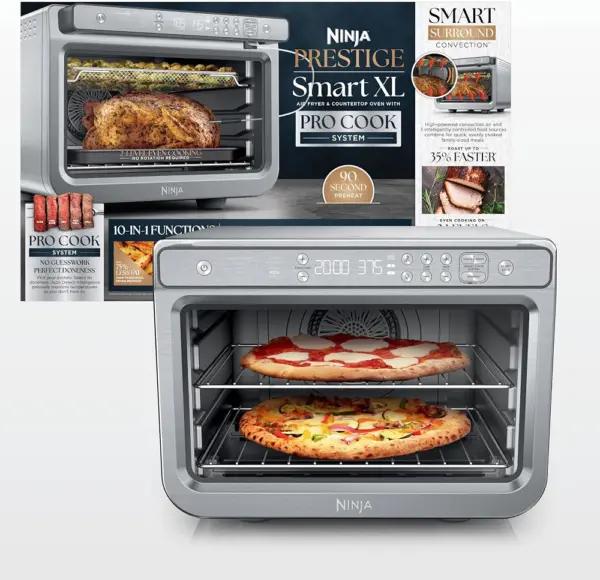
Ninja Prestige Smart XL Pro
Key Features
- Weight: 33.8 lb
- Smart control: Pro Cook thermometer
- Cooking levels: 2
- Cooking functions: 10
- Price: Midrange
Thirty-three pounds is a lot of countertop oven, and it buys one thing above everything else: a second rack. Two levels cook evenly with no rotating, flipping or shaking, which turns vegetables and chicken into one operation instead of two, and it’s why this one stays out rather than living in a cupboard.
The cavity is genuinely family-sized: two 9-by-9 baking trays side by side, 20 cookies, nine slices of toast, or a 12-pound turkey when the holiday lands on you. The Pro Cook thermometer is the smart part, since you set a doneness and the oven takes over from there, and Surround Convection wraps food in moving air rather than blasting it from one side, which is why a full basket of vegetables browns reasonably evenly instead of scorching nearest the fan.
We came away impressed by the cooking and less impressed by the noise. On air fry and roast the fan is loud enough to follow you into the next room, and the case throws real heat, so give it clearance rather than tucking it under a cabinet. What you get in return is a second rack that behaves like a second oven.
Pros
- Two racks cook evenly with no rotating
- Fits two 9×9 trays, 20 cookies or a 12-pound turkey
- Pro Cook thermometer handles doneness
- Comes to temperature quickly for its size
Cons
- Loud fan on air fry and roast
- 33.8 pounds, the heaviest oven here
The pick for a big household: two racks that cook evenly without rotating, and room for a 12-pound turkey or 20 cookies.
Best for Remote Monitoring
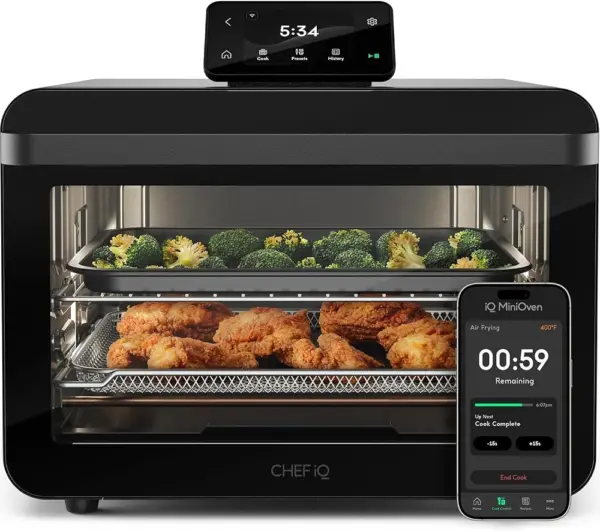
CHEF iQ MiniOven
Key Features
- Capacity: 25 quarts
- Smart control: WiFi app and touchscreen
- Cooking functions: 11
- Temperature range: 70-500 °F
- Price: Premium
A WiFi oven invites skepticism, and we brought plenty. The question isn’t whether the app connects, it’s whether you open it a second time. On this oven you do, because the app carries what the front panel can’t: dozens of chef-tested presets sorted by dish, plus live temperature and time remaining on your phone while you’re in the other room. It also pairs with CHEF iQ’s wireless thermometers, so doneness and the timer sit on the same screen.
What surprised us is how much oven fits in 16 inches of width. The 25-quart cavity takes a 13-inch pizza or six slices of toast, and three rack positions let you run two levels without rearranging mid-cook. The 3200 RPM motor behind the 70-to-500-degree range is why air frying and dehydrating feel like first-class functions rather than afterthoughts, and the five included accessories, all PFAS-free, mean you’re not shopping for a basket on day two.
Two frictions. The app is an extra layer over a panel that works fine on its own, so if you never cook from another room you’re paying for connectivity you won’t touch. It’s also 26.2 pounds and 14.4 inches tall, which needs more clearance above it than a low-profile oven does. Neither has changed how often we use it, but the height is worth checking against the shelf above before you order.
Pros
- App presets and remote monitoring
- 25 quarts in a 16-inch-wide body
- 70-500 °F covers proofing through broiling
- Five PFAS-free accessories included
Cons
- App adds a layer you may never use
- 26.2 pounds and 14.4 inches tall
Worth it if you want to start dinner from another room: the only oven here with an app that earns its keep, plus 25 quarts of space.
Best for Tight Budgets
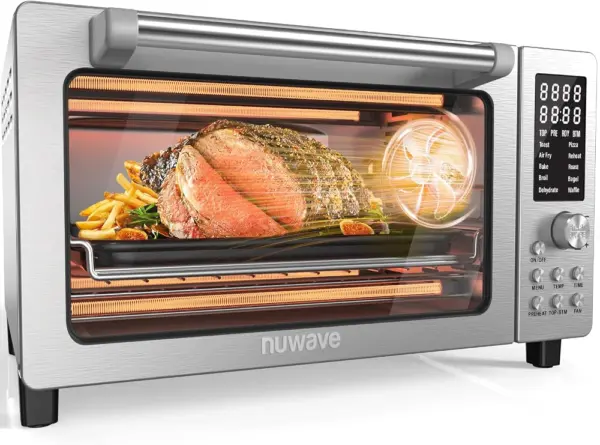
Nuwave Bravo Pro
Key Features
- Presets: 10
- Capacity: 21 quarts
- Fan speeds: 3
- Temperature range: 50-450 °F
- Price: Budget
The control that makes this oven interesting is the one you don’t expect on a budget appliance: separate top and bottom heater percentages. Push the ratio toward the bottom element and a thick-crust pizza sets before the cheese scorches; push it to the top and you get broiler-style browning without moving the rack. Add three fan speeds and you can tune crispness instead of accepting whatever the preset decided.
At 21 quarts and 14.4 pounds it threads a needle the others don’t. It’s big enough for a 12-inch pizza or dinner for three, light enough that one person can move it, and shallow enough at 13 inches deep to sit on a counter with no spare room. The ten presets are ordinary, toast, bagel, air fry, bake, broil, reheat, dehydrate, but they’re the ones people use, and the touch panel is legible without the manual.
Heat is the part to watch. This oven runs hot on the outside, and holding a set temperature is where it’s weakest relative to the rest of this group: it comes up to heat quickly and then drifts. Put an inexpensive oven thermometer inside for the first few cooks and trust that over the display. For casseroles and toast the drift doesn’t matter; for custard and candy it does.
What we appreciated most is where the money went. There’s no screen, no app, no pairing. The cost sits in the heater zones, the fan and the cavity, which is the right trade at this end of the market.
Pros
- Separate top and bottom heater percentages
- Three fan speeds tune how crisp food gets
- 21 quarts at 14.4 pounds
Cons
- Exterior gets very hot in use
- Set temperature drifts during long cooks
This is where the money goes furthest: separate top and bottom heat, three fan speeds, and 21 quarts in a body one person can lift.
How We Tested the Smart Ovens
We started by pulling every countertop oven with a digital display and a convection fan from the major retailers, then filtered by capacity, wattage, and what long-term owners reported about failures in the first year. That left 12 units, which we bought ourselves and rotated through the same eight months of ordinary cooking.
Each one lived on a real counter, not a lab bench. Weekday mornings meant two slices of bread on the middle rack, toasted on the default setting, then set side by side to check for pale corners, dark stripes, and slices that came out uneven from front to back. Weeknights were a sheet pan of vegetables and a basket of frozen fries in air-fry mode. Weekends were a whole chicken with the probe in the thigh wherever the oven had one, a 12-inch pizza, and a batch of bacon that told us everything about cleanup.
We timed the climb to 400°F with a stopwatch, cross-checked the readout against a separate oven thermometer, and noted which corners ran hot. After greasy sessions we cleaned each oven the way its manual specifies and counted how many passes it took to get the glass clear. Across the eight months we also watched for the slower stuff: loose handles, touchscreens that got smudged or slow to respond, and whether an oven was still worth its counter space and its price by the end.
How to Choose a Smart Countertop Oven
Smart means three different things in this category, algorithmic presets, a leave-in probe, and app control, and knowing which one you’ll actually use narrows the field faster than any spec sheet.
Interior space beats exterior size
Two ovens can look identical on the counter and hold very different dinners. What counts is the cavity: an interior around 11 by 10 by 4 inches takes four slices of toast and an 11-inch pizza, while the roomiest ovens here swallow a 9-by-13 pan, two 9-by-9 trays, or a 12-pound turkey. Height is the dimension people forget, and it decides whether a casserole dish fits at all.
Measure your most-used pan, handles included, before you order, and don’t assume the biggest body has the biggest interior. Several ovens here are surprisingly roomy for their width, and one of the largest footprints belongs to a model whose cavity is more modest than it looks.
Decide which kind of smart you’ll use
Algorithmic presets, like Breville’s Element iQ, shift power between five quartz elements to keep results consistent. They ask nothing of you beyond turning a dial, which is why they’re the smart feature most likely to actually get used. A leave-in probe, as on both Ninjas, closes the loop on meat and poultry and removes the guesswork that costs you a roast. App control, which only one oven here offers, is convenience: you can start a cook and watch it from another room.
If you’re choosing between them, take the probe first. It changes results, where an app mostly changes where you’re standing.
Air frying is about airflow, not the basket
Every air-fry claim here comes down to how much hot air moves and how fast. Super convection settings and multi-speed fans produce crackling skin; a single slow fan mostly reheats. Look for a top temperature of at least 450 °F and a dedicated air-fry program rather than a bake function with a basket tossed in. Expect noise as part of the deal: the fans that make good fries are the ones you hear from the next room.
Plan for heat and clearance
These ovens shed heat through the case, not just the door, and the top panel is usually the hottest surface. Give one a couple of inches of air on every side and think twice about the tight slot under an upper cabinet, where warm, moist air has nowhere to go. Nothing here vents like a range hood. If the space above your counter is shallow, a low-profile model such as the Ninja Foodi or a compact one like the Breville Mini fits more comfortably than the full-size ovens do.
Frequently Asked Questions
How long should a countertop smart oven last?
Elements and convection fans are the parts that fail, and they’re what the one- and two-year warranties on several of these ovens cover. Register the oven the week it arrives and keep the receipt somewhere you’ll find it; a covered element failure in year two is the difference between a repair and a replacement. Emptying the crumb tray and keeping the vents clear costs nothing and helps.
Will an 1800-watt countertop oven trip my kitchen circuit?
It can. An 1800-watt oven pulls about 15 amps at 120 volts, which is the whole capacity of a standard kitchen circuit. Don’t run it on an extension cord or a power strip, and don’t share that circuit with a kettle, griddle or coffee maker. If the breaker trips when two of them run at once, move one to another outlet.
How do I stop it smoking when I air fry?
Grease that reaches the interior walls and the crumb tray is what smokes on the next run. Empty the crumb tray after anything fatty, wipe the walls and the inside of the glass once the oven is cool, and don’t let drips pool in the bottom of the cavity. If it’s already smoking, run it empty at high heat with a window open until the smell clears.
Do smart oven apps need a subscription?
No. The CHEF iQ app is free, and every oven here cooks from its own panel whether or not you ever connect it. Treat the app as a bonus rather than a requirement: if you’d rather not create an account, buy for the probe or the presets and leave the WiFi alone.
Final Verdict
Buy the Breville Smart Oven Air Fryer Pro. A full cubic foot, 13 functions and convection that actually crisps make it the one oven here that can take over most weeknight cooking, and its two-year warranty is the longest in this group.
If searing is what you’re after, the Ninja Foodi’s heated plate and probe are the better tool. If counter space is the constraint, the Breville Mini does the same job in 10.7 pounds.