This post contains affiliate links. We may earn a small commission when you buy through our links — at no extra cost to you.
A hand mixer that launches flour across the counter on its lowest setting isn’t saving you time—it’s creating cleanup. That splatter problem is the most common complaint in the category, yet most budget and mid-range models still ship with a first speed that’s too aggressive for gentle folding or incorporating dry ingredients.
The fix isn’t simply spending more. It’s understanding which mixers prioritize speed control over raw wattage. A handful of models use DC motors or engineering tricks to deliver a true slow start, while others rely on brute force that makes messes inevitable.
This guide focuses on that trade-off: whether you prioritize a controlled first speed, multiple attachments for versatility, or the quietest operation for early-morning baking. Each pick solves a specific problem so you can match the mixer to your actual kitchen habits, not the marketing.


Best for Splatter-Free Mixing
Hamilton Beach Pro 5-Speed
Key Features
- Motor Power: 120W DC
- Slow Start: Yes (slow start)
- Speeds & Attachments: 5 speeds, 3 attachments
- Storage: Snap-on case
- Price: $$
At its most basic setting, this hand mixer moves the beaters so slowly you can watch the spatula scrape the bowl without a single splatter. That’s the DC motor at work — it provides torque from the very first turn rather than revving up and flinging batter. The lowest speed is genuinely usable for folding in dry ingredients or incorporating flour into wet mixtures, which is where most budget mixers lose control.
The DC motor also keeps noise down. Running through cookie dough, the sound is more of a low hum than the high-pitched whine of AC-powered alternatives. At full speed, there’s no vibration that walks the mixer across the counter. The 120-watt motor is not the most powerful on paper, but it delivers consistent torque across all five speeds, and the QuickBurst button gives a short boost without overspeeding.
The snap-on storage case holds the beaters, whisk, and dough hooks — a convenience that keeps everything together without taking up drawer space. The stainless steel attachments feel sturdy and clean up easily. The five-foot cord is long enough to reach most outlets without being cumbersome.
For home bakers who make cakes, cookies, and whipped cream regularly, this mixer handles the task without drama. The slow start prevents the initial cloud of flour that plagues many models, and the quiet operation means early-morning mixing won’t wake the house. The main limitation surfaces with very thick cookie dough — the motor can labor, and some users find it insufficient for stiff doughs that a stand mixer would handle without strain. That’s a distinction worth noting for anyone who bakes dense barley or oatmeal cookies frequently.
Pros
- True slow start from the first rotation eliminates splatter
- Quiet enough for early morning or open-plan kitchens
- Five-year warranty covers longer-term peace of mind
- Snap-on storage case keeps beaters and whisk organized
- DC motor delivers consistent torque across all speeds
Cons
- May struggle with very stiff cookie dough that requires heavy kneading
If you want controlled, splatter-free mixing without the noise and can accept its limits on the thickest doughs, this hand mixer delivers where others skip the basics.
Best for Avid Home Bakers
Cuisinart 9-Speed
Key Features
- Motor Power: 220W
- Slow Start: SmoothStart
- Speeds & Attachments: 9 speeds, 4 attachments
- Storage: Snap-on case
- Price: $$
The Cuisinart HM-90BCS offers nine speeds with a SmoothStart feature that gradually ramps up to prevent splattering, plus a comprehensive set of attachments including dough hooks, whisk, and a spatula — all stored in a snap-on case. Where the top pick prioritizes reliable slow start and a long warranty, the Cuisinart provides greater speed granularity and more accessories for a similar mid-range cost.
The 220W motor handles most baking tasks with enough power for cookie dough, cake batter, and whipped cream. The slow start is especially useful when mixing dry ingredients, reducing flour clouds. The included spatula and storage case add everyday convenience that many mixers at this price lack.
This mixer suits avid home bakers who want speed options and attachments without moving to a stand mixer. However, a small percentage of units may have beaters that detach during use — a quality control issue that requires checking the lock before each session. If bulletproof consistency is a must, the top pick is a safer choice.
Pros
- SmoothStart prevents splatter and gives steady control on low speeds
- Complete set of attachments (beaters, dough hooks, whisk, spatula) stores in a snap-on case
- Consistent performance across light batters to thick cookie dough
Cons
- Beaters may detach during use on some units — requires checking the lock before each session
For home bakers who prioritize speed range and attachments over absolute consistency, the Cuisinart delivers strong performance and good value — with the caveat that beater retention should be verified before each use.
Best for Enthusiast Bakers
Breville Handy Mixer
Key Features
- Motor Power: 240W
- Slow Start: BeaterIQ slow start
- Speeds & Attachments: 9 speeds + boost, 3 attachments
- Price: $$$$
The Breville Handy Mixer delivers a combination of smart features and quiet power that few hand mixers match. Its BeaterIQ automatically detects the attachment and adjusts speed limits, while the integrated light illuminates the bowl and the timer tracks mixing time. The 240W motor runs quietly and handles stiff doughs with minimal strain, backed by build quality that feels substantial.
This mixer suits the serious home baker who values precision and detail over cost. The scraper beaters and balloon whisks cover everything from delicate whipped cream to thick cookie dough, effectively reducing the need for a stand mixer. Buyers who bake infrequently or are budget-conscious will find better value elsewhere, especially given the premium price and the possibility of silicone coating wear on the beaters over time.
In use, the motor maintains consistent speed even under heavy loads, and the boost function provides extra power for dense mixtures. The integrated light reduces the need to stop and scrape the bowl, a convenience that speeds up tasks like adding dry ingredients. Build quality is solid, with controls that feel precise and a balanced weight that stays comfortable during extended use.
Pros
- Powerful and quiet motor handles heavy batters and doughs with ease
- Smart features include BeaterIQ, integrated light, and timer for precision mixing
- Solid build quality with durable feel and well-weighted design
Cons
- Silicone coating on beaters can wear off over time, leaving bits in food
- Premium price well above other hand mixers with similar mixing capability
If you want the most advanced hand mixer available and are willing to pay a premium, the Breville delivers near-stand-mixer performance — just keep an eye on the beater coating.
Best for Budget-Conscious Bakers
Hamilton Beach 6-Speed
Key Features
- Motor Power: 250W
- Slow Start: No
- Speeds & Attachments: 6 speeds + Qburst, 3 attachments
- Storage: Snap-on case
- Price: $
Where the top pick excels at slow-start control, this model keeps things simple and affordable — pairing dependable 250W power with a snap-on storage case that keeps beaters and whisk together. Over sixty thousand reviews back its reputation as a no-fuss workhorse for weekend bakers.
For cakes, cookies, and whipped cream, the six speeds provide enough range to get the job done. The lowest setting, however, moves faster than ideal for dry ingredients — expect some flour dust if you don’t ease into the mix. Motor longevity is adequate for occasional use, but pushing it through thick doughs regularly can shorten its life.
This mixer suits budget-conscious bakers who make a few batches per week and don’t need whisper-quiet operation or a slow-start feature. If you bake daily or work with stiff doughs, the top pick’s DC motor and 5-year warranty offer better staying power.
Pros
- Snap-on storage case keeps beaters and whisk together, no hunting in drawers.
- Handles most home baking tasks — cake batter, cookie dough, whipped cream — without struggling.
- Budget-friendly price point makes it accessible for occasional bakers.
Cons
- Lowest speed may be too fast for incorporating dry ingredients, causing splatter.
- Motor can wear out under frequent heavy use, such as weekly thick doughs.
A cost-effective choice for occasional bakers who value storage convenience and simplicity over slow-start precision.
Best for Light Baking
KitchenAid 7-Speed
Key Features
- Motor Power: 100W
- Slow Start: No
- Speeds & Attachments: 7 speeds, 3 attachments
- Price: $$
The KitchenAid 7-Speed stands out for its near-silent mixing. Where many hand mixers produce a noticeable whirr, this one stays discreet enough to use while others sleep. The soft-grip handle and clearly marked speed buttons with an LED indicator make one-handed operation simple. In contrast to the DC-powered models that emphasize slow-start control, this KitchenAid prioritizes low noise and ease of use above all else.
That quiet performance comes with a clear boundary: the 100W motor handles light batters, whipped cream, and thin sauces without complaint, but thick cookie dough or heavy bread dough will strain it. The beaters themselves can show wear under repeated heavier use – a reminder to keep tasks within its comfort zone. This mixer suits bakers who value a peaceful kitchen environment and stick to lighter recipes, or those who need a secondary mixer for quick jobs without waking the household.
Pros
- Operates quietly enough for shared living spaces or early-morning use
- Sturdy construction with a comfortable grip and responsive speed buttons
- Intuitive controls with a lit speed indicator for clear feedback while mixing
Cons
- Beaters can bend or chip when used with dense mixtures – best kept to light mixing
- Motor may struggle or overheat with thick cookie dough or stiff bread dough
If quiet operation is your top priority for light baking tasks, this is a strong choice – but for doughs or high-speed whipping, consider a more powerful model.
Best for Occasional Use
OVENTE 5-Speed
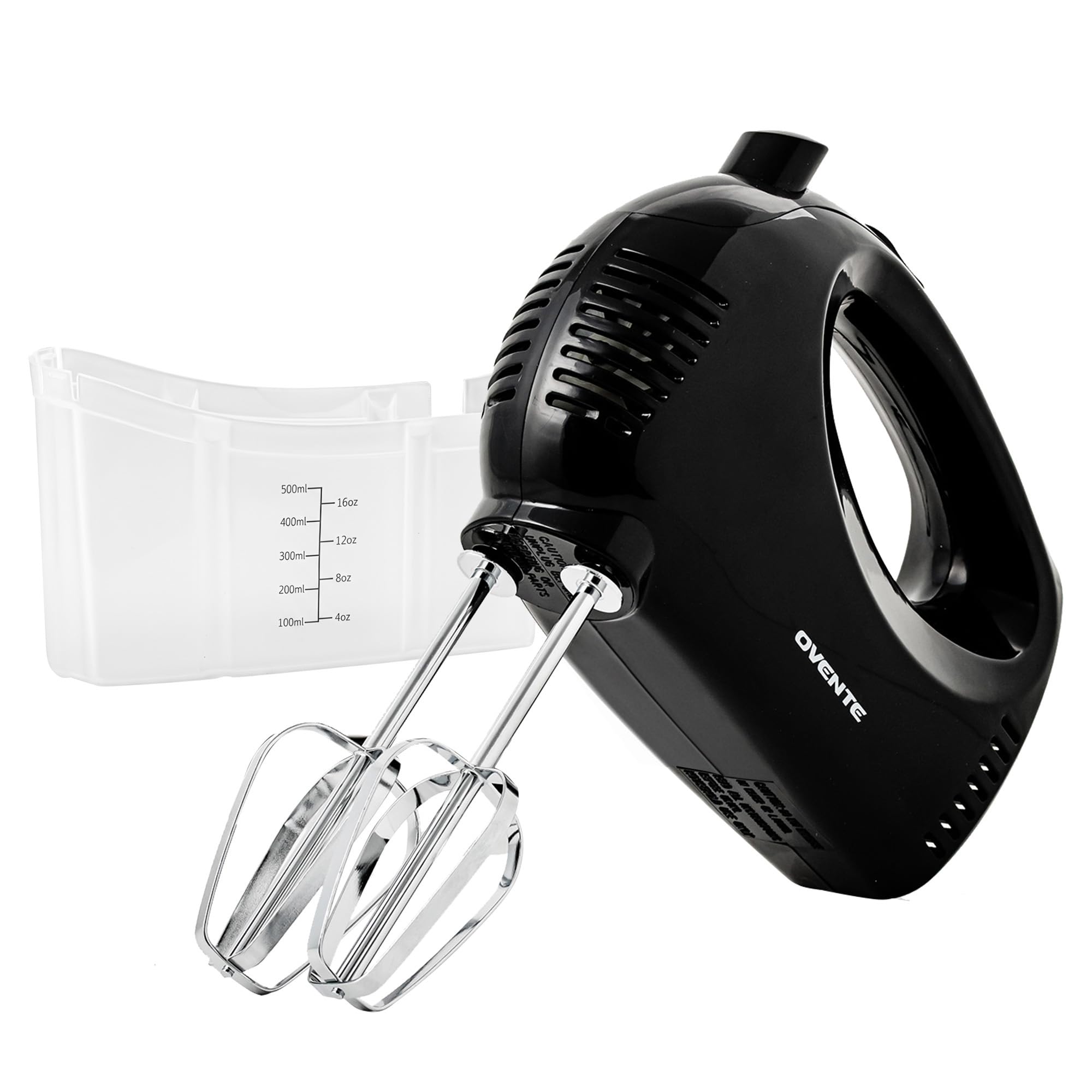
Key Features
- Motor Power: 150W
- Slow Start: No
- Speeds & Attachments: 5 speeds, 2 whisk beaters
- Storage: Snap-on case
- Price: $
At the lowest price point among the mixers here, the OVENTE is built for buyers who need something small and cheap—not something durable or precise. The snap-on storage case holds the mixer and beaters together, making it easy to stash in a drawer or take on a trip. It’s lightweight, so handling it for quick tasks is no effort. But the tradeoffs are immediate: the slowest speed is still too fast for gentle folding or adding dry ingredients without splattering, and the motor and beaters may show wear after a handful of uses. If you’re mixing a boxed cake batter once a month, this will get the job done. For weekly baking or any recipe that calls for controlled speed, the cost savings aren’t worth the frustration.
Pros
- Exceptionally low price – one of the cheapest options available
- Compact snap-on storage case keeps mixer and beaters together
Cons
- Lowest speed is too fast, causing splatter and making gentle mixing difficult
- Motor and beaters may show rust or stop working after limited use
Best when your budget is tight and you mix infrequently — a temporary tool for occasional tasks, not a daily baking companion.
Best for Precise Speed Control
Yomelo 9-Speed Digital

Key Features
- Motor Power: 400W DC
- Slow Start: No
- Speeds & Attachments: 9 speeds, 5 attachments
- Storage: Snap-on case
- Price: $$
The Yomelo stands out with its digital speed display and touch controls, offering precise, repeatable adjustments that most mixers in this price range lack. The 400W DC motor handles thick cookie dough and heavy batters without strain, and the included whisk, dough hooks, and storage case add real utility. However, the cord may fray at the strain relief after several months—a known limitation that makes this a shorter-term option. Additionally, the lowest speed still moves too quickly for gentle folding or delicate mixtures, which reduces its usefulness for tasks like incorporating whipped cream. This mixer suits tech-savvy bakers who value control and power and are willing to monitor the cord condition over time.
Pros
- Digital speed readout provides precise, repeatable control for different mixing tasks.
- 400W DC motor tackles thick doughs and batters with ease.
- Comprehensive attachment set and storage case add value.
Cons
- Cord may fray at the strain relief after several months, posing a safety concern.
- Lowest speed is still too fast for gentle folding or delicate mixtures.
Best suited for bakers who prioritize precise speed control and power over long-term durability, and who are comfortable monitoring cord condition.
Best for Power on Budget
Naitesen 600W 10-Speed

Key Features
- Motor Power: 600W
- Slow Start: No
- Speeds & Attachments: 10 speeds + turbo, 4 attachments
- Storage: Snap-on base
- Price: $
The Naitesen delivers the highest wattage in the budget segment, making quick work of thick cookie doughs and dense batters. Its modern design cleans up easily, and the price is hard to argue with for the power on tap. Where it falls short of a broader recommendation is in long-term reliability — build quality has been inconsistent, with some units experiencing motor or beater issues, and the lowest speed still runs fast enough to scatter dry ingredients. This makes it a reasonable pick for bakers who need raw power for occasional heavy jobs and are willing to accept the possibility of early replacement, but not for daily or reliability-focused use.
Pros
- Most powerful motor in the budget category, handles thick batters with ease.
- Good value for the power output relative to price.
- Modern appearance and smooth surfaces make cleanup simple.
Cons
- Slowest speed may still be too aggressive for gentle folding or mixing delicate batters.
- Build quality can be inconsistent, with occasional reports of motor or beater issues after a few months.
A cost-effective option for bakers who need maximum power for occasional heavy doughs and are comfortable with the gamble on longevity.
Best for Lightweight Mixing
BLACK+DECKER Lightweight

Key Features
- Motor Power: 175W
- Slow Start: No
- Speeds & Attachments: 5 speeds + boost, 2 beaters
- Storage: Heel rest
- Price: $
This mixer’s under-2-pound body and simple controls make it a practical choice for those with arthritis or hand fatigue who only need to beat eggs or stir thin batters. The motor, however, can stop working after even light use, and the lowest speed is still too fast — expect splatter unless you combine dry ingredients first. That tradeoff keeps it suitable only for infrequent, gentle tasks rather than regular baking or heavy mixtures.
Pros
- Extremely lightweight design reduces hand strain during use.
- Simple operation with no complicated settings to learn.
- Budget-friendly price for a basic backup mixer.
Cons
- Motor longevity is limited – some units stop working after light use.
- Lowest speed is still too fast, which can cause splatter on soft mixtures.
Best for those who need the lightest possible mixer for infrequent light tasks and are willing to accept a shorter lifespan than other options.
How to Choose
The single most important factor in a hand mixer is whether the lowest speed can fold flour without launching it across the counter—ignore wattage and focus on speed control first.
Motor Power and Type
Wattage isn’t a direct measure of mixing ability. A 250W AC motor can feel aggressive and noisy, while a 120W DC motor often provides smoother, quieter torque with better speed control.
DC motors excel at maintaining torque at low speeds, which is why models like the Hamilton Beach Professional can start slowly without stalling. AC motors tend to have a higher baseline speed, making gentle mixing harder to achieve.
Slow Start and Speed Control
The most common complaint in this category is that the lowest speed is still too fast, causing splatter and over-mixing. A true slow start means you can fold dry ingredients or add eggs without chaos.
Look for models that explicitly mention ‘slow start’ or ‘smooth start’ in the specs—standard mechanical dials often lack a sufficiently low first gear. DC motors with electronic speed control are your best bet for precision.
Number of Speeds and Attachments
More speeds give finer control, but beyond 7 or 9, the practical difference narrows. For most home bakers, 5–7 speeds with a dedicated whisk and dough hooks cover cakes, cookies, and light doughs.
Attachments like scraper beaters or a spatula reduce manual bowl scraping and improve mixing efficiency. If you often make whipped cream or meringue, a balloon whisk is essential—not all mixers include one.
Storage Solution
A snap-on storage case keeps beaters and whisk together and prevents loss—a small convenience that saves frustration. Some models store attachments inside the mixer body or use a heel rest.
If counter space is limited, a case that clips directly to the mixer (like the Hamilton Beach designs) is more compact than a separate bag or box. Avoid models with no storage if you frequently misplace attachments.
FAQ
Why do my hand mixer beaters keep falling out?
Beater retention issues often stem from poorly designed locking mechanisms or warped metal tabs. Models like the BLACK+DECKER 6-Speed have a known defect where beaters detach during use. To avoid this, choose a mixer with a positive lock (push-and-turn) rather than a spring-loaded eject button.
What is a good slow speed hand mixer that doesn’t splatter?
The Hamilton Beach Professional 5-Speed is the most affordable model with a true slow start thanks to its DC motor. The Cuisinart 9-Speed also uses SmoothStart technology. Both start low enough to fold dry ingredients without dust clouds.
How many watts do I need in a hand mixer for dough?
For cookie dough or bread dough, a standard hand mixer will struggle regardless of wattage—that’s stand mixer territory. However, a 200W–250W AC motor or a 120W DC motor can handle stiff cookie dough in small batches. Avoid models under 100W for anything beyond whipped cream or thin batters.
Are expensive hand mixers like Breville worth the money?
The Breville Handy Mixer delivers unique features like BeaterIQ, a built-in light, and timer that make mixing more precise and convenient. Its performance is exceptional, but the silicone coating on beaters can wear off, and the price is over three times that of the Cuisinart 9-Speed. Worth it only if you bake frequently and value those extras.