This post contains affiliate links. We may earn a small commission when you buy through our links — at no extra cost to you.
Instant ramen lives or dies in about four minutes. In that window the noodles either stay springy or collapse into paste, and the broth either tastes like something that simmered all day or like a salt packet with ambitions. I have eaten plenty of both, and the difference almost never tracks with price.
My team and I spent the past three months working through 18 varieties — soup packets, microwavable cups, stir-fried styles, vegan broths, and a couple that brought real heat. We ate them plain first, then dressed them up the way people actually do, with an egg or scallions or last night’s leftovers. One thing I did not expect: format changes the outcome as much as flavor does. Cup-style ramen is convenient, but those noodles soften faster than a block you boil yourself.
The other thing worth naming is sodium, which runs high across the board, and heat, which is personal in a way labels rarely capture. A bowl can smell fiery and land mild, or the reverse. What follows are the ones that earned a permanent shelf in my pantry.
Best for Everyday Pantry Staple
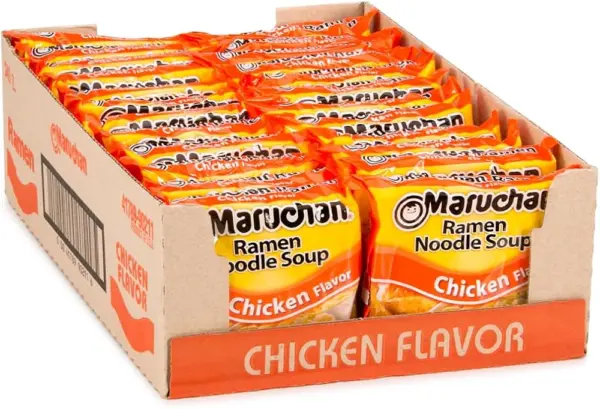
Maruchan Ramen Chicken, 24 Pack
Key Features
- Prep: Stovetop
- Cook Time: 3 minutes
- Pack Count: 24 packets
- Serving Size: 3 oz
- Price: Budget
Twenty-four packets of Maruchan is the least expensive way to keep full-size ramen in the house, and the chicken flavor is why we put it first rather than the price. The broth is light and savory with a little umami behind it, which sounds like faint praise until you start adding things — a soft-boiled egg, the last of a rotisserie chicken, a handful of frozen corn — and find the bowl still tastes like itself.
Three minutes in a saucepan with the packet stirred in off the heat is the whole recipe, and the mildness is the point: it is the pack a kid will finish, the one that takes whatever is in the fridge without turning muddy, and the one we reach for when we do not want to think. Buying by the case is what turns it into a pantry instead of a one-off, and the individual packets stack flat and go anywhere.
The one caution with a box this size is the noodle block. Cases travel and then sit, and a block can arrive cracked into pieces; broken noodles cook exactly the same, so that is cosmetic. A block that is rock hard and smells of nothing is a different problem, so check the date on the individual wrappers when the box lands and buy a case you will finish in a few months rather than one you are still working through next year.
Pros
- Mild broth takes any add-in without turning muddy
- Three-minute stovetop cook, no technique required
- Lowest cost per full-size packet in this set
Cons
- Plain on its own; built to be doctored up
- Big 4.5-pound box needs shelf room
We recommend it as the default because the mild broth takes any add-in, the noodles cook in three minutes, and a case costs less per bowl than anything else full-size here.
Best for Spicy Korean Bowls
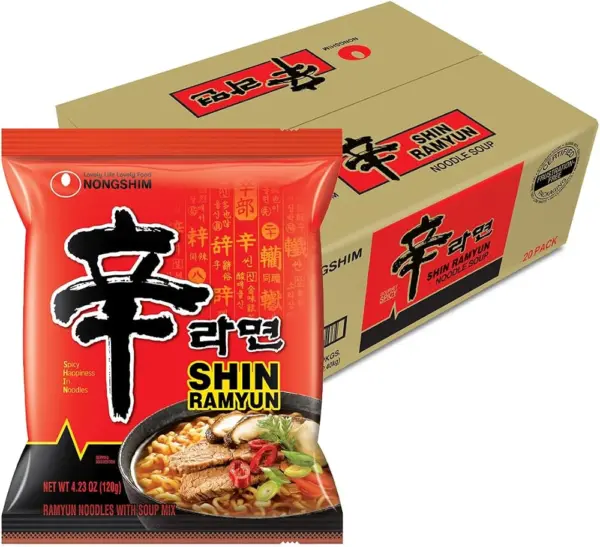
Nongshim Shin Ramyun, 20 Pack
Key Features
- Heat: Spicy, adjustable
- Prep: Stovetop or microwave
- Pack Count: 20 packets
- Serving Size: 4.23 oz
- Price: Budget
A pack of Shin weighs 4.23 ounces, roughly 40 percent more than the standard three-ounce packet, and that is the first thing you notice: this is dinner, not a snack you eat and then go looking for something else. The broth is beef first and chili second, so the heat has something to carry instead of just burning.
What we appreciate most is that the heat is a dial. The soup base is strong enough that two-thirds of the packet still gives a full-flavored bowl, which is how we make it when someone at the table is not chasing endorphins. The noodles earn their own case: they stay chewy and springy even when you leave them in a minute longer than the pack says, which is more forgiveness than most packets offer.
It microwaves too, which matters if you keep a pack at the office — a few minutes in a bowl of water gets you close, though the stovetop gives you more say over how firm the noodle ends up. Twenty packs is a lot of heat to commit to, so eat one bowl before you stock the shelf, and keep a milder pack next to it if kids are eating.
Pros
- Oversized 4.23-ounce pack eats as a full meal
- Heat is adjustable by using part of the base
- Noodles stay chewy if you overcook them
- Beef-forward broth, not just chili burn
Cons
- Serious heat that not everyone wants
- Costs more per pack than our top pick
We reach for Shin when we want heat with actual beef flavor behind it, and the oversized pack makes it a real dinner rather than a snack.
Best for Restaurant-Style Tonkotsu
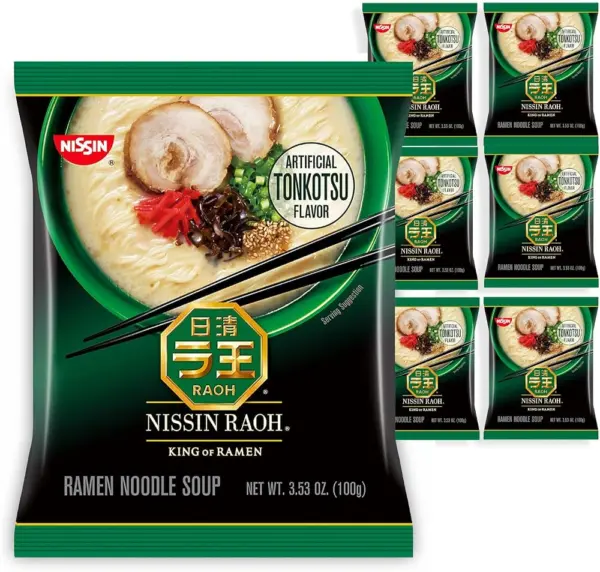
Nissin RAOH Tonkotsu, 6 Pack
Key Features
- Cook Time: 4 minutes
- Pack Count: 6 packets
- Noodle Style: Air-dried, not fried
- Serving Size: 3.53 oz
- Price: Premium
Nissin air-dries and steam-cooks these noodles instead of frying them, and you can taste it in the first slurp: there is a bite and a slight bounce to them, and they hold that texture to the last spoonful. It is why this is the pick we point people to when they want instant ramen that eats like the bowl from a shop.
The broth is tonkotsu — creamy, porky, deeply savory — and it comes together with two cups of water and four minutes. One thing to know before your first bowl: the dry seasoning smells sharply of sesame oil when you open the packet, more than the finished soup tastes of it. Do not judge it on that first whiff, because the bowl is rounder and mellower than the aroma suggests.
This is the pick for the night when the ramen is the point rather than the fuel. Add a boiled egg, corn, and scallions and it lands close enough to a restaurant bowl that we keep a box for weekends rather than for the everyday lunch, and the six packs store in a box small enough for a crowded cabinet.
Pros
- Air-dried noodles with a firm, fresh-style bite
- Creamy tonkotsu broth close to restaurant style
- Compact six-pack box fits small kitchens
Cons
- Priciest per bowl of the picks here
If you want instant ramen that eats like a restaurant tonkotsu bowl, this is the one we point people to — just treat it as an occasional buy.
Best for Microwave-Only Kitchens
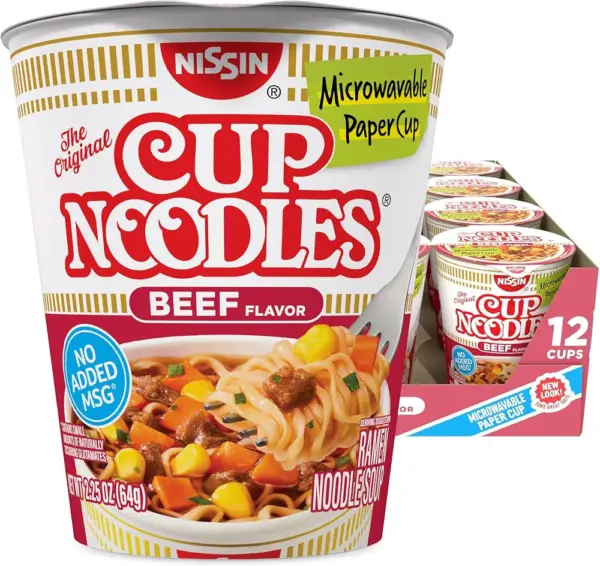
Nissin Cup Noodles Beef, 12 Pack
Key Features
- Cup: Paper
- Prep: Microwave, 2:15
- Pack Count: 12 cups
- Serving Size: 2.25 oz
- Price: Budget
The cup is the feature. This one is paper, so you add water and put the whole thing in the microwave for about two and a quarter minutes — no kettle, no pot, no bowl to wash. For anyone whose hot water comes from a microwave rather than a stove, that changes the calculation entirely. The cup comes out hot, as paper cups do, so set it down for a minute before you pick it up.
The beef broth is mild and a little sweet, the noodles come out tender without going mushy, and there is enough dehydrated vegetable in the cup that it reads as soup rather than broth and pasta. It is a plain, almost retro flavor — nobody is going to call it complex, and that is not what the cup is for.
We rate it the best of the cups here for that microwave line, because it removes the one piece of equipment that keeps cup noodles out of offices and dorm rooms. Keep a case in the drawer, bring a boiled egg from home, and it is the fastest hot lunch in this group.
Pros
- Microwaves in about two minutes, no kettle needed
- Noodles stay tender rather than mushy
- Cheap enough to stock a dozen at a desk
Cons
- Snack-size cup; a real meal takes two
For a desk drawer or a dorm shelf, this is the cup we pick: add water, microwave two minutes, and you are eating without a kettle.
Best for Heat Seekers
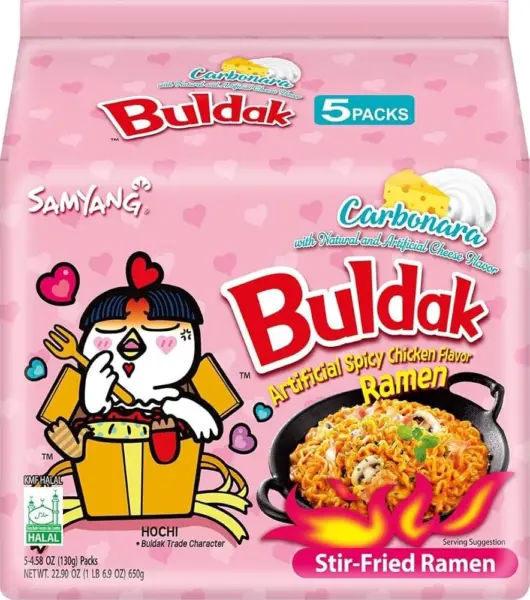
Samyang Buldak Carbonara, 5 Pack
Key Features
- Heat: Very hot
- Style: Stir-fried, no broth
- Cook Time: 5 min boil, 30 sec stir-fry
- Pack Count: 5 packs
- Price: Midrange
There is no broth at the end of this one. You boil the noodles for five minutes, drain them down to a few spoons of water, then stir-fry them with the sauce for half a minute, which is why they come out coated and chewy instead of swimming.
The heat arrives in two stages: a sweetness first, then a build that lingers after the bowl is empty. The carbonara sauce takes some of the edge off, though it is still hot enough that we keep milk nearby; using part of the red packet is the obvious lever, and a spoon of cream cheese does more than you might expect to round it out.
It is the one here that is not really soup, and that is exactly the appeal on a night when a bowl of broth sounds dull — saucy, chewy, sweet-then-hot is a different kind of craving. The bag holds five packs, which is the right size for something this intense: a week of lunches to find out whether you are a Buldak person.
Pros
- Stir-fry method gives a chewy, sauce-coated noodle
- Heat can be tuned with part of the sauce packet
- Five-pack bag is a low-commitment trial
Cons
- Serious, lingering heat that is not for everyone
The one here we keep for nights when broth sounds boring: chewy noodles, a sweet-then-hot sauce, and no soup at all.
Best for Kettle-Only Kitchens
Maruchan Instant Lunch Chicken, 12 Pack

Key Features
- Prep: Add boiling water
- Pack Count: 12 cups
- Stand Time: 3 minutes
- Serving Size: 2.25 oz
- Price: Budget
This is the cup for a kitchen with a kettle and no microwave, or for a lunch where nobody wants to wash a bowl: fold the lid back, add boiling water to the line, close it, wait three minutes. It is also the cup most likely to be in a kid’s lunchbox, and the mild chicken broth is the reason.
We still like it for that job. It is the cheapest cup here, the broth is gentle enough that a picky eight-year-old finishes it, and the noodles go soft in three minutes without any attention — no stirring, no timing anxiety. What holds it back is the competition: the Nissin paper cup microwaves, and this one’s directions call for boiling water, so it is now the cup for kettle households rather than the default.
It is the twelve-pack we keep for the after-school window and the nine o’clock gap, and the one we suggest for a first apartment, because a kettle costs less than a pot and this needs nothing else. Stack the case where the kettle lives and it becomes the thing you never have to think about.
Pros
- Cheapest cup in this set
- Mild chicken broth that kids actually finish
- Needs only boiling water, no pot or bowl
Cons
- Snack-size 2.25-ounce cup
Maruchan’s chicken cup stays in our rotation for kettle households and kids’ lunches, where mild broth and three minutes are the whole point.
Best for Plant-Based Eaters
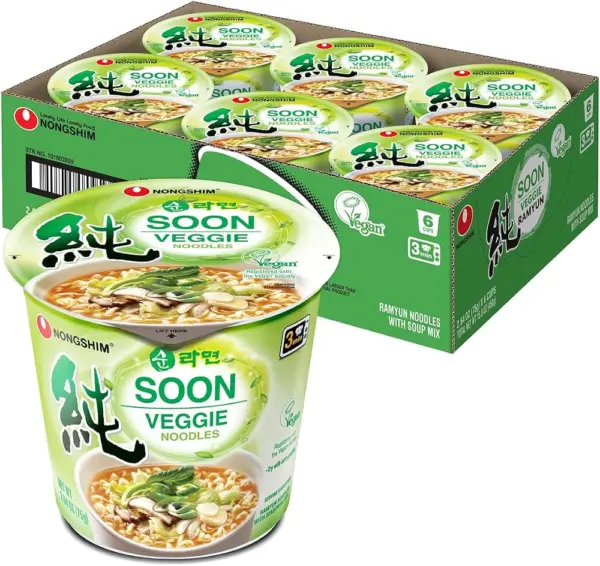
Nongshim Soon Veggie, 6 Pack
Key Features
- Diet: Vegan
- Prep: Hot water or microwave
- Pack Count: 6 cups
- Serving Size: 2.64 oz
- Price: Midrange
Soon Veggie is the only plant-based cup in this group, and it does not eat like a compromise: the broth is a savory vegetable stock with real depth, closer to a good miso soup than to a thin vegetable broth.
It is also the answer for anyone who found Shin Ramyun too hot. The heat here is mild and lingering rather than sharp, and the noodles — 2.64 ounces of them, bigger than a standard cup — keep some bite instead of collapsing into the broth.
Sodium is where it earns a warning. It is salty, the kind of cup where the seasoning packet decides the bowl, so we use about two-thirds of it, add a little extra water, and finish with a squeeze of lime or a splash of rice vinegar to keep the flavor from going flat.
We rate it the best plant-based cup here, and a good mild option for anyone who is not chasing heat. The six-cup box is small enough to try without giving up a pantry shelf, which suits a product one person in a house of meat-eaters might keep for themselves.
Pros
- Fully vegan broth with genuine savory depth
- Mild heat suits people who skip spicy ramen
- Larger 2.64-ounce cup than standard
Cons
- Priciest cup of the picks here
It is the plant-based one worth stocking: savory vegetable broth, gentle heat, and noodles that keep some bite.
How We Chose and Tested Instant Ramen
We built the shortlist by walking the ramen aisle of four grocery chains and cross-checking what stayed consistently in stock online, then filtered by format — cup-style, packet, stir-fried, and vegan broth — so the lineup matched how people actually buy this stuff. Anything seasonal or impossible to reorder got cut. That left 18 varieties, which we tested over three months.
Every variety was cooked exactly as its package directed and timed with a stopwatch. We tasted in passes: the dry block’s aroma first, then the broth on its own, then the noodles at the one-minute mark and again at five and ten minutes to see whether they stayed springy or went soft. We logged the use-by date on each package as it arrived and set aside any block that showed up cracked. Halfway through each week we made a second bowl and doctored it — an egg, scallions, leftover vegetables — to see whether the flavor held up or fell apart under additions.
Heat got ranked three ways, by two of us who eat chile regularly and one who doesn’t, because a bowl that reads mild to one person can be inedible to another. We read the sodium panel on every package, then tasted to see whether the broth had any depth beneath the salt. Ease of use came down to steps: kettle versus microwave, whether the cup needed stirring, how many minutes from opening to eating. Value was judged per serving — how much noodle and broth you actually got, and how much doctoring it took to make a satisfying bowl.
How to Choose Instant Ramen
Before you compare flavors, compare formats: a packet, a cup, and a stir-fry pack ask for different equipment, deliver different portions, and cost very different amounts per bowl.
Packet, Cup, or Bowl: Match the Format to Your Kitchen
Packets ask for a pot, water, and a heat source, and they give you the most control and the most food for the money. Cups ask for hot water and nothing else, but the kind of hot water matters. Nissin’s Cup Noodles is a paper cup that goes in the microwave for a little over two minutes; Maruchan’s Instant Lunch calls for boiling water from a kettle and gives no microwave directions.
That is the trap: the word cup tells you nothing about how it heats. If your only hot water comes from a microwave, buy cups whose directions say microwave. If you have a kettle at home or a hot-water tap at work, either format works. Read the prep line before you commit to a twelve-pack.
Heat Is a Setting, Not a Specification
Spicy labels do not travel between brands. One company’s hot is another’s mild, and the same line often comes in a gentle version and an extreme one. The soup base is the real dial: most spicy packs taste complete with half to two-thirds of the seasoning, and a spoon of cream cheese, a beaten egg, or a little sugar rounds off the edge without flattening the flavor.
So do not stock twenty packs of something you have not eaten once. Buy the smallest format a brand offers, a five-pack bag or a six-cup box, and scale up when you know where your ceiling is.
Noodles: Fried, Air-Dried, and Stir-Fried
Most instant noodles are flash-fried, which is what lets them hydrate in three minutes and keeps them cheap. Air-dried noodles like Nissin’s RAOH take a few minutes longer and cost more, and they come out firmer, with a bite closer to fresh noodles. Stir-fry styles such as Buldak go further: you drain the noodles and toss them in sauce, so there is no broth and the texture is chewier.
Choose soup packets for volume and comfort, non-fried noodles when the noodle itself is the point, and a stir-fry pack when you want something that is not a bowl of broth.
Compare Portion Size Before You Compare Price
The weight on the pack decides whether you are buying lunch or a snack. A 2.25-ounce cup is a snack, a 3-ounce packet is a light meal, and a 4.23-ounce pack of Shin is a full dinner for most people. The case price hides all of that.
Do the division once: 24 packets at 3 ounces is 72 ounces of food, while 20 packs at 4.23 ounces is about 85 ounces. Divide the case price by total ounces and some of the cheapest-looking boxes stop being the bargain they appeared to be.
Turn the Packet Into a Meal
Every one of these is mostly noodles and salt, and what separates a sad bowl from a good one is what goes in it. An egg, soft-boiled or cracked in and poached by the residual heat, a handful of frozen vegetables, greens wilted in the hot broth, or leftover meat all work with any pick here. Acid does more for a flat bowl than extra seasoning: lime, rice vinegar, or a spoon of kimchi.
If sodium is a concern, the packet is your lever. Use part of it and rebuild depth with aromatics such as garlic, scallion, and dried mushroom rather than more salt.
Frequently Asked Questions
What’s the difference between ramen and ramyun?
Nothing you need to worry about. Ramyun is the Korean spelling of the same word, and the packs sold under it, including Shin Ramyun, Soon Veggie, and Buldak, are instant noodles in the Korean style: thicker noodles, beefier broths, and usually more heat than the Japanese and American packets.
The cooking method is the same. Search both spellings when you shop, because a listing may use one and not the other.
Can kids make instant ramen on their own?
The noodles are easy; the water is the risk. A kettle of boiling water is a scald hazard for a child, so for younger kids an adult should pour and set the cup down on a plate before handing it over.
Older kids can handle a microwaveable paper cup like Cup Noodles, with a reminder that the cup and the broth come out hot and need a minute to settle.
How much water do you use for instant ramen?
Cups have a fill line, so use it and stop there; more water makes a weaker broth and a cooler bowl. For packets, about two cups gives you a brothy soup, and slightly less gives a stronger, almost saucy bowl.
When the pack specifies a quantity, follow it, as with Nissin’s RAOH, which calls for two cups and four minutes.
Final Verdict
Our pick is the Maruchan chicken case. It is the cheapest full-size packet here, the broth is mild enough for a kid and neutral enough to take whatever is in the fridge, and three minutes in a saucepan is the entire recipe. If you want one default that covers lunch, a late dinner, and a pantry you do not have to think about, that is it.
Change the requirement and the answer changes: Shin Ramyun if you want heat and a bigger bowl, Nissin’s RAOH if the ramen itself is the treat rather than the fuel, and Cup Noodles if your hot water comes from a microwave.