This post contains affiliate links. We may earn a small commission when you buy through our links — at no extra cost to you.
A butcher block is the rare kitchen purchase that gives something back: a thick wooden surface is gentle on knife edges, quiet under the blade, and steady enough to break down a whole chicken on. The trouble is that a big slab of wood is heavy, it wants oiling a few times a year, and a poorly built one will cup or split long before its time. What you’re really paying for is a board that stays flat and stays put while you work.
I still have the maple block from my first apartment — it has survived two moves and three roommates, so I have opinions here. Over the past eight months, my team and I chopped, carved, and scrubbed our way through 12 boards, from thick end-grain slabs to lighter carbonized bamboo. Worth knowing before you shop: end grain, the checkerboard pattern, is gentler on knives and hides cut marks, but it’s heavier, thirstier for oil, and pricier than edge grain, which is what most people actually need. The picks below are the ones that stayed flat and cleaned up without a fight.
Best for Everyday Prep
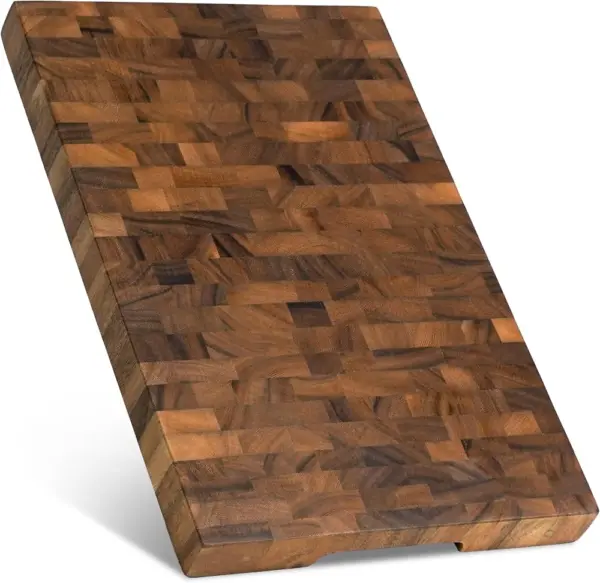
SHUMARU End Grain Board
Key Features
- Weight: 11 lb
- Surface: Flat, groove-free top
- Material: End-grain suar wood
- Dimensions: 20 x 13 x 1.6 in
- Price: Midrange
Eleven pounds of suar wood, 1.6 inches thick, and it goes nowhere. That’s the first thing we noticed about this block: set it down and it plants, non-slip feet and all, so you can push through an onion without chasing the board across the counter. The construction is what makes it our top pick. End grain stands the wood’s fibers on end, so a knife slips between them rather than slicing across, which is easier on an edge and leaves a surface that closes back up behind the blade.
The working surface runs 20 by 13 inches, and all of it is flat — no channel carved around the perimeter, so nothing is wasted on a board this size. That’s the right call for vegetables, bread, and dough. For a roast or a pile of ripe tomatoes, understand that juices will run to the counter, so carve on a rimmed sheet pan or a platter instead of on the board.
Suar is an unusual species for an American kitchen, and it wants feeding: the maker asks for food-grade mineral oil every three to four weeks, hand washing only, no soaking. We treat that as the cost of a mid-priced end-grain block rather than a knock on it, because a sealed board is a board that doesn’t go rough and gray. A one-year warranty backs it, which is a nice thing to have on a species you haven’t owned before.
Pros
- End grain is gentle on knife edges
- 11 pounds plus non-slip feet stay put
- Full 260 square inches of flat surface
- Midrange price for end-grain construction
Cons
- Needs food-grade oil every three to four weeks
- Smaller surface than the 24-inch boards here
Our pick for most kitchens: end grain spares your knife edges, 11 pounds of suar wood stays put, and it costs less than the big maple blocks here.
Best for Big-Batch Cooking
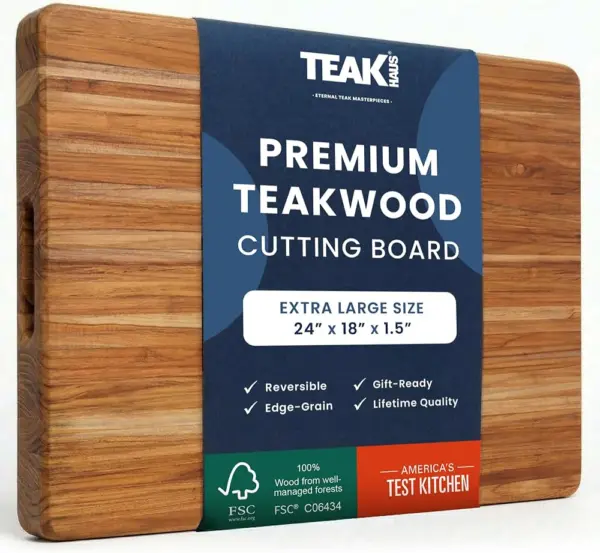
Teakhaus Edge-Grain Teak Board
Key Features
- Grain: Edge grain
- Weight: 14.4 lb
- Material: FSC-certified teak
- Dimensions: 24 x 18 x 1.5 in
- Price: Premium
Twenty-four by 18 inches of teak is a serious amount of board, and the grip handles at each end are what make it practical: 14.4 pounds is more than most people want to carry by the fingertips, and the recessed cutouts give you somewhere to hold on. Teak’s natural oils are the other draw — this is a wood that shrugs off moisture better than most — and the board is FSC-certified if responsible sourcing is part of your decision.
As a prep station it’s the most capable board in this group. A full sheet pan of vegetables, a stockpot’s worth of mirepoix, a bird and its trimmings: this is the board that doesn’t run out of room halfway through, and at 1.5 inches thick it stays flat under a cleaver. We reach for it when the cooking is a project rather than a quick dinner, and the reversible design means both faces earn their keep.
Hand wash it, dry it upright, and don’t leave it standing in water — teak resists moisture, but a board that stays wet is where splitting starts, and splitting is the failure to watch for on this model. On a polished stone counter it can also spin under a hard push, and a damp towel underneath settles it. Neither issue shows up in a home kitchen with a butcher-block counter and a dish towel on hand.
Pros
- Largest cutting surface in this set
- Teak resists moisture and is FSC-certified
- Grip handles make 14.4 pounds manageable
- Two flat faces, both usable
Cons
- Takes 24 inches of counter and sink
- Heavy to lift and rinse at 14.4 pounds
For cooking in volume, the 24-by-18-inch teak surface gives you room a 20-inch board can’t, and the grip handles make the 14.4-pound lift bearable.
Best for Classic Maple Block
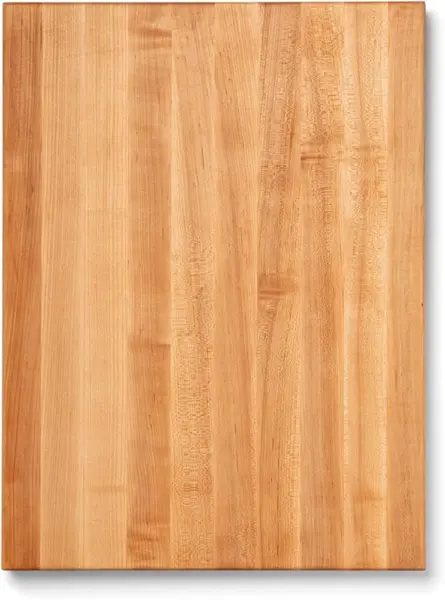
John Boos R-Board
Key Features
- Grain: Edge grain
- Origin: Made in the USA
- Material: Maple
- Dimensions: 24 x 18 x 1.5 in
- Price: Premium
The R-Board lines up with our teak pick inch for inch — 24 by 18 by 1.5 inches — and then goes its own way: hard maple instead of teak, made in the USA, with recessed finger grips at the ends and an oil finish from the factory. Side by side, the difference is the look of the grain and the way each wood takes a mark. Maple reads butcher shop; teak reads furniture.
Maple is the wood that built the American butcher block: dense, closed-grained, and happy to be flipped and used on both faces. It arrives oiled, which is a thoughtful touch, but that finish is a starting point rather than a seal. Budget for Boos’s oil and cream and an hour with the board every few weeks, and the surface stays smooth instead of going thirsty and rough.
Where this board earns its place is the whole package — a genuine American-made maple block with a one-year guarantee, in the same footprint as the teak. The thing to go in knowing is warping: a bowed block rocks instead of sitting flat, and no amount of oil brings one back. Keep it out of the sink, dry it on edge, and stay ahead of the finish, and you’re giving it the best odds of staying flat for years.
Pros
- Hard maple, made in the USA
- Recessed finger grips and a factory oil finish
- Same 24-inch footprint as our teak pick
Cons
- Warps if it stays wet or dries out
- Oil and board cream cost extra
Buy this if you want the American butcher-shop original: hard maple, a 24-inch footprint, and a board that rewards a serious oiling routine.
Best for Small Kitchens
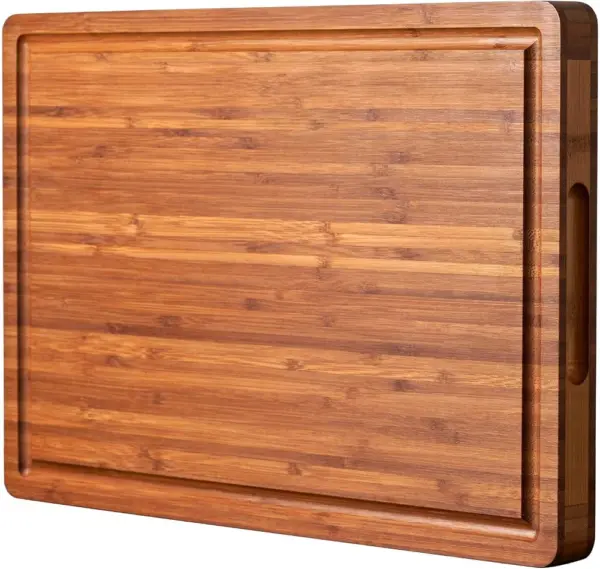
Allsum Carbonized Bamboo Board
Key Features
- Sides: Grooved and flat
- Weight: 3.9 lb
- Material: Carbonized bamboo
- Dimensions: 16 x 11 x 1 in
- Price: Budget
The cheapest board here is bamboo rather than hardwood, and it earns its spot by doing the thing that matters most in a small kitchen: a thick, stiff surface that doesn’t cost much. One inch of carbonized bamboo in three laminated layers, a juice groove down one face and a flat one on the other, and a cutout handle at the end for carrying it out to the grill. For burgers and a pile of peppers, that’s plenty of board.
What the money doesn’t buy is a long life. Bamboo is glued-up grass, and the edges are where it goes — splintering along the rim after a wash is the thing to guard against, so hand wash it, dry it immediately, and keep it oiled. At 3.9 pounds it’s also light enough to skate across a smooth counter, and 16 by 11 inches is a small board: fine for an onion and a couple of chicken breasts, tight for a whole meal’s prep.
The two-sided design is more useful than it sounds. Use the grooved face for a roast chicken or half a watermelon and the flat face for vegetables, so your knife isn’t climbing in and out of a channel every few cuts. Flip it and the board does the other job.
Pros
- Juice groove on one side, flat on the other
- One inch thick for the least money here
- Handle cutout makes it easy to carry
Cons
- Bamboo edges can splinter
- Light enough to slide on smooth counters
- 16 x 11 inches is small
A thick, grooved bamboo board for the least money here — the right first board for a small kitchen, as long as you dry it every time.
How We Tested 12 Butcher Block Cutting Boards
We started by gathering every board we could find that was at least an inch thick, large enough to hold a real pile of chopped vegetables, and built with two usable faces, since reversibility and grip handles came up again and again in what shoppers told us they compare. From there we sorted by grain, footprint, and price, and narrowed to 12 boards, from a 24-inch slab that barely fits beside a sink to a lighter bamboo option built to be carried to the table. Each one’s usable surface area got tallied against its cost so we could see what you’re actually getting for the money.
Every board moved into a real kitchen for eight months and got used the way boards get used: dicing onions and sweet potatoes on a Sunday afternoon, breaking down a whole chicken, kneading bread dough on weekends and letting it rise right on the wood, carving a roast at a holiday dinner, and piling salami and cheese onto it for a party. We weighed each one at the start and noted how it felt to haul out of a drawer or carry across the room.
Flatness was the number we watched hardest. Once a month we laid a straightedge across each face and looked for daylight, including after a board spent a week next to a steamy sink or leaning against a wall. For stability, we minced garlic on a bare counter and then on a damp towel to see which boards crept. Cleaning meant wiping with mild soap and water, then checking whether onion or fish odors hung around, and we photographed every board at week one and week eight to catch cut lines, stains, and color shifts early. Along the way we noted how the blade felt going into a carrot, whether it sank or skidded, and how much oil each board drank at its first seasoning.
How to Choose a Butcher Block Cutting Board
The board you keep is the one you’re willing to wash and oil, so construction, size, and upkeep decide more of this purchase than the species printed on the label.
End Grain or Edge Grain
End grain stands the wood’s fibers upright, so a knife slips between them instead of slicing across; the surface closes back up behind the blade, which is easier on an edge and hides cut marks. Edge grain runs the strips lengthwise, which makes a stiffer, less expensive board that shows every chop.
End-grain blocks also drink more oil and cost more up front. Choose end grain if you care about your knives and will keep up with oiling; choose edge grain if you want the biggest surface for the money and don’t mind a board that records its history.
Match the Size to Your Counter and Sink
A 24-by-18-inch board is furniture. It needs roughly two feet of clear counter and a sink wide enough to wash it, and plenty of apartment sinks can’t take one. A 20-by-13-inch board handles weeknight prep and rinses in a standard sink, which is part of why our top pick lands there.
Weight follows size, and 11 to 14 pounds is the range where a board stops sliding without needing a towel under it. Every pound above that is another pound you lift to the sink.
Plan for the Upkeep
Every wood board here is hand wash only. Heat and standing water swell the wood and stress the glue lines, so wash, rinse, and stand the board on edge to dry rather than leaving it flat on the counter.
Oil is the recurring cost. Food-grade mineral oil every few weeks keeps the fibers sealed, and a board left dry is a board that cracks. Buy a bottle with the board and treat the first oiling as part of setup; Boos sells its own oil and cream, and plain food-grade mineral oil is the usual stand-in on the others.
Juice Grooves, Handles, and Reversible Sides
A groove catches runoff from a roast or a pile of tomatoes, but it also takes a strip of cutting surface out of the board and gives you a channel to clean around. If you carve more than you chop, a grooved board earns its place; if you’re prepping vegetables, a flat top gives you more usable board.
Grips matter more than they sound on anything over 10 pounds. Recessed finger grips or a cutout handle are the difference between moving a block with two hands and wrestling it.
Frequently Asked Questions
Is a bamboo butcher block as good as a hardwood one?
Bamboo is grass pressed and glued into layers, and carbonized bamboo handles moisture well — a one-inch bamboo block is genuinely useful and costs far less than hardwood. What it doesn’t do as gracefully is recover: bamboo edges can splinter where a hardwood board can be sanded and re-oiled smooth.
If you want a board you can refinish more than once, buy hardwood. If you want thickness on a small budget and will dry it every time, bamboo is a fair trade.
Can I cut raw meat on a wooden cutting board?
Yes, with one rule: give raw meat its own side or its own board. Wash with hot soapy water immediately after, then stand the board on edge so both faces dry completely before it touches bread or vegetables.
The thing that causes trouble isn’t the wood, it’s a board that stays damp. Dry it upright with airflow on both faces rather than laying it flat against the counter.
Can I sand out knife marks and stains?
That’s the advantage of solid wood. Let the board dry completely, sand lightly with the grain using fine paper, wipe off the dust, and re-oil. Shallow cuts and most stains come out in a few minutes.
Deep gouges and any crack that has opened along a glue line don’t sand out. A board that has split should be replaced rather than repaired, because the crack will keep catching your knife.
Final Verdict
The SHUMARU is the board we point most people to. End grain at a mid-range price, heavy enough to stay put on the counter, and small enough to wash without a second pair of hands — that combination is why it wins here.
Cook in volume and the Teakhaus earns the extra money with 24 inches of teak; want an American-made maple block and will keep it oiled, and the Boos R-Board is the classic call. Outfitting a first kitchen on a tight budget, the Allsum gets you a thick, grooved board now and a better one later.