This post contains affiliate links. We may earn a small commission when you buy through our links — at no extra cost to you.
The first sign your tap water has a problem usually isn’t dramatic. It’s a glass that smells faintly of chlorine, or ice cubes that taste like the inside of a pool. An under-sink filter fixes that at the source, tucking the treatment out of sight and leaving you with one faucet—or a dedicated drinking-water tap—that you actually want to use. The catch is that “filter” covers everything from a compact inline cartridge to a multi-stage reverse osmosis system that strips minerals and, in some cases, adds them back. I’ve learned to care less about the stage count and more about whether the thing installs without swearing, seals without weeping, and keeps tasting clean long after the novelty wears off.
Over the past six months, my team and I tested 12 under-sink systems in everyday kitchens, timing solo installs, tasting water side by side, and watching filter-life claims against real use. The best ones handled the boring stuff—clearance under the cabinet, leak-free fittings, filter changes you can do without a plumber—as well as the important stuff: water that tastes neutral and stays that way. Value matters too, but not just the sticker: a cheap system with a six-month cartridge can cost more per gallon than a pricier one with a five-year filter. The picks below are the ones we’d put under our own sinks.


Best for Family Kitchens
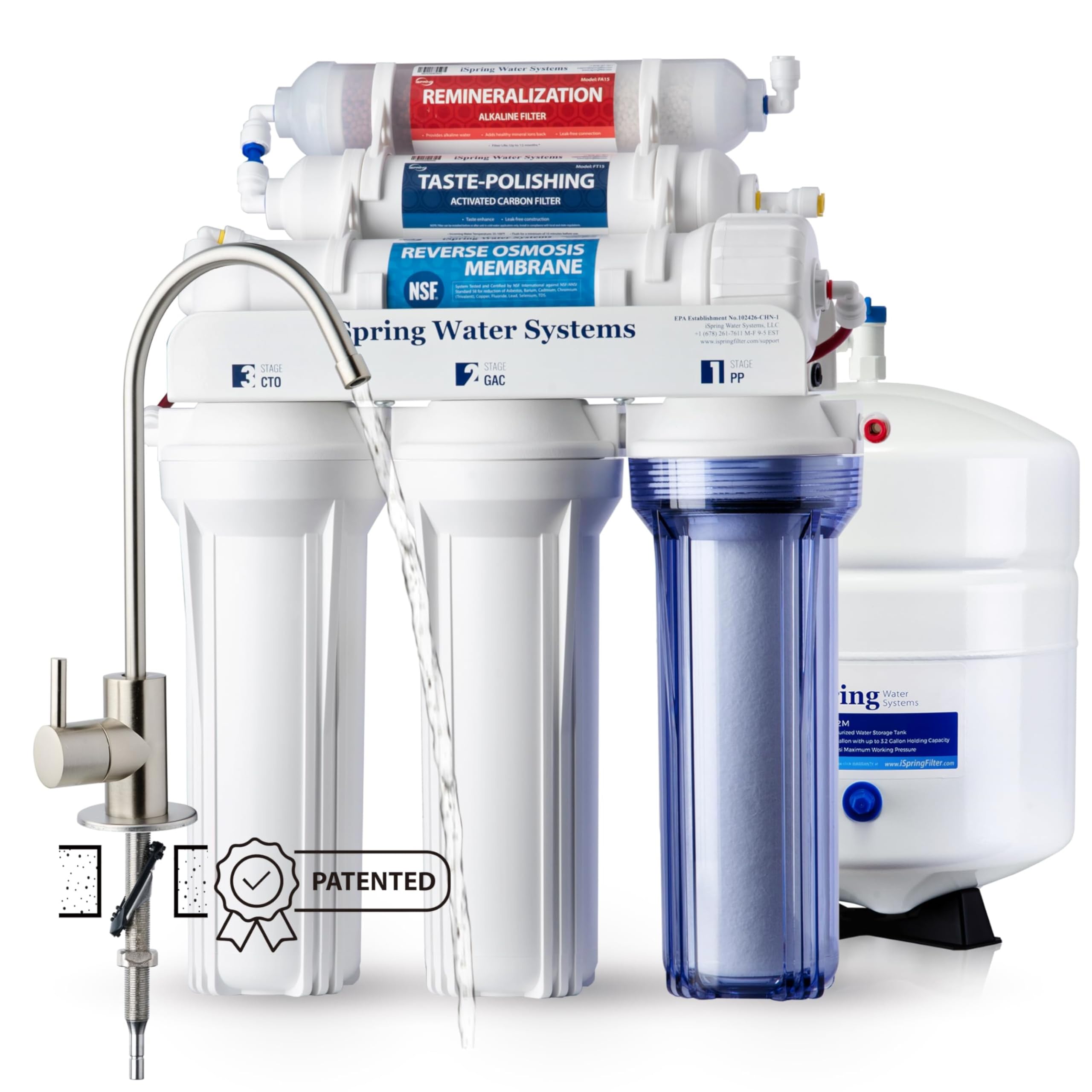
iSpring RCC7AK-BN
Key Features
- Footprint: 15.5 x 16 x 18 in.
- Filtration: 6-stage RO with alkaline stage
- Filter life: 6 months
- Certification: NSF/ANSI 58
- Price: Premium
Six stages and a mineral cartridge is the short version. The RCC7AK is the only system here certified to NSF/ANSI 58 as a complete unit, and the only one that puts minerals back into water its membrane has stripped. That second part is what won us over. Reverse osmosis pulls the dissolved material out — the listed reductions run 93 to 98 percent of total dissolved solids, with PFAS, fluoride, and lead on the same sheet — and it takes the taste with it. The alkaline stage puts the roundness back, and the glass it pours is the best in this group.
Installation is easier than the plumbing under your sink suggests. The faucet fastener is designed to be tightened from above the counter, so you’re not on your back with a basin wrench. You do need a home for two bodies: the filter stack measures 15.5 by 16 by 18 inches, the storage tank is separate, and the reject water needs a drain connection. Measure the cabinet before you commit, because this is the biggest footprint in the guide.
The included faucet is the part to watch. A drip at the spout or at the threads is where this one gives trouble, and the remedy is a replacement faucet — sometimes from iSpring, sometimes a standard one you fit yourself. Plan on filters twice a year, too: a six-stage system means five cartridges, and the transparent first-stage housing is there so you can see the sediment load before the calendar tells you.
One number decides whether it suits you: 750 ppm. iSpring rates the system for supply water up to that TDS, which covers municipal water and plenty of wells. Above it, the membrane works harder, the cartridges die younger, and no amount of filtration math rescues the purchase.
Pros
- NSF/ANSI 58 certified as a complete system
- Remineralizing stage fixes flat RO taste
- Faucet tightens from above the counter
- Clear first-stage housing shows sediment load
Cons
- Needs a deep cabinet corner plus a tank
- Five cartridges every six months
If you want the most thorough filtration on this list and can spare the cabinet space, we think the RCC7AK is the one to buy.
Best for Budget Kitchens
Waterdrop 10UB
Key Features
- Faucet: Included
- Capacity: 18,750 gal.
- Flow rate: 0.75 gpm
- Filtration: Carbon block
- Price: Budget
There’s a wide gap between this and the RO systems in this guide, and it still buys most of what a kitchen actually needs: a separate drinking tap, a brushed stainless faucet, and a carbon block that takes the chlorine out of city water. One cartridge runs 18,750 gallons, roughly a year of drinking and cooking.
The install lands in the half-hour category — push-to-connect fittings, a twist-and-lock cartridge, cold supply only. The one part that isn’t reversible is the hole. A dedicated faucet needs a 1-inch opening in the sink deck or counter, so if you rent, look at the direct-connect systems instead.
At 0.75 gallons a minute the tap fills a glass or a coffee pot without drama and takes its time with a stockpot; for drinking water, we don’t think that matters. Watch the two joints that carry pressure — the faucet threads and the outlet push-fit — wrap the threads with the supplied tape, and run a tissue along both after the first hour.
Against the Waterdrop 15UA this is the same money for half the filter life, and you get a real tap and a real faucet in exchange. In a kitchen with a spare hole and no patience for a plumbing project, that’s the trade we take.
Pros
- Brushed stainless faucet in the box
- Install is a half-hour job
- 18,750 gallons per cartridge
- Removes chlorine taste and odor
Cons
- Needs a 1-inch faucet hole
- One-year filter life is short here
The cheapest way here to get a dedicated filtered tap, and we recommend it for anyone who wants better water without an RO project.
Best for Low Maintenance
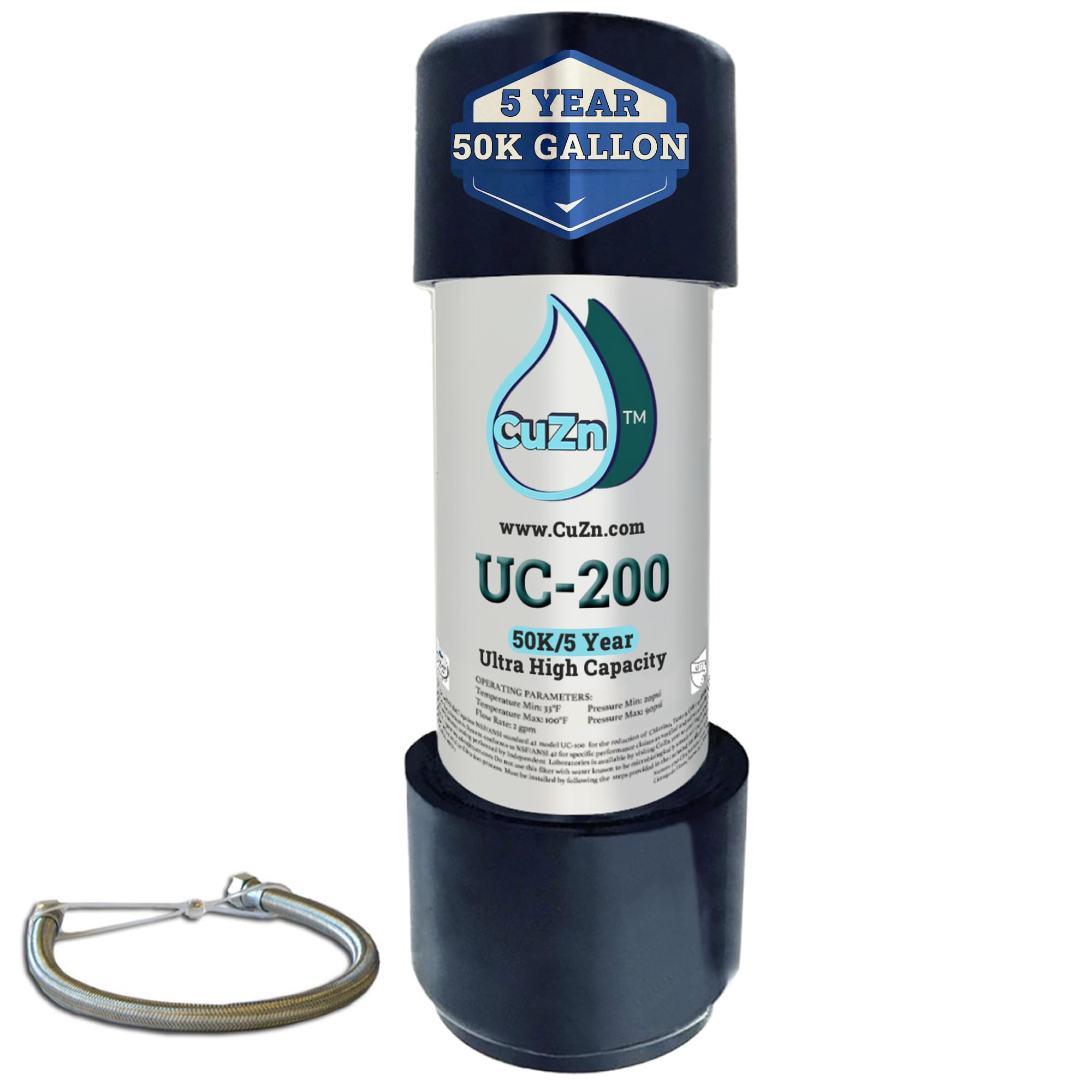
CuZn UC-200
Key Features
- Size: 14 x 5.5 x 5.5 in.
- Filtration: 3-stage KDF and carbon
- Filter life: 5 years
- Certification: NSF/ANSI 42 & 372
- Price: Midrange
Five years is the whole pitch, and it holds together on paper: one canister, one install, one replacement half a decade later. Inside is a three-stage bed — micro sediment membranes, KDF-55, and coconut shell carbon — and it filters without stripping the minerals that make water taste like water. There’s no membrane and no tank, so nothing goes down the drain.
It goes inline on the supply to your existing faucet, which means filtered water at the spout you already use, no extra hole in the counter, and no second tap to keep clean. At 5.5 by 14 by 5.5 inches, with a braided stainless hose in the box, it’s the easiest fit of anything here.
Read the certification before you read the claims. NSF/ANSI 42 covers taste and odor; 372 covers lead-free materials. Neither is a certification for lead or PFAS removal, and this listing claims both, so if a specific contaminant is your reason for buying, a system certified to NSF/ANSI 58 is the safer purchase. For chlorine, taste, and not thinking about it again, this is the one we point to.
Set against the RCC7AK, you trade the membrane and the near-zero TDS reading for five years of silence instead of a filter change twice a year. If your water’s problem is chlorine and taste rather than a contaminant you can name, that’s the better deal.
Pros
- Five-year filter life
- No storage tank or wastewater
- Compact 14-inch canister
- Leaves beneficial minerals in the water
Cons
- Five-year life carries no gallon rating
Buy it if you want to install a filter once and forget it — five years of media, no tank, no drain, and no cartridges to remember.
Best for First Ro System
Express Water RO5DX
Key Features
- Tank: 4 gal.
- Filtration: 5-stage RO
- Daily output: 50 GPD
- Certification: NSF/ANSI 58 & 372
- Price: Premium
Open the box and there’s a leak detector and a full spare filter set sitting next to the system — a year of changes before you buy another cartridge. That’s the detail that makes this the RO kit we send first-time buyers toward: the extras cover the two things new owners get wrong, forgetting the filters and not noticing a drip.
Underneath it’s a conventional five-stage stack — sediment, two carbons, a membrane, and a polishing filter — certified to NSF/ANSI 58 and 372, with a 4-gallon tank and a chrome faucet. Fifty gallons a day is the slowest membrane in this guide against the iSpring’s 75, so a household filling bottles and pots back to back will hear the tank refilling. Two or three people, it keeps up.
The number to check before ordering is 300. Express Water rates the feed water at a maximum of 300 ppm TDS, well under the 750 ppm the iSpring allows, so on a hard well this system sits outside its comfort zone and the membrane pays for it. Municipal water almost never gets near that.
The faucet is the weak link in an otherwise complete kit — watch the threads and the spout for a drip in the first week and put the included detector where you’ll hear it. The system body is 14 by 5 by 15 inches with the tank alongside, so it fits cabinets a wider unit won’t.
Pros
- Leak detector and spare filters included
- NSF/ANSI 58 and 372 certified
- 4-gallon storage tank
- Compact system body
Cons
- Slowest RO here at 50 GPD
- 300 ppm TDS ceiling for supply water
We point first-time RO buyers here: five certified stages, a leak detector, and a spare filter set for less than the iSpring.
Best for High-Volume Use
Waterdrop 15UA

Key Features
- Capacity: 24,420 gal.
- Flow rate: 0.75 gpm
- Filtration: Carbon block
- Filter life: 2 years
- Price: Budget
24,420 gallons, or two years on municipal water, is the longest run between cartridge changes of any direct-connect filter here. That’s the argument for the 15UA in one line: install it once, screw in a cartridge every other year, and the water from your existing faucet stops tasting like a swimming pool.
It’s also the least disruptive install in this guide, because there’s nothing to drill. The system connects to the cold supply under the sink and hangs on two screws; the housing is 16.7 inches tall and under 4 inches square, so it tucks against a cabinet wall and leaves the useful space alone.
Two caveats. The two-year figure is rated for municipal water, and where the supply carries grit the cartridge loads early — flow tapers before the calendar says it should, and that taper is your signal, not the box. And there’s no faucet in the box at all: the filtered water comes out of the tap you already have.
Against the 10UB you give up the dedicated tap and double the filter life for about the same money. In a rental kitchen, or anywhere a 1-inch hole isn’t happening, this is the one that earns its place.
Pros
- 24,420-gallon, two-year cartridge
- No drilling; mounts under the sink
- Twist-and-lock changes without tools
Cons
- No faucet included
- Two-year life assumes municipal water
Two years between cartridge changes and nothing to drill — the simplest way here to put filtered water at the tap you already own.
Best for Tight Cabinets
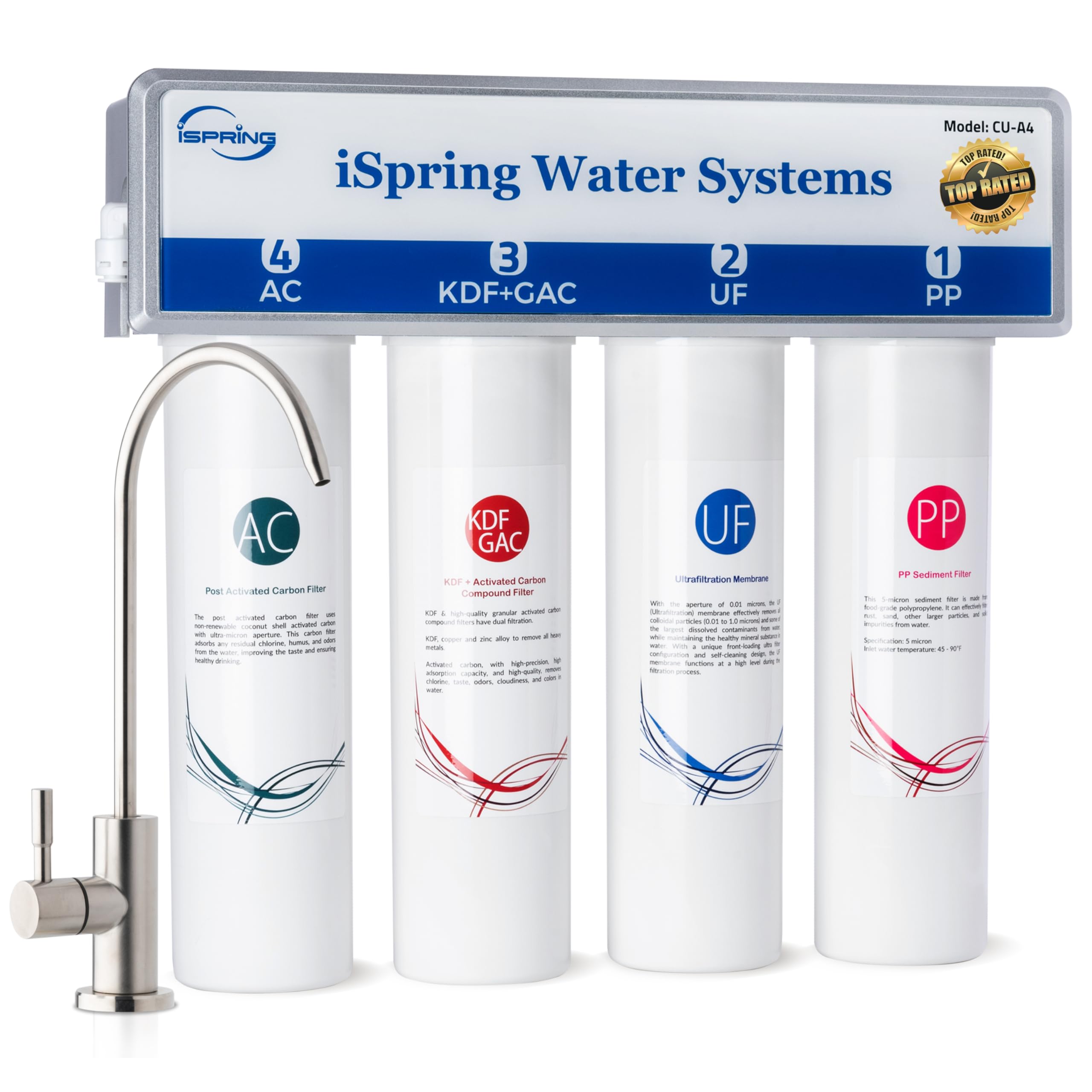
iSpring CU-A4
Key Features
- Size: 10.6 x 4.3 x 12.6 in.
- Faucet: Included, brushed nickel
- Capacity: 8,000 gal.
- Filtration: 4-stage, 0.01 micron UF
- Price: Midrange
No tank, no drain line, and no reject water ticking into the trap. The CU-A4 is for the cabinet with room for a filter and nothing else: four stages in a body 10.6 by 4.3 by 12.6 inches, making filtered water on demand every time you open the tap.
The stack is a 5-micron sediment cartridge, a 0.01-micron ultrafiltration membrane, and KDF/GAC carbon, rated for 8,000 gallons. Ultrafiltration traps fine particles at the pore size while leaving dissolved minerals in the water, so you keep the character of your tap water minus the chlorine — and you don’t get the near-zero TDS reading an RO membrane produces.
Push-to-connect fittings, twist-on cartridges, and a brushed nickel faucet in the box. The detail we appreciate most is the filter change: twist, pull, push, no hoses to disconnect and no wrench waving around in a cramped cabinet.
Where it stops is dissolved contaminants. An ultrafiltration membrane doesn’t strip solids the way reverse osmosis does, so if a high TDS reading or a specific dissolved contaminant is your reason for shopping, one of the RO systems here answers it. This one is for taste, particles, and a cabinet with no room for anything bigger.
Pros
- Tankless, with no drain connection
- 0.01-micron ultrafiltration membrane
- Twist-on cartridges, no tools
- 8,000-gallon capacity
Cons
- Priced above the carbon-only systems here
- Four cartridges to keep track of
For a cabinet with no room for a tank and no drain to spare, this is the system we point to: tankless, wastewater-free, and it keeps the minerals.
How We Tested Under-Sink Water Filters
We started by pulling together the systems that show up again and again in owner reviews and that cover the two main formats: compact inline filters that tie into an existing faucet and multi-stage reverse osmosis units with a dedicated tap. We filtered that list by certifications, rated filter life, replacement-cartridge availability, cabinet footprint, and whether the system needed a separate faucet hole or could feed the faucet already there. Then we bought 12 units and installed them in working kitchens, not a test rig.
Installation was timed solo, with a stopwatch and the tools a normal homeowner has on hand. We noted whether the instructions matched the hardware, how much clearance the housing left under the cabinet, and whether the faucet or fittings needed adapters. Each system ran for a week before we counted it as installed. To check for leakage, we laid dry paper towels under every connection and looked again after 24 hours, then weekly for the rest of the six-month test. We logged drips, weeping threads, and fittings that needed retaping, along with any change in flow rate or faucet finish.
For water quality and taste, we compared filtered and unfiltered water at room temperature and chilled, made coffee and ice, and used chlorine test strips before and after filtration. We tracked whether odors faded, whether water stayed clear, and whether reverse osmosis systems tasted flat or balanced once their remineralization stages kicked in. Filter life and value got the same treatment: we recorded install dates, rated capacities, replacement costs, and how many gallons we actually put through each system, then noted whether cartridge changes were tool-free or required crawling back under the sink. Effectiveness was judged by what came out of the tap over months, not by the box.
How to Choose an Under-Sink Water Filter
The right system is the one that matches what’s in your water and how much cabinet you can give up — after that, most of the differences are convenience.
Match the Filtration to Your Water
Carbon block is the workhorse. It handles chlorine, taste, and odor, and it does it at a flow rate you can fill a pot with. Reverse osmosis adds a membrane that takes dissolved solids, fluoride, and a long list of other contaminants with it, and charges you a storage tank, a drain line, and a slow refill. Ultrafiltration sits between the two: fine enough for particles, gentle enough to leave minerals in the glass.
Then read the certification, not the badge. NSF/ANSI 42 covers taste and odor only. 58 is the full reverse-osmosis standard, and it tells you the whole system was tested rather than one cartridge. 372 covers lead-free materials and says nothing about performance. A listing that says "NSF certified" and means 372 has told you almost nothing.
Measure the Cabinet, Not the Housing
An RO system puts two bodies under your sink: the filter stack and a storage tank, which is why the iSpring needs 15.5 by 16 by 18 inches before the tank goes in. A tankless system such as the iSpring CU-A4 fits a 4-inch slot. Empty the cabinet, measure depth from the back wall to the door hinge, and remember the drain pipe and garbage disposal run through the middle of that space. "Compact" in a listing usually describes the housing alone.
Decide Where the Water Comes Out
A dedicated faucet gives you a separate tap and takes a 1-inch hole in the sink deck or counter — fine in a house you own, a nonstarter in a rental. Filtering the line that feeds the faucet you already have costs you no drilling, and the CuZn UC-200 and Waterdrop 15UA work that way. You give up the second tap and fill pots straight from the spout you already use.
Do the Cartridge Math
Filter life across this group runs from six months to five years, and the interval is only half the arithmetic. A five-stage RO on a six-month cycle sells you five cartridges twice a year; a single five-year canister costs more once and nothing in between. Work out the yearly total before you compare the sticker. Check the flow while you’re there: 0.75 gallons a minute is a normal drinking tap, and an RO system delivers far less because it fills a tank instead.
Plan for Install Day
Most of these use push-to-connect fittings and color-coded tubing, and the job is hand work rather than plumbing. Connect to the cold supply only. Wrap every threaded joint with the supplied tape and run a tissue along each fitting after the first hour — a drip caught on day one is a five-minute fix, and one caught in month three is a cabinet full of water. If the kit doesn’t include a leak detector, put a battery alarm under the tank.
Frequently Asked Questions
How will I know when the filter is spent?
Chlorine is the first thing a carbon cartridge grabs and the first thing to break through, so taste and smell come back before anything else changes. A steady drop in flow at the tap means the cartridge is loading up. The rated interval is the backstop: replace at the listed month, or sooner if the water tells you first.
Can I run an under-sink filter to my refrigerator or ice maker?
Usually, yes. The filtered line on most of these systems is 1/4-inch tubing, and a push-fit tee splits it to a fridge inlet without noticeable loss at the tap. Put a small shutoff valve on the branch so you can service the fridge without killing the kitchen tap, and match the tubing to your fridge inlet size — 1/4 inch on most models.
Where does the wastewater from an RO system go?
Down the drain. A membrane sends a steady trickle of reject water — the concentrated minerals and contaminants it won’t pass — into the drain pipe through the saddle clamp included with the kit. That’s the reason an RO system needs a drain connection and a tankless ultrafiltration unit doesn’t, and it’s worth knowing before you commit on metered water or a septic system. Keep the brine line unkinked or production stops.
Final Verdict
The iSpring RCC7AK-BN is what we recommend when the goal is the best water this group can produce: NSF/ANSI 58 certification across the whole system, a membrane that takes out what carbon can’t, and a mineral stage that fixes the flat taste reverse osmosis is famous for. You pay in cabinet space, a drain line, and filters twice a year.
If that space isn’t there, the Waterdrop 10UB gives you a dedicated tap and clean-tasting water for a fraction of the money and half an hour of work. For a household that would rather never think about a cartridge again, the CuZn UC-200 is the quieter answer.