This post contains affiliate links. We may earn a small commission when you buy through our links — at no extra cost to you.
A reverse osmosis system does one thing: it pushes water through a membrane with pores so small that most dissolved material — lead, nitrates, the minerals that make ice taste like pennies — can’t get through. What separates one unit from another is everything around that membrane: how fast the faucet fills a pot, how much water goes down the drain, and whether the fittings hold at 2 a.m.
My water is hard enough to leave a ring in a glass, so my kitchen went first. Over eight months we installed 10 systems — tanked and tankless, with and without a remineralizing stage — and kept using them long after the hookup, since the first week tells you almost nothing.
The mistake I see most is chasing the highest gallons-per-day number. A bigger rating usually means a bigger membrane and faster refill, and on a tankless unit it means a pump you hear from the next room. What matters is taste, a dry cabinet floor, and filters you can afford to keep buying — the systems below got all three right.



Best for Most Kitchens
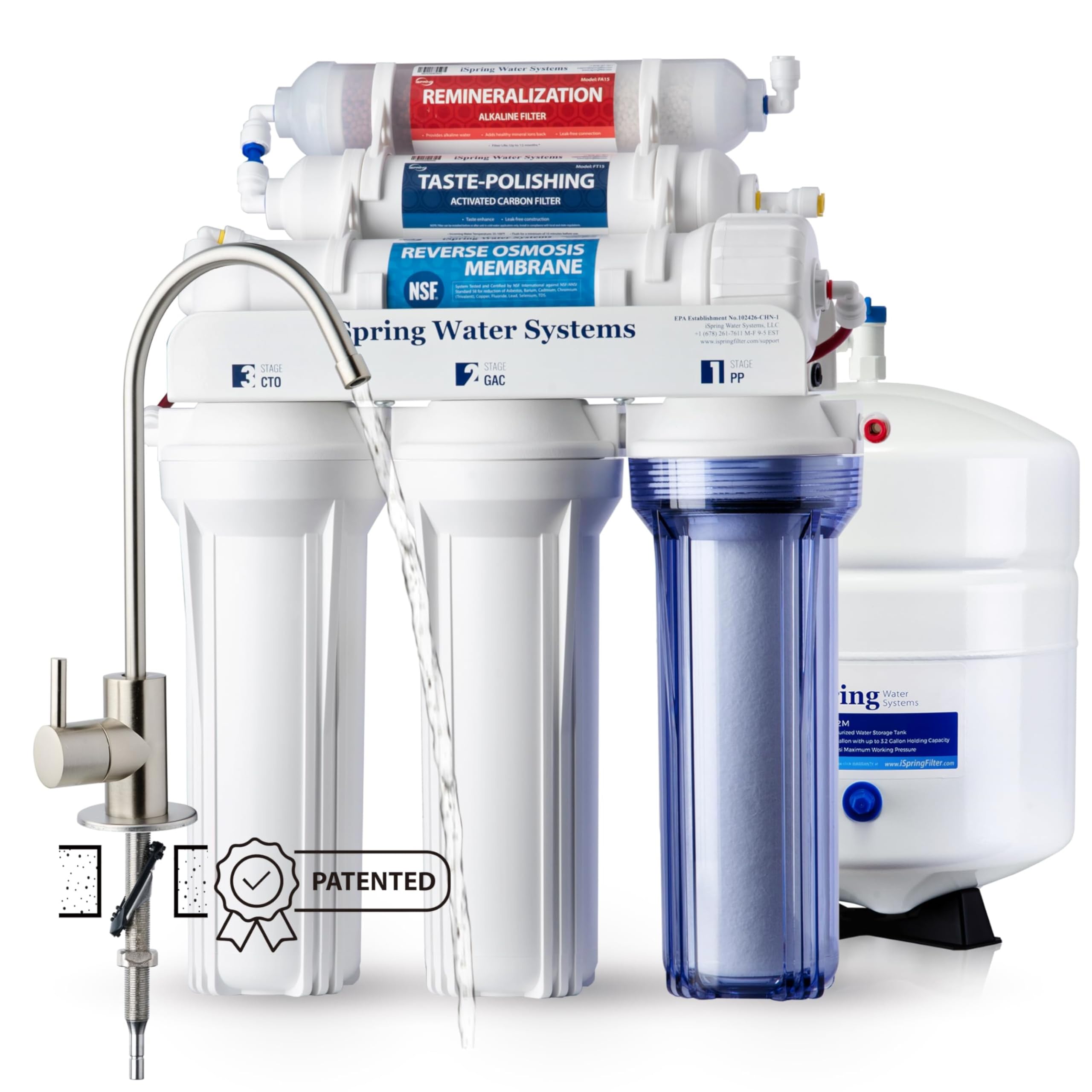
iSpring RCC7AK-BN
Key Features
- Stages: 6, with alkaline remineralization
- Footprint: 15.5"L x 16"W x 18"H
- Certification: NSF/ANSI 58, whole system
- Daily capacity: 75 GPD
- Price: Midrange
The detail that settles the RCC7AK-BN is one you never see again once it is in: the faucet fastener threads on from above the counter, so the whole faucet goes in without a second set of hands underneath the sink. If you have ever held a nut between two fingertips while a basin wrench slid off it, you know what that is worth. Add push-in tubing and a manual that reads in order and the job is an afternoon, not a weekend, which is a large part of why this is the one we recommend first.
The rest of the case is quieter. The system carries NSF/ANSI 58 certification for the whole assembly, it makes 75 gallons a day, and the sixth stage puts minerals back into water the membrane has stripped, which is why a glass tastes rounder than plain RO. The feed-water ceiling is 750 ppm, so if you are on a well with hard water, take a TDS reading before you order rather than after.
The clear first-stage bowl is the most useful maintenance feature here: you can watch the sediment collect instead of trusting a calendar, and a five-minute glance tells you whether the water coming in is dirtier than usual. Everything else is conventional in the best sense, with four housings, a storage tank, and a brushed-nickel faucet that looks like it belongs at the sink.
Sizing is the one thing to settle before the box arrives. The stack stands 18 inches tall and needs floor space for the tank beside it, so measure the cabinet around the drain trap and the disposal rather than the empty corner. Do that and it disappears into the cabinet, and you stop thinking about your water except when the glass is empty.
Pros
- Whole-system NSF/ANSI 58 certification
- 75 GPD with a storage tank behind it
- Alkaline stage restores minerals and taste
- Faucet installs entirely from above the counter
Cons
- Faucet can develop pinhole leaks and drips
- Filters are rated for only six months
For most kitchens this is the system to buy: whole-system NSF/ANSI 58 certification, 75 gallons a day behind a tank, minerals back in the glass, and an install one person can finish.
Best for Tight Cabinets
Frizzlife PD600-TAM3
Key Features
- Display: Live TDS and filter life
- Footprint: 14.7"L x 5.3"W x 15.5"H
- Drain ratio: 2:1 pure to drain
- Daily capacity: 600 GPD
- Price: Premium
There is no tank in the box, and that changes both the install and the cabinet. What arrives is a slim unit under 15 inches wide and about 5 inches deep that sits against the cabinet wall and makes water as you draw it, up to 600 gallons a day. If your under-sink space is currently a puzzle of disposal, cleaning products, and a trash can, this is the shape that solves it.
What we appreciate most is the arithmetic. Six hundred gallons a day means the system never has to catch up with a house full of glasses, and the 2:1 pure-to-drain ratio keeps two gallons for every one it sends away. The trade is that there is no reservoir, so the pour is only as fast as the membrane is working at that moment, and if you tee a line off to a refrigerator dispenser you will want a small pressure tank on that branch to keep the ice maker from stalling.
The alkaline cartridge is the part that makes it taste like water rather than a science experiment, putting minerals back after the membrane strips them. The display panel is genuinely useful too: it reads the TDS of what is coming out and the remaining life of each cartridge, so you change filters when the water says so instead of when a sticker does.
Filters release from the front and swap without disconnecting a line or pulling the unit off the wall, which matters more than it sounds when the alternative involves lying on your back with a wrench. Give it an outlet inside the cabinet and a little clearance at the sides and it asks nothing else of you.
Pros
- No tank, so the cabinet stays usable
- 600 GPD with a 2:1 drain ratio
- Alkaline stage restores minerals
- Display reads live TDS and filter life
Cons
- Elbow connector and faucet are the leak points
- Costs more than the tank systems here
For a crowded cabinet and a busy tap, the PD600 is the tankless system we point to: 600 gallons a day, minerals restored, and a display that shows what the water is doing.
Best for Low Pressure
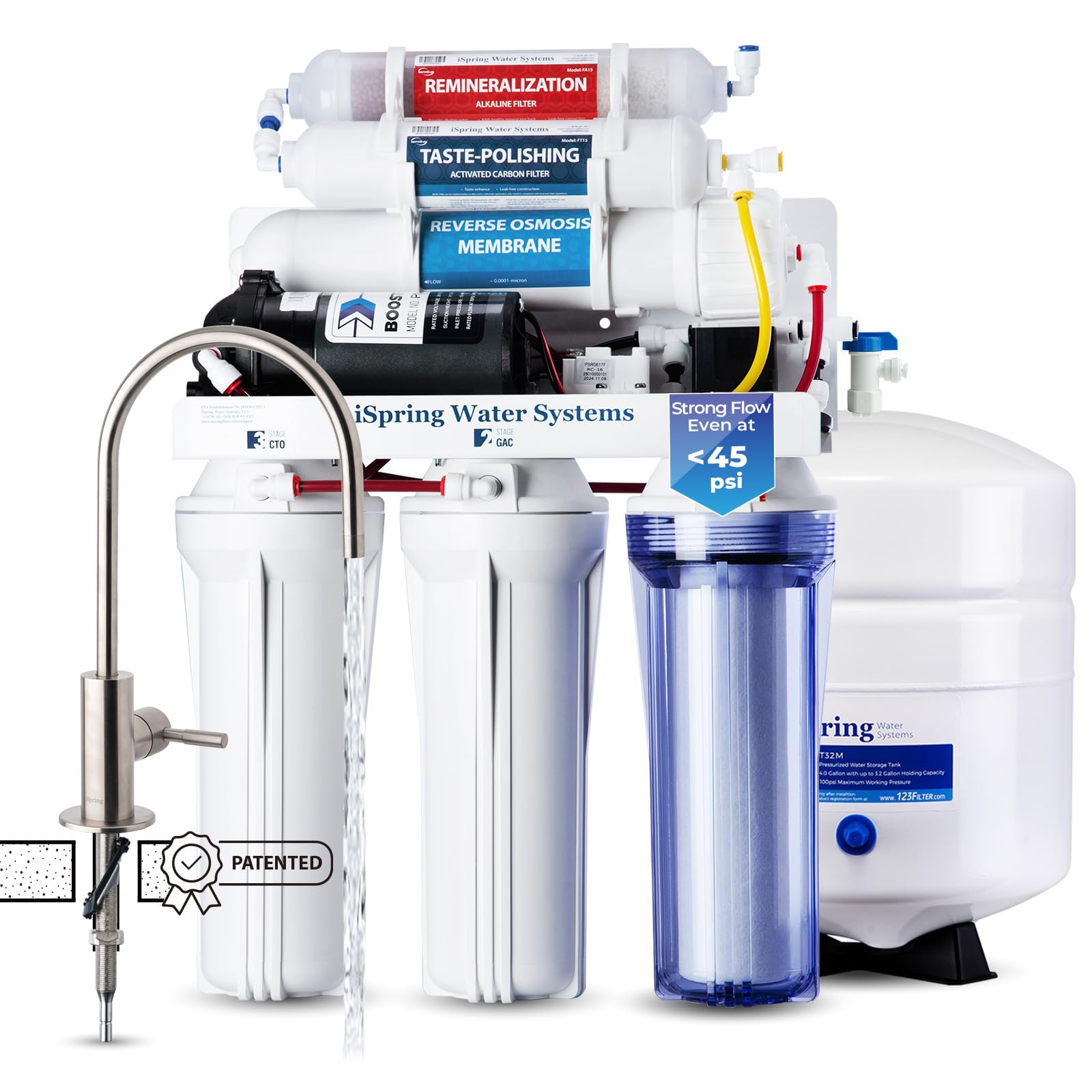
iSpring RCC7P-AK
Key Features
- Stages: 6, with alkaline remineralization
- Booster pump: Included, 100–240V adapter
- Max feed TDS: 2000 ppm
- Daily capacity: 75 GPD
- Price: Premium
A reverse osmosis membrane runs on water pressure, and the systems on this page generally want something near 40 psi at the membrane. In a house on a private well, at the end of a long service line, or on the top floor of an old building, that pressure is not there, and a standard system answers by trickling into its tank and never quite keeping up. The RCC7P-AK answers with a pump.
The pump runs on a 100–240V adapter, so it does not care what the outlet is doing, and it holds output at 75 gallons a day regardless of what the house supplies. The rest is the six-stage iSpring stack with the alkaline cartridge at the end, feed water up to 2000 ppm, and filters rated for a year rather than six months, which halves the number of times you are on your knees with a housing wrench.
For the houses that need it, the pump is the difference between a system that works and one you resent. We were braced for a motor we would hear through the cabinet, and instead it is quiet enough to disappear into kitchen background noise. If your pressure is healthy, this is money you do not need to spend, and the tankless Frizzlife buys considerably more capacity for a bit more again.
Pros
- Booster pump holds output on low pressure
- Six stages with alkaline remineralization
- Handles feed water up to 2000 ppm
- Filters rated for a full year
Cons
- Needs a power outlet under the sink
- Prefilter housing can develop hairline cracks
If your tap pressure sags, this is the system that fixes the problem instead of working around it: a quiet booster pump, six stages, and alkaline water at the end.
Best for Full Houses
APEC RO-90
Key Features
- Stages: 5
- Footprint: 16"L x 5.25"W x 17.5"H
- Daily capacity: 90 GPD
- Filter change interval: 1 year
- Price: Midrange
Ninety gallons a day is the number that separates the RO-90 from the other tank systems on this page, and it is why we put it in front of big households. That is more than a family of five drinks, cooks with, and pours into ice trays, and the margin is what keeps the reservoir full when one person fills a stockpot while another rinses vegetables. Feed water up to 2000 ppm means it also copes with hard, mineral-heavy supplies that would send a lower-rated membrane through filters fast.
Under the cabinet it is a five-stage system tested by WQA, built around larger filter bodies than the compact units here, which is how it stretches changes to once a year. The fittings are JG quick-connects, so the plumbing pushes together rather than threading, and the faucet is a lead-free designer unit rather than a plain chrome spout.
The tank is what makes it feel normal at the sink: a full reservoir gives you a fast pour, and the system refills at whatever pace the day allows. Against the iSpring you trade the top-mounted faucet fastener and a lower price for the extra 15 gallons a day and the annual filter schedule, which is a fair trade for a busy kitchen and a poor one for a couple in a small apartment.
Pros
- 90 GPD, the most of the tank systems here
- Handles feed water up to 2000 ppm
- Filter changes once a year
- JG push-in fittings and lead-free faucet
Cons
- Slow leaks can appear at preinstalled quick connects
For a full house or a hard-water supply, the RO-90 is the tank system we recommend: the highest daily output here, 2000 ppm of feed tolerance, and filters that last a year.
Best for Small Budgets
Express Water RO5DX
Key Features
- Stages: 5
- In the box: Spare filter set and leak detector
- Max feed TDS: 300 ppm
- Daily capacity: 50 GPD
- Price: Budget
Open the RO5DX box and there is a full spare filter set and a leak detector in with the system, neither of which any other pick here includes. The detector is a small thing that earns its keep the first time a fitting weeps behind the disposal, and the spare set covers your first round of changes, so the first year of maintenance is already sitting on the shelf.
We think it is the right first system for a couple or a small family on ordinary municipal water. It is rated at 50 gallons a day, and the tank is what makes that workable: the reservoir absorbs the burst when you fill a pot, and the membrane refills it in the background. It is a five-stage system certified to NSF/ANSI 58 and 372, with a chrome faucet that is plainer than the brushed-nickel ones elsewhere but does its job.
The number to check before ordering is the feed-water ceiling of 300 ppm, which is lower than every other system in this guide. On normal city water you will never think about it. On a well with hard, mineral-heavy water, read a TDS meter first, because a membrane pushed past that limit burns through filters and quits early.
Installation is the standard three connections, and the manual is color coded for anyone doing it for the first time. If your water is in range, this is the least expensive way into a complete certified system here, and the spare filters mean you are not buying anything else for a while.
Pros
- Spare filter set included in the box
- Leak detector comes with it
- NSF/ANSI 58 and 372 certified
- Tank absorbs peak demand
Cons
- Lowest daily output of the under-sink systems here
For a first RO system on normal city water, the RO5DX is the value pick: five certified stages, a spare filter set, and a leak detector in the box.
Best for Rentals
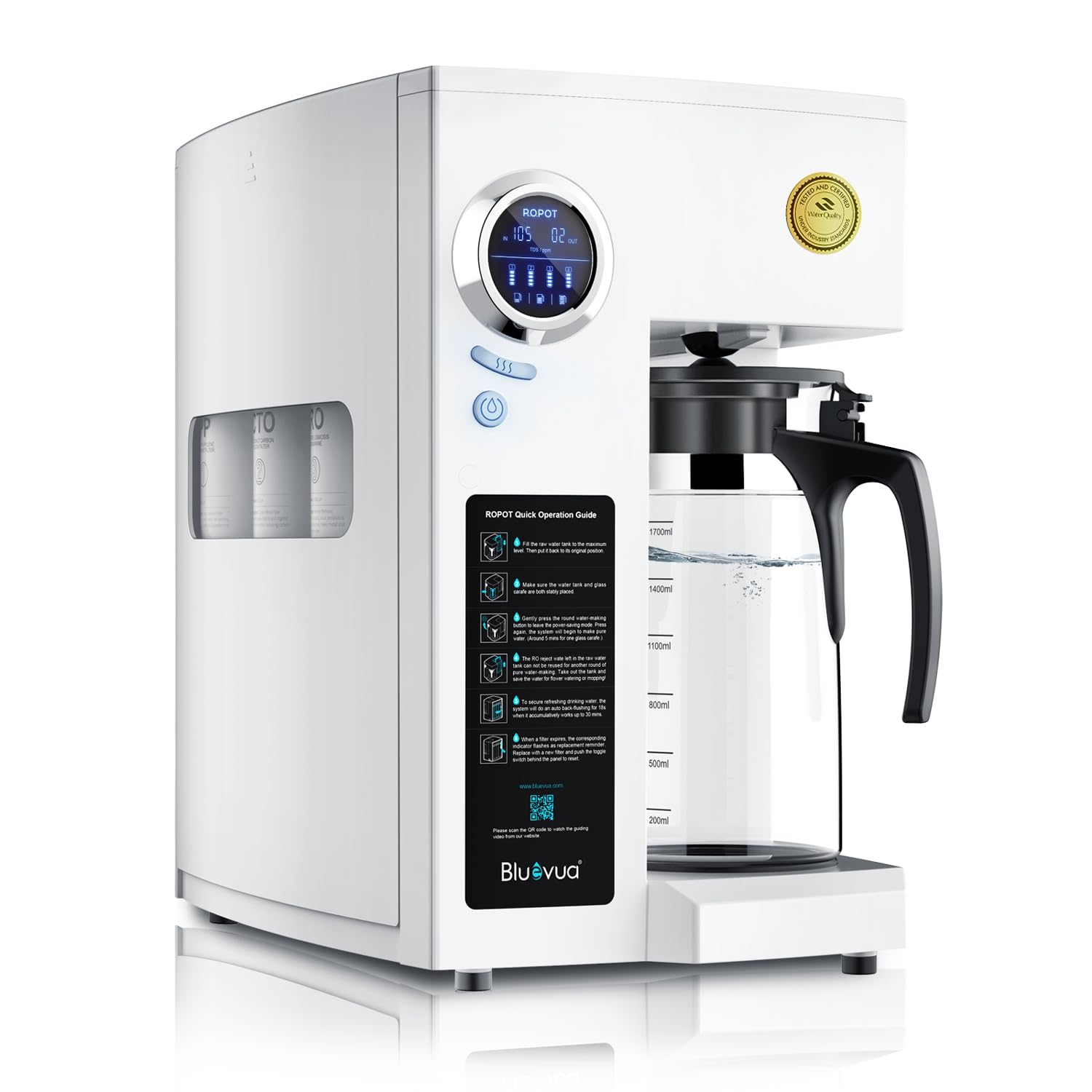
Bluevua RO100ROPOT
Key Features
- Footprint: 10.9"L x 15.4"W x 14.3"H
- Filter life: 12 to 24 months
- Installation: Countertop, no plumbing
- Max feed TDS: 1000 ppm
- Price: Premium
No shutoff valve, no drain saddle, no hole in the counter. The ROPOT sits on the countertop, plugs into an outlet, and turns tap water into drinking water a carafe at a time. For a renter, or for anyone whose kitchen has a stone counter and a landlord, that is not a compromise so much as the only version of this purchase that does not require permission.
Day to day it is simple: fill the reservoir, start it, and the glass carafe fills in a few minutes. It runs five stages with a remineralization cartridge at the end, is certified by WQA and NSF, and drinks from any supply up to 1000 ppm. Between draws it drops into a standby mode, and the filters are rated for a year to two, a longer interval than any under-sink system here.
What we like most is what is not there: no fittings under pressure, no drain saddle, no feed valve, which are exactly the parts of an under-sink install that eventually weep. What you get instead is a machine that moves with you and a carafe of water with the minerals put back. For a countertop unit the filtration itself is serious.
The glass carafe is the part we did not expect to care about, and it turns out to matter: it goes to the table without a plastic aftertaste and looks deliberate sitting out, which is more than most water gear manages on a counter you actually use.
Pros
- No plumbing or drilling required
- Remineralization filter included
- Filters last 12 to 24 months
- Glass carafe looks good on the counter
Cons
- Makes water a carafe at a time
- Takes up counter space near an outlet
For renters and anyone who cannot touch the plumbing, the ROPOT is the answer: five certified stages, minerals restored, and no installation at all.
Best for Data Lovers
Waterdrop G3P600

Key Features
- Faucet: Smart display with TDS monitor
- Footprint: 18.12"L x 5.67"W x 17.72"H
- Drain ratio: 2:1 pure to drain
- Daily capacity: 600 GPD
- Price: Premium
The faucet is the part of an RO system you actually touch, and this one has a screen in it: a live TDS reading of the water coming out, plus the remaining life of each filter. It sounds like a gadget until the first time a number climbs and you know something is wrong before the water starts tasting off. Of everything here, it is the most useful piece of technology bolted to a sink.
Under the cabinet it is a tankless box rated at 600 gallons a day, with a 2:1 pure-to-drain ratio and filters that release and slide out of the front without disconnecting a line or pulling the unit forward, the simplest filter change in this group. It accepts feed water up to 1500 ppm, and at about 18 inches tall and under 6 inches deep it leaves the rest of the cabinet to you.
The flow is the thing to try before you commit. A tankless system only ever pours as fast as the membrane is working, and at 0.42 gallons a minute that is a steady trickle rather than a rush: fine for a glass, slower for a stockpot, and noticeable when two people are filling bottles at the same time.
Where that leaves us: the display is worth paying for if you like knowing, and the filtration and filter access are as good as anything on this page. If you prefer minerals in the glass and a smaller bill, the Frizzlife does both, and the trade is that you give up the screen.
Pros
- Faucet shows live TDS and filter life
- 600 GPD tankless with 2:1 drain ratio
- Filters slide out without disconnecting lines
- Handles feed water up to 1500 ppm
Cons
- Pump noise is audible in a quiet kitchen
- No remineralization stage on this model
If you want to see what you are drinking, this is the one: a faucet that reads TDS and filter life, 600 gallons a day, and the easiest filter swaps here.
How We Tested Reverse Osmosis Systems in Real Kitchens
Every system had to clear a shortlist before it got near a sink: current NSF certification for the contaminants it claims, replacement cartridges we could actually source a year from now, and a footprint that fits a standard base cabinet. From there we narrowed to 10 units, from slow tanked models to high-output tankless ones, plus a countertop unit that needed no plumbing at all.
Installation came first, because that’s where these systems go wrong. I timed each one solo from unboxing to first full glass, noted how many fittings needed a second tighten, and laid a dry paper towel under every connection — checked weekly for the whole eight months. A drip on day one is easy to spot; the ones that matter seep slowly past a push-fit connector around week six.
We timed flow with a stopwatch and a quart jar, then again with the dishwasher running, and listened for pump noise from the next room once the house was quiet. Before-and-after TDS readings tracked filtration performance, and we sent our incoming tap water to a lab so we knew exactly what each membrane was up against. Taste got its own test: chilled overnight, tasted blind beside tap and bottled, then brewed into coffee, with notes on whether the mineral stage softened RO’s flat, empty finish. Finally, we ran each drain line into a bucket to see how much water was wasted per gallon made, and totaled a year of filter costs. At the three- and six-month marks we pulled cartridges, reseated every fitting, and looked for hairline cracks in the housings.
How to Choose a Reverse Osmosis System
Stage counts and gallons-per-day figures are the easy part of this purchase; the decisions that actually determine whether you like the system are the certificate behind the claim, whether there is a tank, and whether your cabinet and your water pressure can take it.
Check What the Certification Covers
The standard worth looking for is NSF/ANSI 58, which can be certified for the assembled system rather than for one cartridge inside it, and NSF/ANSI 372 for lead-free wetted materials in the faucet and fittings. Those claims are verifiable: put the model number into NSF’s online listing and see exactly what was tested.
A listing that mentions certification only in passing, without a model number you can check, is worth a second look. We treat a checkable certificate as the baseline for a system that will sit under your sink for years, not as a premium feature worth paying extra for.
Decide Between a Tank and a Tankless Box
A tank works like a battery. The membrane makes water slowly, the tank stores it, and the faucet pours a fast glass whenever you want one, which is why a 50-gallon-a-day system can still feel generous at the sink. Lower daily output is a real constraint only for a big household that cooks and fills pitchers all day.
A tankless unit skips the reservoir and frees most of the cabinet, but it pours only as fast as the membrane is working at that moment, which is why the tankless models here are rated at 500 to 600 gallons a day. For a family of four, a 75-gallon tank system is the easier fit; for a cabinet already crowded by a disposal and a trash can, tankless earns its price.
Read the Feed-Water Limits Before You Order
Every system has a ceiling on what it will accept: total dissolved solids, pressure, and temperature. Max feed TDS is where these systems differ most, and it is not a marketing number. Push a membrane past its rating and you will buy filters far more often than the schedule promises, so check a TDS reading against the spec before you commit.
Pressure matters just as much. RO needs roughly 40 psi at the membrane, and a kitchen tap that runs weak will leave a standard system trickling into its tank. If your tap is feeble, budget for a booster pump instead of hoping. An inexpensive TDS pen and a pressure gauge answer both questions in five minutes.
Budget for Filters and for the Water You Send Down the Drain
The purchase price is the smallest part of ownership. Filters run on six-month or annual schedules, and a system with annual changes is cheaper to live with even when it costs more up front. Check the price of a full replacement set before you buy, not after.
Water use is the other running cost. A 2:1 pure-to-drain ratio keeps two gallons for every one sent down the drain; older designs can send three or four. On metered water that is a line item, and on a septic system the reject water is volume you should account for.
Decide Whether You Want Minerals Back
RO strips nearly everything, including the calcium and magnesium that give water its body, and the result can taste flat rather than bad. A remineralization stage puts some of that back and balances the pH, which is the practical difference between the iSpring RCC7AK-BN and a plain five-stage system.
It is a taste decision, not a safety one. If you already like the neutral flavor of low-mineral water, skip the extra cartridge and the extra filter to change. If you drink a lot of it straight from the tap, the alkaline systems are easier to love.
Frequently Asked Questions
Can I install a reverse osmosis system myself?
Yes, if there is a spare hole in the counter. The plumbing is three connections: a feed valve on the cold line, a drain saddle on the tailpiece, and the faucet. Most of the systems here use push-in fittings and come with a manual that walks through it, and a careful first-timer can finish in an afternoon.
The faucet hole is what stops people. An RO faucet needs the same 1⅜-inch opening a soap dispenser uses, so look for a blank cover plate or an unused dispenser before you buy. Without one, you are drilling stone or hiring someone who does.
Can I run an RO system to my refrigerator’s ice maker?
Usually, yes. Tee a line off the filtered side and run it to the fridge; tank systems handle this easily because the reservoir supplies pressure on demand.
Tankless systems are the ones to think about first. With no reservoir, the dispenser gets water only as fast as the membrane is making it, which can leave an ice maker short. A small pressure tank on that branch solves it, and it is worth adding at install rather than later.
Do I have to flush a new reverse osmosis system?
Always. New carbon cartridges shed fines and the membrane ships with a preservative, so the manual will tell you to run the system and discard the first output, usually a few minutes at the faucet plus one full tank.
Skip it and the first glasses taste faintly of plastic and look cloudy. It also explains why day one feels slow: an empty tank on a 50-gallon system takes a few hours to fill, and the pour gets brisker once it has.
Final Verdict
In this group, the iSpring RCC7AK-BN is the system we point most people toward: whole-system NSF/ANSI 58 certification, 75 gallons a day behind a tank, minerals put back in the glass, and a faucet that goes in from above the counter instead of from underneath it.
If your kitchen tap runs weak, spend the difference on the iSpring RCC7P-AK and its booster pump. If the cabinet is already full, go tankless with the Frizzlife. And if you rent, the Bluevua takes plumbing out of the question entirely.