This post contains affiliate links. We may earn a small commission when you buy through our links — at no extra cost to you.
A microwave gets food hot; it can’t make it crisp. Leftover pizza comes out limp and chicken skin stays pale. Convection is the answer: a fan and a heating element push hot air around the cavity so food browns as it would in a real oven, while the microwave does the fast work. The catch is that combination ovens vary wildly in how well they juggle those two jobs, and the air-fry setting on the panel isn’t always worth using.
Over the past eight months I’ve cooked in seven of them, some on my counter and one mounted above my range. The gaps show up fast: how evenly they brown, how loudly they run, whether the door still shuts with a solid thunk, and how much scrubbing the interior needs after a chicken.
What you’re paying for at the top is real convection and a sensor that knows when to stop, not another preset. The picks below run from compact countertop models to over-the-range units that take over for your vent hood, and each one earned its spot.


Best for Baking and Roasting
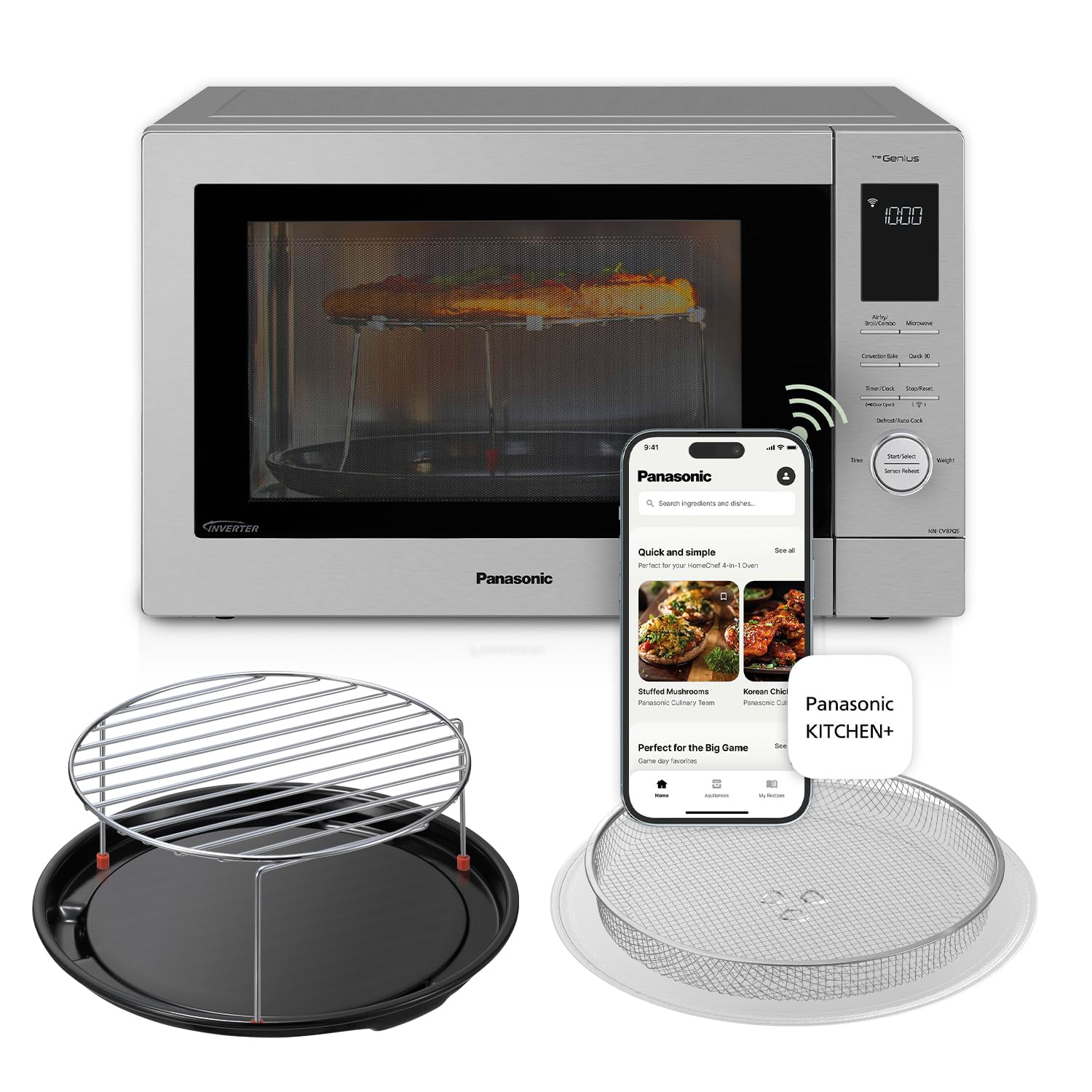
Panasonic HomeChef 4-in-1
Key Features
- Capacity: 1.2 cu ft
- Warranty: 3 years
- Turntable: 14.2 inches
- Microwave power: 1000 watts
- Price: Premium
When the job is baking rather than reheating, the HomeChef is the one we reach for. Convection is a mode you choose here — bake, broil, air fry, or plain microwave — rather than a side effect of an air fry button, and the enamel tray and metal rack in the box say the same thing. This is a machine that expects to be used as an oven, and that is the whole difference between a unit that can bake and one that is built to.
The 1.2-cubic-foot cavity is mid-pack, but the 14.2-inch turntable is the widest in this set, and that measurement decides whether a whole chicken or a 12-inch pizza goes in without hitting the walls. Sensor reheat and keep-warm get more use in our kitchen than the long tail of the 20 presets. The Panasonic Kitchen+ app adds a recipe library, which is welcome on the nights nobody can decide what dinner is.
Three years of coverage is the strongest ownership argument on this page, and every other model here stops at one. The cost is the interface: a dial and buttons with a lot of functions behind them, and it takes a few sessions before your hand finds the mode you want without thinking. Keep the manual in a drawer nearby for the first month. Give it clearance, too — convection in a countertop box pushes real heat out of the top and back, so it has no business being wedged under a cabinet with no room to breathe.
Where it gives ground is speed. As a microwave it is quick, but the air fry and broil modes are not the match of a dedicated basket fryer, and frozen food that crisps quickly in a fryer takes noticeably longer here. Buy it for the oven half; the microwave half is the bonus.
Pros
- Convection bake is a mode you select
- 14.2-inch turntable is the widest here
- Three-year warranty, the longest in the set
- Inverter heat evens out defrosting
Cons
- Premium price for a 1.2-cubic-foot oven
Buy it if you want one countertop box that genuinely bakes: a real convection mode, the widest turntable here, and three years of coverage.
Best for Power and Controls
Toshiba OptiChef Pro Max
Key Features
- Capacity: 1.3 cu ft
- Programs: 25
- Turntable: 13.58 inches
- Microwave power: 1100 watts
- Price: Premium
At 1,100 watts, this is the most powerful microwave in the group, and the advantage shows up in the dull moments rather than the impressive ones. A bowl of cold leftovers comes back hot sooner, and a mug of coffee does not need a second round. If your convection microwave is going to spend most of its life reheating, that extra output is the spec that earns its keep every single day.
The 2.4-inch color screen is the feature we expected to ignore and did not. Twenty-five programs is more than anyone needs, but a screen that names them beats a keypad that makes you look up a code, and the humidity sensor takes most of the guesswork out of reheating. It runs quiet enough that we stopped noticing it, which is more than we can say for the over-the-range units here. The ceramic enamel lining is also the friendliest surface in this group to wipe down after a chicken.
Where it gives ground is the control ladder and the price. Five microwave power levels is a short ladder next to the rest of this set, and the gap is real when you are softening butter rather than blasting a dinner plate. It is priced like a premium appliance and it is new enough that nobody can tell you how it looks at year four. If you reheat more than you bake, the trade is worth it; if you are shopping specifically to bake, the Panasonic’s documented bake mode and longer warranty are the safer buy.
Pros
- 1,100 watts, the highest output here
- Color screen makes 25 programs navigable
- Ceramic enamel interior wipes clean
Cons
- Five power levels, the fewest here
- Premium price for a 1.3-cubic-foot oven
Worth the premium if you reheat more than you bake: the highest microwave wattage here, a screen that makes its programs findable, and quiet running.
Best for Small Kitchens
BLACK+DECKER 5-in-1
Key Features
- Capacity: 0.9 cu ft
- Turntable: 11.3 inches
- Air fry presets: 11
- Microwave power: 900 watts
- Price: Budget
The least expensive way into convection cooking here is also the smallest, and that is the entire pitch. Five modes — microwave, air fry, a grill-and-convection combo, bake, and roast — plus a bake tray and two grill racks, in a body 19.5 inches wide. In a rental kitchen or an apartment where the microwave is the second oven, that combination is the difference between having an oven half and not having one.
The 11.3-inch turntable sets the real limit. Dinner plates, a small casserole, a couple of bagels: yes. A whole chicken or a 12-inch pizza: no. We think that is the right trade for the person this is built for, because the alternative at this end of the market is a plain microwave with no oven half at all. Eleven air fry presets cover the frozen-food basics, and seven auto menus handle popcorn, potatoes, and oatmeal without a decision.
The setting we like most is the combo one, which runs microwave and grill together. It is how you get a crisp top on a casserole without waiting through a full preheat, and it is the mode a plain microwave cannot fake. Just know what you are buying: this is a compact second oven, not a replacement for the range.
Pros
- Least expensive convection here
- Bake tray and two grill racks included
- Only 19.5 inches wide
Cons
- 900-watt output is on the slow side
The budget pick for small kitchens: real bake and air fry modes, a bake tray, and two racks in a footprint that fits under a cabinet.
Best for Crispy Frozen Food
Ninja Crispi
Key Features
- Capacity: 0.9 cu ft
- Turntable: None, flatbed
- Cooking functions: 14
- Air fry temperature: Up to 450°F
- Price: Midrange
There is no turntable in the Crispi, and that single omission is what makes it interesting. A flat glass floor holds a 9-by-11 baking dish, two bowls side by side, or two bags of popcorn, and nothing slides around while the machine works. If you have ever chased a plate back onto a turntable ring mid-cook, you will understand why we kept coming back to this one.
The feature that earns it a place in this guide is FusionCrisp, which microwaves first and then hands off to the air fry element on its own — the two-step sequence that otherwise costs you two appliances and a plate transfer. The air fry side is what Ninja built the machine around: up to 450°F of moving air, with Max Crisp heading five air fry presets. If your reason for wanting a combi microwave is frozen food that comes out crisp, this is the one we point you to.
It is also the heaviest countertop model here at 50 pounds, in a body 20.3 inches wide, wrapped around a 0.9-cubic-foot cavity. That is a lot of counter for the capacity, and it is the trade you make for the flatbed and the air fry hardware. Cleaning is the pleasant surprise: the 5.5-quart glass dish is the cooking vessel, so there is no turntable ring to scrub and no cramped box to reach into.
Pros
- Flatbed fits a 9×11 baking dish
- 450°F air fry side finishes food crisp
- Glass cooking dish is easy to clean
Cons
- Bake and roast play second fiddle to air frying
Buy it if crisp frozen food is the reason you want one of these: a flatbed cavity and a 450°F air fry side make it the crisping specialist here.
Best for Over-The-Range Installs
BLACK+DECKER Over-the-Range
Key Features
- Capacity: 1.5 cu ft
- Vent fan: 300 CFM
- Turntable: 13.6 inches
- Microwave power: 900 watts
- Price: Midrange
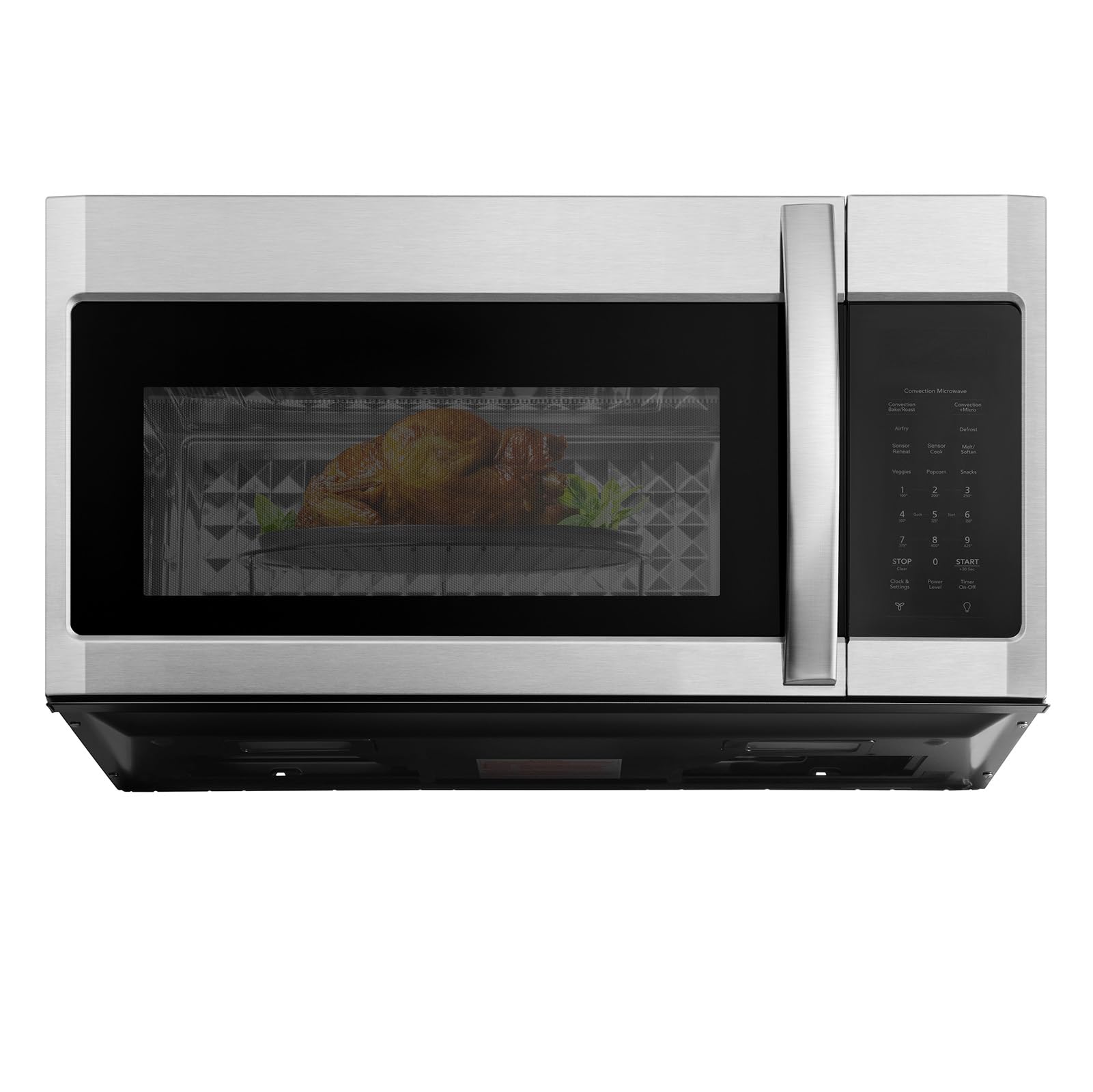
If there is already a microwave bolted under your cabinets, this is the model that makes the swap worth doing. It is a standard over-the-range unit at 29.9 inches wide and 16.4 tall, with six modes including convection, bake, roast, and air fry, plus the vent fan and cooktop light that no countertop machine can give you.
The 1.5-cubic-foot cavity and 13.6-inch turntable are the biggest combination here short of the Toshiba countertop, and that is the reason to go over the range beyond saving counter space: you get more room because you are also buying the hood. The 300 CFM two-speed vent is modest by range-hood standards but enough for the smoke off a broiler pan, and the light is the part you will notice every night.
The compromise is depth. An over-the-range cavity is shallow at 13.9 inches, so a 13.6-inch turntable fills the floor and there is very little headroom for a rack above it. That limits how much you can stack in convection mode, and it is the honest difference between this and a countertop oven of the same capacity.
In most kitchens the trade works: a vent fan, a light, and 1.5 cubic feet that use no counter at all beat a fancier oven you have to lift onto one. Confirm two things before ordering — whether the kitchen vents outside or recirculates, and the exact cabinet opening — because the install, not the cooking, is where these go wrong.
Pros
- 300 CFM vent and cooktop light built in
- 1.5 cu ft with a 13.6-inch turntable
- Six modes including bake and convection
Cons
- 900 watts is modest for a cavity this size
The over-the-range value pick: convection, air fry, and a 300 CFM vent in a standard 30-inch slot at midrange money.
Best for Feeding a Family
Toshiba 4-in-1 1.5 Cu. Ft.

Key Features
- Weight: 45.5 lb
- Capacity: 1.5 cu ft
- Turntable: 13.6 inches
- Microwave power: 1000 watts
- Price: Midrange
The first thing to know is that the manual covers the microwave side thoroughly and the air fry side barely at all, which is a strange way to ship a machine whose marquee feature is air frying. That is a shame, because the hardware underneath is the best capacity-per-dollar deal in this guide: 1.5 cubic feet, a 13.6-inch turntable, and 1,000 watts for midrange money. Plan on learning the modes by trial, and budget an evening for it.
A chicken, a 12-inch pizza, a 9-by-13 pan — all of it fits, and the auto bake and roast menus are the ones worth learning first. The sensor programming takes over once you trust it, and the mute function is a small kindness in an open kitchen: you can kill the beeps without hunting through a menu at midnight.
The question mark is longevity. Units that quit tend to do it a couple of years in, past the one-year warranty, which is why this sits below the picks above rather than beside them. Buy it as a value oven — family-size batches, a big cavity, sensible money — and not as a forever appliance.
Pros
- 1.5 cu ft is the biggest countertop cavity here
- 1,000 watts with auto bake and roast
- Mute function kills the end-of-cycle beeps
Cons
- Air fry mode runs much slower than a basket fryer
The capacity buy: 1.5 cubic feet, a 13.6-inch turntable, and 1,000 watts for midrange money.
Best for Replacement Installs
Sharp R1874T

Key Features
- Width: 29.93 inches
- Capacity: 1.1 cu ft
- Turntable: 13 inches
- Microwave power: 850 watts
- Price: Premium
Twelve convection programs and eight sensor programs is the longest cooking list in this guide, and the R1874T is the one that reads like the oven it is: it browns, bakes, broils, crisps, and roasts, with a low rack and a high rack included so you can run two levels at once. Its dimensions match older Sharp over-the-range convection units, so it drops onto brackets that are already in the cabinet — which is why it turns up in older kitchens and motorhomes as a straight replacement.
If you bake in your microwave rather than just reheating in it, this is the most oven-like machine on the page. A stainless cavity with an interior light, two racks, and enough real convection programming to treat a pan of bars as a normal job rather than an experiment. It is also the oldest design here, and that cuts both ways: the cooking behavior is proven, and the feature list is plainer than the touchscreen machines.
The coverage is the clever part — a year of parts and labor in home, plus six more years of parts on the magnetron, the longest commitment to a single component here. It is the keypad and display that are the aging points rather than the magnetron, so the standard year is the one that matters, and it is worth registering the unit the week it arrives.
Plan the install rather than the cooking. It is 71.5 pounds going into a 30-inch opening with hardware that has to line up with what is already in the cabinet, so have a second set of hands on the day. Once it is up, nobody thinks about the weight again.
Pros
- 12 convection programs plus 8 sensor programs
- Low and high racks allow two-level cooking
- Six extra years of magnetron coverage
Cons
- 850-watt output is the lowest here
- 1.1 cu ft is small for an over-the-range unit
The pick for someone who bakes in an over-the-range slot: real convection programs, two racks, and the longest parts coverage here.
How We Tested (and Lived With) Seven Convection Microwaves
We started with a list of about 30 models and cut it down on specs that change how the oven actually cooks: a real convection fan and heating element rather than a fan-only crisp mode, inverter-controlled power versus the kind that cycles on and off, wattage, and cavity size. We kept countertop and over-the-range formats in play, since a dead built-in often decides the shape for you, and we made sure the list covered the price spread. Seven models made the cut.
Each one ran our everyday circuit for eight months: reheating a plate of leftovers on sensor, defrosting a pound of ground beef, air-frying frozen french fries, roasting a whole chicken, and baking a tray of cookies. To see how evenly heat moved, I scattered shredded cheese across the turntable and noted where it browned first—the good ones browned in a ring, the disappointing ones in one corner while the rest stayed pale. I also ran a sound meter at arm’s length, since noise is what you notice at 7 a.m.
Doors got opened and closed one-handed, dozens of times a week, and I noted any that dropped, stuck, or needed a second push. Cleaning was timed, not eyeballed: spatters left to cool, then a damp cloth, then a count of how many passes it took to clear a greasy ceiling. Stainless fronts were handled with buttery fingers to see how fast they showed prints and how well they wiped clear. After eight months of daily use we compared notes on what broke, what rattled, and which functions we still reached for, then weighed that against price.
How to Choose a Convection Microwave
The word convection on a microwave box can mean almost anything, so the first thing to establish is whether the machine gives you a bake mode with a temperature you set, not just a fan that runs while the microwaves work.
Convection Baking Versus Air Frying
Both use a heating element and a fan, which is why the labels blur. A real bake mode holds a set temperature and cooks like a small oven, which is what the metal racks and enamel trays in the box are for. Air frying is the same hardware pushed hard for browning, and it gets the loudest billing because crisp food photographs well. Look for a named bake or roast program and a metal tray included; a machine with only an air fry button is a crisper that happens to have a microwave attached.
Then be honest about which half you will use. If you roast a chicken or bake a pan of brownies most weeks, pay for the oven half and ignore the preset count. If the machine is mostly a reheater that occasionally handles frozen fries, an air-fry-focused model does that job and costs less.
Capacity Is a Turntable Measurement
Cubic feet sells microwaves; the turntable or the flatbed decides what actually fits. The 14.2-inch turntable on the Panasonic takes a whole chicken or a 12-inch pizza. The 11.3-inch one on the compact BLACK+DECKER takes a dinner plate and a small casserole. A flatbed like the Ninja’s trades the circle for a rectangle, which is how a 9-by-11 baking dish fits in a 0.9-cubic-foot cavity.
The trap is assuming a bigger box means a bigger cook. Measure the pan you actually use and compare it with the turntable diameter, then check the height between the turntable and the cavity roof before you plan on cooking on a rack.
Countertop or Over-the-Range
Over-the-range models give you back the counter, add a vent fan and a cooktop light, and usually hand you more cavity for the money, since you are also buying the hood. They also need a 30-inch cabinet opening, a power source in the cabinet above, and a decision about venting outside versus recirculating before anything ships.
Countertop models are simpler to place, but convection means heat, and heat needs somewhere to go. Leave the clearance the manual asks for above and behind the unit instead of tucking it under a cabinet, and plan on that space permanently rather than sliding it out when you bake.
Watts and Controls
Microwave output here runs from 850 to 1,100 watts, and it changes reheating speed more than it changes baking. A 1,100-watt machine like the Toshiba OptiChef is quick with leftovers; an 850-watt oven still bakes a pan of bars perfectly well. If you mostly reheat, buy watts. If you mostly bake, buy a documented bake mode and a rack and stop worrying about the number.
Then look at the panel. Twenty-five programs sound generous until you are scrolling for the one you want at seven in the evening. Sensor reheat and two or three presets you will actually touch are worth more than a long menu, and a screen that names the modes beats a keypad that makes you look up a code.
Frequently Asked Questions
Can you put metal pans in a convection microwave?
Yes, in convection, bake, or combi mode, which is exactly what the metal rack and enamel tray in the box are for. Never in microwave-only mode, where metal sparks. The habit that keeps you out of trouble is to change the pan when you change the mode, and to keep foil takeout containers and browning sleeves out of the cavity altogether.
Do convection microwaves need their own circuit?
They draw 1,350 to 1,600 watts, which works out to roughly 11 to 13 amps at 120 volts. A standard kitchen circuit carries that on its own, but not with a toaster or an electric kettle running on the same one. If the outlet is shared, move the small appliances. If you are going over the range, confirm there is a receptacle in the cabinet above before the unit arrives.
Is a convection microwave worth it if I already have an air fryer?
Then buy it for the oven half or not at all. A basket fryer still crisps faster and better than any combi unit in this guide, and a plain microwave reheats just as well. What you are paying for is one appliance on the counter that also bakes and roasts. If you bake less than once a week, put the budget toward a basic microwave instead.
How long should one of these last?
Longer than its warranty, and that is the uncomfortable part: coverage runs one year on most models, and the failures that matter tend to land after it. Register the unit the week it arrives and keep the receipt. Panasonic’s three-year warranty and the six extra years of parts coverage Sharp offers on the magnetron are the two longest commitments here.
Final Verdict
For a countertop that has to bake, roast, and reheat, we recommend the Panasonic HomeChef 4-in-1. It is the machine whose convection mode behaves like an oven rather than a fan, it has the widest turntable in the group, and its three-year warranty is the only one that outlasts the first year.
If your microwave already hangs under a cabinet, the BLACK+DECKER over-the-range model gives you convection, air frying, and a 300 CFM vent for midrange money. And if the real goal is frozen food that comes out crisp, the Ninja Crispi’s flatbed and 450°F air fry side are the reason to choose it over any of the ovens here.