This post contains affiliate links. We may earn a small commission when you buy through our links — at no extra cost to you.
A combo machine is a bargain of counter space: one base, one motor, and a stack of jars that promise to crush ice, chop onions, and knead dough. The catch is that a single motor has to be good at two very different jobs, and plenty of them aren’t. I once owned one that turned frozen mango into silk and then left chickpeas in my hummus the size of peas — same machine, same afternoon.
Wattage gets all the attention, and it shouldn’t. A wide, sharp blade in a jar that actually moves the food beats another 200 watts, and the extras that supposedly make a combo versatile — the to-go cups, the little grinder jar — are often the ones that leak or end up jammed in a drawer. Over the past seven months, my team and I have put 11 of these systems through smoothies, hummus, curry paste, and bread dough, weighing performance, power, versatility, and value.
The machines below are the ones we kept reaching for after the novelty wore off, and the differences among them come down to which jobs you actually need done.



Best for All-Purpose Prep
Ninja UltraCrush Pro BP401
Key Features
- Motor: 1500 watts
- To-go cup: 18 oz
- Processor bowl: 8 cups
- Blender pitcher: 72 oz
- Price: Midrange
This is a kitchen system in the useful sense: a 1500-watt base drives a 72-ounce blender pitcher, an 8-cup processor bowl, and an 18-ounce to-go cup. That means the chopping side is a proper bowl rather than a garnish-sized attachment, and at this price the full set is the strongest value in the group.
The 1500-watt motor is the highest rating among our picks, and the four manual speeds, Low through Max, give you direct control. We like that for frozen drinks and pulse-chopping vegetables because you decide when to stop; there is no program guessing at the texture you want. The stacked blade in the pitcher and the separate chopping blade in the bowl also mean you are not using one blade for every job.
What you give up is automation. There are no Auto-iQ-style presets here, so smoothies and dough are manual jobs. The 18-ounce cup is also a single serving rather than the pair of cups you get from the BN801. For most households, neither is a dealbreaker: the controls are simple, and the 72-ounce pitcher covers family batches.
The 8-cup bowl is what makes it a combo rather than a blender with a chopper accessory. That is the detail we notice when prepping a full tray of vegetables, and it is why this Ninja earns the default spot over the smaller budget machines.
Pros
- True 8-cup processor bowl
- 1500-watt motor with four manual speeds
- 72-ounce pitcher plus a to-go cup
- Strong value for a full system
Cons
- No automatic preset programs
- Only one to-go cup included
This is the combo we recommend first: a 1500-watt base, a genuine 8-cup processor bowl, and a 72-ounce pitcher make it the most complete system for the money.
Best for Hands-Off Smoothies
Ninja Professional Plus BN801
Key Features
- Motor: 1400 peak watts
- Presets: 5 Auto-iQ
- Processor bowl: 8 cups
- Blender pitcher: 72 oz
- Price: Midrange
Five Auto-iQ programs are the reason to pick the Professional Plus over the cheaper Ninja. Smoothie, Frozen Drink, Nutrient Extraction, Chop, and Dough each run a timed sequence of pulsing and blending, so you press one button and walk away. We appreciate that on rushed mornings, when the difference between a good smoothie and a stalled one is often pacing rather than raw power.
The hardware is serious: 1400 peak watts, a 72-ounce pitcher, an 8-cup processor bowl, and two 24-ounce cups. The two cups are the practical advantage for couples or anyone making two drinks at once; the BP401 includes only one 18-ounce cup. We also like that the processor bowl uses a separate chopping blade and dough blade, so savory prep does not have to happen in the smoothie pitcher.
The processor bowl handles chopping and dough, but it does not slice or shred. If you want discs for slaw and grating, the HoninJoy is the better fit. We treat the plastic bowl and pitcher as the parts to inspect, and registering the one-year warranty is worth the few minutes it takes.
The preset panel is labeled in plain language, so there is no learning curve before breakfast. For daily smoothies and routine chopping, that combination of automation and a second cup is what makes the BN801 the easier machine to recommend.
Pros
- Five Auto-iQ presets
- 8-cup processor plus 72-ounce pitcher
- Two 24-ounce to-go cups
- 1400 peak watts for frozen drinks
Cons
- No slicing or shredding discs
- One-year warranty is limited coverage
Choose this for hands-off smoothies and chopping: five Auto-iQ programs, a 72-ounce pitcher, and two to-go cups make it the easiest full-size system here to live with.
Best for Big-Batch Chopping
HoninJoy FP12
Key Features
- Motor: 1300 watts
- Functions: 10-in-1
- Processor bowl: 2 liters
- Blender pitcher: 1.5 liters
- Price: Midrange
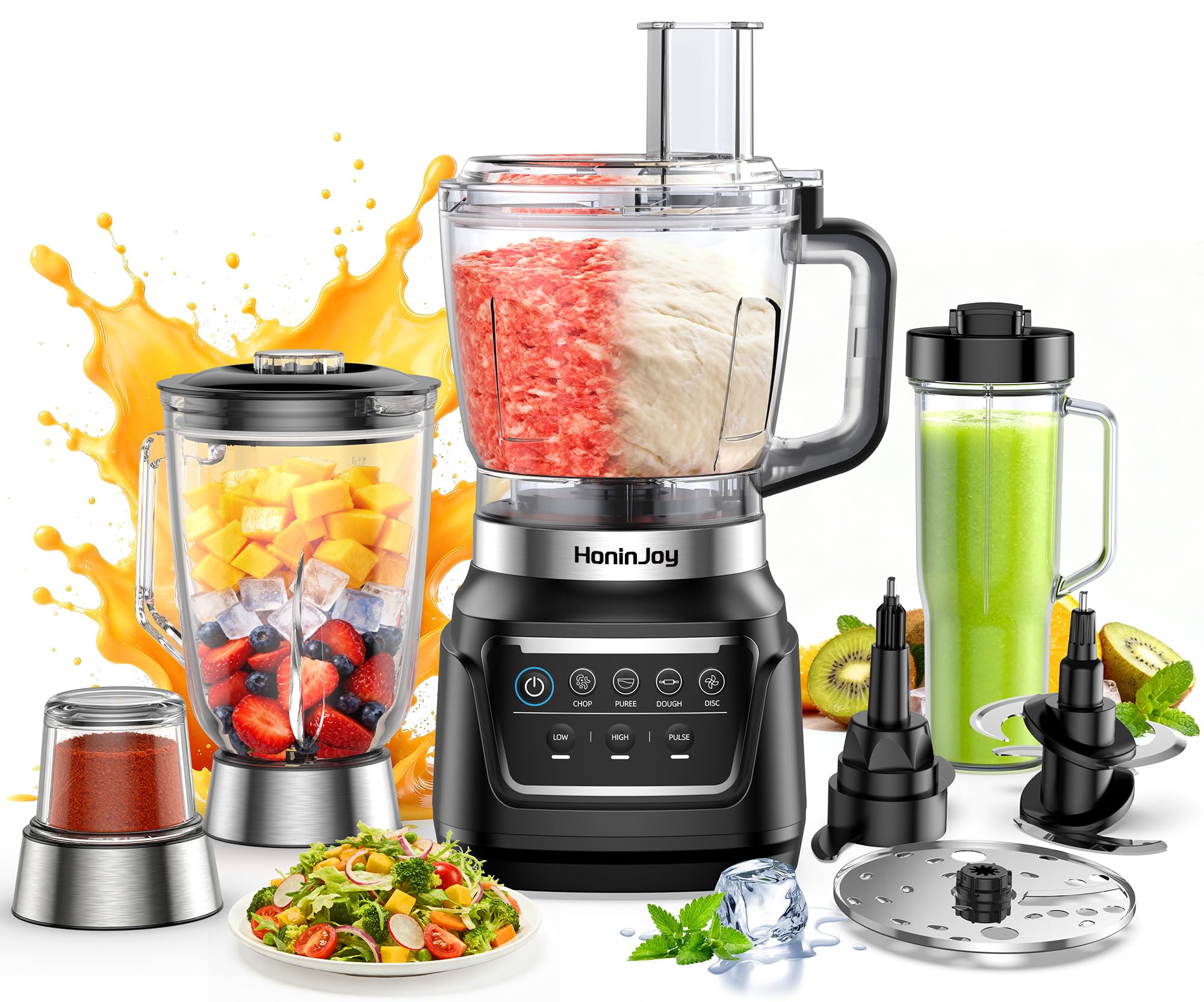
A 2-liter processor bowl is the reason the HoninJoy stands out. That is bigger than the 8-cup bowls on the Ninjas, and it changes what you can do in one go: a full batch of salsa, a pile of vegetables for soup, or dough without splitting the job. The 1.5-liter glass blender pitcher is the other detail we like; glass resists staining and does not hold onto tomato or spice odors the way plastic can.
The 1300-watt motor is a step below the top Ninja, but the feature set is broader: chop, puree, dough, and disc presets for slicing and shredding, plus a grinding function. We see this as the best pick for someone who cooks in bigger batches and wants the processor side to do more than mince.
The trade-offs are real. The main pitcher is glass, but the travel cup and some containers are plastic, so it is not an all-glass set. The 2-liter bowl and tall pitcher also take more cabinet space than the compact KOIOS. For a household that processes often, that bulk buys useful capacity.
The one-touch CHOP, PUREE, DOUGH, and DISC presets make the extra capacity less fussy. We like that the controls name the job rather than the speed; the disc preset is the detail that separates this from the Ninja BN801, which chops but does not slice or shred.
Pros
- 2-liter processor bowl for big batches
- 1.5-liter glass blender pitcher
- Slicing, shredding, and dough functions
- One-touch job presets
Cons
- Travel cup and some containers are plastic
- Large bowl and pitcher need storage space
This is the one for big food-processor jobs: a 2-liter bowl, a glass blender pitcher, and slicing and shredding discs cover more prep than the Ninja combos.
Best for Budget Small Kitchens
KOIOS BL328
Key Features
- Motor: 1000 watts
- Pitcher: 32 oz
- To-go cups: Two 22 oz
- Attachments: Chopper and grinder
- Price: Budget
The KOIOS is the least expensive way into a real combo here, and that is its main appeal. One 1000-watt base runs a blending cup setup, a chopper, and a grinder, with a 32-ounce pitcher and two 22-ounce to-go cups. For a single person or a couple, that is enough hardware to replace a countertop blender and a small food processor.
We like the separate blades: a six-leaf blade for blending, a flat blade for dry grinding, and a slice-shred disc for the chopper. That is more flexibility than the price suggests, and the dishwasher-safe jars and blades make cleanup less of a chore.
Capacity is the compromise. The 32-ounce pitcher is small for a family batch, and 1000 watts trails the 1400- and 1500-watt machines here. The chopper bowl is best for herbs, nuts, and small batches rather than a full tray of vegetables. If your usual job is one smoothie and a quick salsa, those limits are easy to live with.
The compact footprint is the other reason we keep it in the budget slot; the base and cups tuck away more easily than a full-size Ninja system. That makes it a sensible first combo for an apartment kitchen, as long as you are not routinely blending for four.
Pros
- Lowest-priced full combo here
- Chopper, grinder, and two to-go cups
- Dishwasher-safe jars and blades
- Compact for small kitchens
Cons
- 32-ounce pitcher limits family batches
- 1000 watts trails the larger systems
For a small kitchen and a light workload, this is our budget pick: 1000 watts, a chopper, a grinder, and dishwasher-safe parts at the lowest price in the group.
Best for Simple Light Prep
Greatogo BL316

Key Features
- Speeds: 2 plus pulse
- Pitcher: 42 oz
- Grinder cup: 10 oz
- Chopper bowl: 17 oz
- Price: Budget
The 10-ounce grinder cup is the detail that makes the Greatogo worth a look. It gives you a dedicated vessel for coffee, dry spices, or nuts, alongside a 42-ounce pitcher, a 24-ounce to-go cup, and a 17-ounce chopper. Four containers from one base is a lot of flexibility for the money.
The controls are basic: two speeds and pulse. We see that as a plus for simple jobs, since you are not scrolling through menus for a smoothie, but it is not a machine for heavy dough or frozen blocks. Wattage is not stated, so this is not the pick to choose if you need a documented power rating before buying.
The smaller chopper bowl is better for herbs, garlic, and a single onion than for a family-sized batch. The 42-ounce pitcher is still useful for two smoothies, and the grinder is the kind of extra you normally pay more for.
For a first apartment or a light-use kitchen, the container count is the draw. For serious frozen blending, the KOIOS has a stated 1000-watt motor and a clearer power story; the Greatogo is the more accessory-rich light-duty choice.
Pros
- Four containers including a grinder
- 42-ounce pitcher and 24-ounce cup
- Pulse control for coarse chopping
- Low price for the accessory count
Cons
- Wattage is not stated
- Basic two-speed control
Buy this if you want the most containers for light kitchen jobs; its dedicated grinder and chopper make it a useful second appliance, not a heavy-duty blender.
How We Tested the Blender and Food Processor Combos
To build the shortlist, my team and I pulled every combo we could find that shipped with at least two working vessels — a pitcher plus a processor bowl or a grinder jar — then cross-checked motor wattage, vessel material, and how many parts the maker listed as dishwasher safe. Price was a filter, not a ranking, and anything whose extra attachments looked like filler got cut. That left 11 machines, which we ran side by side for seven months.
Testing happened in the kitchen, on the schedule a combo actually gets used. Saturday mornings meant smoothies with frozen strawberries and a full cup of ice, and we noted whether the ice came out as snow or shards and how many times we had to stop and scrape down the sides. Sunday afternoons were hummus and pesto; weeknights were onions, garlic, ginger, and whole spices for a curry. A few of us mixed bread dough to see whether the motor bogged down or cut out mid-knead.
Durability and blades got their own pass. Each machine ran at least 20 rounds of ice crushing over the seven months, and we tracked whether the blade edges dulled, chipped, or stained. We blended curry paste and roasted beets, then washed those jars by hand and in the dishwasher to see which ones clouded, scratched, or held onto the smell.
Value came down to what we reached for. We filled the to-go cups and carried them in a work bag to check for leaks, and we counted how many of the extra vessels earned a spot in the cabinet versus the donation box.
How to Choose a Blender Food Processor Combo
The right combo is a food processor that happens to blend, not a blender with a tiny chopper bolted on.
Look at the processor bowl first
A 3-cup chopper is useful for garlic and herbs, but it will not replace a food processor for salsa, slaw, or dough. Aim for an 8-cup bowl or a 2-liter bowl if you cook in batches; that is the difference between a token attachment and a second appliance. The Ninja BP401 and BN801 both use an 8-cup bowl, while the HoninJoy goes to 2 liters. If you mostly make single smoothies, the smaller KOIOS chopper is enough.
Match power and pitcher size to your batch
Wattage is a rough guide, not a guarantee: a 1000-watt machine can make a good single smoothie, but 1400 to 1500 watts gives more headroom for ice and full pitchers. Pitcher size matters just as much. A 32-ounce jar suits one or two drinks; a 72-ounce pitcher is for family batches and entertaining. If you regularly fill a pitcher to the top with frozen fruit, choose the larger motor and jar together, not one without the other.
Choose presets or manual control
Presets are worth paying for if you make the same smoothie every morning and want the machine to handle the pulsing. Manual speeds and pulse give you more control for chunky salsa or a coarse chop. Neither is better in the abstract: the BN801’s Auto-iQ programs simplify daily drinks, while the BP401’s four speeds ask you to decide when the texture is right. Pick the style that matches how you cook.
Measure the counter before you buy
Full-size combos are tall, and the pitcher often needs clearance above the base to lift off. Measure both the cabinet gap and the footprint; a machine that fits under the cabinet may still be awkward to load. The full-size Ninja systems sit around 17 to 18 inches tall, while compact models are easier to tuck away. Also plan for noise: high-power motors are loud with frozen ingredients, so a nearby pantry shelf is not a sound solution.
Count the accessories you will use
Slicing and shredding discs, a dough blade, a grinding cup, and extra to-go cups are the features that separate one combo from another. They also add storage and cleanup. Be honest about whether you will shred cheese or grind coffee, or whether a chopping blade and a blender pitcher are enough. The HoninJoy’s discs and the KOIOS’s grinder earn their space only if those jobs are part of your routine.
Frequently Asked Questions
What can I make in the food-processor bowl that I can’t make in the blender pitcher?
Use the bowl for low-liquid jobs: salsa, chopped vegetables, nut butters, dough, and, if the model includes discs, sliced or shredded vegetables. A blender pitcher needs liquid to keep ingredients moving, so it turns the same vegetables into puree or soup. If a recipe calls for pieces, reach for the bowl; if it calls for a smooth texture, use the pitcher.
Can I blend hot soup in one of these combos?
Only in small batches, and only with the lid vented. Hot liquid expands and can spit out of a sealed pitcher, so let soup cool slightly, fill no more than halfway, and start on the lowest speed. Hold a towel over the vented lid and keep your face back. A blender is not a stockpot, and a full pitcher of boiling liquid is a burn risk.
Do I need a grinding cup for coffee and spices?
Only if you want one appliance to do both jobs. A flat grinding blade or a dedicated grinder cup, as on the KOIOS and Greatogo, keeps coffee oils and spice dust out of your smoothie pitcher. If you already own a grinder, spend the money on a larger processor bowl instead. Never grind dry spices in a wet blender pitcher and expect an even result.
Final Verdict
Start with the Ninja UltraCrush Pro BP401. It earns the top spot because the food-processor side is real: an 8-cup bowl and a 72-ounce pitcher on a 1500-watt base, with no premium markup for the privilege. That is the combination most households will use for salsa, soup prep, and smoothies.
If you want the machine to manage timing, the Ninja Professional Plus BN801 is the automatic alternative, with five presets and two to-go cups. For big batches and slicing or shredding, choose the HoninJoy FP12; for a small kitchen, the KOIOS BL328 is the budget answer.