This post contains affiliate links. We may earn a small commission when you buy through our links — at no extra cost to you.
Faucet filters are the unglamorous fix for water that tastes like a swimming pool. Nothing gets plumbed, no cabinet space gets surrendered — the thing threads onto your spout in about the time it takes to fill the kettle, and the coffee stops smelling like chlorine. I screwed one onto my own tap after moving to a hard-water town, and the scale in the kettle stopped climbing within a couple of weeks.
The catch: these are small pieces of hardware doing a lot of work, and weak spots surface later — a diverter that sticks, a collar that weeps onto the counter, a cartridge that turns your tap into a trickle. Over six months, my team and I put 14 of them through daily use in real kitchens, and the keepers shared the same handful of traits.
One thing nobody tells you: check your faucet’s aerator thread before you fall for a model. Plenty of returns happen because the adapter won’t fit an odd spout, not because the filter is bad. The picks below cover the spread — some lean on looks, some on flow. Each one earned its place.


Best for Everyday Kitchen Use
Brita Elite Advanced Faucet Filter
Key Features
- Filter life: 4 months
- Spray options: 3
- Faucet compatibility: Standard faucets only
- Contaminant reduction: 60+ contaminants, including lead
- Price: Midrange
Four months between cartridge changes is the number that makes the Brita Elite the easiest faucet filter to live with in this group. It is certified to reduce 60+ contaminants, including lead, and the carbon-block filter handles chlorine taste and odor. In a kitchen where the faucet runs all day, that longer interval matters more than a flashy housing or an extra feature you will rarely use.
The three spray options are more useful than they sound: you can switch to unfiltered water for rinsing or filling a pot, then back to the filtered stream for drinking water. The filter indicator takes the guesswork out of replacement, and installation is tool-free on standard faucets with an external aerator. The white housing is plain, but it does not call attention to itself on the sink.
We like that Brita keeps the daily interaction simple—no separate pitcher to fill, no cartridge to soak, no app to check. On a standard faucet, that four-month rhythm is what keeps it from becoming another gadget in the cupboard.
Pros
- Four months between filter changes
- Certified to reduce 60+ contaminants
- Three spray options and a filter indicator
- Tool-free install on standard faucets
Cons
- Does not fit pull-out or spray faucets
For most kitchens, the Brita Elite is the faucet filter we recommend: the longest filter interval here, broad contaminant reduction, and useful spray settings.
Best for Small Sinks
PUR PLUS Horizontal Faucet Filter
Key Features
- Capacity: 100 gallons
- Filter life: 3 months
- Faucet compatibility: Standard external aerators
- Contaminant reduction: 70 substances, including lead
- Price: Midrange
The horizontal body is the reason to look at this PUR. It sits sideways at the faucet instead of hanging straight down into the basin, which leaves more room for filling pots and washing dishes. The on/off lever is equally practical—one push gives filtered water, another returns to tap—and installation is tool-free on standard faucets with external aerators.
We liked the lever more than we expected; it is the kind of small convenience you notice every time you fill a glass. The 3-in-1 filter is certified to reduce 70 chemical and physical substances, including lead, and the 100-gallon rating puts it on a three-month replacement rhythm. That is shorter than the Brita’s four-month interval, so the PUR makes more sense for a one- or two-person kitchen than for a household filling bottles all day.
Where it gives up ground is reliability: the unit can stop filtering or the indicator light can fail after a few months. That is the reason it is our runner-up rather than the default. The lever is still the detail we kept coming back to, because it makes filtered water feel like a normal part of using the tap.
Pros
- Horizontal body frees up sink clearance
- Simple on/off lever
- Certified reduction of 70 substances
- Tool-free installation
Cons
- Does not fit pull-out or spray faucets
The PUR PLUS Horizontal is our pick for a cramped sink: its sideways body and easy lever make daily filtered water less awkward, provided your faucet is standard.
Best for High-Volume Filtering
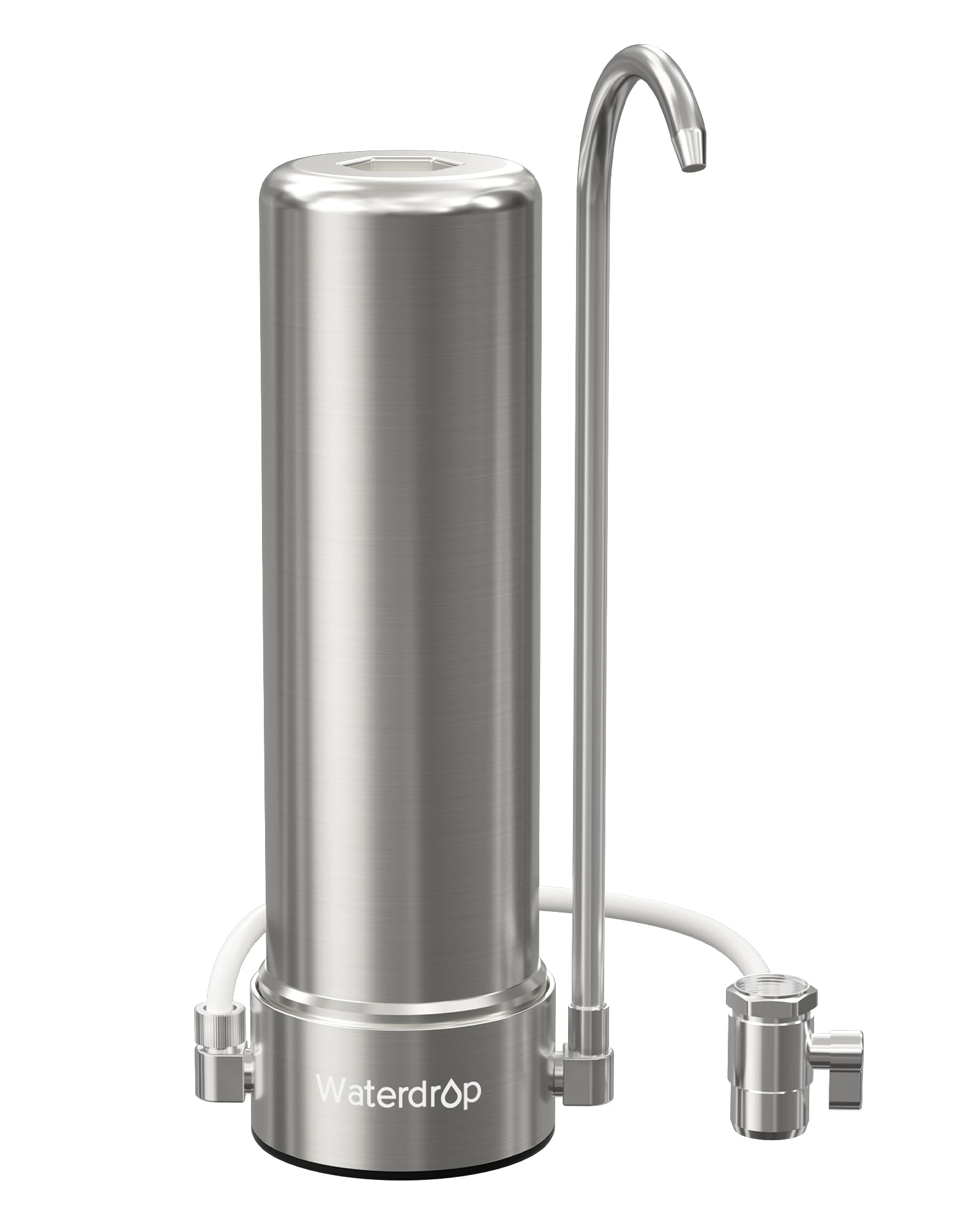
Waterdrop CTF-01 Countertop Filter
Key Features
- Capacity: 8,000 gallons
- Filter life: 12 months
- Installation: Countertop
- Certification: NSF/ANSI 42
- Price: Premium
The Waterdrop CTF-01 is the outlier here: it is a countertop unit, not a filter that clips onto your existing faucet. In exchange, it delivers 8,000 gallons or up to 12 months from one filter, plus a stainless faucet and a 1.6 gpm flow. For a household that fills pitchers and bottles every day, that capacity is the attraction.
It is NSF/ANSI 42 certified and reduces heavy metals and 99% of chlorine, and the five-stage filter is designed to leave beneficial minerals in the water. The countertop format also means you are not hanging a housing off your faucet, so there is less strain on the connection. The hose connection is the detail to check after setup; a drip is easier to catch on the counter than under the sink.
We think this one earns a place for high-volume kitchens and for anyone who wants a longer filter interval without swapping cartridges every season. The stainless housing looks more like a small appliance than a plastic add-on, which is part of why it can sit out without feeling like a compromise.
Pros
- 8,000-gallon filter capacity
- NSF/ANSI 42 certified
- 1.6 gpm flow rate
- Stainless steel housing
Cons
- Needs clear counter space
The Waterdrop CTF-01 is the high-capacity alternative for a kitchen with counter room: one filter lasts up to a year and the stainless body looks at home on the sink.
How We Tested Faucet Water Filters in Real Kitchens
We started with the fine print rather than the marketing copy, favoring units that carry NSF/ANSI 42 certification for taste and chlorine, plus 53 where lead or heavy metals are claimed. From there we narrowed by faucet fit, rated cartridge life, price, and whether the housing was something we’d want to look at every day, then bought 14 of them outright at retail.
Every unit went on with a stopwatch running and no tools, since most people do this on a Tuesday night with a dish towel. We blotted the connection with a dry paper towel right after installation, again 24 hours later, and again at the one-month mark, watching for weeping at the collar and drips running down the spout. Flow got measured the low-tech way: how long a quart measuring cup took to fill with the filter engaged versus straight from the tap.
Then came six months of ordinary life — the 6 a.m. coffee pot, a stockpot for pasta night, kids refilling bottles, dishes. We flipped the diverter one-handed while holding a full pot to see whether the switch jammed, tasted filtered and unfiltered water side by side at room temperature and chilled, and wiped each housing weekly to see how chrome and white plastic held up against fingerprints and splatter. We also logged when each cartridge actually slowed instead of trusting the rating on the box.
Two units developed a slow drip at the adapter inside the first month and came off the list. The rest we simply stopped thinking about, which is the highest compliment a faucet filter can get.
How to Choose a Faucet Water Filter
Start with the faucet in front of you, not the filter’s feature list: the connection determines whether a unit fits securely, and the filter interval determines what ownership costs after installation.
Check the faucet connection first
Most faucet filters need a standard faucet with a removable external aerator. They do not fit pull-out, hand-held, or integrated spray heads, and the adapters in the box only help if the faucet has the right threads. Before ordering, unscrew the aerator and look at the threads. If the faucet pulls out on a hose, skip these and consider a countertop unit instead. The Waterdrop CTF-01 is the exception here—it sits on the counter and connects by hose, so it needs clearance rather than a threaded faucet.
Match filter life to your water habit
A 100-gallon cartridge is a three-month rhythm for many households, while the Waterdrop’s 8,000-gallon filter is rated for up to a year. The difference matters if you fill bottles, pitchers, and cooking pots every day. We look for a filter-change indicator and a replacement cartridge that is easy to find, because the upfront unit is only part of the cost. For a one- or two-person kitchen, a 100-gallon filter may be enough; for a family that drinks a lot of tap water, the longer interval is worth the extra counter space or higher upfront cost.
Decide which contaminants matter
A sink water filter is good at chlorine taste and odor, lead, and some microplastics; it is not a water softener and does not lower TDS. Check the certification and the reduction list rather than the word filtered. The Brita Elite is certified to reduce 60+ contaminants including lead, while the PUR PLUS Horizontal is certified for 70 chemical and physical substances. If your water leaves white scale, a filter will not solve that—test the water or add a softener. If you have a specific concern, match the unit to a certified reduction claim for that contaminant.
Think about daily handling and space
A filter you have to wrestle out of the way is one you stop using. A horizontal body, like the PUR PLUS, leaves more clearance in a tight sink, while a vertical unit can crowd the faucet. A lever or spray selector should move easily with wet hands, and a filter indicator saves guesswork. If counter space is tight, stay with a faucet-mount model; if you have room and want longer filter life, a countertop unit can be the better trade. Measure the space beside the sink before you commit.
Frequently Asked Questions
Can I run hot water through a faucet water filter?
No. These units are meant for cold water; the listed maximum water temperature is around 100°F, and hot water can damage the filter media or housing. Run cold water for drinking and cooking, and if you need hot water, use the unfiltered tap setting or heat cold filtered water separately.
Are replacement filters interchangeable between brands?
No. Each housing takes its own cartridge, so a Brita filter will not fit a PUR unit, and the Waterdrop countertop model uses a different replacement. Note the model number before you buy and confirm that the cartridge is stocked; a low-cost unit with hard-to-find filters is a false saving.
Can I use a faucet water filter on a bathroom faucet?
Yes, if the faucet has a standard external aerator and there is room for the housing. The PUR PLUS Horizontal is rated for kitchen or bathroom faucets, but pull-out and integrated spray heads are out. Check that the lever clears the backsplash and that the spout does not pull out on a hose before you order.
Do faucet water filters work on well water?
They can improve taste and reduce chlorine, but they are not microbiological purifiers. If you use well water, test for bacteria, nitrates, and other contaminants before relying on any filter; choose a treatment system matched to the test results, not just a taste-and-odor cartridge.
Final Verdict
The Brita Elite is our default because it asks the least of you: four months between cartridges, certified reduction for 60+ contaminants, three spray settings, and a tool-free install on a standard faucet.
The PUR PLUS Horizontal is the better fit for a cramped sink, where its sideways body and simple lever earn the shorter filter interval. The Waterdrop CTF-01 is the high-capacity alternative for a kitchen with counter room and a household that fills bottles constantly—but it is not a faucet-mount, so do not choose it if clearance is the problem.