This post contains affiliate links. We may earn a small commission when you buy through our links — at no extra cost to you.
A roast comes out of the oven, the kitchen fills up, and the board you hauled out of the cabinet starts skating across the counter while the juices run for the edge. A carving board that’s actually big enough to hold the bird — and stays put while you work — turns those ten minutes from a scramble into the best part of the holiday. Size matters more than people expect: without a couple inches of clearance around the meat, even a deep juice groove does nothing.
My team and I have spent the past nine months carving on 10 boards — thick edge-grain wood, bamboo, and commercial-grade plastic — and the differences show up fast. Weight and grip matter more than they sound: a heavy board stays put but is miserable to lift and wash, while a light one slides unless it has feet or handles. Wood feels better under the knife; plastic shrugs off raw poultry and the dishwasher.
The picks below run from a board that swallows a 24-pound turkey to one light enough to haul out to the grill, and each earned its spot for a different reason.


Best for Everyday Carving
Thirteen Chefs HDPE Carving Board
Key Features
- Weight: 10 lb
- Material: HDPE
- Dimensions: 24"L x 18"W x 0.75"Th
- Juice groove: One side only
- Price: Midrange
High-density polyethylene is what a lot of restaurant kitchens cut on, and it’s the reason this board asks almost nothing of you: no oiling, no re-sanding, no worrying about what a wet roast does to a grain pattern. At 24 by 18 inches and three-quarters of an inch thick, it holds a spatchcocked turkey or a full packer brisket with room left for trimming.
That combination is why it leads this group. Ten pounds turns out to be the number that matters most at carving time: the board sits on the counter and stays there while you lean into a bird, and the black surface hides the stains a white board would advertise. The juice groove runs around the perimeter on one face only, so you can flip it over for flat work when you’re dicing onions and don’t want to chase them out of a trough.
Cleanup is where plastic earns its keep. A scrub, a rinse, and it’s done — none of the oiling a bamboo or teak board needs, and nothing soaking into the surface. It is hand wash only, though, and at 24 inches long it wants a basin wide enough to take it, so check your sink before you commit. There’s also no pour spout at the corner of the groove, which means emptying the juice involves tipping the whole board.
Neither point bothers us much; the groove handles what a rested roast gives up. If you do want a spout, the Greener Chef has one at each corner, at the cost of the wipe-and-go finish that makes this the board we reach for on an ordinary Tuesday.
Pros
- Commercial-grade HDPE never needs oiling
- Groove on one face, flat on the other
- 10 pounds stays put while carving
- Scrubs clean with no wood upkeep
Cons
- No pour spout at the groove
- Hand wash only, in a wide sink
The carving board we recommend first: commercial-grade plastic that never needs oiling, grooved on one face, flat on the other, and heavy enough to hold still under a knife.
Best for Big Holiday Roasts
Greener Chef Extra Large Bamboo Board
Key Features
- Weight: 11 lb
- Material: Bamboo
- Dimensions: 30"L x 20"W x 0.75"Th
- Juice handling: Corner reservoirs with pour spout
- Price: Midrange
At 30 by 20 inches, this is the biggest solid-wood surface here, and the difference shows up on the days that matter. A 19-pound bone-in rib roast sits on it with room for a pile of carrots alongside; a turkey lands with margin instead of hanging over the edge. That expanse is why the board does more than carving — it drops over a stove or a sink and hands back counter space in a kitchen that doesn’t have any.
The juice handling is the detail we appreciate most. Rather than a groove that runs to the rim, the corners drop into reservoirs with a pour spout, so drippings pool where you can tip them into a saucepan instead of watching them slosh onto the floor. The side handles are cut into the board, which means carrying a loaded one to the table doesn’t involve a towel underneath it.
Bamboo is the trade-off. The ends lifting and separating from the main slab is the failure to watch for, so keep it out of standing water and dry it on edge. The lifetime replacement coverage is what keeps us comfortable recommending it anyway: if a board delaminates, the maker replaces it.
Pros
- Huge 30 x 20 surface for holiday birds
- Corner reservoirs with a pour spout
- Lifetime replacement coverage
- Doubles as a stove or sink cover
Cons
- Bamboo ends can separate over time
- Hand wash with monthly oiling
A 30 by 20 bamboo surface with corner reservoirs and a pour spout, and the board we take out for a holiday bird when we want the drippings saved rather than wiped up.
Best for Serving at the Table
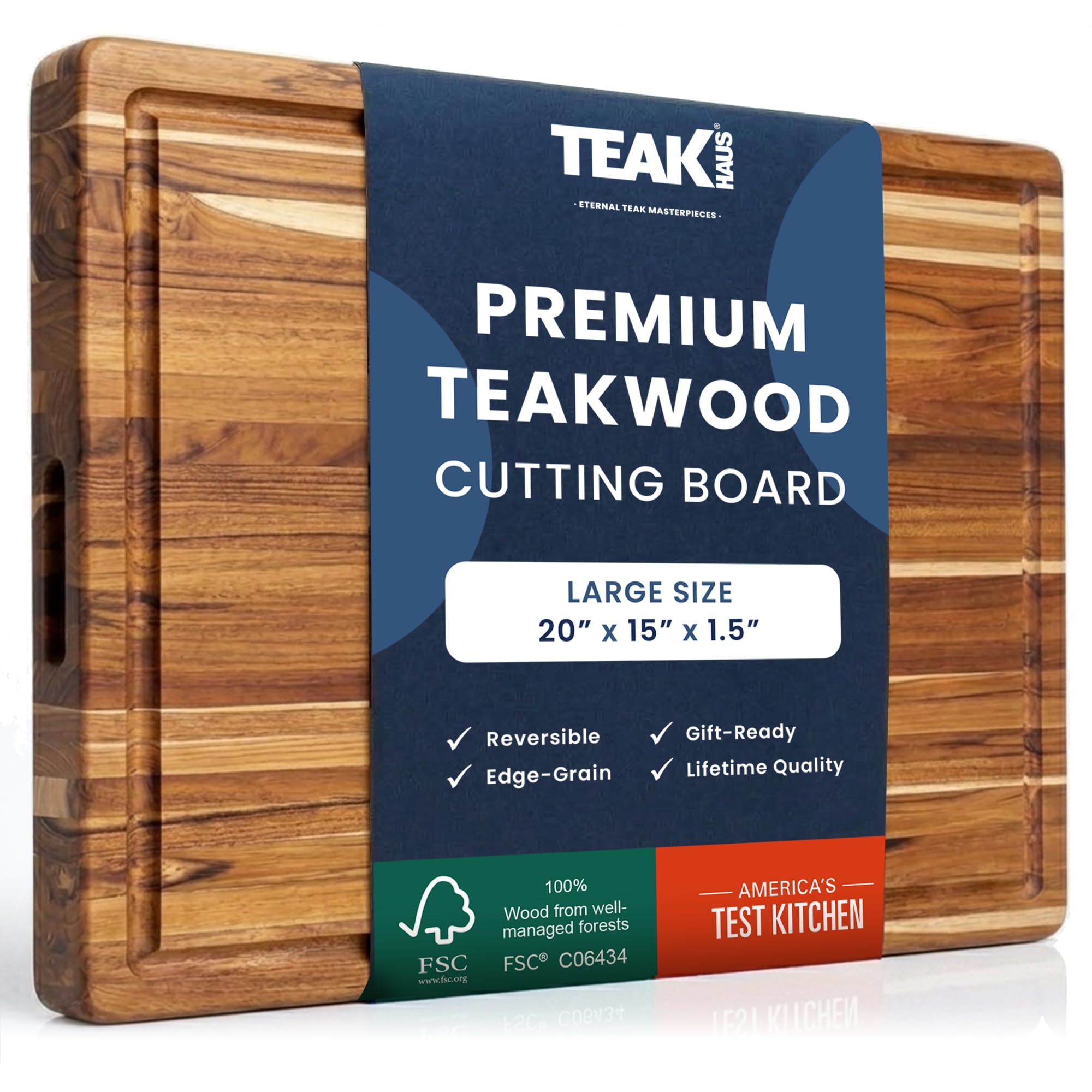
Teakhaus Edge-Grain Teak Carving Board
Key Features
- Weight: 4.5 lb
- Material: Teak wood
- Dimensions: 20"L x 15"W x 1.5"Th
- Juice groove: One side, reversible
- Price: Premium
Twenty by fifteen inches is the size a carving job actually needs on most nights: a roast chicken, a rack of ribs, a pair of thick chops, with the fork resting beside them and no empty acreage to wipe down afterward. It’s also small enough to carry from counter to table without ceremony, which is rather the point of a board that looks like this one.
What that footprint buys is 1.5 inches of edge-grain teak, the thickest board in this guide and rigid enough that it never flexes under a knife. We keep coming back to the reversible design: the groove is cut into one face, so the other side is a clean slab for bread, vegetables, or cheese, and the grip handles are deep enough to hold when the surface is slick. Teak’s natural oils make it more forgiving of a hurried rinse than bamboo.
What tempers it is flatness. Teak moves with moisture, and a board that soaks or sits wet can bow along the grain and rock under your knife; a groove that isn’t cut evenly is the other thing to check when the box arrives. Wash it, dry it on edge, oil it monthly, and store it where air reaches both faces. Looked after that way, it stays flat, and the edge grain keeps the tight, even surface that makes teak a pleasure to cut on.
Pros
- Thick 1.5-inch edge-grain teak
- Reversible with the groove on one side
- FSC-certified stock with natural oils
- Grip handles for carrying to the table
Cons
- 20 x 15 limits it to smaller roasts
- The priciest board in this guide
This is the board to carve at the table: 1.5 inches of edge-grain teak, reversible, the best-looking piece in this group — as long as you dry it upright and oil it.
Best for Small Kitchens
OXO Good Grips Carving Board

Key Features
- Care: Dishwasher safe
- Weight: 3.31 lb
- Material: Plastic
- Dimensions: 21"L x 14.5"W x 0.7"Th
- Price: Budget
Not every carving job needs a plank. This is the board that lives in a drawer and comes out for a chicken, a pork loin, or a Sunday roast, and it weighs a fraction of what the big boards here do — one hand to pull it out, one hand to rinse it, no clearing the counter first.
Both faces are non-porous, so you can carve on one and flip to the other for vegetables, and the deep groove around the border ends in pour corners that funnel juice into a cup instead of over the edge. The tapered edges double as handles, which matters more than it sounds once the board is wet.
That light weight is the whole argument, and it holds up until the board meets a dishwasher. OXO calls it dishwasher safe, but bending out of shape is the problem that shows up most with this board, usually after a machine cycle, and a board that rocks under your knife is worse than no board at all. Wash it by hand, dry it flat, and it stays true — and check that your sink takes a 21-inch board lying down, because that’s the dimension that decides how often you’ll actually reach for it.
Pros
- Lightest board in this guide
- Double-sided and non-porous
- Deep grooves with pour corners
- Tapered edges work as handles
Cons
- Feet lose grip on a wet counter
- Runs short for a whole turkey
The light, compact option we keep for small kitchens and quick jobs: double-sided, deeply grooved, and a fraction of the weight of the big boards here.
Best for Feeding a Crowd
Empune 36-Inch Bamboo Carving Board

Key Features
- Weight: 21.4 lb
- Material: Bamboo
- Dimensions: 36"L x 24"W x 1"Th
- Juice handling: Perimeter groove, side handles
- Price: Premium
Twenty-one pounds of bamboo is a different category of object. This board takes two hands and a plan to move, and that mass is the reason a 36-inch surface can sit still while you portion a brisket — nothing about it shifts when you lean in.
The surface is the point. Thirty-six by twenty-four inches swallows a spatchcocked turkey, a whole packer brisket, or a holiday ham with the carving fork lying beside it, and the groove runs the full perimeter. The side handles are cut into the ends rather than screwed on, which is the right call on something this heavy.
Bamboo at this scale is where the material gets stressed. Oil it monthly, keep it out of standing water, dry it on edge, and run a thumb along the rim before you set a roast down. A splinter found with a fingertip is one that doesn’t end up in the meat.
Pros
- Largest surface here at 36 x 24
- Perimeter groove catches the juices
- Handles cut into the ends
- Doubles as a stove cover
Cons
- Edges can splinter under heavy use
- 21 pounds to lift and store
Our pick when the guest list outgrows the kitchen: 36 by 24 inches of bamboo that swallows a whole bird, with the caveat that it wants gentle handling and dry storage.
How We Chose and Tested Carving Boards
We started by gathering every carving board we could find in wood, bamboo, and plastic, then cut the list by size first — anything under about 18 inches long leaves no room for a turkey plus a groove. We read through customer reviews for the complaints that repeat: boards that cup or split, boards that skate, surfaces that scar after a few roasts. We weighed cost against thickness and overall size, since a big board isn’t a value if it’s an inch thin and warps. Ten made it into the kitchen, and we’ve cooked on them for nine months.
They’ve been through holiday turkeys, Sunday briskets, weeknight roast chickens, and steaks carried in from the backyard grill. We carved on each board at least six times, flipped each one to see whether the second side was genuinely usable, and washed every board the way its maker specifies — by hand for the wood, through the dishwasher for the plastic.
For the juice groove, we poured half a cup of watered-down food coloring into the channel and watched whether it held or spilled onto the counter. To judge non-slip, we set each board on a dry counter and pushed it with a flat palm, then lifted it by the handles with wet hands to see how it carried. We scored the surface with a chef’s knife and tracked the marks over months, weighed each board loaded with a roast, and laid a straight edge across them every few weeks to catch the first sign of warping. Ease of cleaning came down to how much scrubbing a dried-on fat cap took.
How to Choose a Carving Board
A carving board has one job — hold a heavy piece of meat still and keep the juice off your counter — and size, juice handling, material, and flatness are what decide whether it does that job.
Size: Measure the Bird, Then the Sink
Sizing is two measurements, not one. The first is what you cook: a turkey carved off the bone, a whole packer brisket, or a rack of ribs all want a board where the meat isn’t hanging over an edge, and 24 by 18 inches covers nearly everything short of a 20-pound bird. The second is your sink. A board you can’t wash comfortably stops getting used, so check that it lies down in the basin or fits your dishwasher before you fall for the biggest one on the page.
Then think about where it lives between uses. A 30- or 36-inch board is a stove cover and a spare counter in a small kitchen, and a storage problem in a kitchen that already has counters. If it has to go into a cabinet or lean against a wall, the 20- to 24-inch boards are the practical ceiling.
Groove, Reservoir, or Pour Spout
A perimeter groove buys time rather than immunity. On a rested roast it catches what runs off; on a brined bird carved hot, a shallow channel can fill and spill onto the floor. If the drippings matter to you — gravy, au jus, a pan sauce — look for a deeper well or corner reservoirs, and treat a pour spout as the feature that turns a mess into a saucepan.
A groove cut into one face only is worth having, because it leaves a flat side for vegetables, bread, and anything that shouldn’t roll into a trough. Boards with grooves on both faces give you nothing to flip to.
Plastic, Bamboo, or Teak
Material decides how much of your life the board takes up. HDPE plastic never needs oil, doesn’t absorb, and scrubs clean in a minute, which is why it’s what we recommend first to most cooks; it looks industrial doing it. Bamboo gets you a much bigger surface for less money, but it wants monthly oiling and it can delaminate at the ends when water gets in.
Teak is denser and naturally oily, the most forgiving wood here if you’re occasionally careless with a rinse, and you pay for it. Whichever you choose, hand wash and dry it on edge unless the maker says otherwise, and never soak a wood board.
Stability: Weight, Feet, and Flat
A board that slides or rocks is a knife problem, not an annoyance. Weight is the simplest fix — around 10 pounds and up sits still on its own, while lighter boards need rubber feet or a damp towel underneath. Flatness matters just as much, particularly with wood: lay the board on the counter and press opposite corners before you trust it with a roast.
If a wood board does bow, the cause is almost always moisture — a soak, a dishwasher cycle, or storage flat on a wet counter. Dry it upright where air reaches both faces and most of that risk goes away.
Frequently Asked Questions
Do I really need a separate board just for carving?
If you already own a large board with a groove, keep using it. What a dedicated carving board buys you is a surface where a roast isn’t hanging off the edge and a channel that keeps drippings out of your countertop grout.
No groove on your current board? Set it inside a rimmed sheet pan. You get the same juice capture for the cost of one extra dish to wash.
Can I leave a carving board on top of the stove?
Yes, and plenty of people buy one for exactly that — it turns a cold range into counter space. Wait until the burner is cool to the touch before you set wood or bamboo down, and never use the board as a landing spot for a hot pan.
Heat drives moisture out of wood, and that’s how a flat board starts to bow. Plastic tolerates more, but a hot skillet will still mark it.
How do I move a 20-pound turkey from the board to the platter?
Lift the board, not the bird. Carve where the board sits and move the slices with a bench scraper or a wide spatula, or carry the loaded board to the table by its handles with both hands underneath.
If you need to present the whole roast, set the board on a rimmed sheet pan and carry the pan — it catches anything that escapes on the way.
Final Verdict
The Thirteen Chefs board is the one we point most cooks to: commercial-grade plastic with a groove on one face and a flat one on the other, heavy enough to hold a roast still and simple enough to rinse and put away without a maintenance ritual.
Go with the Greener Chef if you want the largest wood surface here and a spout that pours the drippings into a saucepan, or the Teakhaus if the board is going on the table and you don’t mind oiling it.