This post contains affiliate links. We may earn a small commission when you buy through our links — at no extra cost to you.
Raw meat is the one thing I refuse to prep on just any board. A chicken breast leaking pink juice toward the counter, a roast that hangs over the edge, a surface so scarred you can’t tell if it’s clean — that’s how dinner becomes a hazard. A good raw-meat board fixes all three: enough room to work, a groove to catch what runs, and a surface you can actually sanitize. It should also stay put while you saw through a backbone.
Over the past six months, I’ve rotated a dozen boards through my kitchen, breaking down chickens, trimming brisket, and carving pork shoulders. Some were beautiful showpieces that scratched easily; others were cheap plastic sheets that slid across the counter. The keepers got the size right — big enough for a 12-pound bird, small enough for the sink — and didn’t punish me at cleanup. A raw-meat board isn’t where you splurge on looks; it’s where you buy thickness and a surface that forgives a knife. The picks below are the ones I’d trust with Thanksgiving.


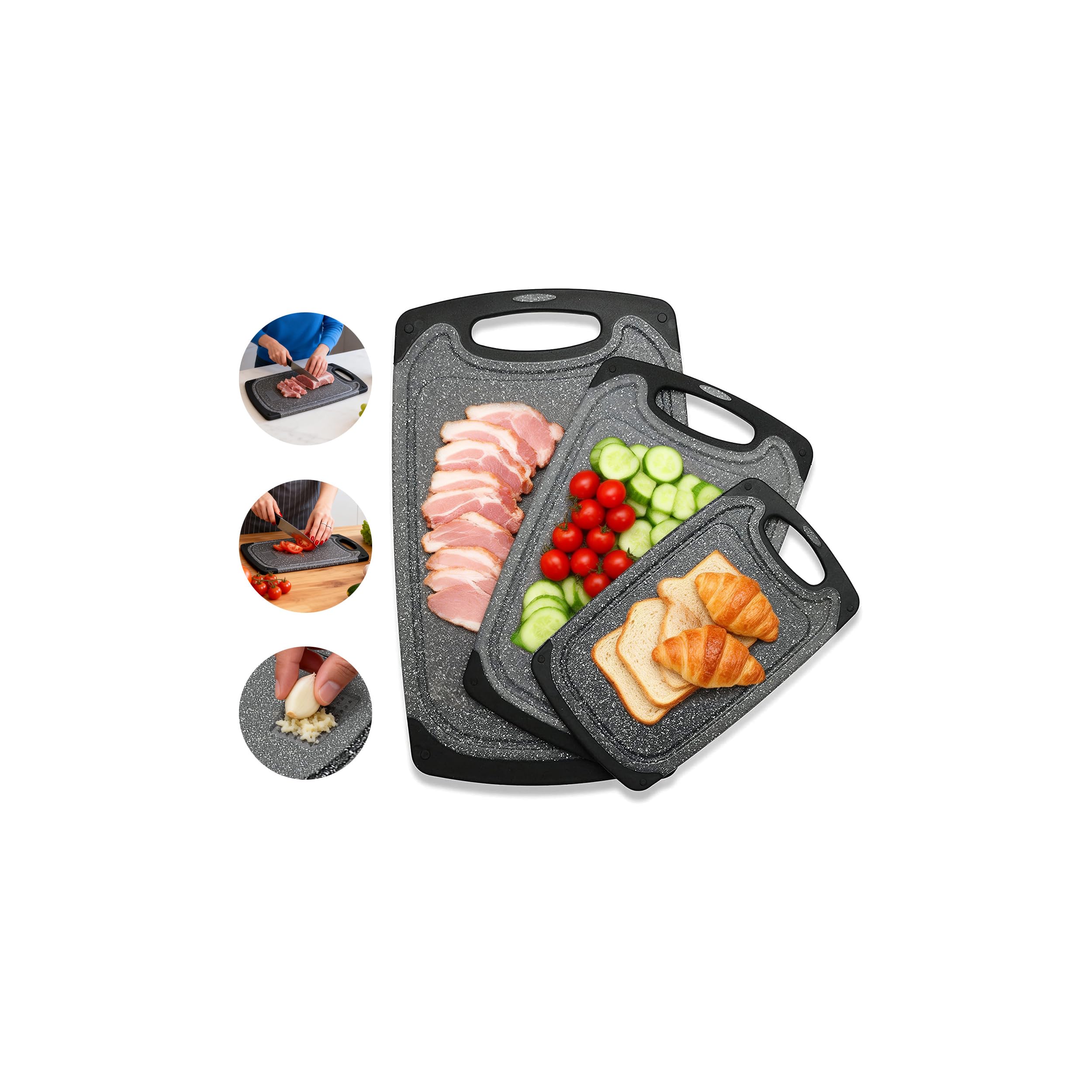

Best for Raw-Meat Meal Prep
Empune Plastic Cutting Board Set
Key Features
- Care: Dishwasher safe
- Material: High-density plastic
- Thickness: 0.4 in
- Largest board: 17 x 11.8 in
- Price: Midrange
The largest board in this Empune set is the one that makes raw-meat prep feel less cramped: 17 by 11.8 inches, with the other two boards stepping down for smaller jobs. The deep juice groove runs around the edge, and the high-density plastic has enough thickness to feel like a board rather than a flexible mat. We like that the set gives you an immediate way to keep raw meat, produce, and a quick sandwich on separate surfaces.
That combination is why this is our top pick for most home cooks. We reach for the large board when a chicken or pork loin needs trimming, then send it through the dishwasher instead of treating cleanup as a separate project. The two smaller boards are genuinely useful, not filler: one can stay out for produce while the large one handles raw meat. In our testing, the set felt stable enough for ordinary slicing, though the largest board can slide on polished stone if the counter is dry.
The main practical catch is fit. The largest board is a generous size, and it may not sit comfortably in a compact dishwasher, so check the rack before you count on machine washing every piece. The plastic will show knife marks over time, as any plastic board does, but the surface is easy to scrub and the groove is shallow enough to clean without a brush. For a raw-meat board that has to be ready again tomorrow, that matters more than a pretty grain.
Pros
- Three sizes separate raw meat and produce
- Deep juice groove catches runoff
- Dishwasher-safe for thorough cleanup
- Thick 0.4-inch plastic feels substantial
Cons
- Largest board may not fit compact dishwashers
We recommend the Empune set as the best all-around raw-meat board for most kitchens: three sizes, a deep groove, and dishwasher-safe cleanup.
Best for Small Kitchens
OXO Good Grips 2-Piece Set
Key Features
- Care: Dishwasher safe
- Features: Non-slip feet and drip-catcher corners
- Material: Plastic
- Board sizes: 9 x 12.9 in and 7.25 x 10.75 in
- Price: Midrange
The OXO set is small on purpose: a 9 by 12.9 inch everyday board and a 7.25 by 10.75 inch prep board. That compact size is exactly why we keep it in the small-kitchen slot. A board that fits beside the sink and slides into the dishwasher gets used more often than a giant one that lives in the cupboard, and the OXO’s non-slip feet and drip-catching corners make it feel thought-through rather than merely small.
We recommend it for weeknight chicken breasts, steaks, and trimming jobs where a full-size board is more surface than you need. The soft, tapered edges double as handles, so moving a loaded board to the stove is less of a juggling act. The double-sided plastic is nonporous, and the boards are dishwasher-safe, which is the routine we want after raw meat. The drip-catcher corners are a nice detail: they give runoff somewhere to collect instead of letting it run straight off the edge.
The trade-off is surface area. This is not the board for a holiday turkey or a big batch of stock meat; the everyday board is best for smaller cuts, and the prep board is for garnishes and trim. The hand feel is better than the bare plastic suggests, and the tapered edges make the boards easy to pick up with wet hands.
Pros
- Non-slip feet keep the board steady
- Drip-catcher corners control runoff
- Dishwasher-safe for raw-meat cleanup
Cons
- Surface shows knife marks quickly
We recommend the OXO set for small kitchens and weeknight raw-meat prep, where steady feet and drip-catching corners matter more than a giant work surface.
Best for Large Batches
Winco CBWT-1830 Cutting Board
Key Features
- Material: High-density plastic
- Thickness: 0.5 in
- Dimensions: 29.9 x 17.9 in
- Certification: NSF certified; HACCP color coding
- Price: Premium
At roughly 30 by 18 inches, the Winco CBWT-1830 is less a countertop board than a portable prep station. It is the board you clear space for, not the one you tuck beside the toaster. That size is the point: a whole pork loin, several chickens, or a big batch of vegetables can be broken down without shuffling pieces onto a second surface.
The board is made from high-density plastic, half an inch thick, and weighs about five pounds. It is NSF certified and available in HACCP-friendly colors, which is the language of commercial kitchens rather than decorative home gear. The plastic is stain resistant and dishwasher-safe, and the reversible surface gives you a fresh side when one has done a shift with raw meat.
We think it earns its place for big-batch cooks who want one large, stable surface. The weight keeps it from skating around while you saw through a backbone, and the commercial certification is reassuring if you take food safety seriously. It is a board that makes a big job feel smaller.
There is no juice groove, so a rimmed tray or a towel under the edge is smart when a roast releases liquid. A whole pork loin fits with room to spare, which is the point. The board rewards a cook who thinks in batches, and it turns a messy job into one clean station.
Pros
- Huge 30 x 18 inch work surface
- NSF-certified, HACCP-friendly plastic
- Heavy 5-pound body stays put
Cons
- Too large for most home sinks
We recommend the Winco for large-batch raw-meat prep and anyone who wants a commercial-kitchen surface; it rewards a dedicated prep counter.
Best for Budget Setups
Viretang Plastic Cutting Board Set
Key Features
- Care: Dishwasher safe
- Material: Plastic
- Thickness: 0.35 in
- Largest board: 15.6 x 9.4 in
- Price: Budget
The Viretang set is the budget route to a three-board rotation, and it does not feel like a throwaway. The largest board is 15.6 by 9.4 inches, with a medium and small board stepping down, and each has a juice groove around the edge. Two of the boards also have a grinding area for garlic and ginger, which is a small extra that makes the set feel more considered than its plain look suggests.
We recommend it for cooks who want separate boards for raw meat and produce without turning the purchase into a project. The rubber feet are the detail that lifts it above the usual cheap plastic set: they grip the counter and make the board feel less likely to skate while you slice. The plastic is dishwasher-safe, and the grooves are deep enough to catch a chicken breast’s runoff. It is not the set for a holiday roast; the largest board is better sized for steaks, cutlets, and weeknight portions.
For a first apartment, a rental kitchen, or a household that wants separate boards without much spending, the Viretang set covers the basics well. We keep the largest board for raw meat, the medium for vegetables, and the small one for fruit, which is the kind of simple system that makes the set more useful than a single fancy board.
Pros
- Three sizes for separate tasks
- Non-slip rubber feet
- Deep juice grooves
Cons
- Surface scratches easily
We recommend the Viretang set as the budget pick for cooks who want separate boards for raw meat and produce without spending much.
Best for Wood-Board Fans
Greener Chef Bamboo Cutting Board
Key Features
- Care: Hand wash; oil regularly
- Material: Moso bamboo
- Thickness: 0.63 in
- Dimensions: 18 x 12.5 in
- Price: Midrange
The Greener Chef board comes with a lifetime replacement guarantee, which is the first thing we noticed on a bamboo board at this level. That guarantee does not make the board indestructible, but it does change the calculation if you have been burned by a bamboo board that dried out or split.
The board is 18 by 12.5 inches and about 0.63 inch thick, with a juice groove on one side and a reversible flat side on the other. The vertical-grain construction and Moso bamboo give it a denser feel than the thin, pale bamboo boards that turn up in discount bins. At about 3.5 pounds, it is light enough to move from counter to stove without feeling fragile. It is a hand-wash board that wants occasional oil, so it belongs to the cook who treats wooden tools as tools, not dishwasher cargo.
We recommend it for someone who prefers a wood surface and will keep up with the care. The large surface is roomy enough for a chicken or a pile of vegetables, and the juice groove is a real help with raw meat. The board is gentle on knives and pleasant to work on, which is the reason to choose bamboo in the first place.
What keeps it from being our top pick is the maintenance. If you want a board that goes from raw meat to dishwasher without a second thought, choose plastic. If you want the feel of bamboo and will treat it accordingly, this is the wood-board pick we trust most here. The guarantee is what makes that recommendation feel safe: it backs the part most likely to disappoint.
Pros
- Large 18 x 12.5 inch surface
- Lifetime replacement guarantee
- Light 3.5-pound body
- Juice groove and reversible side
Cons
- Can splinter if neglected
We recommend the Greener Chef for cooks who prefer bamboo and want a large, lifetime-backed board; the guarantee makes it the wood pick we trust most here.
Best for Simple Prep
Farberware Large Cutting Board

Key Features
- Care: Dishwasher safe
- Material: Polypropylene
- Thickness: 0.25 in
- Dimensions: 11 x 14 in
- Price: Budget
The Farberware board is thin and light, the kind of board you grab for a quick trim and then rinse. We think that makes it a useful second board rather than the one we reach for first when a roast is involved. It is 11 by 14 inches, a quarter-inch thick, and reversible, with a hand hole that helps you lift it without fumbling.
For a quick chicken breast, a few steaks, or trimming fat before dinner, the size is convenient. The polypropylene surface is nonabsorbent, the board is dishwasher-safe, and the light weight makes it easy to move from counter to sink. We like it as the board that lives near the cutting area for small jobs and gets washed without ceremony.
The Farberware is not trying to be a do-everything board; it is the spare that keeps a big board free for bigger jobs. It stores in a narrow slot, and the hand hole makes it easier to lift when your hands are slick.
Pros
- Dishwasher-safe for quick cleanup
- Lightweight and easy to handle
- Reversible with a hand hole
Cons
- Thin body can slide on smooth counters
- No juice groove for runoff
We recommend the Farberware as a light-duty second board for quick raw-meat trims and tight kitchens, not as the main board for a large roast.
Best for Bamboo Variety
Royal Craft Wood Bamboo Set

Key Features
- Care: Hand wash only
- Material: Deep-carbonized bamboo
- Thickness: 0.6 in
- Board sizes: 15 x 10 in; 12 x 8 in; 9 x 6 in
- Price: Premium
The Royal Craft set gives you three bamboo boards—15 by 10, 12 by 8, and 9 by 6 inches—so raw meat, produce, and serving can stay apart without a stack of mismatched boards. The graduated sizes are the practical part: the small board is handy for garlic or a single chicken breast, while the large one has room for a pile of vegetables or a modest roast.
The boards are made from deep-carbonized bamboo, with side handles and a deep juice groove on each. The surface is pre-oiled and smooth, and the dark finish looks richer than its simple construction suggests. The bamboo is gentle on knives, and the handles make it easy to move a loaded board to the stove or table. The reversible design gives you a fresh side when one has been used for raw meat.
The deep groove is useful, but it is also the part that needs the most attention when you wash the board; a quick rinse is not enough after raw meat. The bamboo surface is smooth and pleasant under a knife, and the dark finish hides some stains better than pale wood.
We recommend the Royal Craft set for cooks who want a bamboo rotation and will treat it accordingly. The graduated sizes make it easy to keep raw meat and ready-to-eat food separate, and the deep groove is useful for juicy cuts. Stacked together, they take up less room than three unrelated boards, which is the practical reason the set works.
Pros
- Three sizes keep tasks separate
- Deep juice groove on each board
- Side handles make carrying easier
Cons
- Hand wash and oil only
- Can crack if it dries out
We recommend the Royal Craft set for bamboo lovers who want three sizes for separating raw meat and produce.
How We Tested the Best Cutting Boards for Raw Meat
To build the shortlist, I started with boards sold specifically for raw meat or large enough to handle a whole chicken — anything under 14 inches wide was out. I read spec sheets for material, thickness, juice groove capacity, and whether the manufacturer claimed dishwasher safety, then filtered by price so we had a mix of budget plastic, composite, and wood. The final twelve ranged from thin plastic sheets to two-inch maple blocks.
For six months, those twelve boards lived on my counter. I broke down a whole chicken every Sunday, trimmed brisket, carved pork shoulder, and sliced fish for tacos. Each board got the same jobs: I checked whether a 12-pound bird fit without overhang, whether juice stayed in the groove or ran off the edge, and whether the board slid when I pushed a knife through chicken bones. I noted how deep the knife marks went after a week of normal prep and whether those marks held pink juice after washing. After hand-washing and drying, I checked for warping, splitting, and raised grain.
I also looked at how each board aged — whether the surface stayed even or turned into a map of pale scratches. At the end, I asked whether the price matched the board’s thickness and finish. The ones that rose to the top shared a few things: enough usable surface that a roast wasn’t hanging off the edge, a juice groove deep enough to hold more than a few tablespoons, and a surface that didn’t gouge after one dinner. None of them were the cheapest or the prettiest. They were the ones I stopped thinking about.
How to Choose a Cutting Board for Raw Meat
The right raw-meat board is the one you can clean thoroughly without dreading the job, so start with care and size before you fall for a pretty grain.
Material and the washing routine
For raw meat, we put dishwasher-safe plastic at the front of the line. A nonporous plastic board is easy to scrub, and machine washing gives you a more reliable reset than a quick rinse. Wood and bamboo are pleasant under a knife and kind to edges, but they ask for hand washing, prompt drying, and occasional oil; leave them wet or skip the oil and cracking becomes a real risk. If you want the easiest raw-meat routine, choose plastic. If you prefer wood, choose it knowing the upkeep is part of ownership.
Size and the space around it
A board that is too small makes raw meat feel crowded: juices run off the edge and you run out of room to move a roast. A large board around 17 by 12 inches gives most home cooks enough room for a chicken or a pork loin, while a 30-inch commercial board is for dedicated big-batch prep. Measure the sink and dishwasher before you size up. The largest board in a set can be the most useful one and still be the one you have to hand wash because it does not fit the rack.
Stability is part of safety
A board that slides while you are slicing raw meat is more than annoying; it makes the knife harder to control. Rubber feet, a rubberized border, or a damp towel underneath all help. Thin, lightweight boards are the ones most likely to skate on polished stone, and a board that bows can rock under pressure. We prefer a board with a grippy edge or enough weight to stay put, and we keep a folded damp towel nearby for the ones that do not.
Juice grooves and separate boards
A juice groove catches runoff before it reaches the counter, which matters when you are cutting a juicy roast or breaking down a chicken. It is a convenience, not a substitute for washing: the groove itself needs scrubbing. A set with two or three sizes also lets you keep raw meat on one board and ready-to-eat food on another, or use one side for raw and the other for cooked after a wash. Reversible boards help, but only if you actually keep the sides straight.
Plan for wear
Plastic boards pick up knife marks, and bamboo can splinter or crack if it dries out. Light scratches are normal; deep grooves, cracks, and rough edges are where a raw-meat board stops being easy to clean. We inspect the surface with a fingernail and retire any board that catches or has a split. Dishwasher-safe plastic is the lower-maintenance choice, but even plastic can warp or score over time. The board you keep is the one you can clean completely every time.
Frequently Asked Questions
How should I wash a cutting board after raw meat?
Scrub both sides with hot, soapy water and rinse thoroughly. If the board is dishwasher-safe, the dishwasher gives you the most reliable reset. If it is hand-wash only, wash it promptly, rinse well, and stand it on edge to dry completely before storing. Do not soak wood or bamboo.
Are expensive cutting boards worth it for raw meat?
Not automatically. A dishwasher-safe plastic board with enough surface for the cut and a stable base does the job well. Spend more for a larger work surface, better grip, or a material you prefer working on, not for the label alone. A pricey board that you cannot clean thoroughly is a worse raw-meat board than a simple one you can.
Final Verdict
Our default is the Empune plastic set: the 17 by 11.8 inch board gives raw meat room, the deep groove catches runoff, and all three boards go in the dishwasher. It is the easiest board to keep clean after handling chicken or pork, which is the job that matters most here.
If your counter is tight, the OXO set’s non-slip feet and drip corners make more sense. Choose the Greener Chef if you want bamboo and will treat it accordingly. The Winco is the right call only when you have the space for a commercial-size prep surface.