This post contains affiliate links. We may earn a small commission when you buy through our links — at no extra cost to you.
A rotating waffle maker works on one good idea: pour in the batter, close the lid, flip the iron 180 degrees, and let gravity pull the batter to the edges instead of letting it pool in the middle. That’s why flip models turn out evenly browned, deep-pocketed waffles while stationary irons give you a pale center and scorched corners. The flip doesn’t fix the batter that drips down the side or the deep pockets that are miserable to scrub.
We spent six months with 11 of them, cooking weekend batches for a crowd, rushed weekday mornings, and one gluten-free batter that glued itself to three sets of plates. Rotation turned out to be the least interesting variable. The browning dial, plates that lift out for the dishwasher, a drip tray that catches the overflow, and a base heavy enough to stay put while you flip — those decided it.
A few of these stand upright in the cabinet, which matters more in a small kitchen than you’d expect. The double-plate models raise a fair question, though: two waffles at once only helps if both plates brown the same. The ones below answered it.
Best for Everyday Belgian Waffles
Presto FlipSide Belgian Waffle Maker
Key Features
- Grid: Ceramic nonstick
- Storage: Locks upright
- Wattage: 1100 W
- Waffle size: 7-inch diameter, 4 sections
- Price: Midrange
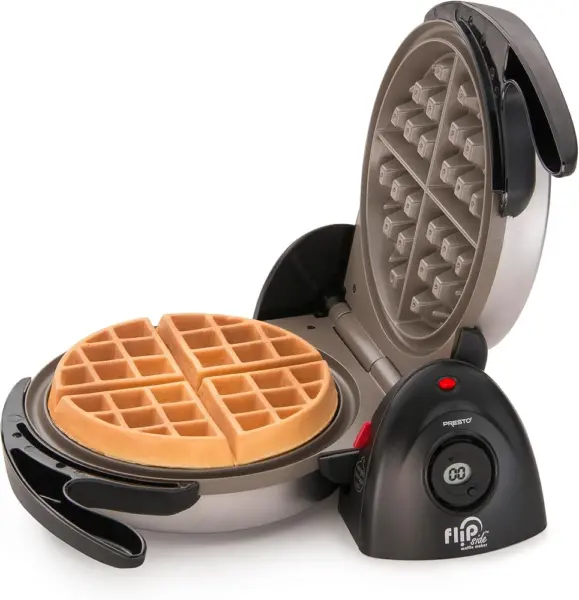
The grid is the first thing we noticed. Presto coats the plates in ceramic rather than the dark nonstick most flip irons use, and waffles come off it with a tap and a lift — no spray, no fork, no torn edges. The plate bakes one 7-inch round scored into four sections, so the waffle pulls apart along the seams, and the head rolls a full 180 degrees on its base before locking upright to stand on its edge in a cabinet.
What earns it the top spot is how little it asks of you. There’s no browning dial to learn, the light tells you when the plates are hot, and the shade comes out even across all four sections rather than pale at one corner and dark at another. Of everything here, it’s the one we trust to turn out a matching batch for guests without a practice run.
The timer is the weak link. It’s a mechanical dial that winds with a click, and it isn’t precise enough to lean on for the difference between golden and dark. Watch the steam instead: while it’s puffing steadily the waffle is still setting, and when it slows to a thin curl, lift the lid.
Two details we appreciated after a few rounds: the handle stays cool enough to flip bare-handed with the plates at full heat, and the pockets are deep enough that syrup pools in them instead of running off the edge. Small things, but they’re why this one stays out on the counter.
Pros
- Ceramic grid releases without spray
- Even browning across all four sections
- Locks upright for shelf storage
- Stays cool to the touch on the flip
Cons
- One-year warranty, against three from Cuisinart
- Base tray doesn’t lift out for washing
The flip iron we recommend first: even browning, ceramic release that needs no spray, and a body that stores on its edge. Buy it if Belgian waffles are a regular weekend thing.
Best for One Thick Waffle
Cuisinart Flip Belgian Waffle Maker
Key Features
- Wattage: 1000 W
- Warranty: 3 years limited
- Waffle depth: 1 in.
- Browning settings: 5
- Price: Midrange
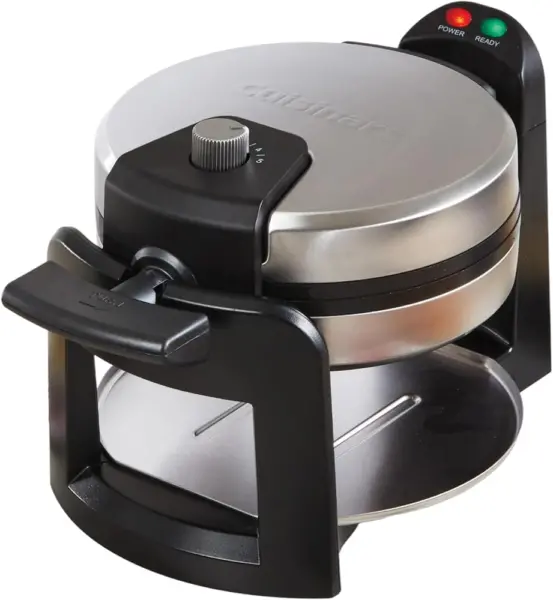
Where the Presto leaves you reading steam, this Cuisinart hands you a dial. Five browning settings, a batter cup sized to the plate, and a full inch of depth add up to the most controllable single-waffle iron in this group — light and fluffy at one end of the dial, dark and crisp at the other, and the setting you choose is the setting you get.
The inch of depth is what you notice at the table. The walls are high enough that fruit, whipped cream, and a heavy pour of syrup stay in the waffle instead of sliding onto the plate, and the round shape means no thin corners to overcook. The nonstick surface releases cleanly, and the stainless drip tray comes out and goes in the dishwasher.
The body is where it feels its price: plastic, light in the hand, and not as planted as the Presto when you roll it over. What balances that is the coverage — this is one of only two irons here with a three-year warranty — plus a housing that wipes down with a damp cloth in seconds.
Pros
- Five browning settings give real control
- Inch-deep plate holds toppings
- Dishwasher-safe stainless drip tray
- Three-year limited warranty
Cons
- Plastic housing feels light next to the Presto
The pick if you want one deep waffle you can dial darker or lighter. Five settings, a batter cup, and three years of coverage make it the most controllable single-flip iron here.
Best for Family Breakfasts
BLACK+DECKER Rotating Belgian Waffle Maker
Key Features
- Grids: Deep nonstick
- Wattage: 1250 W
- Capacity: Two waffles at once
- Indicators: Power and ready lights
- Price: Midrange
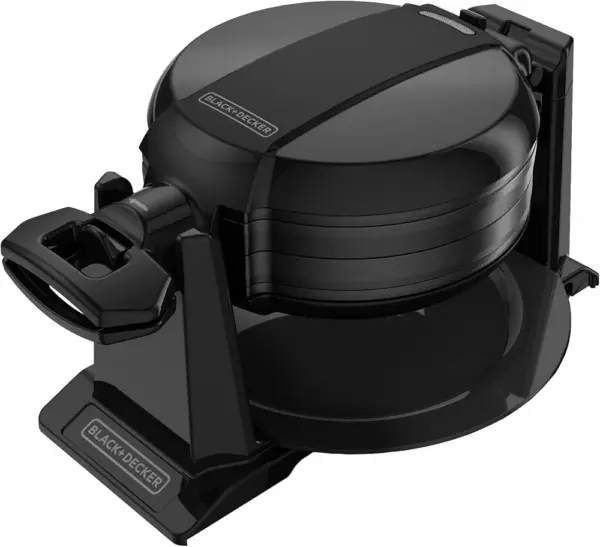
Two waffles per flip, from one pour and one roll of the handle. That’s the entire case for the WMD200B, and it’s a strong one: 1250 watts across two deep grids means a family of four eats in two rounds instead of four, and the pockets are deep enough to hold a serious amount of butter and syrup.
The mechanism is simple to the point of being foolproof — lock the handle, roll the head over, and the batter spreads into both grids at once. Both plates heat from the same element and, in our pours, the pair came out matched: same shade, same crisp edge, no shuffling between batches.
It costs about the same as the single-plate Cuisinart, and that’s the decision in one line: double the output, or a browning dial and a deeper plate. If the waffle maker comes out for a family breakfast rather than a single serving, we think the volume is worth more than the control.
Cleanup happens where it stands. The grids don’t come off, so you wipe along the grooves with a damp cloth while the plates are still warm, and the drip tray catches whatever runs over the edge. It’s also the widest iron here, which is worth knowing if your counter is already crowded.
Pros
- Two waffles per flip
- Deep Belgian pockets
- Matched browning across both plates
- Simple lock-and-roll handle
Cons
- No browning dial to set
- No power switch, just the plug
Buy it if you cook for a family and want two deep Belgian waffles per flip for about the money of a single-plate iron.
Best for Big Weekend Batches
Cuisinart Double Flip Belgian Waffle Maker
Key Features
- Wattage: 1400 W
- Warranty: 3 years limited
- Waffle depth: 1 in.
- Browning settings: 5
- Price: Premium
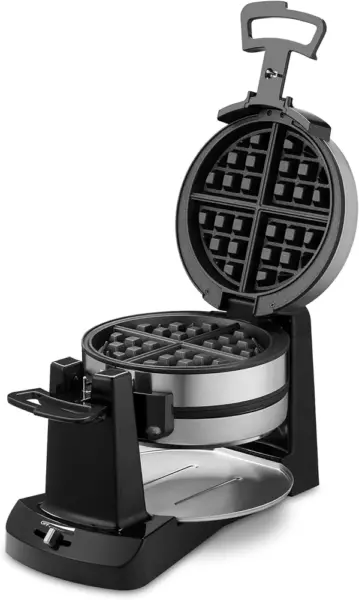
This is the most expensive iron on the list by a wide margin, and it’s also the only one that bakes two inch-thick Belgian waffles with five browning settings behind them. Both of those facts are the recommendation: nothing else here does two at a time with that much control.
Fourteen hundred watts across the two plates brings both waffles up together, and the rotary handle rolls the whole head over so the batter spreads on its own. The ceramic surface is PFAS-free, the batter cup is included, and the head locks positively before you turn it — no wobble halfway through a flip.
Watch the lower plate. It sits closest to the element and browns faster than the upper one, so two waffles from the same pour can come out a shade apart. Pull the lower waffle a touch early, or nudge the dial one level lighter, and the pair matches closely enough that nobody at the table notices.
One more thing to plan for: the plates don’t come off. Cuisinart builds them in, so cleanup is a wipe-down once the iron cools rather than a trip to the sink — a small annoyance on a machine that otherwise feels made for daily use.
Pros
- Two inch-thick waffles per round
- Five-setting browning control
- PFAS-free ceramic plates
- Three-year limited warranty
Cons
- Heavy to lift at about 12.7 pounds
The pick for a household that wants two thick, evenly shaded waffles per round and will pay for the dial, the depth, and a three-year warranty.
Best for Fast Cleanup
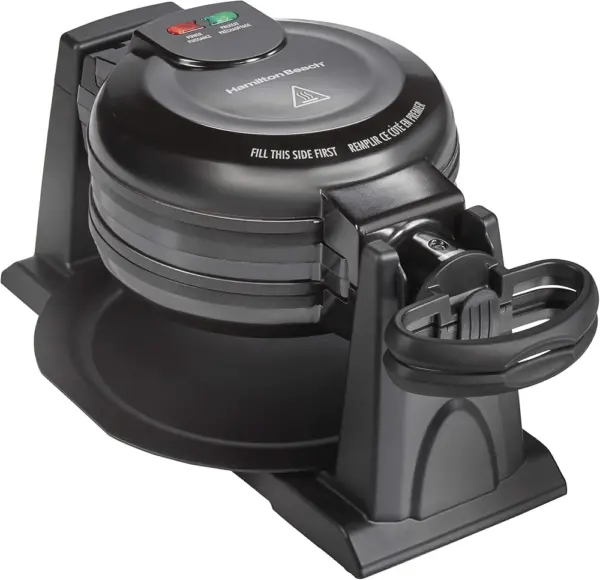
Hamilton Beach Double Flip Belgian Waffle Maker
Key Features
- Plates: Removable, dishwasher-safe
- Wattage: 1300 W
- Capacity: One or two at once
- Waffle size: 7 in. round, 0.92 in. deep
- Price: Premium
The plates come off. Of everything here, this is the only pick whose grids unclip and go in the dishwasher, and for anyone who has gouged dried batter out of a fixed grid with a chopstick, we think that’s the feature worth paying for.
It also bakes two 7-inch waffles at a time, just under an inch deep, with 1300 watts behind them and a D-shaped handle that’s easy to grip one-handed. Indicator lights cover power and preheat, and the drip tray catches the overflow when a plate gets filled too far.
The end of breakfast is where the design earns its keep: both plates lift out, the tray comes free, and the batter that bakes onto a fixed grid wipes off in one pass. Two at a time also means the second waffle is still hot when the first one is eaten, which is more than the single-plate irons here can promise.
Pros
- Dishwasher-safe removable plates
- Two 7-inch waffles at once
- Easy one-handed D-shaped handle
Cons
- Latch holding the plates is the weak spot
- Heavy at just over nine pounds
Buy it if cleanup is what keeps you from making waffles. Removable dishwasher-safe plates and two-at-once capacity make it the easiest iron here to live with.
Best for Small Kitchens
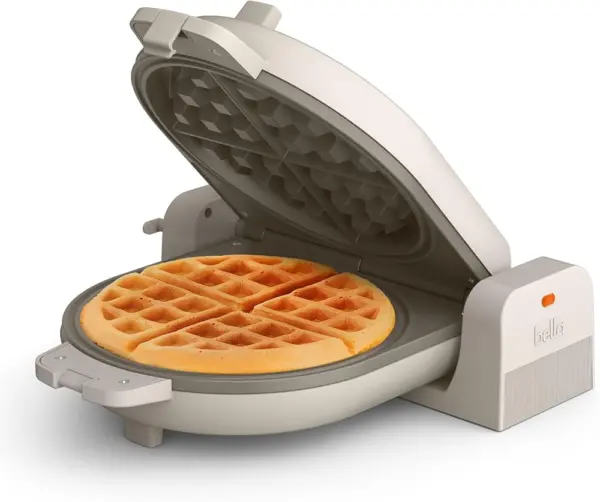
bella Flip-n-Store Belgian Waffle Maker
Key Features
- Weight: 3.3 lb
- Coating: PFAS-free ceramic
- Waffle size: 7 in. round, 1.5 in. thick
- Browning settings: 6
- Price: Budget
Three and a third pounds, about eleven inches across, and it stands on its hinge end in a cabinet — the Flip-n-Store solves storage instead of merely surviving it. If your waffle maker has to share a shelf with the sheet pans, start here.
The waffles are the thickest in this group: a 7-inch round, an inch and a half deep, with a ceramic coating free of PFAS and six browning settings on the dial. The handles stay cool through the flip, and the whole thing wipes down in a minute once it’s cool.
What we like most is that nothing about it feels like a compromise on space — it bakes a deeper waffle than either Cuisinart from a machine half the size. The trade is heat: the outer edges of the plate run hotter than the center, so a full pour browns at the rim before the middle catches up. Pour a little less than you think and give it another minute.
Pros
- Stands upright for shelf storage
- Deepest waffle here at 1.5 inches
- PFAS-free ceramic coating
- Six browning settings
Cons
- Grid lock can stop catching
The small-kitchen pick: a 1.5-inch waffle from a three-pound iron that folds upright, at the lowest price here. Just pour shy of full.
Best for Budget Double Batches
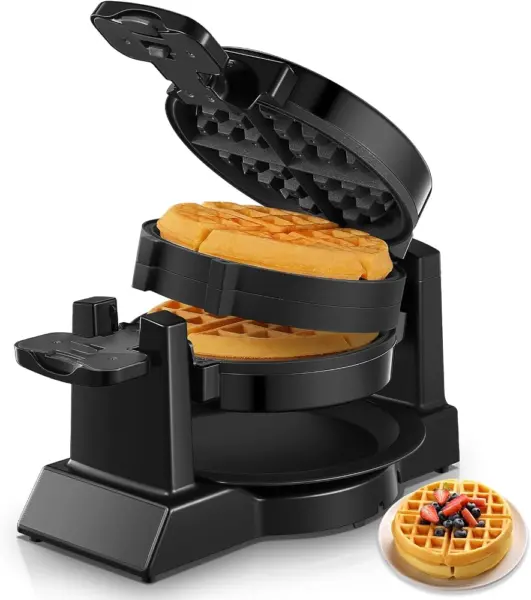
FOHERE Double Belgian Waffle Maker
Key Features
- Weight: 6.6 lb
- Wattage: 1400 W
- Capacity: Two 7-inch waffles
- Waffle depth: 0.99 in.
- Price: Midrange
Fourteen hundred watts, two round plates, and a box that promises two waffles in three minutes. The wattage is real and matches the Cuisinart double; the plates are 7 inches across and just under an inch deep, so the waffles come out wide and a little shallower than the Cuisinart’s.
The arithmetic is what sells it. Two waffles per round for less than most of the single-plate irons here makes it the cheapest way in this group to feed four people without a queue, and the head rolls over cleanly on its hinge. For a house where waffles are a production rather than a treat, that math is hard to argue with.
Build is where it gives ground. Six and a half pounds puts it in the two-handed class for a high shelf, and the plates don’t come off, so cleanup happens in place with a damp cloth once the iron has cooled.
Pros
- Two 7-inch waffles per round
- 1400 watts heats fast
- Cheapest double waffle iron here
- Removable drip tray
Cons
- Latch can snap and leave the lid unclamped
The budget route to two Belgian waffles at once. Buy it for a busy family breakfast, and treat the latch gently.
Best for Dorm Rooms
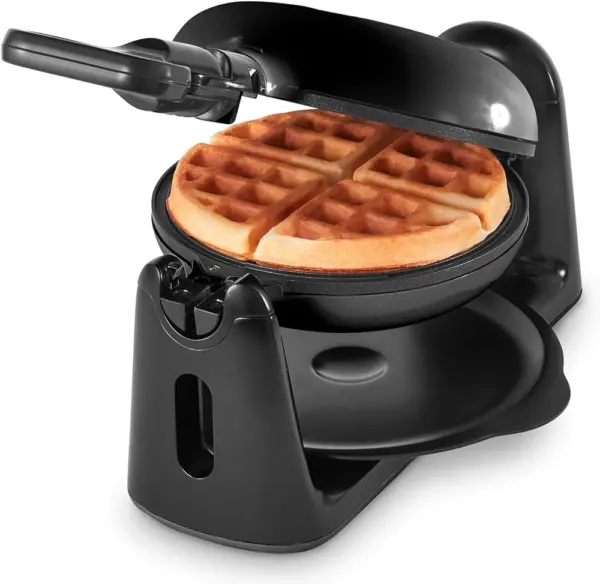
Dash Flip Belgian Waffle Maker
Key Features
- Handle: Folds for storage
- Weight: 5.2 lb
- Wattage: 1000 W
- Waffle size: 6.5 in. round
- Price: Budget
Six and a half inches across — the smallest waffle here by a clear margin. In a dorm room, a studio, or a kitchen where the waffle maker lives in a cupboard, that’s less a compromise than the whole point.
The flip works the same way as on the big irons: pour, close, roll the head over. The handle folds for storage, the drip tray is dishwasher-safe, and at a little over five pounds it’s easy to move between shelf and counter. The pockets are deep too, so a small waffle still holds a lot of syrup.
Two things we noticed while using it. The head doesn’t always stay put once batter is in it, so keep a hand on the handle for the first few seconds after the flip and it settles. And the browning comes out even across that small plate, which matters most when you can’t adjust the heat.
What it won’t do is feed a crowd. Four people means four rounds, and at that point the BLACK+DECKER’s two plates look considerably smarter. As a cupboard-friendly iron, though, it does everything a bigger one does, just one waffle at a time.
Pros
- Folds down for cupboard storage
- Dishwasher-safe drip tray
- Deep pockets in a small waffle
Cons
- Single heat setting, no browning dial
A compact, inexpensive flip iron for one or two people: small waffles, one heat setting, and a handle that folds away.
How We Tested Rotating Waffle Makers
We started by pulling every 180-degree flip model we could find from the small-appliance brands that stock replacement parts, then pared the field to 11 based on availability, plate material, and how often reviews mentioned hinges that loosened or latches that popped mid-flip. For six months, at least two stayed out on the counter at a time, cooking the same buttermilk batter side by side so no iron got an unfair advantage.
Every maker got the same first run: half a cup of batter into the center, lid closed, flipped, and watched. We noted which ones pushed batter out of the seam, which needed a second flip halfway through, and how level the finished waffle sat. Heat distribution got checked by cooking three rounds back to back with no cool-down — the third waffle is where uneven plates show up as a dark ring or a blond patch. Each adjustable dial ran from lightest to darkest, and we timed how long the ready light and audio alert actually took.
Cleaning happened while the plates were still warm and again after they cooled: paper towel first, then a brush into the corners, then, on models with removable plates, more than a dozen dishwasher cycles to see whether the coating dulled or chipped at the edges. Sturdiness got measured in counter inches — how far the base slid during a flip — and in hinge play after weeks of use. We also folded each one for storage and timed how fast it came back out.
Value came down to whether the extras — timer, alert, drip tray, a second plate — changed how often we reached for the machine.
How to Choose a Rotating Waffle Maker
The flip is the easy part — what separates these machines is how evenly they hold heat, how cleanly the plates release, and whether the thing fits the way your household actually eats breakfast.
One Waffle or Two at a Time
Capacity changes your mornings more than any other choice here. A single 7-inch plate suits one or two people: pour, flip, eat, repeat, and the iron stays small enough to leave out on the counter. Two-plate machines halve the rounds when four people are waiting, but they eat counter space and cost more.
We think the break is simple: if waffles are a weekend event for a family, buy the double; if they’re a weekday breakfast for two, a single plate is easier to live with. Keep in mind that two plates on one element can brown at different rates, with the lower plate usually running darker.
Plate Depth Sets the Texture
Belgian plates in this group run from just under an inch to an inch and a half deep. Deep pockets hold more butter and syrup and give you a custardy middle; shallower plates crisp faster and more evenly. A half-inch of depth is the difference between a waffle that sags under fruit and one that shrugs it off.
Depth also sets the pour. A 1.5-inch plate takes more batter and a little more time, and filling it to the rim is how batter ends up in the drip tray instead of the grid. Match depth to how you eat them: deep for toppings, shallow for crunch.
Timers, Dials, and Lights
Three controls show up here, and they do different jobs. A browning dial changes the shade of the finished waffle; a timer buzzes when a set interval is up; indicator lights only tell you the plates are hot. A dial is worth paying for if you like to fiddle. A timer is only worth it if it’s accurate, and mechanical ones often aren’t.
None of them beats steam as a doneness cue. While the plume off the hinge is steady the waffle is still setting; when it slows to a curl, it’s ready, whatever the dial says. That single habit makes you a better judge than any control on these machines.
Removable Plates and Everyday Cleanup
Every waffle iron is easy to clean for the first month. After that, the seam and the grid corners decide it. Removable, dishwasher-safe plates — the Hamilton Beach is the pick here that has them — turn a five-minute scrub into a rinse. Fixed ceramic grids wipe down more readily than dark nonstick, but batter that has baked on still needs soaking.
The rule that saves the coating: wipe while the plates are warm and never submerge the body or the hinge. A soft brush along the hinge line does more than any amount of soap.
Where It Will Live
Measure the cupboard before you fall for a two-plate machine. Uprights such as the Presto and the bella Flip-n-Store stand on their edge and need inches of shelf, not feet. Weight matters too: a nine- or twelve-pound iron is a two-handed lift off a high shelf, and one that’s awkward to put away stops coming out.
If the counter is where it stays, check the footprint against the toaster and the kettle first. A waffle maker that has to be moved to be used gets used less.
Frequently Asked Questions
Is a rotating waffle maker actually better than a fixed-plate one?
A flip waffle maker spreads batter across the plate for you, so you get an even fill without a spatula, and both faces start baking against a hot surface at the same moment. That’s why nearly every diner-style Belgian iron rotates.
If you want thin, crisp waffles rather than deep Belgian ones, a fixed-plate iron does the job, costs less, and takes less space. Buy the flip for deep pockets and an even fill; skip it for thin and crunchy.
Do I need 1,400 watts?
No. The irons here run from 1,000 to 1,400 watts, and every one of them gets hot enough to bake. Extra wattage buys recovery: at 1,400 watts the plates climb back to temperature faster between pours, which matters when you’re making six waffles back to back.
For two waffles on a Sunday morning, 1,000 watts is fine. Buy the wattage if you’re feeding a line of people.
What’s the difference between Belgian and regular waffles?
Belgian waffles are thicker, with deeper pockets and a lighter interior — the style every rotating iron here is built for. Regular waffles are thinner and crisper, and a deep Belgian plate turns them pale and cakey instead of crunchy.
If crisp thin waffles are the goal, look for a shallow-plate iron. A flip Belgian maker will fight you every time.
Final Verdict
The Presto FlipSide is the rotating waffle maker we recommend first. The ceramic grid releases without spray, the browning comes out even across all four sections, and it stores on its edge — the qualities that decide whether an iron keeps earning counter space.
Want a browning dial and one thick waffle? Take the Cuisinart Flip Belgian Waffle Maker. Feeding four at once? The BLACK+DECKER Rotating Belgian Waffle Maker doubles the output for about the same money.