This post contains affiliate links. We may earn a small commission when you buy through our links — at no extra cost to you.
There’s a particular smell that comes out of a kitchen sponge around day ten — sour, damp, and impossible to rinse away. I’ve thrown out more sponges over that smell than over actual wear, which is a little embarrassing for something that costs about two dollars. A good one should survive a week of sheet-pan dinners without crumbling, scrub dried egg off a plate without shredding itself, and leave the finish on your nonstick skillet alone.
What separates them isn’t packaging, it’s the material and the scrubber: cellulose holds its shape and rinses clean, thin foam goes soggy and stays that way, and the abrasive side is either a genuinely nonstick-safe pad or something closer to sandpaper. Our team has worked through 18 sponges over the past three months, and the ones that held up were almost always the ones that didn’t start to reek. Below are the picks I’d buy again, whether you need serious scrubbing power, something gentle, or just a long honest life at the sink.



Best for Everyday Dishwashing
Scotch-Brite Zero Scratch
Key Features
- Shape: S-shaped grip
- Pack size: 6 sponges
- Scrub surface: Non-scratch
- Price: Budget
The pan decides it. If you have to stop and check whether the sponge in your hand is safe on the skillet, it is the wrong sponge for the sink, and the Zero Scratch removes that hesitation: it is rated for nonstick, glass, countertops and coated cookware, and we have scrubbed all of those with it without leaving a mark.
It is the one we keep coming back to, for unglamorous reasons. The sponge side holds enough water to carry suds across a sink of dishes, the scrub side is stiff enough to move dried egg off a plate, and a six-pack means a fresh one is always within reach. In a category where the cheapest sponges fall apart and the clever ones cost real money, that middle ground is the whole argument.
Two things we noticed across repeat use. The scrub side is genuinely stiff, which is welcome on a baked-on rim and less so on a wine glass, where the soft side does the work. And it will sour if it spends the night face down in a puddle at the bottom of the sink; squeezed out and stood on its edge, ours stay usable for weeks.
The S-shaped cut is not styling. The waist sits under your thumb when you grip it, and the notch at the end reaches into the corner of a mug in a way a rectangular block does not — the kind of detail you notice only after you go back to a plain sponge and find yourself rotating it, looking for an edge.
Pros
- Rated safe on nonstick, glass and countertops
- Absorbent enough for a full sink
- Among the cheapest per sponge here
- S-shaped cut grips well and reaches corners
Cons
- Not for stainless steel appliance surfaces
We put it first because it is safe on the nonstick you cook with daily, absorbs enough to carry suds through a sink of dishes, and costs so little per sponge that replacing it is not a decision.
Best for Odor Control
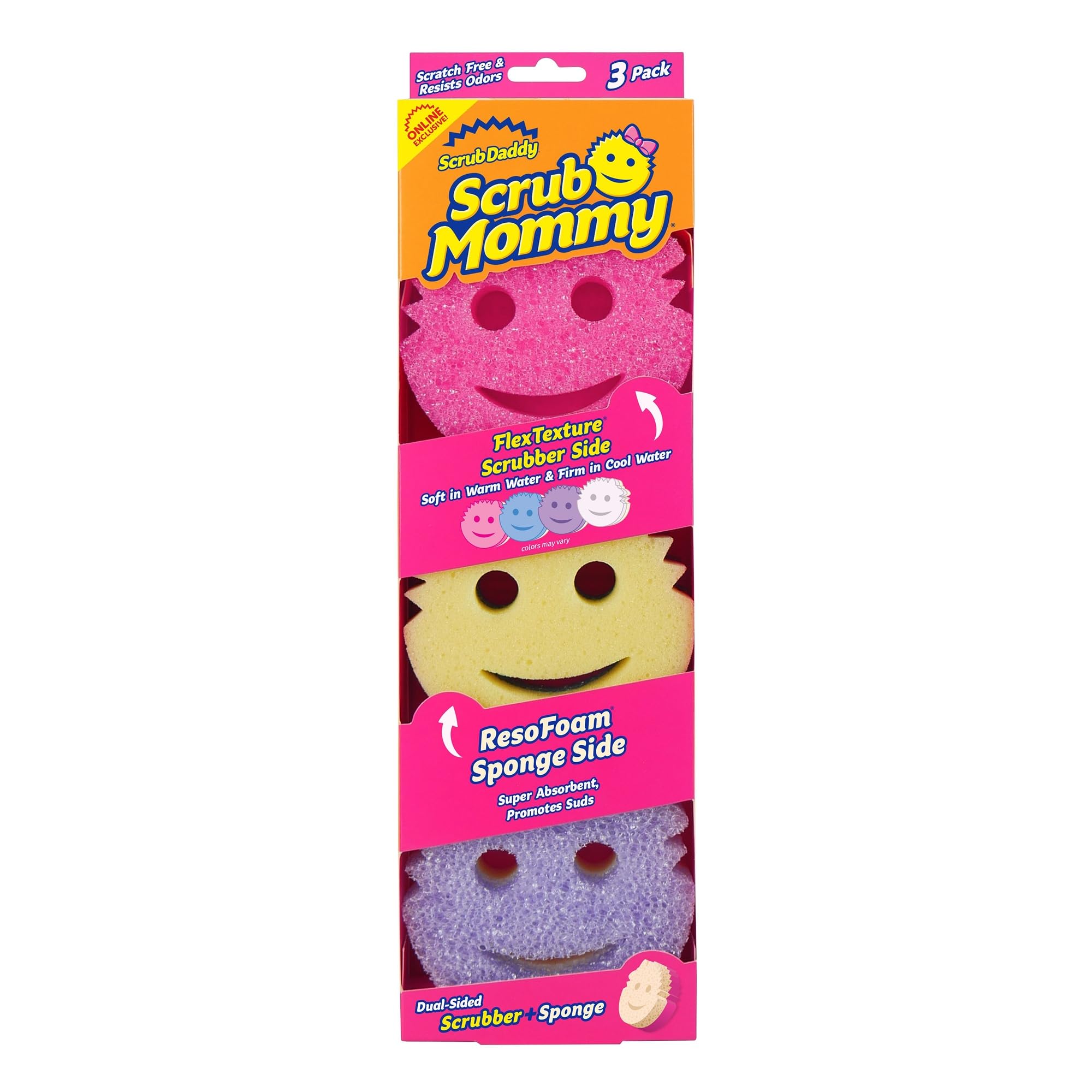
Scrub Mommy
Key Features
- Pack size: 3 sponges
- Foam types: FlexTexture and ResoFoam
- Dishwasher safe: Yes
- Temperature response: Soft in warm water, firm in cool
- Price: Midrange
Scrub Mommy is the most expensive sponge per unit in this guide by a wide margin, and we still think it earns a place: what you are buying is a sponge that does not turn on you in week two. The FlexTexture side firms up in cool water and softens in warm, and the ResoFoam layer behind it holds soap like a proper sponge rather than smearing it around the plate.
The temperature trick stops being a gimmick the first time you use it. Run it cold and the same block that wiped a butter dish will take dried sauce off a pan; warm water and it is soft enough for stemware. The shape helps more than we expected — the eyes give your fingers something to hold when it is slick with soap, and the mouth cleans both sides of a fork in one pass.
Cost is the catch, and it is the one thing here that does not improve with use. It is rated for the dishwasher, though, and that is where the money comes back: a cycle every few days keeps it fresh, and ours has stayed in service long past the point where a cheap cellulose sponge has gone soft and sour. This is the one you keep rather than the bag you work through.
Pros
- Resists odor better than the rest here
- Firms in cold water, softens in warm
- Dishwasher safe, so it lasts longer
Cons
- Highest cost per sponge in this guide
We think the priciest sponge per unit here is still worth it for anyone who has thrown one out because of the smell rather than the wear.
Best for Burnt-On Messes
Scotch-Brite Heavy Duty
Key Features
- Pack size: 9 sponges
- Surface use: Uncoated pots, grates, grills
- Scrub surface: Heavy duty
- Dishwasher sanitizing: Up to 20 cycles
- Price: Midrange
A sheet pan that has been through a hot oven does not care about a non-scratch sponge. This is the Scotch-Brite we keep for that pan, for the grill grate, and for the enamel pot with the burnt ring on the bottom — the green scrub layer bites in a way the gentle sponges in this guide simply do not.
A nine-pack makes it the cheapest sponge per unit here, and the maker rates it for up to 20 trips through the dishwasher top rack before it needs retiring. That matters more than it sounds, because the thing that usually kills a sponge is smell rather than wear, and a scrub sponge you can put through the machine gets a second and third life.
We treat it as the second sponge in the kitchen rather than the only one. The abrasive that makes it useful on a grill grate will haze a nonstick pan and scuff a plastic tumbler, so the gentle sponge still handles anything coated. Expect the scrub layer to go fuzzy at the edges before the sponge body stops absorbing; an aggressive surface wears itself out as well as the mess, and that is the price of having something that will take on a burnt pot at all.
Pros
- Lowest cost per sponge in this guide
- Scrub layer bites into burnt-on food
- Dishwasher sanitizing up to 20 cycles
Cons
- Abrasive enough to haze nonstick and plastic
Buy it as the second sponge in the kitchen: we keep ours for sheet pans, grill grates and uncoated pots, well away from anything with a coating.
Best for Easy Rinsing
O-Cedar Scrunge
Key Features
- Pack size: 6 sponges
- Dimensions: 4.25 x 2.63 x 1.18 in
- Scrub surface: Rippled, rinse-clean
- Surface safety: Non-scratch
- Price: Premium
The first thing we noticed about the Scrunge was not the scrubbing, it was the rinsing. Its scrub side is a rippled, closed-cell surface rather than an open mat of fibers, so egg, oatmeal and grated cheese slide off under the tap in one pass instead of lodging in the pad until you dig them out with a fingernail.
At 1.18 inches it is the thickest sponge here, and that changes how it sits in the hand: there is enough body to press down on a stuck skillet without your knuckles grazing the pan, and the sponge side is dense enough that it does not collapse into a rag halfway through a sink of dishes.
Rinsing clean is not the same as staying clean. The scrub surface sheds food, but the sponge behind it still holds water, and smell follows this one more than most here — squeezed out and stood on its edge it lasts, left in a puddle it will not. That is a habit worth having with any sponge.
It is also the second-priciest per sponge in this guide, which is why it sits behind the Scotch-Brite rather than at the top: you are paying for the rinse, not the scrub. If you cook eggs, fish or anything with a batter, that rinse is worth the premium — it is the difference between a sponge that feels clean under the tap and one that smells like the sink.
Pros
- Food rinses off the rippled surface
- Thickest sponge here at 1.18 inches
- Non-scratch on glass and nonstick
Cons
- Costs more per sponge than the Scotch-Brite packs
We recommend it to anyone who picks food out of a sponge and hates it — the rippled surface rinses clean, and the thickness is a real comfort.
Best for Eco-Friendly Kitchens
AIRNEX Natural Sponges
Key Features
- Materials: Cellulose and coconut husk
- Pack size: 12 sponges
- Dimensions: 4.5 x 2.8 x 0.8 in
- Compostable: Yes
- Price: Premium
A sponge is an object you keep for a couple of weeks and then send to landfill, which is what makes the AIRNEX pack more interesting than it looks. The sponge side is FSC-certified cellulose, the scrub side is coconut husk, and the whole thing is sold as compostable. It is also the only plant-based sponge here that earns its place on scrubbing alone rather than on good intentions.
The coconut fiber is coarser than a green Scotch-Brite and finer than a heavy-duty scrubber — it takes dried sauce off a plate without the foggy marks an aggressive pad leaves. The cellulose side is properly thirsty: it swells, holds a sinkful of suds and goes stiff as a board when it dries, which is what real cellulose does.
Twelve in a pack works out cheaper per sponge than most of the picks here, which softens the blow of the ones that go early. The fibers feel prickly once the scrub side dries out, and it is thinner than the Scrunge, so anyone who likes a fat cushion under the fingers should look there instead. What keeps us coming back is the end of its life: ours go out with the vegetable peelings rather than into the bin.
Pros
- Compostable cellulose and coconut husk
- Scrubs without scratching coated pans
- Twelve-pack keeps cost per sponge low
Cons
- Coconut fibers feel prickly once dry
Our eco pick, and it earns that on scrubbing as much as on material: plant-based, compostable, and useful enough to keep at the sink.
Best for Machine Washing
Scrub-it Multi-Purpose
Key Features
- Washable: Machine washable
- Materials: Polyester, polyamide, polyurethane
- Pack size: 6 sponges
- Dimensions: 6.1 x 3.3 x 0.7 in
- Price: Midrange
Laundering a sponge takes a minute to get used to, and then it makes a certain amount of sense. This Scrub-it pack is microfiber on one side and a scrub mat on the other, and when it starts to turn, it goes in the washing machine instead of the bin.
The thin profile is what makes it work — at 0.7 inch it folds around the rim of a tall glass and slips into a narrow utensil crock in a way a thick foam sponge cannot. The microfiber side lifts grease off a plate rather than pushing it around, and it wipes a counter as well as it washes up.
Where it earns its place is a household that already runs a load of laundry most days: in with the towels in a mesh bag, out and ready to go again. Without that habit the advantage evaporates, because these are not a sponge you can rinse and forget — left damp in the caddy, ours have gone sour like any cheap cellulose one.
One thing we did not expect: the scrub mat is mild enough that we reach for it on a coated skillet ahead of sponges with a rougher side, and it has yet to leave a mark. For dishes and glassware it is a genuinely good everyday sponge that happens to be washable, not a washable sponge that happens to work.
Pros
- Machine washable instead of disposable
- Thin 0.7-inch profile folds around glassware
- Microfiber side lifts grease and wipes counters
Cons
- Thin, with little cushioning for hard scrubbing
We rate it for households already running a daily wash — these go in the machine instead of the bin, and the pack stretches a long way.
Best for Bulk Restocking
MR.SIGA Cellulose Sponge

Key Features
- Materials: Cellulose and scrub layer
- Pack size: 12 sponges
- Dimensions: 4.1 x 3.3 x 0.8 in
- Price: Midrange
Twelve sponges in one box, each 4.1 by 3.3 by 0.8 inches, with a yellow cellulose face and a green scrub layer bonded to the other side. Cellulose is the material that behaves the way people expect a sponge to behave: it swells with water, wipes a plate dry rather than pushing a film around it, and stiffens as it dries out.
That is the whole pitch, and in a lot of kitchens it is enough: a dozen plain sponges at one of the lowest costs per unit here, so a fresh one goes out when the last starts to look tired instead of the good one being rationed. We rank it below the Scotch-Brite because it is the plainest sponge in this guide — no temperature trick, no rippled rinse-clean surface, nothing to think about — but the scrub layer is bonded properly, the cellulose is genuinely absorbent, and there is no fuss to any of it. If you want the sink restocked and the decision finished, this is the box.
Pros
- Twelve sponges at a low cost per unit
- Absorbent cellulose wipes dishes dry
Cons
A dozen plain, absorbent cellulose sponges at one of the lowest costs per unit here; we recommend it for anyone who wants the sink restocked and the decision finished.
How We Tested 18 Kitchen Sponges
We started with about 40 sponges — the ones on the shelf at the grocery store, the ones with a cult following online, and a few bundles that only make sense by the case. We cut that list down by material, scrubber type, and cost per sponge, which ranged from about a dollar to six, then bought 18 to use at home.
Each one went into a real kitchen rotation: nightly dinner dishes, greasy sheet pans, a casserole dish left to soak, coffee mugs, the sink basin, and the countertop after raw chicken. To compare cleaning power directly, we smeared plates with dried egg and melted cheese and counted how many passes it took to clear them, and we attacked a burnt-on sheet pan with each scrubber to see how quickly it lifted.
Durability and value got measured rather than eyeballed. We weighed every sponge new and again after two weeks of use to see how much material was washing away, and we tracked how many weeks passed before the scrub layer flattened or tore. For odor, we left each sponge damp in the sink caddy overnight and smelled it the next morning — the sour ones declared themselves fast. Gentleness was a scratch check: scrubber against a nonstick skillet and a stemmed glass, then a look under a bright light.
How to Choose a Kitchen Sponge
A kitchen sponge comes down to two things: what your pans are coated with, and how much smell you are willing to tolerate before you throw one out.
Match the scrub to your pans, not to the mess
Reaching for the most aggressive scrubber on the shelf is the standard mistake. Abrasive layers are built for uncoated steel, cast iron, grates and sheet pans; used on a nonstick skillet they haze the coating, and the damage shows up weeks later as eggs that stick. The reverse is true as well, because a non-scratch sponge will push a burnt ring around a pot rather than lift it.
We keep one of each. If you are buying a single sponge, buy the gentle one, since it covers more of what a normal kitchen throws at it. One trap worth knowing: a non-scratch label does not extend to brushed stainless appliances, which Scotch-Brite’s own instructions exclude.
Cellulose or foam: what the water does
Cellulose behaves the way people expect a sponge to behave. It swells, carries a lot of soapy water from plate to plate, and dries stiff as a board. Foam sponges such as Scrub Mommy’s FlexTexture and ResoFoam feel lighter, dry faster, and in the temperature-controlled versions change firmness with the water temperature.
If you wash a whole sink in one go and want the sponge delivering suds the entire time, cellulose has the edge. If you wash a few things at a time and leave the sponge sitting on the caddy, foam dries out faster and gets fewer chances to sour.
The smell decides how long it lasts
Almost nobody retires a sponge because the scrub layer wore out. It goes because it stinks. That makes drying the maintenance habit that matters: squeeze it out, stand it up so air reaches both faces, and keep it out of the puddle at the bottom of the sink.
Where the maker rates a sponge for the dishwasher, the top rack buys real extra time, and a cycle with the dinner plates resets ours. Closed-cell and rippled surfaces also rinse cleaner than an open mat of fibers, which is the practical difference between the O-Cedar Scrunge and a plain scrub sponge.
Compare the price per sponge, not per pack
The number that matters is cost per sponge, because it sets how willing you are to retire one. A twelve-pack of plain cellulose lands well below a three-pack of engineered foam on that measure, and the gap is big enough to change your replacement habit.
That habit is the real expense. A sponge you will throw out at the first whiff does more for your kitchen than a premium one you are trying to stretch another month. Buy the pack size that matches how often you actually swap.
Thickness, shape and hand fit
Thickness is the underrated specification. A sponge around 1.2 inches thick, like the Scrunge, gives you something to press against without your knuckles hitting the pan, and it holds more water. Thin sponges fold around the rim of a glass and slip into a utensil crock.
The S-shaped cut on the Scotch-Brite sponges looks like styling and is not: the waist sits under your thumb and the notch reaches into the corner of a mug. If your hands are on the smaller side, a very thick sponge can feel like holding a brick.
Frequently Asked Questions
How often should you replace a kitchen sponge?
Replace it when it smells even after a dishwasher cycle, or when the scrub layer starts shedding fibers. That usually arrives well before the sponge looks worn out.
This is why multi-packs make sense: a fresh sponge costs very little, and one you are stretching another week is doing a worse job on your dishes than a new one would.
Can you put kitchen sponges in the dishwasher?
Yes, where the maker rates it. Scrub Mommy, Scrub Daddy, the Scotch-Brite Heavy Duty and the Scrub-it microfiber sponges are all built to go through, on the top rack and away from the heating element.
Don’t expect the cycle to restore a worn scrub layer. It buys you more days of freshness, not a new sponge, so retire one when the surface starts shedding regardless of how clean it comes out.
Which kitchen sponges can go in the compost?
Only the ones with no plastic in them. The AIRNEX sponges are cellulose and coconut husk and are sold as compostable, so they can go in with food waste.
Check the scrub side specifically. A plant-based sponge with a plastic scouring layer bonded to it is not compostable, and a standard Scotch-Brite or Scrub Mommy belongs in the trash.
Final Verdict
The Scotch-Brite Zero Scratch is what we tell most people to buy. It is safe on the pans you actually cook with, it carries soap through a whole sink of dishes, and it costs little enough per sponge that nobody has to nurse one past its useful life. Nothing else here covers as much of a normal kitchen’s work.
Add a heavy-duty Scotch-Brite beside it for the sheet pans and grill grates. And if the reason you are shopping is that your current sponge stinks by Thursday, go straight to Scrub Mommy: the foam and the dishwasher rating are worth the premium for that problem in particular.