This post contains affiliate links. We may earn a small commission when you buy through our links — at no extra cost to you.
The roll of paper towels under my sink used to be a weekly purchase, and every spill came with a pang of waste. Reusable paper towels fix that: they soak up the same messes, then go in the wash instead of the trash. The catch: not every set behaves like the paper version you’re replacing. Some push water around instead of absorbing it, some take all day to dry, and some look so stained after one pot of chili that you’d rather hide them than hang them out.
Over the past six months, my team and I have run 16 reusable paper towel sets through everyday kitchen use — spilled coffee, wiped counters, and the laundry pile. We kept track of how much liquid each sheet held, whether the size and thickness felt right, how long they took to dry, and whether they stayed soft and presentable after washing. We also did the math on cost per sheet because value is the whole point of the switch. The picks below are the ones that held up without turning a spill into a project.


Best for Counter Spills
Swedish Wholesale Sponge Cloths
Key Features
- Care: Dishwasher or machine wash
- Material: Cellulose and cotton blend
- Pack size: 10 cloths
- Cloth size: 8 x 7 in
- Price: Midrange
A glass of water knocked across the counter is the moment a reusable towel proves itself, and this is the cloth we keep coming back to. It takes the whole spill, wrings out over the sink with one twist, and comes back for the second pass. Nothing about it feels precious, which is the point — it’s the one we hand to guests who ask what to buy.
The blend of cellulose and cotton is doing the work. It’s a flat, sponge-like sheet that holds many times its own weight in water and then lets go when you squeeze, so a wet cloth stays a tool instead of becoming a wet rag. At 8 by 7 inches it’s smaller than a paper-towel sheet, and that takes a day to get used to: you wipe in overlapping passes across the counter rather than one heroic swipe.
Out of the pack, and after every wash, it dries stiff as a cracker. We’ve stopped treating that as a flaw — the cloth that stays flat and airy is the one that doesn’t sour, and two seconds under the tap brings it back soft. Care is genuinely easy: top rack of the dishwasher, or the washing machine with the towels, then air dry it draped over the sink divider. One cloth is said to replace more than a dozen rolls and last nine to twelve months with that routine, and the ones in heaviest rotation here have kept their shape.
Ten cloths is more than it sounds. We keep two in rotation by the sink, one in the cleaning caddy, and the rest folded in a drawer, so there’s always a dry one — running out of clean cloths is how these experiments fail. Split the pack that way and the paper-towel roll stops being the fastest option in the kitchen.
Pros
- Soaks a full spill and wrings out for more
- Dries fast and stays odor-free between uses
- Dishwasher or washing machine, either works
- Ten cloths cover months of kitchen wiping
Cons
- Light colors show stains after a few weeks
- Higher cost per cloth than a bulk microfiber pack
Our first pick for any kitchen: it soaks a counter spill, wrings out, dries without souring, and one pack covers months of wiping.
Best for Glass and Mirrors
MR.SIGA Microfiber Cleaning Cloths
Key Features
- Edges: Reinforced stitching
- Material: 85% polyester, 15% nylon
- Pack size: 12 cloths
- Cloth size: 12.6 x 12.6 in
- Price: Midrange
A bathroom mirror is the hardest surface to fake. With nothing but water and a dry buff, these 12.6-inch squares took ours from spotted to clear, and they did the same on a stainless fridge door, a microwave front and a laptop screen. The edges are stitched rather than cut, which is the detail that decides whether a cheap cloth survives a year of washing.
Twelve cloths in three colors is the practical part: we assigned one color to glass, one to kitchen counters and one to the bathroom, and stopped mixing tasks. The polyester and nylon blend is soft enough for a nonstick pan and for a phone screen, and it doesn’t shed the way cotton can. The reinforced hem has held through repeated laundering without curling, and at this price per cloth we don’t baby them.
Two things to know before the first use. Wash the pack separately — the colors release dye, and the care note says as much. And on a puddle these saturate and start pushing water around, which is why a sponge cloth still lives by our sink; microfiber is the finisher, not the soaker.
Pros
- Streak-free on glass, screens and stainless
- Reinforced hems survive repeated washing
- Three colors keep jobs separate
Cons
- Lint and pet hair cling to the fibers
We reach for these on glass, stainless and screens, where they finish streak-free with water alone and the edges survive the wash.
Best for Roll-Style Wiping
Fantasticlean Microfiber Cloth Roll
Key Features
- Roll size: 75 cloths
- Cloth size: 12 x 12 in
- Reuse claim: Up to 50 washes
- Fabric weight: 175 gsm
- Price: Premium
The first thing we did with this roll was drop it onto a paper-towel holder, and that’s the whole argument for it: nothing about your routine changes except the material. You tear off a 12-inch square, wipe the counter, and put the cloth in a small bin instead of the trash. For a household that has tried a stack of loose cloths and quietly gone back to paper, the format is the fix.
The cloths themselves are microfiber partly made from recycled bottles, lint-free on counters and stainless, and the pack rates them for 50 washes. They come off the roll flat and stay flat, and they’re kind to a nonstick pan. After a wash they don’t re-roll as neatly as new ones — true of any cloth that has been through a machine — so keep a mesh bag near the washer and treat the roll as the supply, not the storage.
Seventy-five cloths is the number that matters. It means one for a greasy pan, one for the floor and one for the bathroom, without doing laundry that night, and the habit holds because you never ration. As the thing that replaces the roll on the counter, nothing else here does the job as directly.
Pros
- Fits a standard paper-towel holder
- 75 cloths before you need to buy again
- Washes and reuses up to 50 times
Cons
- Thin fabric that saturates fast
- Sold in a single color
We recommend this roll to anyone who wants the paper-towel habit intact: tear one off, wipe, and wash it when the bin fills.
Best for Composting Kitchens
SUPERSCANDI Swedish Dishcloths
Key Features
- Material: 70% wood pulp, 30% cotton
- Pack size: 10 cloths
- Cloth size: 7.87 x 6.69 in
- Compostable: Yes
- Price: Midrange
Every reusable cloth ends up in the trash eventually, and that is the fact this pack is built around. It’s 70 percent softwood pulp from Swedish forests and 30 percent cotton, with no plastic in the cloth, and it’s sold as fully biodegradable and compostable. When one finally wears out, it goes into the compost rather than the bin.
In use it behaves like the other cellulose-cotton cloths here: wet it and it goes from board-stiff to floppy, one pass takes a counter spill, and a twist over the sink empties it. It dries fast enough to be ready again after lunch, and it doesn’t pick up the damp-cloth smell that sends people back to paper.
What surprised us is how well the grey holds up. Coffee, tomato sauce and a curry all washed out, and the cloths still look like cloths rather than rags after weeks of rotation. Top rack of the dishwasher, or the machine with everything else, then air dry.
Where it lands: it’s the pick for a kitchen that already sorts its waste and wants the cloth to follow the same logic. Sustainability is the reason to choose it, but it isn’t the only thing it has going for it — the fast drying and the lack of smell would earn it a place in the drawer anyway.
Pros
- Compostable when it finally wears out
- Dries quickly and doesn’t pick up smells
- Grey hides stains through repeated washing
Cons
- Smallest sheet in this group
The one we point to when the compost bin matters: wood pulp and cotton, quick to dry, and it still handles daily kitchen mess.
Best for Sink-Side Hanging
Eulnars Swedish Dishcloths
Key Features
- Included: 2 self-adhesive clips
- Material: 70% cellulose, 30% cotton
- Pack size: 8 cloths
- Cloth size: 7.8 x 7.8 in
- Price: Midrange
The clips in the box are the reason to pick this pack over the other Swedish cloths here. Two self-adhesive mounts mean the cloth lives on a cabinet door or the side of the fridge, drying flat and staying within reach, which is the difference between using it and forgetting it. The prints are the other draw: eight cloths across four patterns, which is more personality than most of this group offers.
Behind that it’s a solid cellulose and cotton cloth. It soaks a counter spill, rinses clean at the sink, and the pack rates it at 20 times its weight in water and up to 200 reuses. It’s 7.8 inches square, a hand-sized cloth rather than a towel, and it goes stiff when dry like every one of these does. Mount the clips where water won’t run down the wall and it earns its place beside the sink.
Pros
- Two self-adhesive clips included
- Eight cloths across four printed patterns
- Soaks a counter spill and rinses clean
Cons
- Stains survive the wash
- Shrinks after machine washing
We pick this pack for the clips rather than the cloth: hung by the sink, it dries flat and stays in reach between wipes.
Best for Messy Utility Jobs
USANOOKS Microfiber Cleaning Cloth

Key Features
- Pack size: 12 cloths
- Cloth size: 12.5 x 12.5 in
- Wash claim: 1,200+ washes
- Fabric weight: 300 gsm
- Price: Budget
At the lowest cost per cloth of anything on this list, this is the pack you buy to find out whether reusable cloths will stick in your house without spending much on the experiment. You get twelve 12.5-inch squares in a neutral grey, 300 gsm by the pack, with overlocked edges and a claim of 1,200 washes.
The honest description is lighter and thinner in the hand than that number suggests. We noticed it most on a wet counter, where one cloth needed a fold to finish the job, and least in the garage, where a thin cloth reaching into a wheel arch is a virtue. What we never did was hesitate: a stack this size means grabbing a fresh one for a greasy pan or a floor spill without a second thought.
Grey turns out to be the right color for the jobs these end up doing — brake dust, pet bowls, the outside of the bin — and they wash back to usable without fuss. Keep a plush square for the mirror; this pack is for the work you don’t want to think about.
Pros
- Lowest cost per cloth in this group
- Grey hides grime on utility jobs
- Overlocked edges hold up to washing
Cons
- Thin and light in the hand
- Small for a full counter spill
We never hesitate to grab one of these for a greasy pan or a floor spill, and at the lowest cost per cloth here, we don’t have to.
Best for Drying Dishes
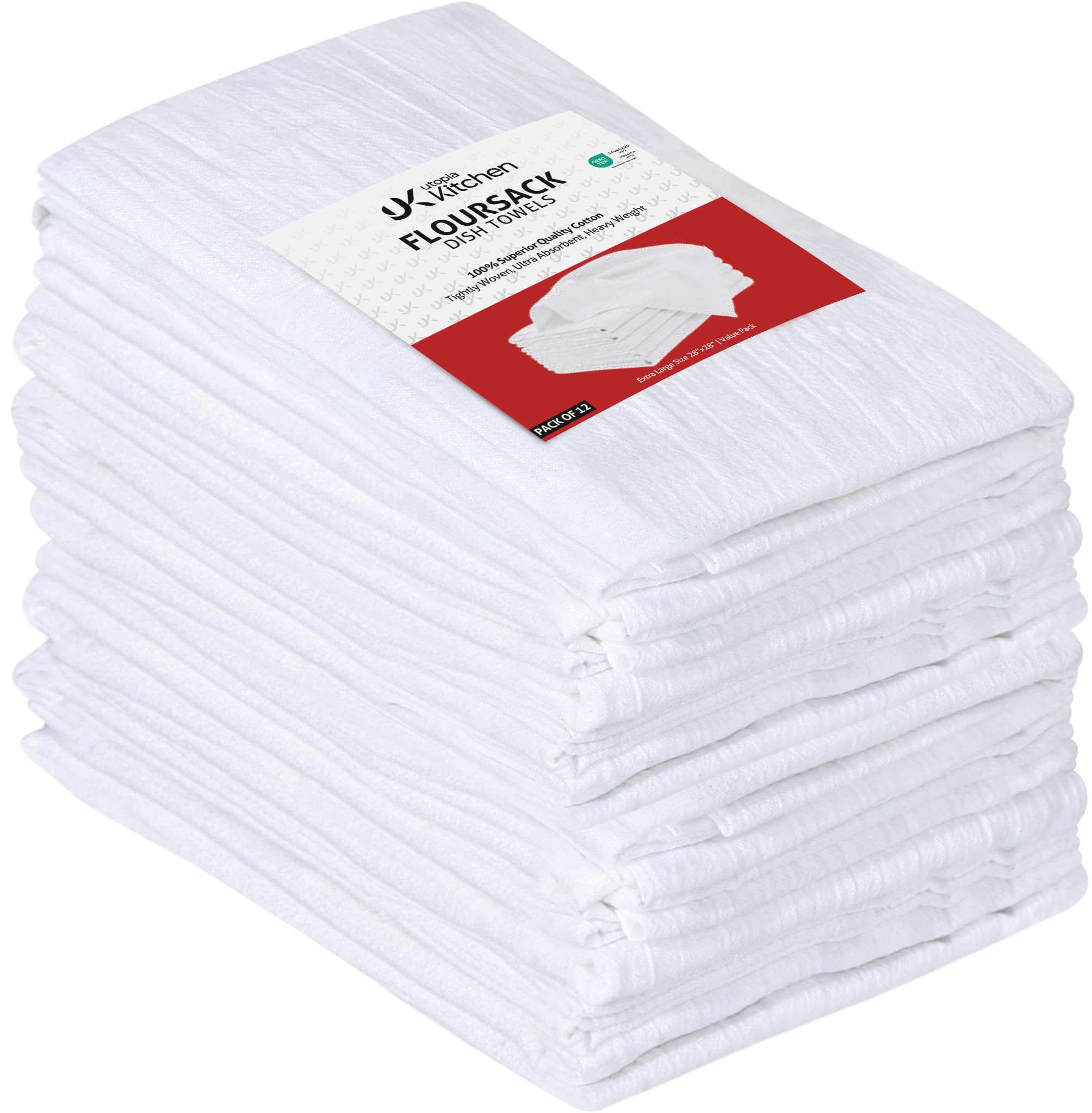
Utopia Kitchen Flour Sack Towels
Key Features
- Weave: Plain weave
- Material: 100% ring spun cotton
- Pack size: 12 cloths
- Cloth size: 28 x 28 in
- Price: Midrange
Unfolded, one of these is 28 inches square, which is many times the area of a hand-sized sponge cloth. That size explains everything else about it, including why it’s the wrong tool for a knocked-over glass of water and the right one for a dish rack full of wet plates.
As a drying towel it’s excellent. It wraps a stack of plates, dries glasses without leaving lint, covers a bowl of rising dough, and works as a strainer cloth when you need one. The hems are sewn and the weave is flat, so it folds down thin and hangs over an oven handle without bulk. Ring-spun cotton is why they feel softer after a month than they do on day one.
New out of the pack they’re stiff and slightly slick, and water sits on them instead of soaking in. Wash the whole dozen once before they go in the drawer, skip fabric softener entirely, and they start drinking properly — softener is the single thing most likely to make a cotton towel useless.
Call them what they are: the paper-towel replacement for the sink and the dish rack, not for the countertop puddle. Twelve towels that soften with every wash is a fair deal for the drying half of the job, and the drying half is where most of the paper actually goes.
Pros
- 28-inch squares dry a whole dish rack
- Softens and absorbs better with washing
- Covers dough, produce and straining jobs
Cons
- Thin enough to see through when held up
We use these for drying, not for spills: 28 inches of cotton that drinks properly after a few washes.
Best for Scrubbing Dried Food
Homaxy Waffle Weave Dish Cloths

Key Features
- Weave: Waffle
- Material: 100% cotton
- Pack size: 6 cloths
- Cloth size: 12 x 12 in
- Price: Budget
The honeycomb weave is the whole idea here: those raised squares give just enough friction to lift dried egg off a plate or a stub of cheese off the counter without reaching for a scouring pad. Wet one and it softens; wring it out and it’s a dishcloth again.
Six cloths, 12 inches square, 100 percent cotton, with a hanging loop sewn into one corner — a small thing that matters more than it should, because a cloth with somewhere to hang gets used and a cloth in the drawer gets forgotten. The colors hold through washing and the cotton softens with every cycle.
Where they lose ground is the loose weave. Pull one across a grater, or wash it with anything that has a zipper, and you’ll find lifted threads and pulled loops; the same openness that makes them dry quickly makes them the least durable cloth here. Six is also a small pack, so this is a top-up rather than a full swap. As a textured scrubber for the sink, though, they do something the flat cloths can’t.
Pros
- Waffle texture scrubs without a pad
- Hanging loop keeps it off the counter
- Softens with every wash
Cons
- Loose weave pulls threads
- Only six cloths in the pack
We like the waffle texture for dried-on food; treat it as the scrubber in a two-cloth system rather than your only swap.
How We Tested (and Re-Washed) Reusable Paper Towels
We started by pulling together reusable paper towel sets that were widely available, machine washable, and sized for ordinary kitchen work, then narrowed the field by price, sheet count, and material. That left 16 sets, which we rotated through my kitchen and a colleague’s over six months. They handled spilled coffee, wiped down counters and appliances, dried dishes, dusted shelves, and cleaned up after two kids and a very messy cat.
Absorbency was easy to see: I poured a half cup of water onto a cutting board and timed how long each sheet took to pull it up before I had to wring it out. For drying time, I wet each towel, draped it over a drying rack, and checked back every hour. Softness got the back-of-the-hand test, before and after washing. Size and thickness mattered more than I expected — I compared each sheet to a standard paper towel, folded it around a stemmed glass, and held it up to a window to judge how flimsy it looked.
Durability and stain resistance came from the laundry pile: every set went through at least 20 wash-and-dry cycles, and I deliberately wiped up tomato sauce and turmeric to see what survived. I also counted sheets per set and compared cost per sheet against the paper towels we used to buy. The best ones kept their edges, stayed soft, and came out of the wash looking close to new; the weaker ones pilled, shrank, or held onto stains.
How to Choose Reusable Paper Towels
The cloth that saves a spilled glass is rarely the one that leaves a mirror clear, so most kitchens need two materials rather than one perfect towel.
Match the cloth to the mess
Three materials do three different jobs. A cellulose-and-cotton sponge cloth is the closest thing to a paper towel: it takes a puddle, holds it, and gives it up when you squeeze. Microfiber grabs grease and lifts the film off glass, which is why it’s the better choice for mirrors and stainless. Flat-woven and waffle cotton are for drying — dishes, hands, produce.
A sponge cloth on a greasy pan mostly moves the grease around, and a flour sack towel on a spilled glass takes three passes. Buy one material for spills and one for shine instead of hunting for a single cloth that does both.
Size, format, and where it lives
An 8 by 7 inch sponge cloth is sized to a hand; a 12 inch microfiber square covers more counter per swipe and folds into quarters for a mirror; a 28 inch flour sack towel is a drying towel and behaves like one. Format matters as much as size. A tear-off roll drops onto a standard paper-towel holder and preserves the habit you already have, though washed cloths never re-roll as neatly as new ones, so plan a small bin for the used ones.
If your cloth has no loop or clip, add one. A cloth that lives in a drawer gets used half as often as one hanging by the sink.
Fast drying is what keeps them from smelling
Nearly every complaint about reusable cloths comes down to the same thing: the cloth that gets balled up wet. Cellulose sponge cloths dry stiff as a board, and that’s fine — stiffness is the sign that a cloth isn’t holding water, and a dry cloth doesn’t sour. Give any cloth air on two sides: draped over the sink divider, clipped to a cabinet door, or laid flat on a rack.
If your kitchen has nowhere a cloth can hang free, buy fewer cloths rather than more. Two that dry beat six that sit damp in a pile.
Washing rules that decide how long they last
Fabric softener and dryer sheets coat microfiber and cut its absorbency, so skip both — the softener that fluffs a bath towel works against you here. Bleach shortens the life of cellulose and cotton blends, and a hot dryer shrinks cotton. Cold wash, low or no heat, and most of these will outlast the habit they replaced.
Count cloths against your laundry cycle rather than your counter: a household doing a load every few days gets by with ten sponge cloths, while somewhere that washes weekly needs a second pack. The moment you reach for paper again is the moment you’ve run out of dry ones.
Frequently Asked Questions
Do reusable paper towels scratch nonstick pans or granite?
Microfiber and cellulose sponge cloths are soft enough for nonstick and for stone counters. It’s the textured cotton ones to watch: use a waffle cloth wet and with light pressure, or keep it for cast iron and baking sheets.
On granite and quartz the cloth isn’t the risk — an abrasive cleanser is. Wipe with the cloth and water first, and reach for the scouring product only if that fails.
Should I use separate cloths for the kitchen and the bathroom?
Yes, and color is the simplest way to keep them apart. Several packs here come in mixed colors, so assign one color per room and never swap. If your pack is a single color, store the bathroom cloths in their own caddy rather than in the kitchen drawer, and wash both sets in the same load.
Are they safe to use after wiping up raw meat?
Treat that cloth as contaminated: send it straight to the laundry on a hot cycle instead of rinsing it and wiping the next surface, and wash your hands after handling it.
Keep a second, dry cloth for the rest of the counter, and make sure the washed one is completely dry before it goes back into rotation.
Final Verdict
Replacing paper towels comes down to drying time and smell, and the Swedish Wholesale sponge cloths win on both: they take a spill, wring out, dry stiff and come back without the sour edge that ends most cloth experiments. Ten cloths is enough to keep two in rotation by the sink and one in the cleaning caddy, which is what stops the drawer from running empty.
If the roll on the counter is the habit you want to keep, the Fantasticlean pack is the closer swap, and if glass and stainless are what you notice, MR.SIGA’s microfiber squares finish them with water alone. We keep both in the same kitchen; start with one and add the second material later.