This post contains affiliate links. We may earn a small commission when you buy through our links — at no extra cost to you.
Every kitchen drawer has a graveyard at the back: the avocado slicer that worked once, the garlic press that never got fully clean, the can opener that quit mid-can. A gadget either earns its drawer space or it doesn’t, and there’s rarely much middle ground. What separates the keepers has nothing to do with the gimmick on the package — it’s whether the blade is still sharp after a month of tomatoes, whether the numbers on the display are actually right, and whether the whole thing is easier than the knife you already own. The right gadget takes a step out of dinner; the wrong one just moves the mess around.
I cook in a small apartment kitchen where counter space is mostly theoretical, and over the past five months my team and I have lived with 16 gadgets through weeknight dinners, a holiday bake, and one batch of caramel that seized twice. The pattern held: the ones you reach for clean up in under a minute, and the ones with the most attachments stay in the drawer. Here’s what survived.



Best for Everyday Temperature Checks
Alpha Grillers Thermometer
Key Features
- Weight: 2.4 oz
- Display: Backlit digital
- Response time: 2 seconds
- Water resistance: IP67
- Price: Budget
We reached for the Alpha Grillers more than any other thermometer because it removes the two worst parts of checking doneness: waiting and guessing. Open the probe and the display wakes; close it and it shuts off. That matters when your hands are covered in chicken juice and the pan is already hot. The two-second read is quick enough to check a thick pork chop without holding the oven door open, and the backlight makes the numbers legible in a dim kitchen.
The IP67 body is the other detail we appreciate. We rinse the probe under the tap after raw meat, and the sealed housing does not make us baby it. The magnet is just as useful: it lives on the fridge door or the side of the grill, so it is within reach instead of lost in a drawer. At 2.4 ounces, it also disappears into a utensil cup when you need the counter clear.
Compared with the TempPro, this one is smaller and simpler, with a screen that does not rotate but is easy to read straight on. We prefer it for everyday kitchen checks; the TempPro makes more sense when you are cooking outside and want a bigger display. The Alpha is the thermometer we leave on the fridge, not the one we have to hunt for.
Pros
- Fast two-second readings
- IP67 body rinses clean
- Magnet keeps it within reach
- Backlit display is easy to read
Cons
- Durability is the weak spot
- Hand wash only
If you cook meat, poultry, or bread with any regularity, this is the small thermometer we recommend first: fast, readable, waterproof, and easy to keep within reach.
Best for Grilling and Smoking
TempPro TP19H Thermometer
Key Features
- Display: 2.0-inch auto-rotating
- Accuracy: ±0.9°F
- Certification: NSF
- Water resistance: IP65
- Price: Budget
The TempPro’s 2-inch display rotates 180 degrees, which sounds like a gimmick until you are holding a probe at an awkward angle over a hot grill. The numbers stay upright and big, and the backlight is strong enough for dusk. The magnetic back lets it sit on the side of the grill or the fridge, and the probe folds shut with a satisfying click.
For grilling and smoking, that combination is the reason to choose it. The ±0.9°F accuracy spec and NSF certification are the numbers we care about, and the IP65 body can be rinsed after a sticky marinade. We also like the lock function: it holds a reading while you move the meat off the heat. That is a small thing that makes a crowded grate less stressful.
The trade-off is size. At 7.5 inches long, it is not a pocket thermometer; it wants a drawer or a magnet. We also find the Alpha simpler for quick kitchen checks, while the TempPro is easier to read from a step back. If your cooking happens over charcoal or a gas grill, the bigger screen earns its space.
Pros
- Large auto-rotating display
- NSF certified with tight accuracy spec
- IP65 body and magnetic back
Cons
- Durability is the main question
For grilling and smoking, the big auto-rotating display and magnetic back make this the thermometer we reach for when the light is bad and the lid is hot.
Best for All-Purpose Kitchen Cutting
KitchenAid Kitchen Shears
Key Features
- Sheath: Included
- Weight: 4.8 oz
- Blade length: 4.7 inches
- Overall length: 8.73 inches
- Price: Budget
The 4.7-inch blade is long enough to get through a whole chicken, but the soft handle is what makes these shears feel less like a chore. The grips are wide and cushioned, so repeated snipping of herbs, bacon, or packaging does not leave your palm sore. They are also ambidextrous, which matters in a shared kitchen.
We used them for everything a knife is awkward for: opening bags, cutting pizza, trimming chicken, and snipping herbs directly over a pan. The blades have a solid, slightly weighty feel, and the protective sheath keeps them from turning into a drawer hazard. The 8.73-inch overall length gives you leverage without feeling like garden shears.
The one thing we watch is moisture. The blades are dishwasher-safe on paper, but the hinge is where rust can start, so we rinse and dry them right away. That small habit is worth it. These are the shears we keep by the cutting board, not buried in a utensil drawer, because they handle the messy jobs without complaint.
Pros
- Long 4.7-inch blade
- Soft, secure handle
- Protective sheath included
Cons
These are the shears we keep by the cutting board for everything from herbs to chicken bones, and the comfortable handle makes the extra size worth it.
Best for Washing Salad Greens
OXO Salad Spinner
Key Features
- Weight: 2.5 lb
- Capacity: 6.22 quarts
- Dimensions: 6.75 x 10.25 x 10.25 inches
- Dishwasher safe: Top rack
- Price: Premium
The one-handed pump is the reason this spinner earns its counter space. Press the handle a few times and the basket gets up to speed; the brake stops it without a wobble. We like that we can rinse a head of lettuce, spin it, and lift the basket out with one hand while the other holds the bowl. The storage lock presses the pump down, so the whole thing collapses to a lower profile.
The 6.22-quart bowl is sized for salads for two or a big bunch of herbs, and the basket doubles as a colander. The lid comes apart for cleaning, and all the parts go on the top rack of the dishwasher. It will not get every leaf bone-dry—tougher greens still want a towel—but for everyday lettuce it is the faster path. The mechanism is the point.
Pros
- One-handed pump and brake
- 6.22-quart capacity
- Lid comes apart for cleaning
- Collapses with a storage lock
Cons
- Premium price for a single-task tool
This is the spinner we recommend for anyone who eats salad often enough to resent wet leaves; the one-touch pump and tidy storage justify the premium.
Best for Fast Vegetable Prep
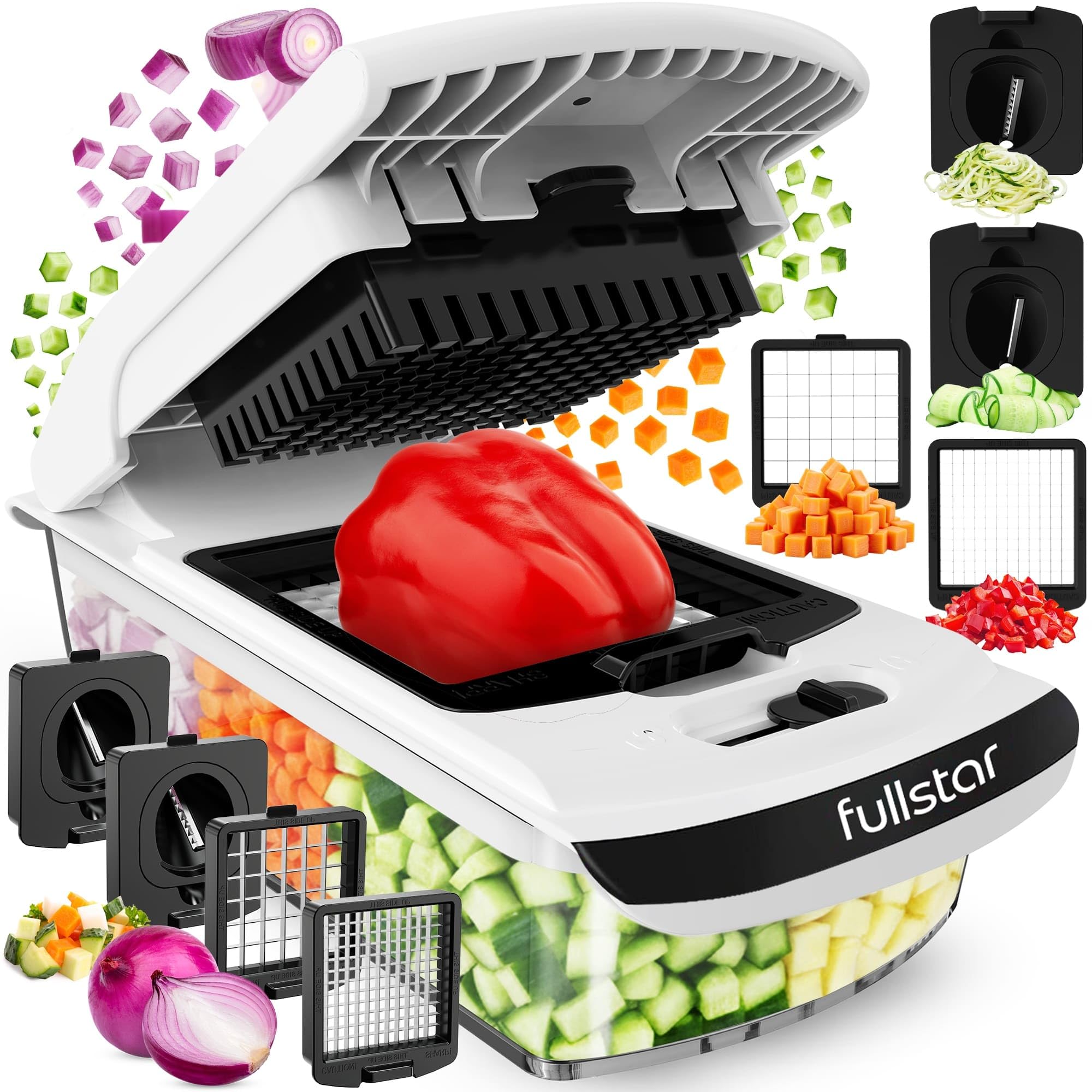
Fullstar Vegetable Chopper
Key Features
- Blades: 4 interchangeable
- Capacity: 5 cups
- Dimensions: 4.96 x 4.84 x 10.71 inches
- Dishwasher safe: Top rack
- Price: Midrange
When a recipe starts with three onions, two peppers, and a pile of carrots, the Fullstar turns the knife work into a short job. The 5-cup container catches the dice, and the four interchangeable blades cover coarse and fine cuts plus spiralizing. It is the gadget we pull out for a big pot of chili or a week of salad prep, not for a single shallot.
The soft-grip handle and non-skid base make it feel more controlled than a cheap chopper. You press down with both hands, the lid locks, and the blades push through onions, zucchini, carrots, and peppers without the usual knife-and-board rhythm. It is happiest with firm vegetables; soft tomatoes and fibrous squash need a knife or a lighter hand.
Cleanup is straightforward if you stay ahead of it. The brush and scraper push food out of the grid, and the parts are top-rack dishwasher safe. We still hand wash the blade frame most of the time to keep the plastic clear and the edges from knocking around. It takes a minute, not a production.
All the parts nest inside the container, and the whole thing stores on its side. That makes it easier to justify than a single-blade slicer that lives on the counter. The trade-off is a taller footprint than a simple mandoline, so check your drawer depth before you commit.
For the cook who preps several vegetables at once, this is the chopper we recommend. It saves the most time on onions and peppers, and the dishwasher-safe parts make the cleanup manageable. If you mostly slice one tomato for a sandwich, a knife is still better. The Fullstar earns its place when volume is the problem.
Pros
- 5-cup catch and four blades
- Top-rack dishwasher safe
- Stable base and soft-grip handle
- Fast for volume prep
Cons
- Plastic frame can crack under pressure
- Blades can dull with heavy use
For chopping a pile of vegetables in one go, this is the tool we recommend, as long as you accept plastic parts and hand-wash care to keep the blades sharp.
Best for Shredded Chicken Batches
SURETIVIAN Chicken Shredder
Key Features
- Weight: 12.3 oz
- Dimensions: 9.84 x 9.84 x 1.89 inches
- Dishwasher safe: Yes
- Heat resistance: Up to 356°F
- Price: Midrange
The first thing the instructions tell you is to cook the meat before it goes in, and to cut it into small pieces. That is not a suggestion: raw meat can damage the plastic teeth. Once the chicken is cooked and roughly divided, the shredder does what it promises, turning a plate of warm breast into rough, sauce-friendly shreds in a few twists.
That makes it a weeknight tool, not a raw-prep gadget. We like it for pulled chicken for tacos, enchiladas, and chicken salad because it produces more even pieces than two forks and keeps the mess in one container. The clear lid lets you watch the teeth catch, and the included fork helps lift the finished meat out.
The 9.84-inch square is easy to store flat, and the BPA-free plastic is heat resistant up to 356°F, so warm meat is fine. The brush gets into the teeth, and the whole thing is dishwasher safe. It is a one-job tool, but that job comes up often if you meal-prep chicken or pork.
It is a one-job tool, and that job comes up often if you meal-prep chicken or pork. For a household that rarely pulls meat, two forks are still the simpler choice. The shredder earns its drawer space when you want the job done in one container with less hand strain.
Pros
- Shreds cooked chicken quickly
- Dishwasher safe with brush and fork
- BPA-free and heat resistant to 356°F
Cons
- Slides on smooth countertops
This is the gadget we recommend for turning a batch of cooked chicken into shreds in minutes, provided you cut the meat small and brace the base.
Best for Dough and Pastry
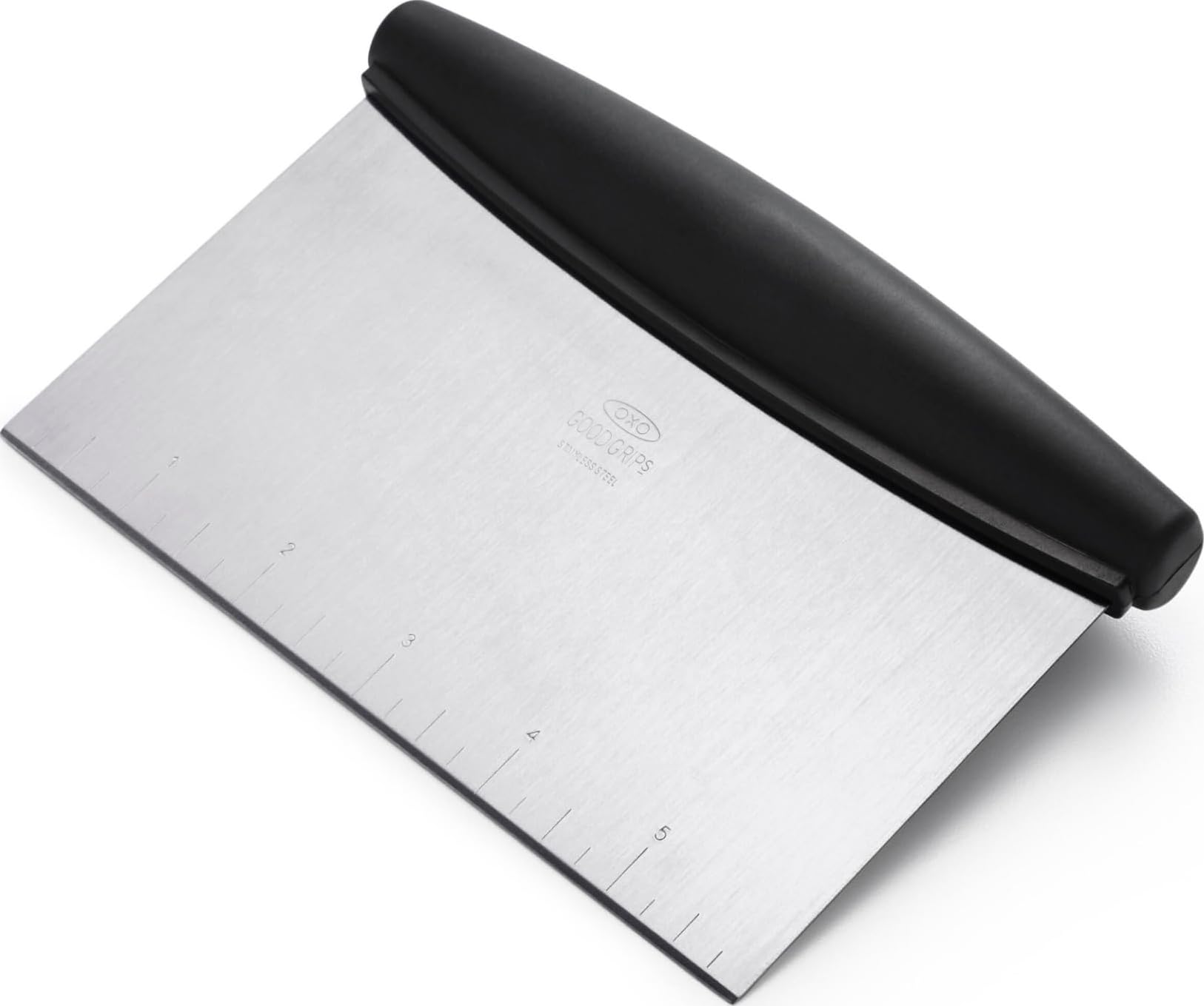
OXO Bench Scraper
Key Features
- Blade length: 6 inches
- Blade markings: 1-inch increments
- Overall length: 6.25 inches
- Dishwasher safe: Yes
- Price: Midrange
The 6-inch stainless blade has 1-inch markings stamped into it, which sounds like a small detail until you are portioning dough and do not want to hunt for a ruler. The blade is rigid, the handle is soft and nonslip, and the whole tool feels balanced in the hand. It is a simple object, but it is put together well.
We use it to cut dough into portions, scoop chopped vegetables off the board, and scrape flour and sticky bits from the counter. The straight edge gets under dough without tearing it, and the measurements help when a recipe asks for equal pieces. It is also dishwasher safe, which makes it easy to keep in rotation.
For the quiet jobs—bench work, portioning, cleanup—it is the scraper we reach for. The stainless blade and comfortable handle are worth it for anyone who bakes or preps on a board, and the dishwasher-safe build means it does not become a chore.
Pros
- 6-inch blade with 1-inch marks
- Comfortable nonslip handle
- Dishwasher safe
Cons
- Blade is not especially sharp
A bench scraper is the quiet workhorse here, and this OXO is the one we recommend for its comfortable grip, measuring marks, and dishwasher-safe build.
Best for Controlled Oil Misting
TrendPlain Oil Sprayer

Key Features
- Capacity: 470 ml
- Lid care: Hand wash only
- Material: BPA-free glass
- Spray dose: 0.15 g per spray
- Price: Budget
The spray-and-pour idea is what sold us: one bottle for misting a pan and pouring a glug over a salad. The nozzle delivers a fine mist when you press firmly, and the pour spout flips open without removing the lid. The 470 ml glass body looks good on the counter, and the black finish does not show fingerprints the way clear glass can.
We used it for olive oil on roasted vegetables, a light coat on the air-fryer basket, and a pour over bread. The spray is fine enough for a light coat, and the bottle is easy to refill with a funnel. It is a nicer habit than aerosol spray and less messy than tipping a heavy jug.
The collar is the fussy part. A drop of oil in the threads can migrate down the bottle, so we wipe the spout after each pour and keep the fill below the neck. That small habit keeps the bottle clean and the spray consistent.
We recommend it for cooks who want both spray and pour without two bottles on the counter. If you only need a mister, a simpler sprayer is easier to live with; if you only pour, a plain bottle is fine. The dual function is the reason this one earns its place, and the cleanup routine is the price of keeping it working.
Pros
- Spray and pour from one bottle
- 0.15 g per spray for control
- 470 ml BPA-free glass body
Cons
- Glass body can break if knocked
- Lid is hand-wash only
We recommend this sprayer for cooks who want to mist and pour from one bottle, but it rewards careful filling and regular wiping around the collar.
Best for Opening Cans Daily
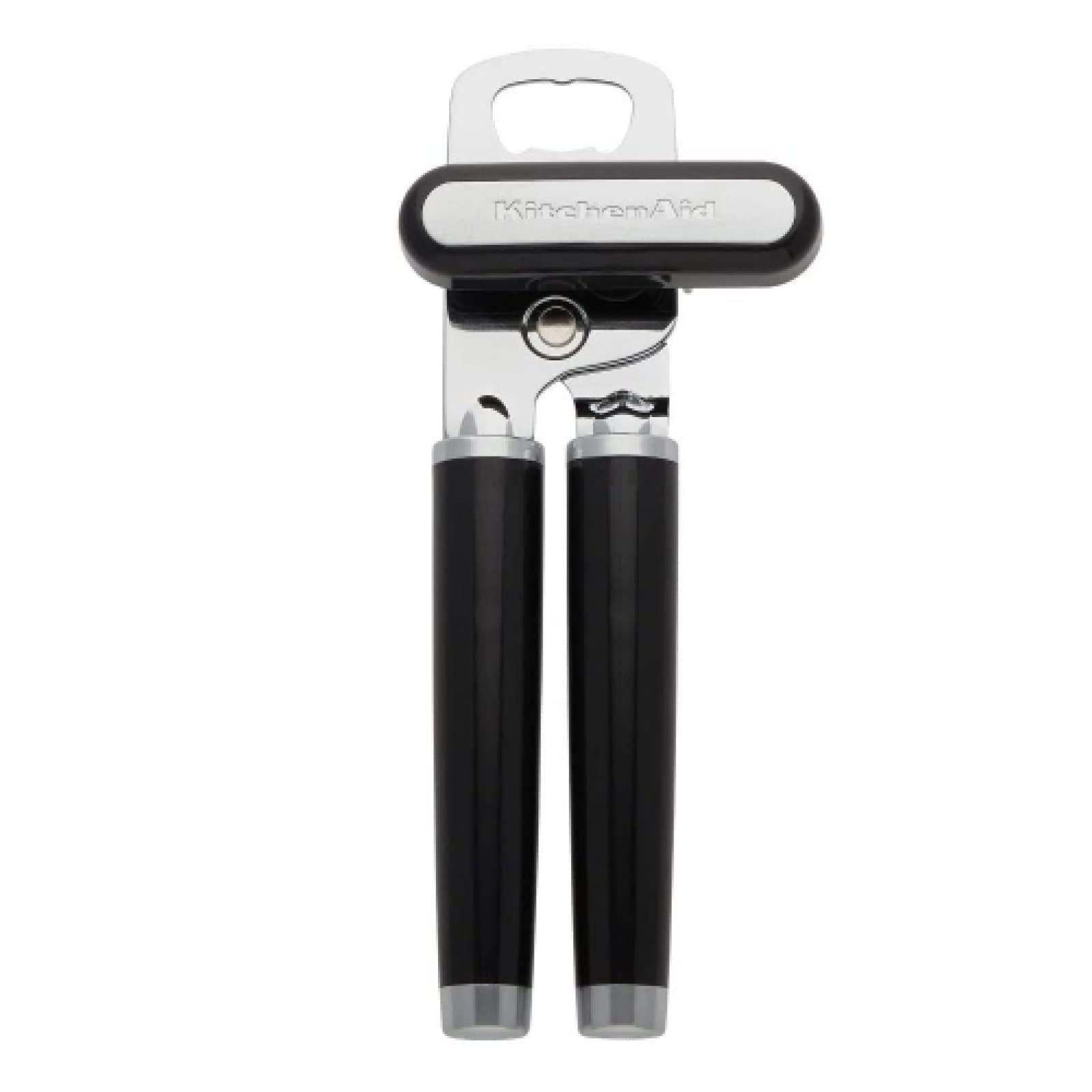
KitchenAid Can Opener
Key Features
- Length: 8.34 inches
- Weight: 4.48 oz
- Material: Stainless steel
- Bottle opener: Built-in
- Price: Midrange
The oversized turning knob is the first thing you notice, and it is the reason this opener feels easier to control than a skinny-knob model. The knob gives you a full-hand grip, so you are turning with your wrist instead of pinching. The handles are soft and wide, which helps when you are opening several cans for a big batch of chili.
The stainless steel cutting wheel is the working part, and the built-in bottle opener saves you from hunting for another tool. It is a manual opener, so you still do the work, but the design makes the work feel more controlled. The 8.34-inch body is long enough for leverage without being unwieldy.
There are no batteries or cords, and the whole tool can be rinsed and wiped clean. It is not a fancy can opener; it is a comfortable one. The black finish looks smart on the counter, and the 4.48-ounce weight is light enough to hang on a hook if you have one.
For anyone who opens cans regularly and wants a manual tool with a big knob and a bottle opener in the same handle, this is the one we recommend. It is also a sensible choice if hand strength is a concern, because the oversized knob gives you more to hold. If you want a gadget that does more than open cans, look elsewhere; this one is deliberately single-minded.
Pros
- Oversized knob turns easily
- Soft ergonomic handles
- Built-in bottle opener
- Stainless steel cutting wheel
Cons
The KitchenAid is the can opener we recommend for anyone who wants a comfortable manual tool with a big knob and a built-in bottle opener.
How We Tested 16 Kitchen Gadgets
We started with a shortlist of about 60 gadgets — bestsellers, staff favorites, and a few oddballs that kept surfacing in customer reviews — then cut anything that duplicated a category we’d already covered or cost more than it could plausibly save you. That left 16, which we rotated through three home kitchens over five months: weeknight dinners, a long Sunday meal prep, holiday baking, and all the washing up that followed.
Accuracy got checked against references, not vibes. Thermometers went into an ice bath and then boiling water; scales weighed the same scoop of flour three times in a row; measuring cups were filled to the line and tipped to see whether anything ran down the outside. We read every display at arm’s length and again in dim light, handed the fussier tools to a left-handed tester, and timed how long each one took to set up and break down.
For the cutting tools, we peeled through a five-pound bag of potatoes, zested a pile of citrus, and sliced tomatoes to see which ones crushed instead of cut. Everything went through the dishwasher on repeat to watch for rust, wobbly handles, and hairline cracks, and we hand-washed the rest to see where water pooled and stayed. Stability mattered more than we expected — we leaned hard on every mandoline and colander set on a wet counter. Then we asked the question that really counts: did it do something a knife and a bowl couldn’t?
How to Choose Kitchen Gadgets That Earn Their Space
The best kitchen gadget is the one that removes a step you repeat, not the one that looks clever in a drawer.
Buy for the job you do most often
A gadget has to beat the tool you already reach for, or it becomes clutter. Start with the prep or cooking step you repeat several times a week: checking doneness, snipping herbs and chicken, chopping onions, washing greens, opening cans. If a task happens once a month, a knife and board are usually enough. If it happens most nights, a dedicated tool can pay for itself in consistency and speed. That is why a thermometer earns the top spot here: it answers a question no knife can.
Match capacity and footprint to your kitchen
Capacity cuts both ways. A 6.22-quart salad spinner suits salads for two or a bunch of herbs; a 5-cup chopper handles a batch of onions but takes more drawer depth than a hand chopper. Before you buy, measure the drawer or cabinet where it will live, not just the counter. The trap is assuming compact means tiny: a folding thermometer stores in a drawer, while a spinner with a 10-inch lid does not. Also check batch size against your usual cooking—large tools punish small kitchens, small tools punish big batches.
Plan for cleaning before you buy
Cleaning decides whether a gadget stays in rotation. Dishwasher-safe parts are a real convenience, but the fine print matters: top-rack only, hand-wash the lid, dry the hinge. Folding thermometers, shears, and oil sprayers all have crevices where moisture or oil collects. If you know you will not hand-wash, choose the tool whose dirty parts can go straight into the dishwasher. If you will, a quick rinse and dry is often enough. The worst outcome is a useful tool that sits dirty because cleaning it is annoying.
Handle comfort and build quality are not luxuries
You use a gadget with your hands, often when they are wet or tired. Wide, soft handles help with shears and can openers; a non-slip base helps a chopper or shredder stay put; a balanced scraper is easier on the wrist. Build quality shows up at the wear points: a folding thermometer’s hinge, a chopper’s plastic frame, the collar of an oil sprayer, the blade edge of a scraper. Paying more can buy better materials or a more comfortable grip, but it does not guarantee a longer life. Buy the one whose weak point you can live with.
Frequently Asked Questions
Can I use an instant-read thermometer in an air fryer?
Yes, if the probe is rated for the heat and you keep it off the metal rack. Pull the basket out, insert the probe into the thickest part of the food, and let the reading settle. Poultry should reach 165°F and ground meat 160°F. A folding model like our top pick is easier to angle into a small basket than a dial thermometer.
Is a chicken shredder worth it if I already have a stand mixer?
A stand mixer with a paddle can shred a large batch, but it takes a bowl, a paddle, and cleanup. The dedicated shredder is hand-powered, stores flat, and goes in the dishwasher, so it is the easier choice for a single meal’s worth of chicken or pork. If you already shred often and have limited storage, the mixer may be enough.
How much oil does one spray from an oil sprayer deliver?
The TrendPlain lists 0.15 grams per spray, so about 100 sprays deliver roughly 15 grams of oil. That is enough to coat a pan or finish a salad without pouring a glug. For comparison, a teaspoon of oil is about 4.5 grams, so a few sprays go further than most people expect.
Final Verdict
Start with the Alpha Grillers thermometer. It is the small tool we recommend first because it gives you a fast, readable number before the chicken goes dry or the bread turns to toast. If your cooking is more about volume prep, the Fullstar chopper is the better fit; for grilling, the TempPro’s rotating display is easier to read in low light. The rest earn their places by doing one job well, not by filling a drawer.