This post contains affiliate links. We may earn a small commission when you buy through our links — at no extra cost to you.
A new grill announces itself in the driveway: a big cardboard box, a bag of bolts, and a diagram with no words printed on it. I’ve put enough of them together to know that first hour is telling — whether the panels line up, whether the hardware feels like pot metal, whether the lid settles flush on the first try. The harder question arrives a season later, after some rain and a few hundred burgers: does it still light on the first click, and does the grease tray still slide out without a fight? Weber built its name on that second question, which is why so many people end up shopping this lineup and nothing else.
My team and I have spent the past eight months cooking on 10 Weber grills, from small kettles to full gas cabinets, and the differences between them aren’t the ones the spec sheets brag about. What actually separates a good one from a great one is how it handles a two-zone fire, how much ash you’re scraping out on a Sunday morning, and whether the frame is still tight after a winter outside. What follows are the ones worth your money — and the places where you’re mostly paying for a badge on the lid.


Best for All-Round Charcoal
Weber Original Kettle Premium 22
Key Features
- Fuel: Charcoal
- Weight: 32.3 lb
- Warranty: 10-year limited
- Cooking area: Up to 13 burgers
- Price: Midrange
Charcoal has a reputation for being fussy, and this is the grill that talks us out of it. The thermometer built into the lid means you read the cooking temperature instead of guessing at it, and the grate is hinged, so you can lift a section and add or push around coals without hauling the whole thing off your food. Those two details do more for a nervous first cook than anything else on the grill.
The One-Touch cleaning system sweeps ash into a high-capacity catcher, and that pays off across a weekend of back-to-back cooks more than in any single session, because you are emptying a bucket rather than scraping out a bowl. The porcelain-enameled bowl and lid hold heat steadily, and the aluminum dampers give you real range, from a covered slow cook up to a hard sear over a full chimney.
Twenty-two inches is the size most people should buy: room for a party, still a one-person job to wheel to the side of the deck. A 10-year limited warranty backs the bowl and lid. What separates it from the standard Kettle is confidence rather than capacity, since the grate and the fire are the same, and the extras are all about helping you get it right.
Pros
- Lid thermometer takes the guesswork out of heat
- Hinged grate lets you add coals mid-cook
- One-Touch sweep empties into a large catcher
- Porcelain-enamel bowl and lid hold heat
Cons
- Picture-only instructions slow assembly down
Our default charcoal grill: a lid thermometer and hinged grate make the kettle behave predictably, and the One-Touch ash catcher turns cleanup into a single sweep.
Best for Budget Charcoal
Weber Original Kettle 22
Key Features
- Fuel: Charcoal
- Dimensions: 25 x 25 x 39.5 inches
- Cooking area: 363 square inches
- Price: Budget
Take the extras off our top pick and you are left with this: the same 22-inch kettle, the same porcelain-enameled bowl and lid, and the same One-Touch ash sweep, with an aluminized steel catcher in place of the big bucket. The lid has no thermometer, and the grate has no hinged section.
For plenty of cooks that is the honest trade. It carries the highest rating in this group, and the cooking itself is identical, with the same dampers, the same lid, and the same fire. If you own a decent thermometer and you do not mind lifting the grate to add coals, the money you save buys a lot of charcoal.
The thermometer is the first thing to sort, and a vent-mount gauge covers what the lid is missing. After that the only real loss is the hinged grate, which matters most on long cooks when you are reloading coals with food already on the surface.
Pros
- Same 363-square-inch kettle for less money
- Highest buyer rating of the grills here
- One-Touch ash sweep keeps cleanup quick
Cons
- Smaller ash pan than the Premium’s bucket
Buy it if you already run a chimney with confidence: same 22-inch cooking as our top pick, without the extras that push the price up.
Best for Everyday Gas
Weber Spirit E-325
Key Features
- Fuel: Propane
- Warranty: 10-year limited
- Cooking area: 360 square inches
- Main burners: 3
- Price: Midrange
Searing is where mid-priced gas grills tend to disappoint, and this is the one in the group built around it. Its boost burners push extra output into a dedicated sear zone, and the practical result is a steak that browns instead of steaming when it hits the grate. Three main burners buy you a real cool side, too: run two, leave one off, and you can finish chicken away from the flame.
The main grate measures 360 square inches with a second rack above, which is a family-of-four-to-six amount of food rather than a party’s worth. Snap-Jet ignition lights each burner individually with one hand, the porcelain-enameled cast-iron grates hold heat well, and a 10-year limited warranty covers the whole grill.
The cart runs 48.3 inches wide and 98.1 pounds, so measure the gap between the railing and the door before it arrives; this is not a grill you shuffle around the deck. Assembly is the other sticking point, because the instructions leave gaps and the cart goes together far faster with a second person holding panels while you drive screws.
Pros
- Dedicated sear zone browns better than the others
- Three burners allow genuine indirect cooking
- One-handed Snap-Jet ignition on each burner
Cons
- Cabinet back is open, exposing the tank bay
The gas grill we point most backyards to: three burners, a real sear zone, and a cart that fits a normal patio.
Best for Small Patios
Weber Spirit E-210
Key Features
- Fuel: Propane
- Weight: 90.4 lb
- Cooking area: 360 square inches
- Main burners: 2
- Price: Midrange
Two burners, one cabinet, no sear zone and no side burner: this is the entry point into Weber’s gas range and it does not pretend otherwise. What is still there is the part that matters, including porcelain-enameled cast-iron grates, stainless Flavorizer bars, one-hand Snap-Jet ignition on each burner, and a 10-year limited warranty.
For a couple, or a household that grills four burgers and a tray of vegetables rather than a brisket, this is the amount of grill we recommend. Run one burner and you have an indirect side for finishing chicken; run both and 360 square inches take a meal for four with room left over. Where it runs out is hosting, because you feel the missing burner before you feel the missing space.
The surprise is the footprint. Two burners sounds compact, but the E-210 sits on the same 48.3-inch cart as the three-burner models and weighs 90.4 pounds, so it claims the same patio real estate as its bigger sibling. Measure first if the deck is tight, because small firebox does not mean small grill.
Pros
- Right-sized firepower for two to four people
- One burner off gives an indirect cooking side
- Cabinet hides the propane tank
Cons
- Two burners leave no room for a sear zone
For two people, we think this is the right amount of gas grill: two burners, 360 square inches, and no sear zone to pay for.
Best for Big Families
Weber Spirit E-425
Key Features
- Fuel: Propane
- Weight: 102.5 lb
- Cooking area: 428 square inches
- Main burners: 4
- Price: Midrange
Four burners is the point where a gas grill stops being a compromise. The E-425 adds a burner and 68 square inches over the E-325, and more usefully it gives you two genuine zones with room to spare: sear on the right, hold on the left, and still have space for a tray of vegetables.
The rest is familiar Spirit hardware, including porcelain-enameled cast-iron grates, stainless Flavorizer bars that catch drippings and send them back up as smoke rather than down into the burners, boost burners in the sear zone, and a 10-year limited warranty. The cart runs 51.8 inches wide and 102.5 pounds.
The honest math is that you pay a real step up over the three-burner model for one more burner and a wider grate, and it only pays off if the extra zone gets used. A family of six or a standing Sunday crowd will use it every week. Two people cooking two steaks will not, and the E-325 will do the same dinner.
Pros
- Fourth burner makes two-zone cooking easy
- Flavorizer bars turn drippings into smoke
- Wider grate than the three-burner models
Cons
- Wide, heavy cart wants a permanent spot
For a household that feeds a crowd, we look here first: a fourth burner and 428 square inches, without the Genesis cart or its price.
Best for Serious Hosting
Weber Genesis E-415
Key Features
- Fuel: Propane
- Warranty: 12-year limited
- Cooking area: 994 square inches
- Main burners: 4
- Price: Premium
Size is the headline. At 994 square inches across the main and warming grates, this is more than double the cooking area of the Spirit models here, and it is enough that a party’s food goes on in one pass instead of three. The cart is 64.5 inches wide, so this is a permanent outdoor-kitchen decision rather than a grill you tuck against the wall.
Weber’s PureBlu burners use a tapered design to spread a consistent flame across the surface, and the raised flame openings are meant to keep drippings from clogging them. Porcelain-enameled cast-iron grates sit between stainless side tables, and the warming rack earns its space, keeping buns and finished pieces warm while the main course catches up.
Then there is the WEBER CRAFTED system. The grates accept a frame kit and custom-fit inserts, including a pizza stone, a griddle, and a dual-sided sear plate, all sold separately. If you want one grill that handles breakfast and dinner, that is the most convincing argument the Genesis makes.
Here is where we land. This is a lot of grill, and it justifies itself only if you fill it: a household that hosts, wants the 12-year limited warranty, and is done replacing grills every few summers. Everyone else gets most of the cooking from the E-425 on a smaller and easier cart.
Pros
- 994 square inches handles a whole party
- 12-year limited warranty is the longest here
- Crafting inserts add griddle and pizza work
Cons
- Needs a large permanent footprint
The biggest grill we cover, and the longest-warranted: 994 square inches, four PureBlu burners, and a cart that turns a patio into an outdoor kitchen.
Best for Camping and Tailgates
Weber Q 2800N+
Key Features
- Fuel: Propane
- Weight: 51 lb
- Cooking area: Up to 12 burgers
- Temperature range: 250–700°F
- Price: Midrange
The temperature range is the whole story here: 250 to 700 degrees Fahrenheit from two burners, with a plus burner that either pushes the top end for searing or, running alone, holds the low end for roasting. That spread is why the Q 2800N+ cooks like a bigger grill than it looks, and it is the spec we kept coming back to.
The grate takes twelve burgers or two full racks of ribs, the high-dome lid clears a whole chicken, and the venting is shaped to keep heat even when the wind picks up, which matters more at a campsite than on a sheltered patio. It runs on propane like the full-size grills.
We treat portable as relative. This is a grill you load into the car for a tailgate or a weekend away and set down when you arrive, not something you carry to a viewpoint. What the bulk buys is real searing, a five-year limited warranty, and a lid deep enough to roast under.
Pros
- 250 to 700 degrees covers searing and roasting
- Twelve burgers or two racks of ribs fit
- High-dome lid clears a whole chicken
Cons
- 23.13 kg makes it a two-trip carry
- Griddle insert is sold separately
Our go-anywhere pick: 250 to 700 degrees Fahrenheit on two burners, twelve burgers of space, and a lid that clears a whole chicken.
Best for Trunk and Campsite
Weber Smokey Joe 14
Key Features
- Fuel: Charcoal
- Height: 17 inches
- Weight: 8.4 lb
- Cooking area: Fits 6 burgers
- Price: Budget
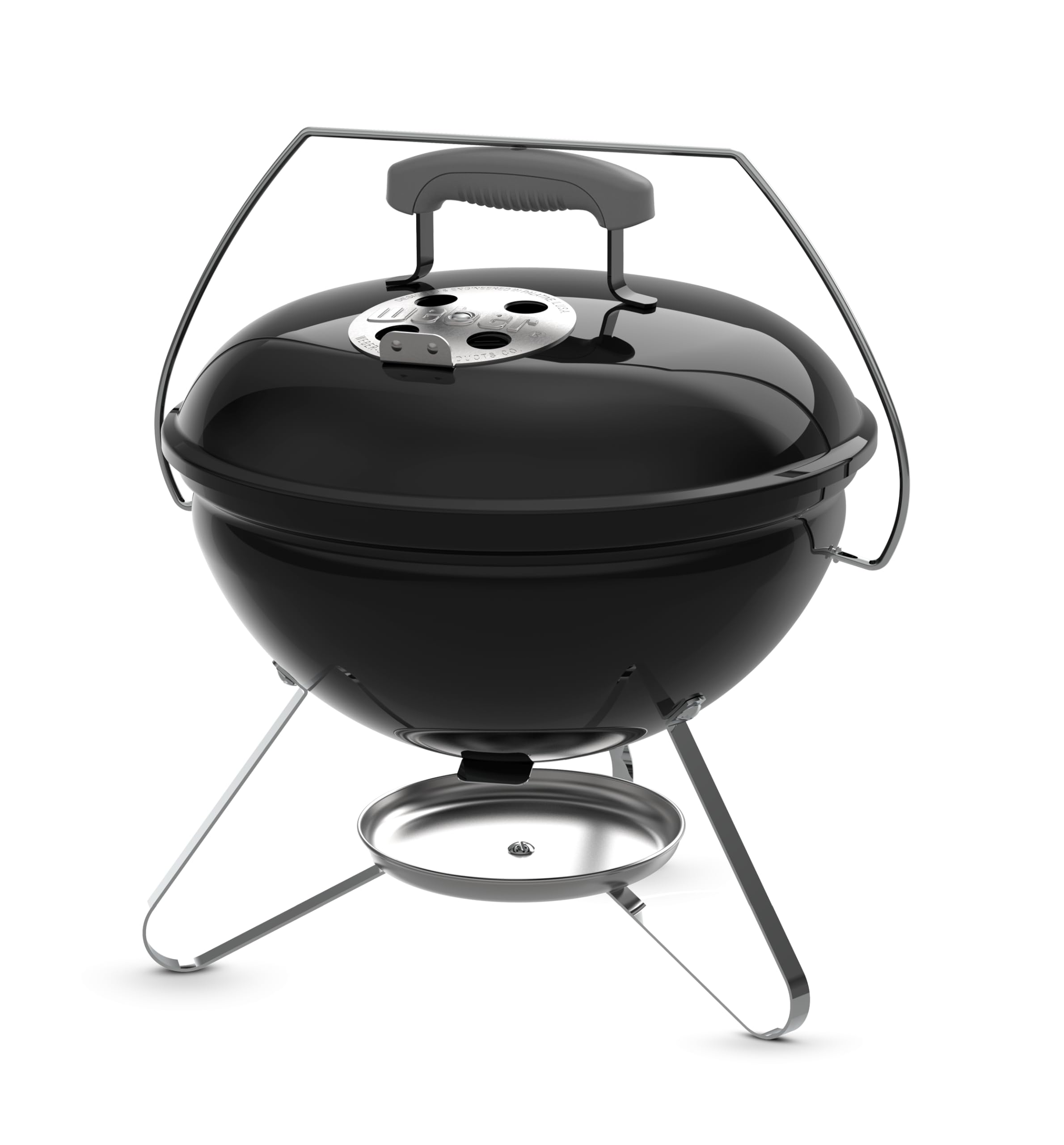
Fourteen inches of grate and 8.4 pounds puts the Smokey Joe in a different category from everything else here. It holds six burgers, which is dinner for two with a spare, and it wears the same porcelain-enamel finish as the full-size kettles, so it is built to the same finish standard rather than a cheaper one.
The Tuck-N-Carry lid lock is the detail worth knowing about. The lid locks down for transport and then hangs on the side as a lid holder once you are cooking, so you are not balancing a hot lid on a picnic table or setting it in the dirt. The ash catcher underneath keeps embers off whatever surface you set it on.
At 17 inches tall overall it sits low. Plan to set it on a picnic table or a tailgate rather than the ground, or you are crouching over it while you turn dinner, and give it something level to stand on.
What we appreciate most is that it removes the excuse not to cook outside. It is the least expensive grill in this group, it stores on a shelf, and it goes into a trunk without rearranging anything else. Treat it as the second grill that ends up getting used first.
Pros
- 8.4 pounds is a genuine one-hand carry
- Tuck-N-Carry lid lock doubles as a lid holder
- Ash catcher protects the surface underneath
Cons
- Single 14-inch grate rules out two-zone cooking
The grill we recommend for a trunk, a tent, or a boat locker: 8.4 pounds, fourteen inches, six burgers, and a lid lock that doubles as a handle.
How We Tested 10 Weber Grills
We started on paper, comparing the current lineup by fuel type, cooking area, grate material, warranty length, and price, then cross-checked owner reviews for the complaints that keep repeating — hardware that rusts, grates that warp, grease trays that don’t come out without a wrestle. From that shortlist we bought 10 grills spanning the range, from a compact kettle to a full-size gas cabinet, and cooked on them for eight months.
Assembly came first, done solo with a stopwatch and only the tools in the box. We noted the step where the instructions stopped making sense, whether the legs wanted a second set of hands, and whether the bolts seated cleanly or needed coaxing. Build quality got checked the same afternoon: lifting the lid by one corner to feel the hinge, leaning on the side shelves, running a hand along the welds, and hefting the cooking grates to judge how thick the steel really was.
Then we cooked. Each grill got a two-zone setup, a batch of burgers, chicken thighs over indirect heat, and a full grate of white bread slices to map the hot spots — the pattern of char tells you more than any thermometer. After every cook we pulled the grease tray and emptied the ash the way a normal person would on a weeknight, without special tools, and paid attention to whether the ash sweep actually cleared the bowl or just pushed dust around. Ease of use showed up in small things: whether the lid stayed open while we moved food, how steadily the vents or knobs held temperature, and how much fiddling a low-and-slow cook required.
Value and durability we judged on the long tail. Four of the grills stayed outside through a wet winter, two covered and two not, and we checked welds, burner tubes, and hardware for rust once spring arrived. The question we kept coming back to was simple: does the extra money buy a better cook, or just a bigger badge?
How to Choose a Weber Grill
The first fork in the road is not the model, it is charcoal or gas, because that single choice decides how you cook, how you clean up, and how much patio the thing occupies.
Charcoal or Gas: Start With How You Cook
Charcoal gives you a higher heat ceiling, smoke flavor gas cannot fake, and a fire you manage by hand. It also means a chimney, a wait, and ash. Gas gives you a knob, an even grate, and a grill you can light on a Wednesday after work.
We think of it as a frequency question. Cook outside two or three times a week and gas wins on sheer use. If grilling is the weekend event you look forward to, charcoal gives you more to work with and the ritual is part of what you bought.
Match the Cooking Area to Your Table
Cooking area is the number to compare, but the cart is what you live with. A 360-square-inch Spirit takes a 48-inch-wide footprint; the Genesis E-415 is 64.5 inches wide for its 994 square inches. Decide how many people you actually feed, then measure the space and the clearance for an open lid.
The trap is buying for the party you host twice a summer and giving up deck space for the other fifty weeks. A grill that fits your Tuesday gets used; a grill that dominates the patio becomes furniture.
Burners and Zones: What a Sear Zone Buys
A burner count is really a zone count. Two burners give you a hot side and a cool side, enough for burgers and chicken pieces. Three burners give you a searing zone, a cooking zone, and an off zone for indirect heat, which is where gas starts to feel flexible.
A sear zone is a separate high-output burner you can run flat out for a crust. We reach for it on steaks and chops and leave it idle for everything else, which is why three burners is our floor for a gas grill that has to do real work.
What Portable Actually Means
Portable covers everything from a grill you carry in one hand to a box you wrestle into a trunk. The Smokey Joe weighs 8.4 pounds and stands 17 inches tall; the Q 2800N+ weighs 23.13 kg and wants a firm, level surface at the other end.
Check the packed weight, the height, and whether you are setting it on a table or the ground. A grill that is a chore to move stops being portable after the first trip, and the one that stays in the car is the one that gets used.
Assembly, Cleanup, and the Box on the Doorstep
Kettles go together with hand tools in a single sitting. Carts take longer and go much faster with two people and a flat surface, because panels have to be held square while screws go in. Cleanup splits the same way: charcoal models sweep ash into a catcher, gas models pull out a grease tray and drip pan.
Open the box and inspect before you bolt anything together. The bigger the cart, the more likely a panel arrives bent, and a return is far easier before assembly than after.
Frequently Asked Questions
Can I use a Weber kettle on an apartment balcony?
Space is usually not the obstacle: a 22-inch kettle takes about 25 inches across and the Smokey Joe takes 16.5. Permission is the obstacle. Plenty of leases and building rules bar open-flame cooking on balconies, and charcoal embers draw more objections than gas.
Read your lease and ask the building before you order, not after the box arrives.
How do I hold a low temperature on a charcoal kettle?
Control comes from the dampers more than from the pile of charcoal. Light fewer coals than feels right, keep the bottom vent partly closed and the lid vent open enough to keep the fire drawing, and top up through the hinged section of the grate, or lift a corner, if the heat starts to fall.
Chasing temperature with a full chimney is how a slow cook turns into a hot one.
What does the Weber warranty cover, and for how long?
It depends on the model: 10-year limited on the Original Kettle and the Spirit gas grills here, 12-year limited on the Genesis E-415, and 5-year limited on the Q 2800N+. Those cover defects in materials and workmanship rather than wear and tear.
A panel dented in shipping is a return to the seller, not a warranty claim, so inspect the box before assembly and register the grill once it is built.
Final Verdict
For most people, the grill to buy is the Original Kettle Premium. Twenty-two inches, a lid thermometer, a hinged grate, and an ash system that does not fight you, at a price that leaves room for charcoal. It is the one here that makes charcoal cooking feel less like a project.
If weeknights matter more than smoke, the Spirit E-325 is the gas equivalent and the one we point most backyards to. And when the cooking happens somewhere other than home, the Q 2800N+ is the grill that goes with you.