This post contains affiliate links. We may earn a small commission when you buy through our links — at no extra cost to you.
Sunday breakfast for a crowd should not require a relay race of frying pans. An electric griddle gives you one wide, open cooking surface for pancakes, bacon, eggs, and hash browns at once, but the wrong one can turn that convenience into a morning of scraping stuck-on batter and shuffling food from hot spots to cool corners. I care about a griddle that heats evenly from edge to edge, releases food without a fight, and wipes clean before the syrup dries. The best ones also earn their counter space: big enough for a family breakfast, stable enough not to slide, and light enough to lift in and out of a cabinet without a two-handed wrestling match.
Over the past eight months, my team and I have cooked on 12 electric griddles, from compact models to family-size plates, and the differences show up fast—especially at the edges, where cheap units run cool, and at cleanup, where a so-called nonstick surface can cling to egg like glue. A griddle is not a place to pay for bells and whistles; you are paying for even heat, a surface that survives metal spatulas and daily scrubbing, and a size that fits both your family and your storage. Value matters too, but only after those boxes are checked. Below are the ones that kept earning a spot on the counter.



Best for Family Breakfasts
Presto 07062 Ceramic Griddle
Key Features
- Weight: 5.7 lb
- Heat control: 6 settings, Control Master
- Cooking surface: 22 inches
- Removable handles: Yes
- Price: Midrange
The removable handles and 22-inch cooking surface are what make the Presto 07062 the griddle we recommend first to families. The handles come off so the plate fits in the sink and cabinet more easily, and the ceramic surface gives you enough room for a full batch of pancakes, bacon, and eggs without cooking in shifts. That combination is more useful than a long feature list.
We think this is the best all-round choice here because it balances size, cleaning, and heat control better than the rest. The Control Master dial holds a set temperature rather than making you chase it, and the cast-aluminum body is built to resist warping. The catch is heat distribution: the surface can run hotter toward the edges, so we rotate food and keep the outer ring for items that need more color. That is a trade-off we accept for the size.
The textured ceramic surface is another detail we appreciate. It gives pancakes a little grip and seems less fragile than a glossy coating, though it does mean you should use a silicone spatula rather than metal. At 5.7 pounds, it is light enough to move from counter to sink, and the removable handles make storage less awkward.
The grease tray and feet come off too, which makes the plate easier to wipe down after bacon. For most families, this is the one that makes the most meals with the least fuss, even if it is not the cheapest large griddle here.
Pros
- Large 22-inch ceramic cooking surface
- Removable handles ease sink and storage
- Control Master holds set temperature
- Cast-aluminum body resists warping
Cons
- Edges can run hotter than the center
The Presto 07062 is our default family griddle: its big ceramic surface, removable handles, and steady heat control make weekend cooking easier to manage.
Best for Easy Cleanup
Dash Deluxe Everyday Griddle
Key Features
- Warm setting: Yes
- Cooking surface: 20 x 10.5 inches
- Removable plate: Yes, dishwasher-safe
- Temperature range: 200–400°F
- Price: Midrange
The removable plate is the reason to look at the Dash Deluxe: it lifts off and goes in the dishwasher, which turns one of the messiest breakfast jobs into a quick wipe-down. The 20 x 10.5-inch surface is big enough for eight slices of bread or a family batch of pancakes, and the aqua finish gives it a friendlier look than the usual black slab.
The dial runs from 200°F for eggs to 400°F for burgers, with a warm setting for holding food. At 1500 watts it heats quickly, and the low-profile body stores without much drama. Give it a full preheat before adding food; the surface can cycle and leave lighter patches. That is a real convenience if you cook breakfast on busy mornings.
We rate it as the easiest cleanup pick in this group, and that matters more than a few extra square inches. The plate and drip tray are dishwasher-safe, and the removable plate makes hand-washing practical when the dishwasher is full. The warm setting is the small extra that earns its place on a buffet, holding cooked food without you turning on the oven.
Pros
- Removable dishwasher-safe plate
- Family-size 20 x 10.5-inch surface
- Warm setting holds cooked food
Cons
- Heating element durability is mixed
We recommend the Dash if you want a family-size griddle whose plate lifts off for the sink or dishwasher, and you can live with some heat variation.
Best for Budget Crowds
Chefman XL Electric Griddle
Key Features
- Weight: 4.4 lb
- Cooking surface: 10 x 20 inches
- Temperature range: 200–420°F
- Dishwasher-safe cooktop: Yes, control removed
- Price: Budget
A 10 x 20-inch cooking surface for budget money is the Chefman’s opening argument, and it is a strong one. You get room for a full batch of pancakes or a row of burgers, a removable temperature control, and a cooktop that can go in the dishwasher once the probe is out. For a first griddle or a holiday overflow appliance, that is a lot of useful surface for the outlay.
The 200–420°F dial gives you a wide range, and the nonstick surface releases eggs and pancakes well when it is not run too hot. Keep delicate food toward the center; the outer edges are where browning runs ahead. The 4.4-pound body is easy to lift, and the slide-out drip tray keeps grease from pooling.
The cooktop is immersible and dishwasher-safe after the control comes off, which is more cleaning convenience than the price suggests. We also like that the temperature probe is removable rather than fixed; it makes the plate easier to handle and store.
Our verdict is that it earns a place for big-family cooking on a budget, with the understanding that you are trading some finesse for capacity. If you cook for a crowd a few times a week and want to spend less, it is the one we point to first.
Pros
- Large 10 x 20-inch cooking surface
- Wide 200–420°F temperature range
- Dishwasher-safe cooktop after probe removal
Cons
- Coating durability is mixed
The Chefman is our pick for feeding a crowd on a budget, as long as you accept a little unevenness at the edges.
Best for Searing and Browning
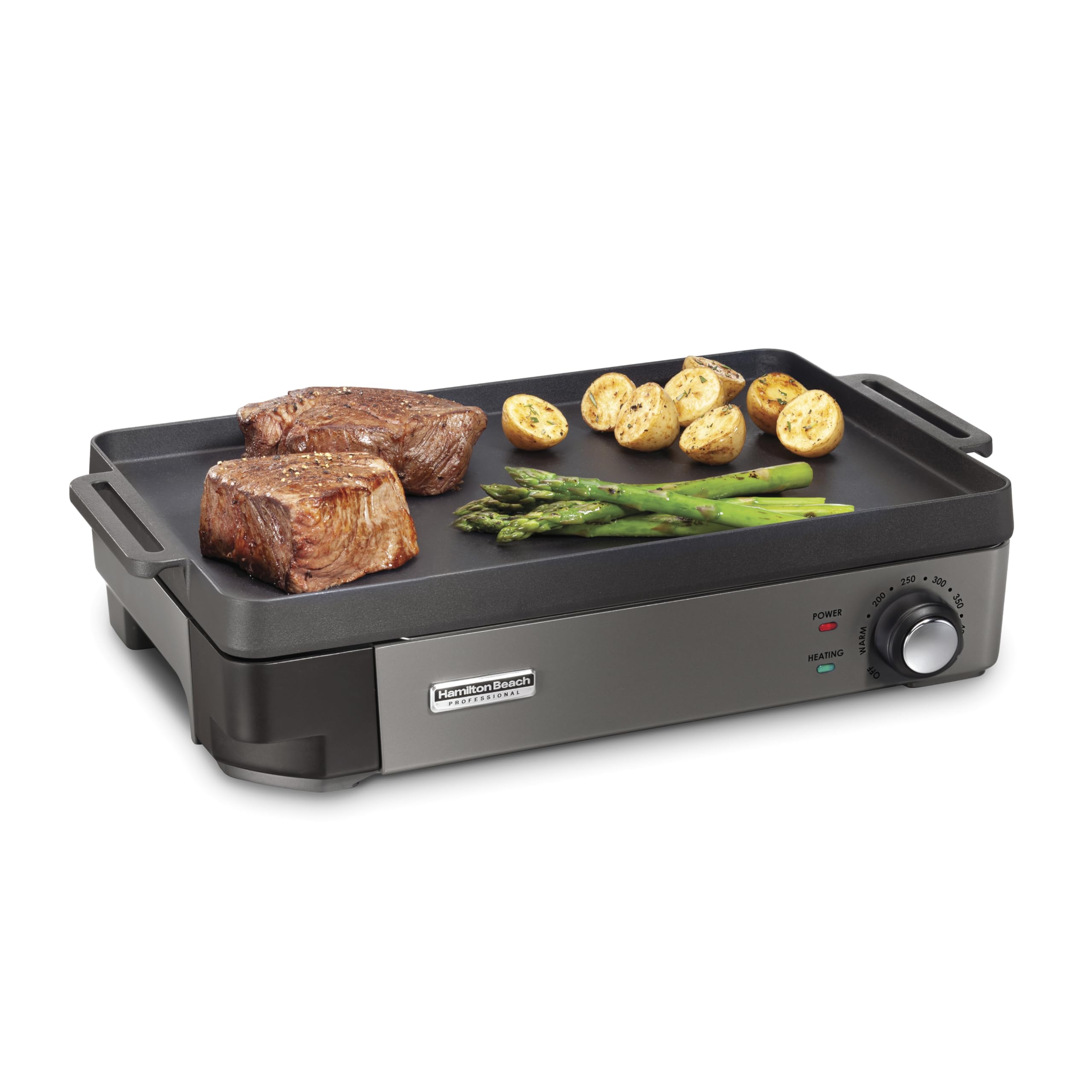
Hamilton Beach Cast Iron Griddle
Key Features
- Weight: 22.2 lb
- Material: Preseasoned cast iron
- Cooking surface: 10 x 16 inches
- Max temperature: 450°F
- Price: Premium
The 22.2-pound cast-iron cooking plate is the first thing you notice about the Hamilton Beach Professional, and it explains both the appeal and the commitment. We think it is the best searing option in this group, and the only one that behaves more like a flat-top than a breakfast appliance. This is not a griddle you toss in a cabinet one-handed. It holds heat, sears, and feels built to outlast the nonstick aluminum models here.
The preseasoned cast iron goes to 450°F, and the surface holds temperature when cold food hits it. It needs a proper preheat and a thin film of oil, and you should treat it like cast iron: dry it thoroughly and reseason when it dulls. The 10 x 16-inch surface is smaller than the big aluminum griddles, so it is better for burgers, eggs, and smaller batches than a full family pancake line.
The cooktop lifts off for cleaning, and the drip tray is top-rack dishwasher-safe, which makes cleanup more manageable than the weight suggests. The trade-off is that the plate is heavy and the unit takes up real counter space. For a buyer who wants durability and browning over light weight, this is the premium pick. It costs more and asks more of you, but it delivers the kind of heat that the inexpensive coated griddles cannot match.
Pros
- Cast iron holds heat for searing
- Preseasoned and durable
- Removable cooktop and dishwasher-safe tray
Cons
- Very heavy at 22.2 pounds
We reach for the Hamilton Beach when browning and searing matter more than light lifting, because its cast-iron plate holds heat far better than the aluminum alternatives here.
Best for Small Kitchens
Presto 07047 16-Inch Griddle
Key Features
- Weight: 4.6 lb
- Heat control: 6 settings, Control Master
- Cooking surface: 10.5 x 16 inches
- Cool-touch base: Yes
- Price: Budget
The 16-inch surface and low-profile body are what make the Presto 07047 easy to live with in a small kitchen. It takes up less counter space than the 20- and 22-inch models here, slides into a cabinet without a fight, and still fits six pancakes or a few grilled sandwiches at once. For a couple or a small family, that is often the more practical size.
The 1300-watt element heats quickly, and the ceramic nonstick surface is one of the more consistent performers in this group. The Control Master dial holds a temperature rather than just cycling hard, and the cool-touch base is a nice detail when you are moving food around. It is not the widest surface, so a big breakfast still takes two rounds.
We recommend it as the best small-household choice here because it gets the basics right without making you store a monster. The 4.6-pound body is light enough to lift, the surface wipes clean, and the low profile means it does not dominate a counter. The trade-off is the size: if you regularly cook for five or more, you will feel the limit. It is the griddle we point to when storage and quick cleanup matter more than maximum batch size.
Pros
- Compact 16-inch footprint
- Quick 1300-watt heating
- Control Master holds temperature
Cons
- 16-inch surface limits big batches
We like the 16-inch Presto for a small kitchen or a household of two or three: it is compact, quick to heat, and easy to wipe down.
Best for Budget Ceramic
Amazon Basics Ceramic Griddle

Key Features
- Cooking surface: 10 x 20 inches
- Grease channels: Deep channels
- Removable plate: Yes, dishwasher-safe
- Temperature range: 200–400°F
- Price: Budget
A detachable ceramic plate at a budget price makes the Amazon Basics a sensible second griddle, though we do not choose it as the main one for a family that cooks breakfast every weekend. The 10 x 20-inch surface gives you family-size cooking area, the plate comes off for washing, and the 200–400°F probe gives you a useful range for eggs, pancakes, and burgers.
The ceramic coating is slick enough that food can slide toward the drip channel when you flip, and the release is not as consistent as the best surfaces here. The body is light and easy to move, and the dishwasher-safe plate is a genuine convenience. Give it a full preheat and a little oil to give the coating its best chance. The plate is easy to lift out and rinse.
The deep grease channels are a useful detail for bacon, and the removable plate makes cleanup straightforward. The trade-off is that the surface is more slippery than grippy, which takes a little getting used to with pancakes and eggs. We treat it as a value alternative for light duty, not a workhorse.
Pros
- Detachable dishwasher-safe plate
- Large 10 x 20-inch surface
Cons
- Surface can be too slippery for delicate food
- Release is less consistent than the best here
A detachable ceramic plate at a budget price makes the Amazon Basics a sensible second griddle, though we do not choose it as the main one for a family that cooks breakfast every weekend.
How We Tested Electric Griddles
We started by narrowing the field to 12 griddles sold by established brands and reviewed the specs that matter before cooking: plate size, cooking surface area, wattage, temperature range, drip tray design, and listed weight. We ruled out models with vague or inconsistent sizing and those whose prices put them in a different league than their build quality suggested. Then we brought the shortlist into the same kitchen and used each one the way a griddle actually gets used—not just for one photo-ready pancake stack.
Over eight months, we cooked weekend pancake breakfasts for a family of four to six, batches of bacon and eggs, smash burgers, grilled cheese, and hash browns. We paid attention to how evenly pancakes browned from the center to the corners, whether bacon fat ran toward the drip tray or pooled under the food, and whether eggs slid off or left a lace of stuck protein behind. We also tested the surface with everyday tools—thin metal spatulas, nylon turners, and the occasional impatient scrape—and checked for scratches, dark patches, and coating wear as the weeks went on.
Cleanup was part of every session: after the griddle cooled, we wiped it with a damp cloth, washed per the manufacturer’s instructions, and noted whether food released in one pass or needed soaking, especially around the drip tray and corners. We lifted each unit in and out of a lower cabinet, checked whether it fit under the upper cabinets and in a standard cabinet, and weighed it on a kitchen scale to see how it felt to store and move, since a griddle that is awkward to handle tends to stay buried. At the end, we compared what each one cost against how consistently it cooked and how well its surface and controls held up—value only counted if the basics kept working.
How to Choose an Electric Griddle
The right griddle is the one that fits your biggest regular batch and your sink, not the one with the largest number on the box.
Match the surface to your regular batch
A 20- or 22-inch griddle is the family-breakfast size: it can hold a dozen pancakes or a pound of bacon without a second round. A 16-inch model is easier to store and wash and still works for two to four people. Measure your counter and, more importantly, your sink and cabinet before you choose; a big griddle that does not fit either becomes a chore. Check the cooking surface, not just the overall width, because handles and a drip tray add inches.
Prioritize even heat over a long feature list
Aluminum griddles heat quickly but can run hotter near the element; cast iron heats slowly and holds temperature better. Neither is automatically better. For pancakes and eggs, look for a thermostat that holds a steady low-to-medium heat and give any griddle a full preheat. For burgers and steak, cast iron is the more convincing choice. A high wattage number does not guarantee even heat; the useful question is whether the surface recovers after you add cold food.
Look at what actually comes off for cleaning
Removable plates and handles make a griddle much easier to wash, but the temperature probe and base usually stay out of the sink. Check whether the plate is dishwasher-safe and whether the drip tray is removable. A fully immersible cooktop is convenient, provided the control is unplugged and kept dry. The textured ceramic surface on the Presto 07062 is a good example: it cleans well, but it asks for a silicone spatula rather than metal.
Plan for storage and grease
A low-profile griddle can slide into a cabinet; a cast-iron model may live on the counter because it is too heavy to move often. Think about where the grease goes, too. A removable drip tray is easier to empty than a fixed channel, and a front-facing tray is easier to check than a rear one. If storage is tight, measure the height with the handles on and off; removable handles can save a few inches.
Treat the coating as a wear item
Even the best nonstick coating is a wear item. Use silicone, wood, or heat-proof plastic utensils, avoid overheating an empty pan, and wash the plate gently. Cast iron is the exception: it can take metal, but it needs drying and occasional reseasoning. If you want a griddle that might outlast several coated ones, pay for cast iron; if you want easy release and quick cleanup, accept that the coating will eventually dull.
Frequently Asked Questions
Why use an electric griddle instead of a large skillet?
A griddle gives you a flat, uninterrupted surface for batch cooking: more pancakes, eggs, and bacon at once, and you can keep it on a buffet. A skillet is better for single servings, tossing, and oven-to-stove dishes. If you regularly cook for four or more, the griddle earns its storage space; for one or two, a skillet is usually enough.
Do I need to season an electric griddle?
Not if it has a ceramic or nonstick coating; those are ready to use after washing. Cast iron is different: the Hamilton Beach model comes preseasoned, but you should dry it thoroughly and reseason when the surface dulls. Never season a coated griddle with oil at high heat, because that can bake on a sticky film.
How do I keep food from sticking to a new griddle?
Preheat the empty griddle on low or medium for several minutes, then add a thin film of oil or butter just before the food. High heat is the usual cause of sticking and browned-on residue; most pancakes and eggs cook better around medium. Let the surface cool slightly before wiping it clean.
Final Verdict
Buy the Presto 07062 if you want one griddle for family breakfasts: its 22-inch ceramic surface, removable handles, and steady control make it the easiest large model to live with. If your kitchen is tight, the Presto 07047 is the better fit; if searing matters most and you do not mind the weight, the Hamilton Beach cast-iron model is the one to choose.