This post contains affiliate links. We may earn a small commission when you buy through our links — at no extra cost to you.
A hard-boiled egg can go from neat to ragged in one wrong press. That’s the quiet frustration of egg slicers: the wires look simple enough, but cheap ones bend, the base flexes, and the egg white tears while the yolk crumbles. The right slicer fixes that small daily annoyance — clean rounds for salads, even slices for sandwiches, and a quick way to cut strawberries or other soft fruit for a snack. Most models worth considering share stainless steel wires, an aluminum body, and a dishwasher-safe finish, though those claims only matter if the tool holds up after repeated use.
I started paying attention while making egg salad for lunches, and the difference comes down to wire tension, base stability, and a hinge that still lines up after a few washes. Over four months, our team tested 14 slicers in our own kitchens, using them on breakfast eggs, weekend brunch, and soft fruit for snacks. We judged slice quality first, then wire durability, cleaning effort, and whether each one felt worth the drawer space.
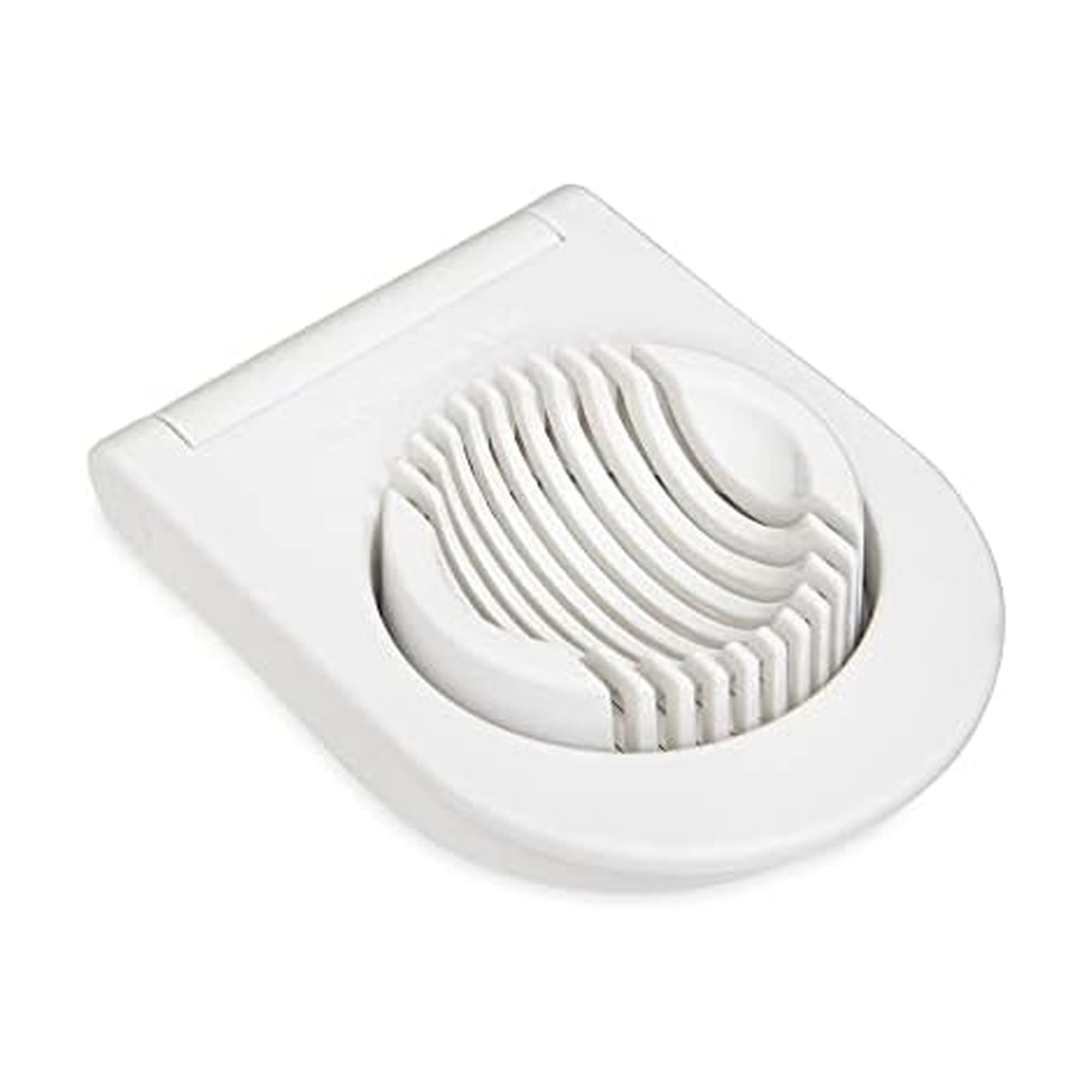


Best for Everyday Slicing
KitchenAid Classic Egg Slicer
Key Features
- Base: Nonslip
- Dimensions: 4.5"L x 4.5"W x 9"H
- Blade material: Stainless steel wire
- Dishwasher safe: Yes
- Price: Budget
Egg whites tear. That’s the small indignity of most slicers: the wires go through, the yolk crumbles, and the slices collapse into a heap. The KitchenAid Classic gave us the cleanest cuts in this group, with wires tight enough to pass through an extra-large egg and leave the slices standing.
The shape does the work. The hopper is deep enough to cradle a peeled egg so it can’t roll, and the top presses straight down instead of hinging at an angle, which is where cheaper tools flex and the wires stall halfway. A nonslip base keeps the whole thing planted, so one hand can hold the plate and the other can press. Turn the egg 90 degrees, press again, and you have a dice for egg salad.
Nine inches of height is the trade-off. That measurement is why it won’t slide into a shallow gadget drawer the way the flat metal slicers will, so check the inside height of the drawer before you order, or plan on a shelf. What you get in return is a wide, stable top that’s comfortable to push with the heel of your hand.
The steel wires are stainless and the body is dishwasher safe, so cleanup is a rinse and a top-rack cycle. Hand washing is gentler on the wires, and on any of these the wires decide how long the tool lasts.
Pros
- Clean, whole slices through extra-large eggs
- Nonslip base stays put on the counter
- Cuts lengthwise or crosswise for a dice
Cons
- Nine-inch height needs a deep drawer
Our pick for most kitchens: the wires stay tight, the base stays put, and extra-large eggs come out in whole, even slices. If your drawer can spare nine inches of height, buy this one.
Best for Lifetime Kitchen
Westmark Germany Egg Slicer
Key Features
- Warranty: 5-year guarantee
- Dimensions: 6.5"L x 4"W x 1.25"H
- Frame material: Cast aluminum
- Dishwasher safe: Yes
- Price: Premium
The Westmark is the most expensive slicer here by a wide margin, and the only one that arrives with a five-year guarantee. Both facts point at the same thing: cast aluminum, stainless wires, German manufacturing, and a hinge that doesn’t wander.
We came away understanding the price. The frame is cast rather than stamped, so it has real heft for a five-ounce tool and sits dead flat while you press. The wires are taut, and the slice is the closest to a knife’s in this set: thin, even, and clean enough to shingle across a salad. There’s even a small musical ping as the wires meet the aluminum base, the sound of two halves of a tool actually meeting.
It handles the side jobs too. Mushrooms and strawberries go through without crushing, kiwis hold their shape, and the open underside rinses clean in seconds. Westmark rates it dishwasher safe, but the wires are thin enough that hand washing is the smarter habit, and it takes less time than loading the rack.
Where it gives ground is value, and only value. If eggs are a twice-a-week habit, the guarantee and the heft are easy to justify. If the slicer comes out for deviled eggs once a year, the KitchenAid does the same work for a fraction of the money.
Pros
- Cast-aluminum frame with real heft
- Five-year manufacturer guarantee
- Thin, near-knife-even slices
- Open base rinses clean quickly
Cons
- Most expensive slicer in this group
The slicer we reach for when the cut has to be perfect: cast aluminum, a five-year guarantee, and slices thin enough to shingle. Worth the premium if eggs are a regular habit.
Best for Metal on a Budget
REDSETS Metal Egg Slicer
Key Features
- Dimensions: 5.3"L x 3.1"W x 1.5"H
- Item weight: 5.29 oz
- Frame material: Aluminum alloy
- Dishwasher safe: Yes
- Price: Budget
Most of us start with a plastic slicer and replace it every couple of years, usually after the hinge loosens up. The REDSETS is the all-metal answer to that: an aluminum alloy body and handle with stainless wires and no plastic anywhere in the frame.
That matters more than it sounds. Press down and the frame takes the load instead of flexing, so the wires travel through a firm, cold egg in one motion instead of stuttering halfway. At about five ounces it’s light, and it folds nearly flat, which is the detail we appreciated most in a drawer that’s already full.
Cleaning is the other reason it earns a spot. The base is open underneath, so egg doesn’t pack into a seam; a rinse handles most of it and the dishwasher finishes the job. The cut is clean on eggs and fine on strawberries and mushrooms, though like everything in this group it prefers soft food to anything with structure.
The hopper takes one egg at a time, the price of that compact footprint: a bowl of egg salad is four presses, not one. For the cooking most of us actually do, that’s a fair trade.
Pros
- Aluminum frame doesn’t flex under pressure
- Folds nearly flat for drawer storage
- Hollow base rinses clean
Cons
- One egg per press
The best metal slicer for the money: an aluminum frame that doesn’t flex, tight stainless wires, and a base that rinses clean. A sensible upgrade from plastic.
Best for Batch Prep
YFYTL Larger Egg Slicer
Key Features
- Dimensions: 7.9"L x 4"W x 1.4"H
- Blade material: 304 stainless steel
- Eggs per press: 2-3
- Dishwasher safe: Yes
- Price: Midrange
Two or three eggs in a single press is the pitch, and it holds up: the YFYTL’s hopper is roughly twice the size of a standard slicer’s, so a bowl of egg salad takes three presses instead of eight. A banana fits lengthwise. So do fat strawberries.
At 7.9 inches long and nearly 10 ounces it’s the biggest tool in this group, and the mass works in its favor. The base sits still on the counter while you push, and the wires meet the whole egg at once rather than biting in at one end. The 304 stainless wires arrive tight, and the slices are even across the full width.
We reached for this one when prepping for a crowd rather than for a single sandwich, and that’s the honest way to think about it. For one chopped egg on a salad it’s more machine than the job needs. For a tray of deviled eggs, a week of lunches, or a banana bread morning, the capacity buys back real time.
The cost is storage. It needs a full-width drawer slot and it won’t fold flat, so measure before you commit. Aluminum frame, ABS ends, dishwasher safe, and a wide wire bed that still asks for soft food only.
Pros
- Two or three eggs per press
- Long hopper fits bananas and big berries
- Heavy base stays put while pressing
Cons
- Needs a full-width drawer slot
Buy this if you slice by the batch: two or three eggs in a single press, a hopper long enough for a banana, and a heavy base that stays put. Too much tool for one egg.
Best for Two Kitchens
KABUDA Egg Slicer 2-Pack
Key Features
- Dimensions: 5.3"L x 3.1"W x 1.4"H
- Pack count: 2 slicers
- Frame material: Aluminum alloy
- Dishwasher safe: Yes
- Price: Midrange
Two slicers in one box is a strange pitch until you think about where the second one goes: a camper, a rental, a desk drawer at work, or the kitchen of whoever keeps borrowing yours. The pair we handled had tight wires and flat bases, and at this size there’s no reason to want a fancier one.
There’s nothing exotic here, which is the point. Each is 5.3 inches long and about five ounces, with a hollow base that rinses clean and a gray powder coat that looks better than the shelf it came off. Push down and the frame holds; the wires go through a hard-boiled egg in one motion.
In use they’re unremarkable in the best way: one press, a quarter turn, a second press, and you have a dice for sandwiches. What they don’t have is the mass of the Westmark or the wide hopper of the YFYTL. These are single-egg, small-drawer tools, and they’re happiest with soft food.
The catch is that a spare slicer is only useful if you have somewhere to keep it, and the pair doesn’t come out cheaper than one good slicer. If you need one, buy one. If you’ve been meaning to stock a vacation rental or send a kid off to school with real kitchen tools, this is the tidy way to do it.
Pros
- Two slicers in one purchase
- Compact aluminum bodies with tight wires
- Attractive powder-coat gray finish
Cons
- Spare slicer needs somewhere to live
Two well-made aluminum slicers in one box, which makes sense if you cook in two places: a home kitchen and a camper, rental, or dorm room.
Best for Small Drawers
Sopito Wire Egg Slicer
Key Features
- Care: Hand wash only
- Included: Cleaning brush
- Dimensions: 5.12"L x 2.95"W x 1.2"H
- Item weight: 4.96 oz
- Price: Budget
The Sopito ships with a small cleaning brush, which sounds like a gimmick until you’ve tried to get yolk out from under a wire bed with a sponge. It’s the kind of extra that suggests someone at the company actually washes dishes.
The tool itself is compact, about 5 inches long and just under 5 ounces, with an aluminum body, 304 stainless wires, and a hollow base that lets a rinse carry most of the residue away. Slices are clean and even on hard-boiled eggs, and we got strawberries and kiwis through without crushing them.
The hand-wash instruction is what separates it from the rest. Sopito asks you to skip the dishwasher, and after using it that makes sense: the wires are fine, the frame is light, and the brush turns washing into a ten-second job instead of a chore. If your rule is that everything goes in the rack, this isn’t your slicer.
There’s a one-year warranty, more coverage than most of the metal tools here offer, and the small footprint disappears into a crowded drawer. What it lacks is mass: press hard on a firm, well-chilled egg and you feel the difference next to the cast-aluminum picks.
Pros
- Cleaning brush reaches under the wires
- Compact enough for a crowded drawer
- One-year manufacturer warranty
Cons
- Lighter frame than the cast-aluminum picks
Small, well made, and easy to live with: a brush for the wire bed, a one-year warranty, and clean cuts on eggs and soft fruit.
Best for Tight Spaces
Ortarco Metal Egg Slicer

Key Features
- Wires: 10
- Dimensions: 5"L x 3"W x 1"H
- Slices per egg: 11
- Dishwasher safe: Yes
- Price: Budget
Ten wires, eleven slices, and a footprint of 5 by 3 inches: the Ortarco metal slicer is the one that disappears into a crowded utensil drawer and still cuts an egg into more pieces than most of the egg cutters on this page.
The aluminum shell has some weight to it, about five ounces, and the wires are set into a frame that doesn’t flex when you press. It’s dishwasher safe and rust resistant, and the base is narrow enough to sit on a small plate without chasing it around.
On eggs we got an even cut with no tearing, and a second pass at 90 degrees gives a fine dice for sandwiches or a cobb salad. It’s also the natural pick for a lunch kit or a small apartment, where a nine-inch slicer is more tool than there is room for.
What you give up is mass and room. It’s the lightest metal slicer in this group, and at 5 inches the hopper holds one large egg comfortably, while an extra-large one needs a little care to seat before you press. Since it’s the cheapest metal tool here, that’s an easy trade for a second slicer or a first kitchen.
Pros
- Ten wires cut eleven even slices
- Compact five-inch footprint
- Cheapest metal slicer in the group
Cons
- Snug fit for extra-large eggs
The cheapest metal slicer here, and a genuinely good one: ten wires, eleven slices, and a footprint small enough to live in a utensil drawer.
Best for First Apartment
Ortarco Plastic Egg Slicer

Key Features
- Material: PP plastic
- Dimensions: 4.5"L x 3.34"W x 1.37"H
- Dishwasher safe: Yes
- Slice thickness: 5 mm
- Price: Budget
Plastic earns its bad reputation in this category, but there’s still a case for the cheapest tool in the drawer: the Ortarco plastic slicer is light, green, roughly the size of a deck of cards, and the least expensive thing on this page.
The wires are stainless and set 5 mm apart, which gives a noticeably thicker slice than the metal tools, good for a sandwich and less good if you want a fine dice. The raised handle makes it easy to open, and the whole thing goes in the dishwasher.
Where plastic gives ground is the hinge. The body flexes a little under pressure, which we noticed most on a cold egg straight from the fridge, so it takes a deliberate push rather than a tap, and the hinge is the part that decides how long the tool lasts. Soft jobs suit it better: strawberries and kiwis go through cleanly.
For a first apartment, a dorm room, or a kitchen where the slicer comes out a few times a year, that’s a fair trade. If you slice eggs most weeks, spend a little more for one of the metal tools and skip the replacement cycle.
Pros
- Lowest price in the group
- Cuts clean five-millimeter slices
- Rinses clean in the dishwasher
Cons
- Plastic hinge flexes under pressure
- Thicker slices than the metal picks
The least expensive way to stop mashing eggs with a fork, and a fair choice for a first kitchen, a dorm, or a slicer that comes out a few times a year.
How We Chose and Tested Egg Slicers
We started by researching the egg slicers shoppers actually compare, filtering out flimsy wire designs and models that didn’t list stainless steel wires or a dishwasher-safe body. From that shortlist, we tested 14 slicers over four months in the places these tools actually live: on the counter during breakfast, at the table for deviled eggs, and beside the cutting board during weekend meal prep. We sliced hard-boiled eggs warm and chilled, then noted whether the wires had enough bite to cut cleanly through the white and yolk or simply crushed them into uneven pieces. We also ran them over strawberries, butter, and cheese to see whether the multipurpose claims held up outside the egg carton.
Wire durability got its own stress test. We pressed each slicer through dozens of eggs, checked how the wires tracked after repeated use, and looked for bending, slack, or rust after hand-washing and dishwasher cycles. We watched whether the base flexed under pressure, whether the hinge stayed aligned, and whether egg caught between the wires or rinsed away easily. Size and ease of use came down to a simple question: could we grab it, slice, and set it down without rearranging the drawer, or was a too-small base tippy and a bulky one harder to store?
Value came down to whether the build justified keeping it within reach. We compared slice consistency, cleaning effort, and durability after the four-month run rather than just first impressions. The slicers that made the cut were the ones that stayed aligned, cleaned up without fuss, and felt steady in the hand, whether we were making a quick egg salad or prepping snacks for the week.
How to Choose an Egg Slicer
The gap between a slicer that lasts five years and one that quits in a month is invisible in a product photo, so judge the wires, the frame, and the footprint before anything else.
The Frame Sets the Quality of the Cut
A slicer works by pushing a bed of taut wire through something soft, and the frame’s only job is to hold those wires steady. A cast or stamped aluminum body takes the load and sends the wires through in one motion. A plastic hinge flexes, so a cold egg stalls halfway and the white tears. Metal costs more and weighs more, and it’s the right call if you slice eggs most weeks.
If the slicer comes out for deviled eggs and the occasional chef’s salad, plastic is honest enough, as long as you expect to replace it. Either way, look for a nonslip base. That’s the difference between pressing with one hand and chasing the tool across a plate.
The Wires Are the Whole Tool
Nothing here gets sharpened; the wires cut because they are under tension, and the day one stretches or pops out of its seat, the tool is finished. So the most useful thing to check before buying is the wire bed: thin stainless wires anchored into a rigid frame. Note that heavy duty in a listing usually describes the frame, not the wires inside it.
Two habits keep wires alive. Keep the slicer to soft food, meaning eggs, strawberries, bananas, mushrooms, and soft cheese, and leave carrots and frozen fruit to a knife, since a snapping wire can also drop a fragment into the food. Go easy on the dishwasher too, because heat and detergent are hard on thin steel. A long guarantee, like Westmark’s five years, tells you the maker expects its wires to last.
Match the Hopper to the Way You Cook
Most slicers take one egg. A wide model takes two or three at once and swallows a banana lengthwise, which is worth the extra inches if you make egg salad by the bowl. For a single sandwich, the small tool is faster to rinse and easier to put away.
Then watch the height. The slicers here run from about an inch and a quarter tall lying flat to nine inches standing up, and a drawer that swallows a flat one won’t close on a tall one. Measure the inside of the drawer before you order rather than after it arrives.
Cleaning and What Else It Can Slice
An open or hollow base rinses clean in seconds. A closed base with a dicer grid traps egg in the corners, and that is where most of the irritation in this category comes from. A small brush helps more than it sounds like it would, which is why the Sopito’s included one counts for something.
As for the multipurpose billing: strawberries, kiwis, bananas, mushrooms, and soft cheese all go through fine. Anything with real structure, such as apples, carrots, or cured sausage, will strain the wires and shorten the life of the egg cutter. For those jobs a knife is still the better tool.
Frequently Asked Questions
Do you have to peel the eggs before slicing?
Yes. The wires cut the white, not the shell, and a peeled egg seats properly in the hopper instead of skidding around on top of it. Chill the eggs first: a cold, firm egg slices cleanly, while a warm one straight out of the pot tends to crumble and stick to the wires.
A quick rinse of the wire bed between eggs keeps yolk from smearing the next one.
Do the wires on an egg slicer ever need sharpening?
No. Egg slicer wires cut by tension rather than by a honed edge, so there is nothing to sharpen, and the tool either holds its wires tight or it doesn’t. That makes the warranty worth checking before you buy: Westmark covers five years, Sopito one, and some listings state no coverage at all.
How do you get diced egg instead of slices?
Slice the egg once, rotate it a quarter turn in the hopper, and press again. Two passes at right angles give you a rough dice that’s right for egg salad or a sandwich filling, and it works on any single-egg slicer here. There is no third pass without a special grid, so the two-way cut is the technique.
Final Verdict
For most kitchens our answer is the KitchenAid Classic. The wires hold their tension, the base stays where you put it, and extra-large eggs come out in whole slices instead of a pile of torn white. In a category where cheap tools fail at the same spot, that combination is the safest buy of the ones here.
Spend more only for a reason. If egg salad is a weekly habit and you want near-knife slices, the Westmark’s cast-aluminum build and five-year guarantee justify the premium. If you slice by the bowl, take the wide YFYTL instead. And if your gadget drawer is shallow, stick to one of the flat metal slicers and skip the tall one entirely.