This post contains affiliate links. We may earn a small commission when you buy through our links — at no extra cost to you.
A cheese slicer is really just a wire held under tension. Everything that goes wrong with one — a sagging wire, a wobbling arm, a wedge-shaped slice — comes back to how well a model keeps that tension. I’ve snapped a cheap wire clean through a block of aged gouda, and it’s the kind of failure that makes you stop trusting the drawer.
Thickness adjustment is the other thing that separates these tools, and no two makers handle it the same way — some slide the wire arm, others run a roller along the frame, a few use a tension wheel at the handle. We tested 14 slicers over four months, handheld and board-mounted, and the ones that lasted had a wire you can re-tighten yourself when it stretches.
Two things get misread in this category. Wire gauge matters more than frame material: a thin wire glides through soft mozzarella but digs into aged parmesan, while a slightly thicker wire handles both. And weight isn’t sturdiness — a heavy slicer only steadies the cut if the grip keeps it from skating. The picks below did both well and shipped with spares.




Best for Thin, Even Slices
BOSKA Copenhagen Cheese Slicer
Key Features
- Weight: 2.12 oz
- Cleaning: Dishwasher safe
- Cheese types: Semi-hard and hard
- Blade material: Stainless steel
- Price: Budget
There is no wire in this slicer, and that single fact is why it tops our list. Every wire cutter here hangs its performance on a thin steel loop holding tension, and on all of them the wire is the piece that eventually gives. The Copenhagen uses a fixed stainless blade instead, so the failure that defines this category simply is not in the box.
The everyday work is where it earns the spot. Drawn across a block of cheddar, gouda, or swiss, it lifts an even slice without tearing the surface, and the hollow handle keeps the whole thing at 0.06 kg, so your wrist does not tire halfway through a pound. It also goes in the dishwasher, which sounds minor until you have tried to scrub cheese out of a wire frame.
The limit sits at the far end of the cheese case. Extra-mature, dry wheels can break at the edge of the slice instead of peeling off cleanly, and if aged gouda or parmesan is most of what you cut, a wire does a tidier job. For the semi-hard and hard but not crumbling cheeses that fill most sandwiches, nothing here cuts cleaner.
A lifetime warranty backs it, it takes up less drawer space than any wire frame, and it sits near the bottom of this set on price, which makes the recommendation easy to defend. One slicer, no spare parts to lose, nothing to retension.
Pros
- No wire to snap or retension
- Thin, even slices on cheddar and gouda
- Dishwasher safe with no frame to scrub
- 0.06 kg frame is easy on the wrist
Cons
- Fixed thin cut with no thickness adjustment
We recommend it as the default slicer for block cheddar, gouda, or swiss: it cuts thin, even slices, goes straight into the dishwasher, and has no wire to snap.
Best for Adjustable Everyday Slicing
Bellemain Wire Cheese Slicer
Key Features
- Cleaning: Hand wash
- Material: Zinc alloy and stainless steel
- Wire length: 3.5 inches
- Thickness range: Paper-thin to 1/4 inch
- Price: Midrange
Paper-thin to a quarter inch, with the wire sliding along the frame to set the gap: that range is why this one holds a place instead of being one more cheese cutter in a crowded drawer. The body is a single piece of zinc alloy, so the roller and the handle move together rather than flexing against each other mid-slice.
Against the other wire slicers here, this is the one we hand to a cook who cuts sandwich slabs on Monday and shavings for a board on Friday. The 7.2 ounces of zinc is what steadies it: on a firm cheddar the frame sits down and stays down while the roller walks across the top of the block. That weight is also the thing to think about if your hands are small or you slice for a long stretch.
Bellemain ships a spare wire in the box, and that matters more than a line on a spec sheet suggests. The wire is the part with a finite life on any of these cutters, so a spare turns a dead tool into a two-minute fix. The rest of the frame is plain and unbothered, with nothing to work loose and no crevices for cheese to hide in.
Pros
- Adjusts from paper-thin to 1/4 inch
- One-piece zinc body feels solid
- Spare wire ships with it
Cons
- Hand wash only
Buy this one if you want a quarter-inch sandwich slab one day and a paper-thin shaving the next; it is the most useful adjustable wire slicer we tried.
Best for Wire That Stays Tight
KITCHENDAO Handheld Wire Slicer
Key Features
- Cleaning: Dishwasher safe
- Material: Aluminum alloy and stainless steel
- Spare wires: 3, in handle
- Wire length: 3.75 inches
- Price: Midrange
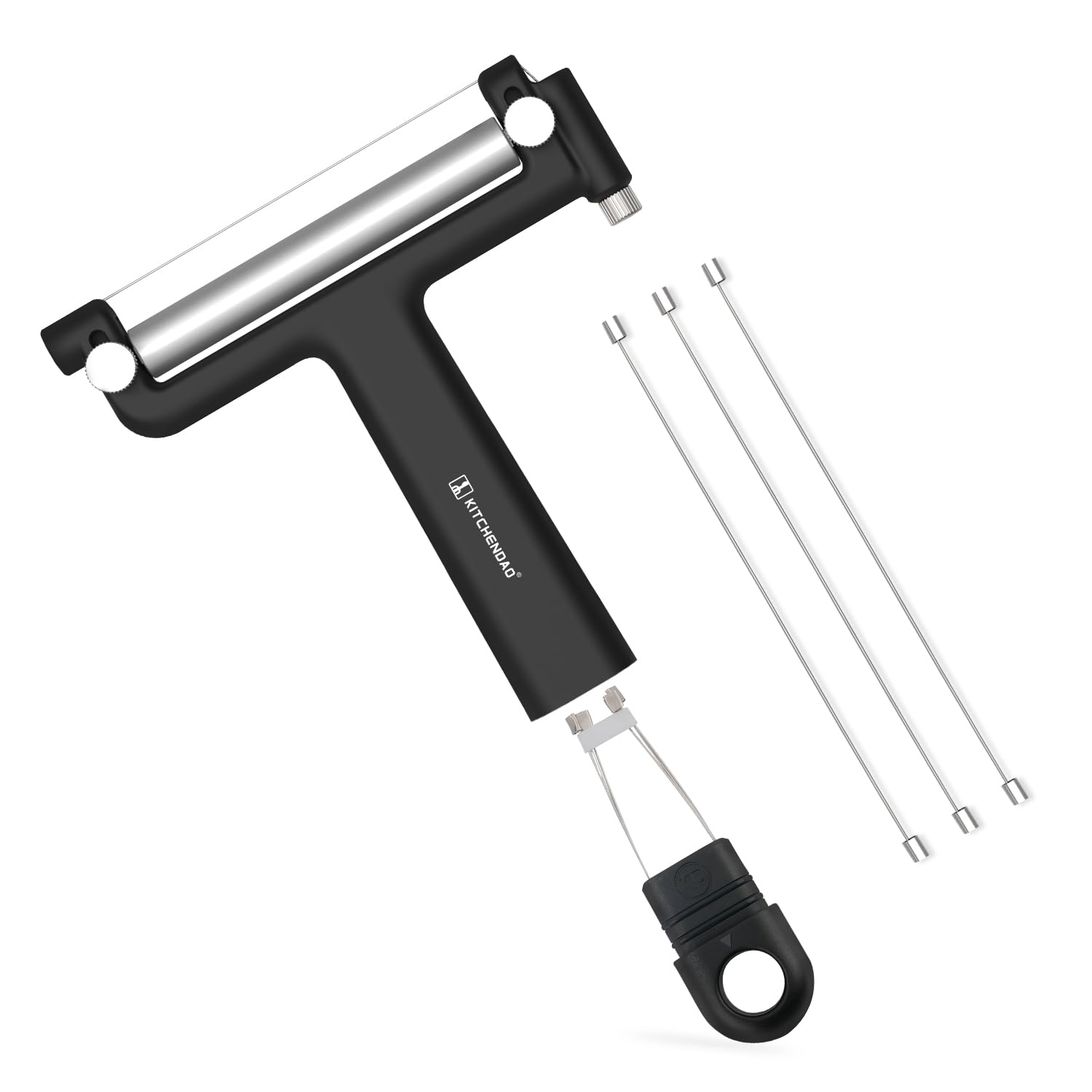
Three anchoring points instead of two sounds like marketing arithmetic until you watch the wire stay put on the third block in a row. The KITCHENDAO fixes its wire at three stress points and gives you a tension screw to take up slack, so the loop does not wander out of its slot halfway down a block. That is the failure this pick exists to prevent.
The adjustment is the practical kind. The wire slides to give anything from a shaving to a quarter-inch slab, the screw keeps it taut for a harder cheese, and the wire itself runs 3.75 inches. The aluminum frame is light enough to work through a pound without setting it down, which is more than we can say for the zinc-bodied slicers here.
The detail we did not expect to care about: three spare wires store inside the handle, out of sight, so a break does not mean digging through a utensil drawer or waiting on a delivery. The whole thing is dishwasher safe, and a wire swap is a thumb-and-turn job rather than a project.
Pros
- Wire held at three stress points
- Three spare wires stored in the handle
- Dishwasher safe aluminum frame
- Wire swaps in about a minute
Cons
- 3.75-inch wire caps slice width
If a slack, sagging wire is what ruined your last slicer, start here: the wire holds its tension, a screw takes up any slack, and three spares live in the handle.
Best for Slicing Whole Blocks
KITCHENDAO Wire Slicer with Board
Key Features
- Cleaning: Dishwasher safe
- Board size: 9.65 x 8.5 inches
- Spare wires: 2, in storage case
- Measuring grids: Yes
- Price: Premium
Measuring grids run along the board, so you set the block against a line, swing the wire arm through, and get the same thickness on the tenth slice as on the first. That repeatability is the case for a board-mounted cutter over a handheld one, and this is the most complete version of it in this set.
The stability is what changes the work. The block lies flat on a stainless surface and the arm pivots on a fixed path, so slices come out square instead of tapering toward one end, which is what happens when you are holding the slicer and the cheese at the same time. We think that matters most for anyone who cuts a whole pound on Sunday and eats it all week.
The wire has its own tension screws and swaps out in about a minute, and two spares ride in a small storage case so they do not vanish into a drawer. Stainless steel throughout, dishwasher safe, and heavy enough at 0.6 kg that it does not skate while you press down on the arm.
Pros
- Measuring grid keeps thickness repeatable
- Board holds the block flat and square
- Two spare wires in a storage case
- Dishwasher safe stainless steel
Cons
- Needs real drawer space at 9.65 by 8.5 inches
For slicing a whole block at once, this board-mounted cutter keeps the cheese still and the slice square, with a measuring grid and fast wire changes.
Best for Paper-Thin Shavings
BOSKA Monaco+ Cheese Slicer
Key Features
- Surface: Quilted non-stick
- Cleaning: Dishwasher safe
- Warranty: 10 years
- Blade material: Stainless steel
- Price: Midrange
Take our top pick, sharpen the blade, and emboss the face with a quilted pattern: that is roughly the Monaco+, and the pattern is not decoration. The raised diamonds break the contact between cheese and metal as a slice comes off, so it drops away instead of clinging and tearing at the last inch.
It is one piece of stainless with no moving parts, 120 grams in the hand, and it goes in the dishwasher. Boska backs it with a 10-year warranty, which is a fair signal of how the brand regards a blade with nothing on it to break.
Where it earns its place over the Copenhagen is the shaving itself: thinner, more even, and cleaner off the face, which is what you want over a salad or a bowl of pasta. Where it gives ground is thickness. This is a thin-slice tool by design, and if you want a quarter-inch slab for a grilled cheese, the wire slicers here do that better. We reach for the Monaco+ for serving, not for building sandwiches.
Pros
- Quilted non-stick face releases slices
- Very sharp, clean thin slices
- One-piece stainless, dishwasher safe
- 10-year warranty
Cons
- Costs more than our top pick
This is the plane we reach for when the slice has to be nearly see-through, and the quilted face keeps cheese from clinging to it on the way off.
Best for First-Time Buyers
TOPULORS Wire Cheese Slicer
Key Features
- Material: Zinc alloy and stainless steel
- Thickness: Adjustable wire
- Spare wire: 1 included
- Wire length: 3.9 inches
- Price: Budget
A zinc-alloy frame, a stainless wire, an adjustable thickness setting, and a spare wire, for less than anything else on this list. That is the pitch, and it mostly holds up.
In the hand it is heavier than the price suggests, at 6.4 ounces, with a short handle that puts your hand close to the block. The wire slides to set thickness, the frame is rated dishwasher safe as long as you dry it right away, and the whole thing is compact enough to live in a crowded drawer. Check the box when it arrives — the spare wire is part of the deal and it is the piece most worth having.
Our read is that this is the right first slicer for someone testing whether they will actually stop buying the pre-sliced stuff. It handles cheddar and jack without drama, and if it ends up at the back of a drawer, you are out the least money of anything here.
Pros
- Lowest price tier in the set
- Adjustable wire with a spare included
- Heavy zinc body at 6.4 ounces
- Dishwasher safe if dried promptly
Cons
- Wire can snap with steady use
- Handle runs short and heavy
The least expensive way to try an adjustable wire slicer, and it cuts better than the price suggests — just check the box for the spare wire.
Best for Soft and Semi-Soft
Westmark Wire Cheese Slicer

Key Features
- Material: Cast aluminum and stainless steel
- Warranty: 5 years
- Thickness: Set by slicing angle
- Wire length: 3.8 inches
- Price: Budget
Thickness here comes from your wrist, not a dial: hold the slicer flat for a thin slice, tilt it up for a thicker one, and the wire does the rest. It is the oldest trick in the category and it still works better than most of the gadgets that replaced it.
The frame is a cast aluminum handle with a stainless wire, 2.4 ounces in total and 7 inches long, which makes it the lightest full-size wire slicer here. Five years of warranty sit behind it, and there is nothing to disassemble: a rinse, a dry, back in the drawer.
It handles gouda, butterkäse, and mozzarella without tearing them and is just as happy on a young cheddar. What it does not give you is a measured quarter inch. The angle method is consistent once you have practiced it, and not before.
Our honest read is that it slices as cleanly as anything on this page and feels better in the hand than the zinc-bodied models, which is why it stayed in the roundup at all. It is the slicer for soft and semi-soft cheese and for anyone who learned on this shape.
Pros
- Thickness set by slicing angle
- Light 2.4-ounce frame
- Five-year warranty
- Rinses clean in seconds
Cons
- Wire can pull loose from the frame
- No spare wire included
Our pick for soft and semi-soft cheese: a light, beautifully made wire cutter whose thickness comes from your wrist rather than a slider.
Best for Heft and Looks
Zulay Kitchen Wire Cheese Slicer

Key Features
- Cleaning: Hand wash
- Blade width: 5.2 inches
- Spare wires: 2 included
- Thickness range: Paper-thin to 1/4 inch
- Price: Midrange
Pick this one up and the mass is the first thing you notice: 220 grams of cast zinc and aluminum with a polished finish that reads well beyond its price tier. It is the heaviest handheld slicer in this group, and that is either the appeal or the objection.
The roller is the widest of any handheld here at 5.2 inches, and the wire slides to give anything from a paper-thin shaving to a quarter inch. Two replacement wires ship in the box, which is the right call on a tool whose wire is the wear item.
On firm cheddar it takes more of a push than the KITCHENDAO or the Bellemain, and the slice can drag at the far edge if you hurry it. On semi-soft cheese — jack, muenster, fontina — it is clean and close to effortless.
If you like a light slicer, this is not the one; the weight is the whole point of it. It looks good enough to leave out on a board between courses, and the grip stays comfortable through a long session.
So it lands as a solid, good-looking cutter for the soft and semi-soft half of the cheese drawer, with two spares to keep it going and enough heft to feel like a tool rather than a gadget.
Pros
- Widest roller here at 5.2 inches
- Paper-thin to 1/4 inch adjustment
- Two replacement wires included
- Substantial 220-gram body
Cons
- Hand wash only
A handsome, substantial wire slicer with the widest roller here; it shines on semi-soft cheese and asks for a little patience on firm cheddar.
Best for Quick Tension Fixes
OXO Good Grips Wire Cheese Slicer

Key Features
- Tension: Adjustable thumb wheel
- Cleaning: Dishwasher safe
- Material: Die-cast zinc
- Spare wires: 2 included
- Price: Midrange
A wheel sits on the handle and takes up slack in the wire, which is the first feature we look for on any wire slicer. A loose wire turns a clean cut into a smear, and going slack is the usual way one of these tools stops being useful.
The body is die-cast zinc with a soft, non-slip handle, and two spare stainless wires come in the box. Thickness is set by the angle you hold it at, the same method as the Westmark, so thin and thick come from the wrist rather than a marked frame.
It is dishwasher safe, which puts it ahead of the zinc-bodied slicers that ask for hand washing, and the grip is the softest of the group. Nothing about it looks like a specialty tool, which in a kitchen drawer is a compliment.
Our take: it is the tension-wheel alternative to the KITCHENDAO, and the softer handle is the difference between the two. If you slice for a household every morning, the wheel is a thumb-and-turn rather than a search for a screwdriver.
Pros
- Thumb wheel tightens a loose wire
- Two spare stainless wires
- Soft non-slip handle
- Dishwasher safe die-cast zinc
Cons
The tension wheel on the handle is why this one is here: a thumb and a turn take up slack that would otherwise end a wire slicer’s useful life.
How We Chose and Tested Cheese Slicers
We started by gathering every wire slicer with a real following and sorting them three ways: how the thickness adjustment works, whether spare wires come in the box, and whether replacement wires can be ordered on their own. That last filter eliminated more contenders than anything else — a slicer with a proprietary wire and no way to buy a new one has a countdown clock on it. We ended up buying 14 models, handheld and board-mounted, and used them for four months.
Testing happened where cheese actually gets cut: weeknight grilled cheese, a block of parmesan for pasta, Sunday boards with company standing around, and cold cheddar straight out of the fridge, which is where flimsy frames give themselves away. Each slicer went through the same run — a two-pound block of medium cheddar, a soft mozzarella, and a hard wedge. We watched whether the wire tracked straight or wandered, whether the frame flexed under a firm press, and whether slices came out even across the full width of the block.
Adjustability got its own pass. We set each slicer to its thinnest and thickest positions, cut a stack, and laid the slices side by side to see whether the setting held or drifted as we worked through the block. We counted how many blocks each wire got through before it stretched or snapped, then timed a replacement with only the maker’s instructions in front of us. Dishwasher-safe models ran through repeated cycles, and we checked the wire-fixing hardware afterward for trapped cheese and corrosion. We also noted weight in the hand — a heavy slicer steadies the cut but tires your wrist by the end of a block, and a light one skates unless the grip is right.
How to Choose a Cheese Slicer
Two decisions do most of the work: how the slicer sets thickness, and what happens the day its wire goes slack.
Wire, plane, or board: pick the shape first
A handheld wire slicer is one hand on a frame and one hand on the cheese; thickness comes from a slider or from wrist angle, and the whole tool rinses in seconds. A cheese plane works the same way with a fixed blade instead of a wire, so the slice is thin by design and there is nothing to tension — our top pick is that style. A board-mounted cutter trades drawer space for stability and repeatability, which is the right call if you slice a block at a time rather than a sandwich at a time.
What adjustable thickness really buys you
Adjustable slicers run from paper-thin to about a quarter inch, and that is the useful range: an eighth of an inch stacks flat in a sandwich, a shaving melts over pasta, and anything thicker is a knife job. The trap is confusing thickness with width. The wire’s length sets the widest slice a frame can take — 3.75 inches on the KITCHENDAO handheld, 5.2 on the Zulay — so measure the blocks you actually buy before deciding a slicer is big enough.
Wire tension and the spare in the box
Every wire cutter here depends on a loop of steel holding tension, and every one of them will eventually lose it. What separates them is what you can do about it. A tension screw or thumb wheel lets you take up slack yourself, and anchoring the wire at three points resists the slack in the first place. Spares count just as much: three wires store inside the KITCHENDAO handle, two ship with the Bellemain, and a slicer with neither a spare nor an adjustment has a fixed working life.
Hand wash, dishwasher, and the finish
Most metal-bodied wire slicers are hand-wash items, and that is not brand laziness: detergent and heat dull a zinc-alloy frame and can loosen the wire’s grip. The dishwasher-safe picks here — our top pick, both KITCHENDAOs, the Monaco+, and the OXO — are the ones to choose if the slicer will live in a busy kitchen. Where a listing calls itself dishwasher safe and then asks you to dry it straight away, take the second half of that seriously.
Match the slicer to the cheese
A plane is the wrong tool for a crumbly blue and the right one for a firm cheddar. A wire cuts soft cheese cleanly as long as it is taut and smears it when it is not. Very dry, aged wheels crumble at the edge under any slicer, so plan on a knife for parmesan shards. Semi-hard is the sweet spot for everything on this list — gouda, cheddar, swiss, jack — and it is what most of us cut most often.
Frequently Asked Questions
Is a cheese slicer actually better than a sharp knife?
A knife is more versatile and easier to sharpen; a cheese cutter is better at one thing, which is taking an even thickness off a block. If your slices need to stack flat for sandwiches or a cheese board, the fixed geometry does what freehand cutting cannot. If you mostly crumble blue cheese or shave parmesan, keep the knife.
How thick should I set the slicer?
About an eighth of an inch for sandwiches, thinner for a board where the slices go onto crackers. Most adjustable wire slicers top out at a quarter inch — the Bellemain and the Zulay both run paper-thin to 1/4 inch — so a thick slab is a knife job, not a slicer job.
Why does my cheese crumble when I slice it?
Cold cheese is brittle. Let a block sit on the counter for 10 to 15 minutes before slicing, then use long, even pressure instead of a sawing motion; cheddar and gouda both cut noticeably cleaner at cool room temperature. Very dry aged cheese crumbles no matter what you do, which is why a plane leaves ragged edges on parmesan.
Final Verdict
Buy the BOSKA Copenhagen. It makes the thin, even slices most of us actually want, it goes in the dishwasher, it sits near the bottom of this group on price, and it has no wire to go slack on a Sunday morning. That combination is hard to beat at any price.
If you need two thicknesses from one tool, the Bellemain’s slider covers paper-thin to a quarter inch for a little more, and the KITCHENDAO board is the right call when you slice whole blocks at a time and want the grid to keep you honest.