This post contains affiliate links. We may earn a small commission when you buy through our links — at no extra cost to you.
Every camping stove is a trade-off between weight and stability. A palm-size canister burner boils water in three minutes and vanishes into a pack, right up until you set a full four-quart pot on it and spend breakfast with one hand on the handle. A two-burner suitcase stove will hold a griddle dead steady all weekend — and ask for its own seat in the car.
I’ve made that trade both ways for years, and over the past eight months my team and I have cooked on 12 stoves — ultralight canister burners, folding two-burner models, and one convertible we ran on both propane and butane — at picnic-table campsites, in a tailgate lot, at backcountry sites, and during a two-day power outage at home.
Two things I’d tell a first-time buyer: the push-button igniter is usually the first part to fail, so pack a lighter no matter what the box promises, and wind protection matters more than a big BTU number. The picks below are the ones I’d buy again, sorted by how you actually camp.


Best for Car Camping
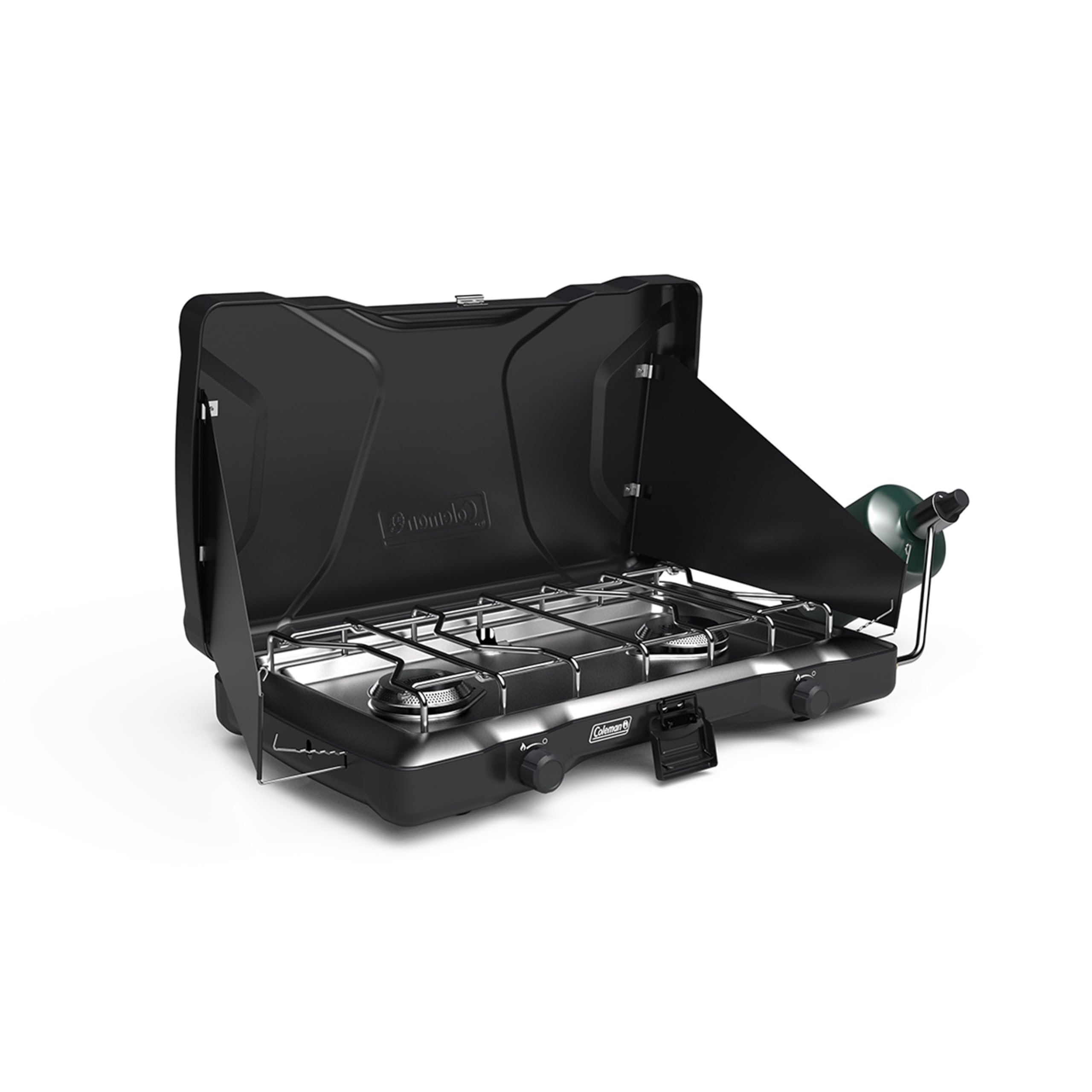
Coleman Triton 2-Burner Propane Stove
Key Features
- Weight: 5 lb
- Burners: 2
- Warranty: 3-year limited
- Total output: 22,000 BTU
- Price: Premium
Two burners inside a steel case that latches shut like a toolbox: that’s the Triton, and it’s the reason it’s our top pick. Set it on a picnic table, thread a 1-pound propane cylinder onto the regulator, and 22,000 BTUs split across two burners you control separately — a stockpot on the left, a skillet on the right, nothing shuffled back and forth while something scorches.
What we appreciate is how little the stove asks of you once it’s open. The two wind guards fold up around the burners and earn their keep on an exposed table, and the chrome grate lifts out in one piece, so last night’s bacon fat doesn’t become part of the stove. The knobs turn finely enough to hold a simmer instead of jumping from off to scorch, and the three-year limited warranty is longer than the one-year coverage the Gas One and both Jetboils list.
Weight is the honest trade-off. Five pounds plus a case the length of a suitcase means this is a stove you drive to; nobody is carrying it up a ridge. The grate is sized for real cookware, but two 12-inch skillets will jostle for the same space, so plan on one big pan and one medium one. Give the case and grate a look when the box arrives. Otherwise this is the stove that makes cooking at a campsite feel less like improvising.
Pros
- Two independent 22,000 BTU burners
- Folding wind guards and a latching case
- Removable chrome grate wipes clean
- Three-year limited warranty
Cons
- Five pounds — a car-camping stove, not a pack stove
- Two 12-inch pans crowd the grate
We point most campers here: two independently controlled burners, 22,000 BTUs, wind guards, and a steel case that latches shut like a toolbox — all backed by a three-year warranty.
Best for Budget All-Rounder
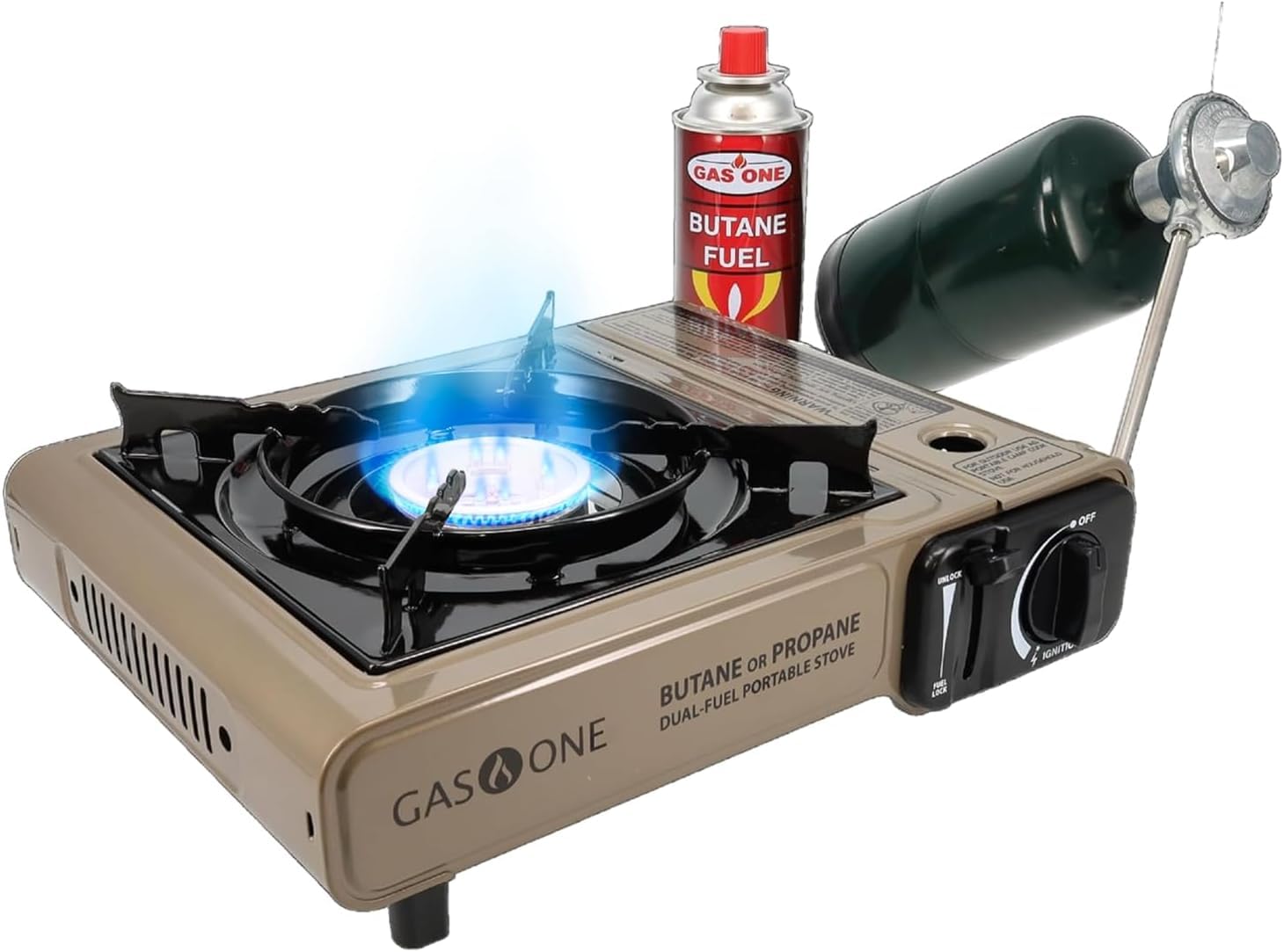
Gas One GS-3400P Dual Fuel Stove
Key Features
- Fuel: Butane or propane
- Weight: 3.1 lb
- Burners: 1
- Ignition: Piezo-electric
- Price: Budget
It’s the least expensive stove here, and the only one in the group that takes both an 8-ounce butane cartridge and a 16.4-ounce propane cylinder. That flexibility is why we keep one around: you can buy it before you know what your local store stocks, switch fuels without buying a second stove, and leave it in the garage for the night the power goes out.
The piezo ignition means no hunting for matches in the dark, and the butane side carries a pressure sensor that ejects the cartridge and cuts the gas if something goes wrong — safety hardware we’re glad to see on a stove at this price. It rides in its own case at 3.1 pounds, small enough to live in a tote with the rest of the camp kitchen, and it puts out enough heat to bring a big pot to a boil in cool weather.
Two things to know. The parts that give out on this stove are the propane line and the igniter, so treat the hose gently and pack a lighter as backup. And it’s a fair-weather machine on the butane side: butane pressure sags as the temperature heads toward freezing, which is exactly when the propane cylinder earns its place in the kit.
Pros
- Runs on butane cartridges or propane cylinders
- Piezo ignition with no matches needed
- Pressure sensor and gas cut-off on butane
Cons
- Propane line and igniter are the wear points
- Butane side fades in near-freezing weather
A cheap, genuinely useful single burner: it runs on butane or propane, lights with a piezo click, and travels in its own case — our pick if you want one stove that handles everything.
Best for Backpacking Boils
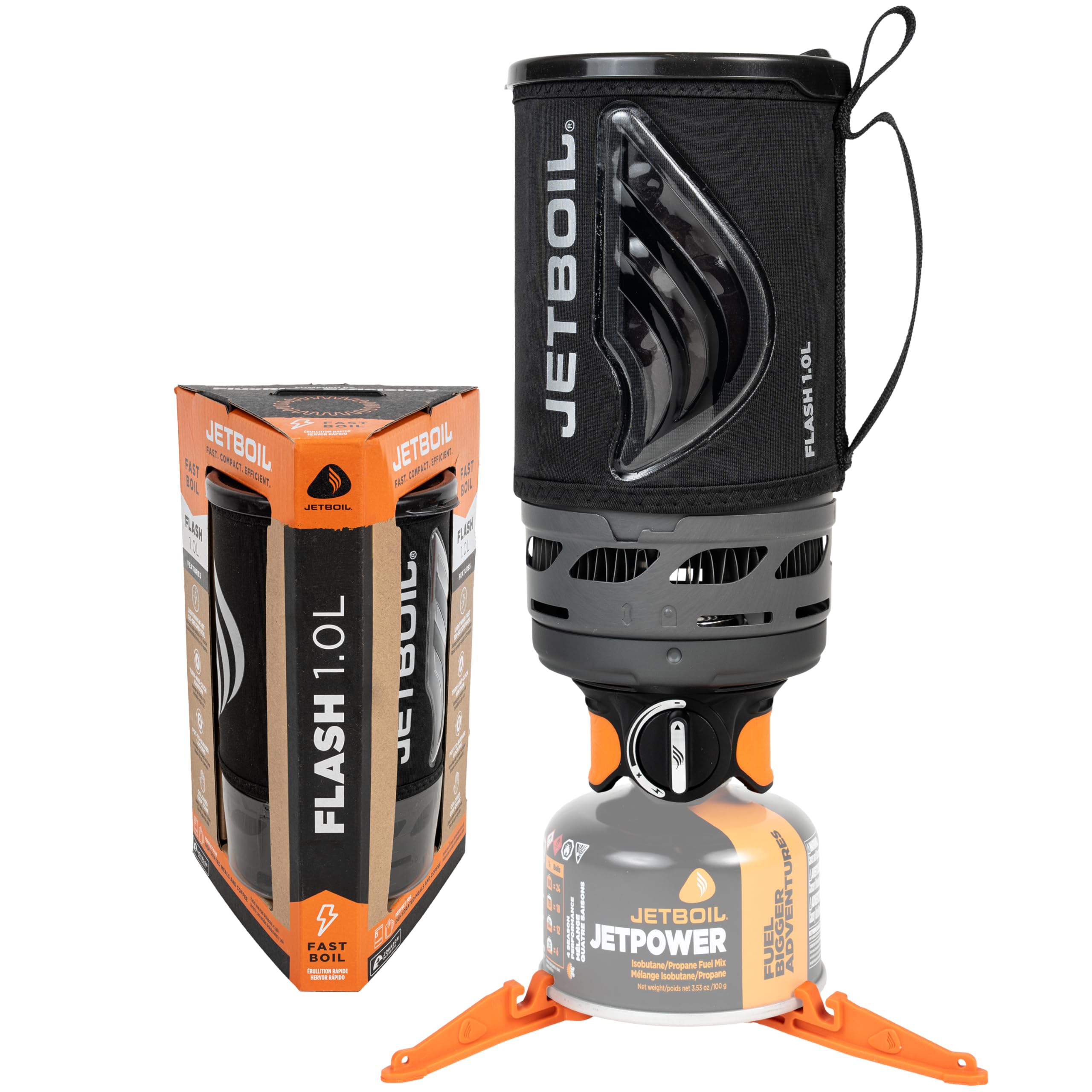
Jetboil Flash 1.0L Fast Boil Stove
Key Features
- Weight: 13.1 oz
- Capacity: 1.0 L pot
- Ignition: Turn-and-click auto
- Boil time: 16 oz in 2 min
- Price: Premium
Jetboil rates the Flash at two minutes for 16 ounces of water, and the whole design is aimed at that number: a fluxring pot that locks onto the burner at three points, an insulated cozy that keeps the heat in the cup, and a burner that dumps its output into the base of the pot instead of the air around it.
The turn-and-click ignition is the change we care about most, because it means no fumbling for a lighter with cold hands at 6 a.m. The color-coded rubberized zones stay cool enough to grab the pot while it’s still hot, and everything nests inside the 1-liter cup — burner, fuel stabilizer, lid, and a 100-gram canister you buy separately — so it goes into a pack as one lump instead of five loose parts.
It boils water. That’s the job, and it’s worth being blunt about it: dehydrated meals, coffee, oatmeal, all handled faster than any open burner in this group. A skillet of trout and potatoes is not what this is for. If you want one Jetboil that can also fry, the MightyMo below is the one to look at; if you want the fastest hot meal on a cold morning, this is it.
Pros
- 16 ounces boils in about two minutes
- Turn-and-click auto ignition, three locking points
- Everything nests into the 1-liter pot
Cons
- Fuel canister sold separately
- Built for water, not pan cooking
The Flash is for boiling water fast on the move, and it does that better than anything else here: turn the knob, click, and 16 ounces are rolling in about two minutes.
Best for One-Pot Cooking
Coleman Bottletop Propane Stove
Key Features
- Fuel: 1-lb propane cylinder
- Output: 10,000 BTU
- Burners: 1
- Pan size: Fits 8-inch pan
- Price: Midrange
There’s no base, no legs, and no hose: the Bottletop threads straight onto a 1-pound propane cylinder, and the cylinder becomes the stand. That sounds like a gimmick until you’ve set one down on ground that isn’t level — the weight sits at the bottom, the pot sits low over the flame, and the whole assembly takes up less trunk room than a shoebox.
We like it for trips where cooking means one pot and a mug. The 10,000 BTU burner is fed through a pressure regulator, so it holds a steady flame as the cylinder cools, and the wind baffles wrap closely enough around the burner to keep a boil going on a breezy morning. The grate takes an 8-inch pan, which is the right size for two people and a one-pot dinner.
Two caveats. There’s no igniter, so bring a lighter or matches; apart from that it’s a one-motion setup. And once a 1-pound cylinder is attached it’s an awkward shape to wedge into a pack — this is a car-camping stove that happens to be small, not a backpacking stove.
Pros
- Screws onto the cylinder — no hose or legs
- Pressure regulator holds a steady flame
- Wind baffles around the burner
Cons
- No built-in igniter — bring a lighter
- Cylinder mount is bulky in a pack
We keep a Bottletop in the truck because it needs no table, no legs, and no hose — just a 1-pound cylinder, a lighter, and whatever pot is in the bin.
Best for Ultralight Cooking
Jetboil MightyMo Camping Stove
Key Features
- Output: 2,900 W
- Weight: 3.36 oz
- Ignition: Pushbutton
- Cold rating: Regulated to 20°F
- Price: Midrange
3.36 ounces is the entire stove — burner, valve, folding arms, igniter — and that figure is why it lives in a top pocket instead of a stuff sack. What makes it more than a weight exercise is the four-turn regulator: you can walk the flame down to a genuine simmer instead of choosing between off and inferno, which is how a canister stove turns into something you cook on rather than boil water with.
Jetboil regulates it down to 20 degrees Fahrenheit, so a cold morning doesn’t turn the fuel canister into a paperweight, and the pushbutton igniter saves the usual pat-down for a lighter. The open platform takes a 10-inch skillet or a Jetboil pot without a separate pot support, more than most stoves this light will do. Rated at 2,900 watts, it reaches a rolling boil in roughly three minutes.
What it doesn’t have is a wind break. On an exposed ridge or an open beach the flame is vulnerable and there’s no built-in screen to save it, so pick a sheltered spot behind a rock or a pack. Fuel is sold separately here too, as it is with both Jetboils on this list.
Pros
- 3.36 ounces with a pushbutton igniter
- Four-turn regulator goes from simmer to full boil
- Open platform takes a 10-inch skillet
Cons
- No wind break for the burner
Light enough for a summit pack and smooth enough to actually cook on, the MightyMo is the ultralight stove we hand people who don’t want to live on freeze-dried dinners.
Best for Budget Two-Burner
ODSD 2-Burner Folding Camp Stove

Key Features
- Weight: 3.98 lb
- Burners: 2
- Packed size: 10.63 × 9.06 × 5.12 in
- Total output: 20,000 BTU
- Price: Midrange
Two grates, a griddle, a gas pipe, and a bag arrive in the box, and the stove folds to 10.63 by 9.06 by 5.12 inches at just under four pounds. A magnetic catch holds the halves together in transit, which is a small thing that makes pulling it out of a full car noticeably less annoying.
The two burners make 20,000 BTUs between them and adjust independently, and a windshield panel shields the flames from the side. Output isn’t the limitation — a 3-quart pot gets to a boil without a long wait on either burner — and having a griddle in the bag means breakfast isn’t oatmeal again.
Stability is the part to check. The burners are small relative to the frame, so a wide skillet overhangs its support, and the windshield panel doesn’t reliably stay upright in a stiff crosswind. As a second stove for a family camp it earns its keep; it isn’t the one to buy if you cook in one enormous pan every night.
Pros
- Two independently adjustable 20,000 BTU burners
- Folds to 10.63 by 9.06 by 5.12 inches
- Griddle and carry bag included
Cons
- Small burners let a wide pan overhang
- Windshield won’t always stand up in wind
Two burners, a griddle, and a carry bag — we recommend it to anyone feeding a family at a campsite who doesn’t want to pay premium prices for the privilege.
How We Tested 12 Camping Stoves
We started with every stove a real camper might buy, then filtered by fuel type, burner count, packed weight, and price until the shortlist covered the whole category instead of one shelf of it. Twelve made the cut, and testing ran eight months across campground picnic tables, backcountry sites, a tailgate lot, and a few power-outage evenings at home.
Ignition got tested hardest. I lit each stove twenty times in calm air and twenty more in wind, counting clicks and noting how many needed a match. On gusty mornings I set them up fully exposed and timed how long a burner took to catch and stay lit, with the wind guards on and off. For stability, I filled a four-quart pot and a 10-inch cast-iron skillet, set each on the burner, and gave it a deliberate nudge to see whether the pot supports flexed or the legs skated.
Portability is where the marketing and the reality split. I weighed every stove packed in its own bag, carried it a quarter mile from the car by its handle, and loaded it into a 40-liter pack to see if it fit next to everything else. I latched each lid one-handed, checked whether the handle stayed cool after twenty minutes of boiling, and turned every valve as low as it would go to see whether it held a simmer or just ran hot.
The rest happened over eight months of ordinary use: stoves lived in a truck bed, got rained on, dropped, and packed away greasy. I logged rust, bent legs, and clogged burner ports, then weighed fuel per liter boiled against what each stove costs to own. One convertible ran on butane one cold morning and propane the next, which told us more about dual-fuel claims than any spec sheet.
How to Choose a Camping Stove
The first decision isn’t BTUs — it’s whether the stove has to fit in a pack, because that one answer eliminates most of this category before you look at anything else.
Start With the Trip, Not the BTU Rating
A stove that rides in a backpack and a stove that rides in a trunk are different machines. Pack stoves are built around a canister and measured in ounces: the MightyMo is 3.36 ounces, and the Flash is 13.12 ounces with its pot. A car-camping camp cooktop can weigh five pounds and open into two burners, which is exactly what you want when dinner for four is the evening’s entertainment. Be honest about the trip you take most and buy for that one. If you do both, buy two — a cheap canister burner and a two-burner cost less together than one stove that is mediocre at both.
Pick a Fuel You Can Actually Buy
Three fuels cover this category: 8-ounce butane cartridges, 1-pound propane cylinders, and isobutane-propane canisters for pack stoves. Butane is inexpensive and easy to find in cities, but its pressure falls off as the temperature drops toward freezing, which turns a roaring burner into a lazy one on a cold morning. Propane and the iso-propane mixes keep working. If you camp in shoulder seasons, buy the propane side of the shelf — or a dual-fuel stove like the Gas One, which lets you decide at the register instead of committing in advance.
Wind Protection and a Real Simmer Beat Peak Output
A 22,000 BTU burner you can’t turn down will burn the onions, and a 10,000 BTU burner with no shield won’t hold a boil on a breezy afternoon. Two separate features decide this: a valve with a fine low end, and something physical between the flame and the wind — folding guards on a two-burner, baffles wrapped around a bottletop burner, or a screen you bring yourself. The MightyMo has the best low-flame control in this group and no wind protection at all, which is a good reminder to check for both rather than trusting one number.
Check What the Pot Sits On
Pot support spacing decides which pans you can actually use. The Coleman bottletop is built around an 8-inch pan; the Triton’s grate takes two full-size pans but crowds two 12-inch skillets into the same space. Folding two-burners often pair a wide frame with small burners, so a big skillet overhangs its support and tips when you stir. Set your widest pan on the grate before you commit, and think about a full pot rather than an empty one — a quart of chili shifts weight in a way an empty saucepan never does.
Budget for the First Season, Not Just the Stove
Fuel is rarely included, and it’s the cost that keeps coming. Add a cylinder or two, a lighter, and a case to the first order if the stove doesn’t ship with one. A 1-pound propane cylinder holds roughly 21,000 BTUs, so a two-burner running flat out drains one in about an hour, while simmering stretches it across several meals. Pack stoves work the other way: a 100-gram canister covers a weekend of boiling water, but costs more per meal than a 1-pound cylinder — which is the real reason car campers put up with the weight.
Frequently Asked Questions
Can I use a camping stove inside a tent or garage?
No. Every stove here is an outdoor appliance that produces carbon monoxide, and the butane tabletops are labeled for outdoor use only. A tent, a closed garage, or a porch with the flaps down is the wrong place for one — the danger isn’t the flame you can see, it’s the gas you can’t. Cook outside. If the weather is genuinely awful, eat cold and save the hot meal for morning.
How much fuel do I need for a weekend?
For a two-burner, plan on a 1-pound propane cylinder per two days of real cooking. A cylinder holds roughly 21,000 BTUs, and two burners wide open will drain one in about an hour, so simmering is what buys you the second day. For a pack stove, a 100-gram canister covers a weekend of boiling water for one person. Bring a spare either way.
Does a camp stove need any maintenance?
Less than you’d think, and more than most people do. Wipe the grate while it’s still warm, and at the start of the season check the burner ports and air inlet — insects nest in burner tubes over the winter, and a blocked port burns yellow and weak. Store the stove with the canister off, and check the seal where the fuel connects before your first trip each year.
Final Verdict
The Coleman Triton is the stove we recommend to most people, because most people drive to camp and cook more than one thing at a time: two burners, wind guards, a grate that lifts out for cleaning, and three years of warranty for less than the Jetboil Flash costs.
If the stove has to go in a pack, the answer changes. Take the Flash for boiling water and nothing else, or the MightyMo if you plan to actually cook — 3.36 ounces, a four-turn regulator, and no wind break to speak of.