This post contains affiliate links. We may earn a small commission when you buy through our links — at no extra cost to you.
The coldest morning of tailgate season is a bad time to find out your stove’s flame can’t handle a breeze. A butane stove has one job — put a hot, controllable flame under a pot — and it does it in a parking lot, a campsite, or on your counter when the power is out. What separates a good one from a frustrating one is rarely the headline number; it’s whether the canister locks in without a fight and whether the wind guard truly blocks wind.
Simmer control matters more than raw heat. Most of these will boil water quickly; fewer will hold a low flame long enough to finish rice without scorching it. Plenty also run on propane with an adapter hose, which is worth knowing before you go hunting for butane on a holiday weekend. We’ve cooked on 14 of them over the past six months, and the gaps showed up fast.
The picks below cover tailgaters, backpackers, and anyone who wants a backup burner in the closet. None replaces a full range, but the good ones come close on a weeknight.




Best for Camping and Outages
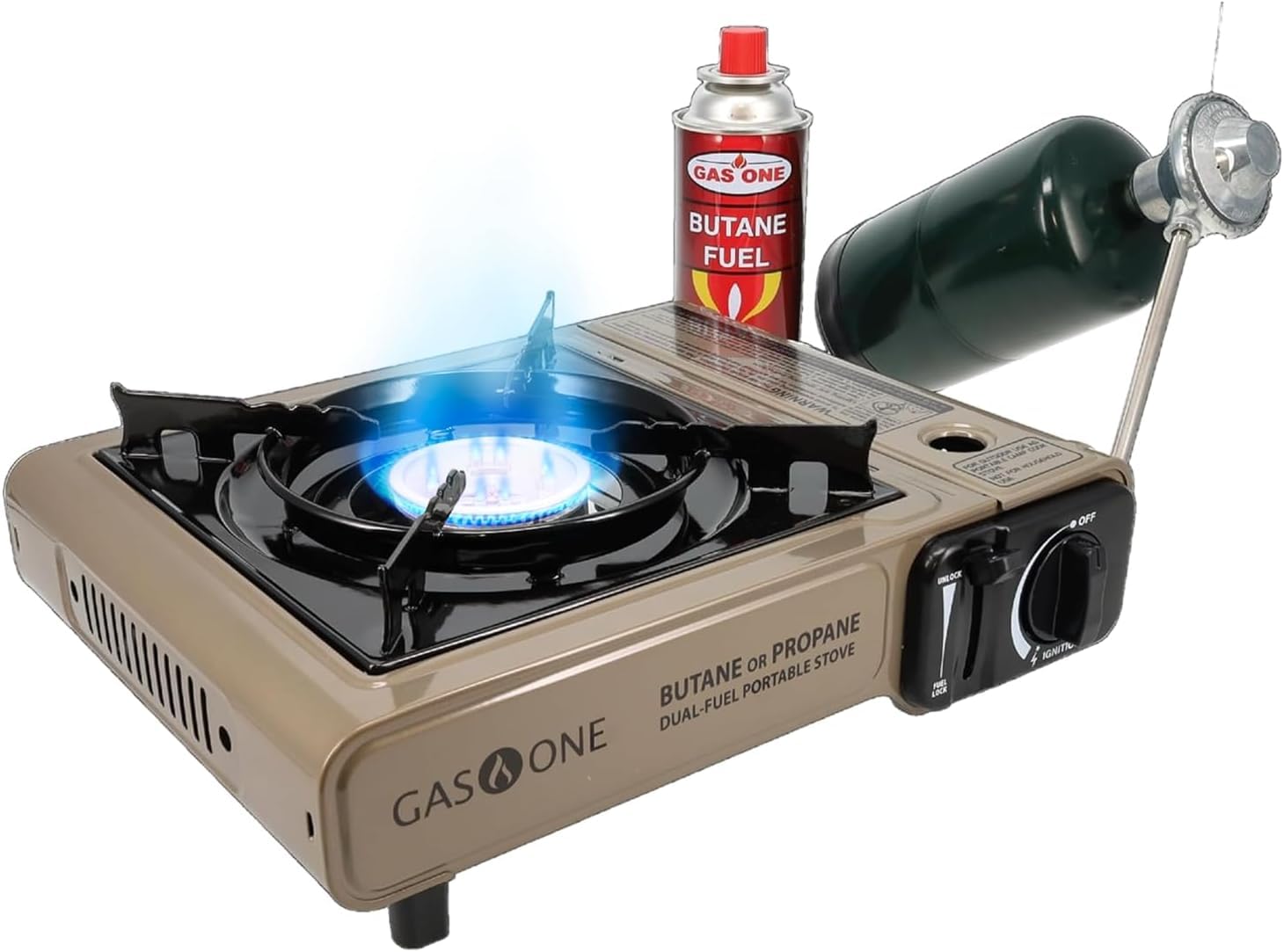
Gas One GS-3400P
Key Features
- Fuel: Butane or propane
- Weight: 3.1 lb
- Warranty: 1 year
- Packed size: 13.5 x 11 x 4.45 in
- Price: Budget
The switch that matters is the fuel. A butane cartridge clips in for a tabletop breakfast; a 16.4-ounce propane cylinder screws on when the morning is cold or you want cheaper fuel. That is why this is our top pick: butane sags as the temperature drops toward freezing and propane doesn’t, so one stove covers a July picnic and a January outage without a second purchase.
It cooks like a real burner, too. There is enough output to take a stockpot to a rolling boil and enough travel on the dial to hold a simmer without scorching the bottom, and the pan supports sit close enough that a breeze across a picnic table doesn’t push the flame off the pot. The piezo clicker has lit on the first or second press every time we’ve used it.
We also appreciate the safety hardware at this price: a pressure sensor that ejects the cartridge and cuts the gas if something goes wrong at the seal. Packed, it’s 3.1 pounds and 13.5 inches long, so it lives in its case beside the camp box rather than in a backpack.
Between arriving and eating there is very little to do — set it down, latch a cartridge, click, cook. Only the folding Big Horn here gets you to a flame faster, and it gives up propane to do it.
Pros
- Runs on butane or propane cartridges
- Strong heat with a usable simmer dial
- Pressure-sensing cartridge ejection
- 3.1 pounds with a carrying case
Cons
- Propane line and igniter are the weak points
- Only one year of warranty coverage
Our default pick: it runs on a butane cartridge or a propane bottle, so a cold morning doesn’t stall breakfast. Buy it unless you need a smaller stove to pack.
Best for First-Time Buyers
JoChef Portable Butane Stove
Key Features
- Fuel: Butane
- Weight: 3.1 lb
- Warranty: 3 years
- Packed size: 13.3 x 10 x 3 in
- Price: Budget
Three years of warranty is the longest coverage in this guide, matched only by the Coleman, and it’s the reason this stove sits near the top of our list. Pair that with CSA certification and a safety lock that keeps the canister from seating unless the lever is fully engaged, and you have the stove that answers the trust question before anyone asks it.
First-timers get the most out of it, in our view. The brass burner lights on one click, the dial has real travel between a whisper of a simmer and a hard boil, and the hard case swallows the stove, a spare canister, and a lighter without bulging. Set the windshield before you light and even a picky cook stops watching the flame.
At 3.1 pounds and three inches tall packed, it slides behind a seat or stands on edge in a cupboard. The windshield is the one part that feels cheap — it clips on loosely and rattles until the stove is set down — but seat it first and the flame stays put in a breeze.
Pros
- Three-year warranty and CSA certification
- Brass burner lights on the first click
- Hard case included, 3 inches packed
- Windshield keeps the flame steady
Cons
- Butane only, with no propane option
The best coverage in this guide: CSA certified and warranted for three years, with a brass burner that lights on the first click and holds a low simmer.
Best for Easy Cleanup
Coleman Classic 1-Burner
Key Features
- Grate: Removable porcelain-coated
- Ignition: Instastart matchless
- Warranty: 3 years
- Heat output: 7,650 BTU
- Price: Midrange
The grate is the reason to buy this one. It lifts off in a single piece, and the porcelain coating means last night’s bacon fat comes away with a paper towel instead of a scrubbing pad — a small thing until you’re cleaning a riveted grate at a picnic table with cold water.
Underneath sits a 7,650 BTU burner with Coleman’s Instastart ignition, which fires without matches and without the long click-click-click some piezo systems need. That’s the middle of the pack on output here: fine for a skillet of eggs, a pot of chili, or a kettle, and not the stove for searing a steak or driving a wok.
The base is wide enough to hold a 10-inch cast-iron pan steady while you stir, which the folding stoves can’t manage. It’s also the tallest of these packed at 6.5 inches — fine under a truck bench seat, awkward in a kitchen drawer.
Pros
- Removable porcelain grate wipes clean
- Wide base steadies a cast-iron skillet
- Three-year limited warranty
- Matchless Instastart ignition
Cons
- Carry case cracks with hard use
Our pick for greasy cooking: the porcelain grate lifts off for the sink and the base holds a cast-iron skillet steady, which makes it the easiest of these to live with.
Best for High-Heat Cooking
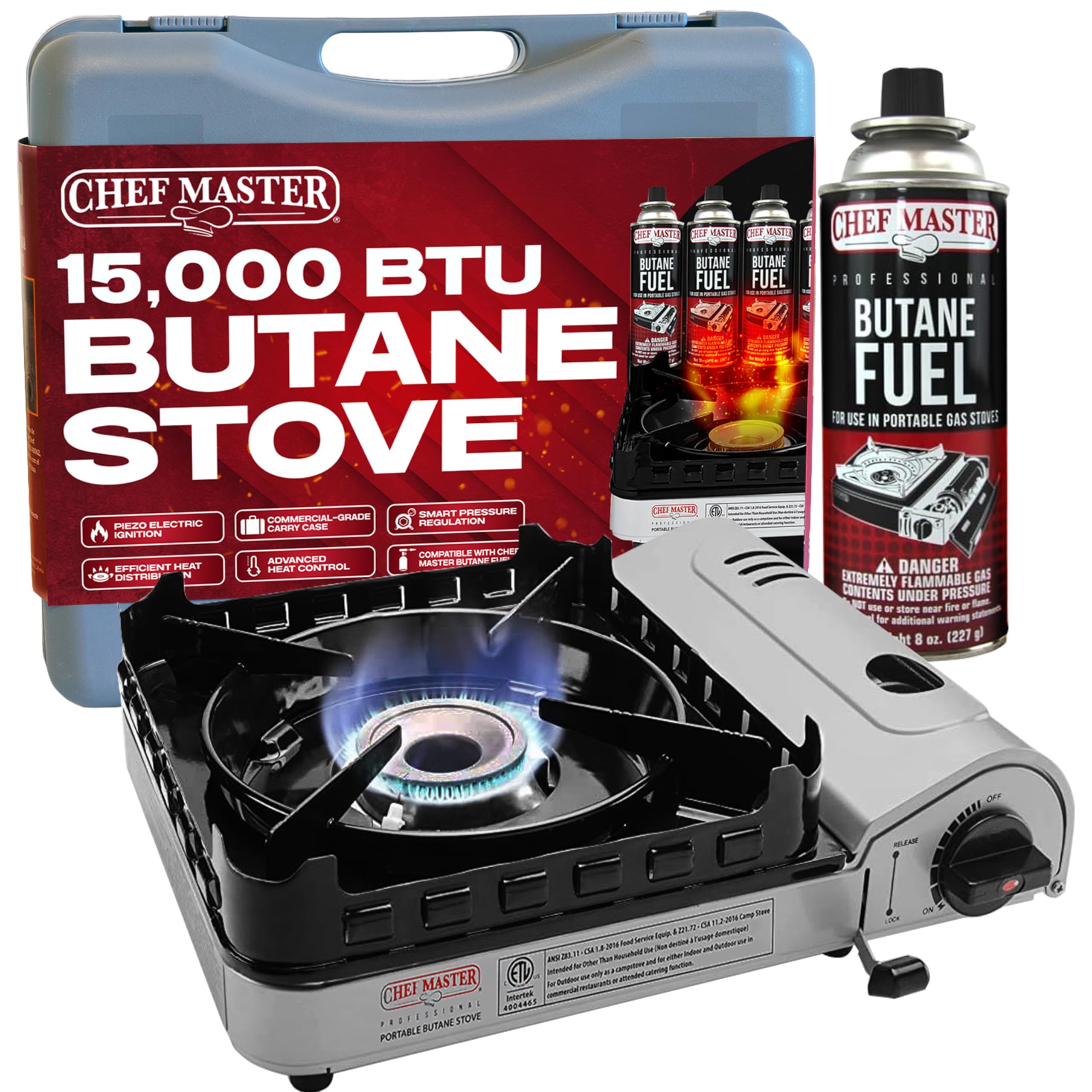
Chef Master 90019
Key Features
- Fuel: Butane
- Heat output: 15,000 BTU
- Packed size: 13.2 x 11.2 x 4.5 in
- Wind protection: Double wind guard
- Price: Premium
Fifteen thousand BTU is close to double what the Coleman puts out, and it changes what you can cook: a wok that sears instead of steams, oil that stays hot through a second batch, a stockpot that comes to a boil while you’re still chopping. We think that output is worth paying for when high heat is the whole point of the stove for you.
The hardware around the burner is set up for open air. A double wind guard wraps the flame, an in-line regulator feeds it evenly as the canister chills, and a pressure-sensing shut-off plus a canister lock cover the safety side. The hard-shell case comes in the box.
Packed, it’s 13.2 inches long and 4.5 inches tall — a tailgate-size stove, not a backpack one. The 15,000 BTU burner is the entire argument, and it keeps that heat when the pot is full and the table is in the wind.
Pros
- 15,000 BTU, the highest here
- Double wind guard around the flame
- Regulator plus pressure-sensing shut-off
- Hard-shell case included
Cons
- Grate and case feel thin for the price
- Igniter is the part to watch
The most powerful stove here, and the one we point to for wok cooking and big pots. Its double wind guard earns its keep on an open tailgate.
Best for Solo Cooking
Iwatani Tough Maru Jr.
Key Features
- Fuel: Butane cassette
- Weight: 3.5 lb
- Packed size: 11.3 x 7.6 x 4.8 in
- Wind protection: Double windproof
- Price: Premium
It’s the priciest stove in this guide and one of the smallest — 11.3 inches long, 7.6 wide — which sounds like a contradiction until you pick it up. The body is die-cast aluminum, the lid closes with a real click, and nothing rattles when you shake it.
Two windproof panels fold around the burner, and the flame stays where you put it with a breeze crossing the table. It also holds steady as the canister chills and pressure drops, which is exactly when cheaper stoves start to fade.
The burner is small on purpose, and that is the trade we keep coming back to. It behaves like the small burner on a home range: rice, a one-pan breakfast, a kettle, a simmering sauce — not a stockpot or a wok. For one or two people it’s a lovely thing to cook on; for a crowd it’s the wrong stove, and the Chef Master delivers far more heat for less money.
The case is dedicated rather than generic, which matters more than it sounds: the stove drops in, the lid closes, and there’s no strap to fiddle with at the end of a wet morning. Of everything here, it’s the one that feels most like a tool rather than an accessory.
Pros
- Smallest footprint in this guide
- Die-cast body with double windproofing
- Steady flame as the canister chills
- Dedicated hard carrying case
Cons
- Premium price for a butane-only stove
- Dense at 3.5 pounds for its size
The premium choice for solo cooking: the smallest, most solidly built stove here, and worth the money if it lives in a go-bag.
Best for Tight Storage
Big Horn Outdoors Folding Stove
Key Features
- Ignition: One-touch piezo
- Folded size: 10.8 x 3.15 x 4.13 in
- Heat output: 7,500 BTU
- Certification: SGS
- Price: Budget
Most stoves here are a metal box with a lid. This one folds into itself like a bucket — 10.8 inches long and about three inches thick collapsed — so it disappears into a drawer, a tote, or the gap behind a car seat. Ours came in pink, which is either why you’ll buy it or why you won’t; the finish has survived a season of being shoved into a bag.
Folded out, it’s steady in a way budget stoves usually aren’t. The trivet is cast iron, the feet have non-slip pads, and a heavy skillet sits flat instead of rocking on wire arms. The one-touch piezo lights it, and 7,500 BTU is honest for a stove this size: a quart of water, a couple of burgers, a pan of eggs.
We keep coming back to how little room it takes for how planted it feels. Next to the bigger stoves it gives up burner diameter, but as a second stove, a first stove for a small car, or the thing you keep in a closet for an outage, it’s the value pick of this group.
Pros
- Folds to 3.15 inches thick
- Cast-iron trivet holds a heavy pan
- 7,500 BTU with one-touch ignition
- SGS certified for North America
Cons
- Needs a wind screen in even a light breeze
The budget pick and the only folding stove here: it collapses to about three inches thick and held a cast-iron skillet without a wobble.
Best for One-Box Setup
National Standard Portable Stove

Key Features
- Ignition: Piezo
- In the box: Stove, case, 4 canisters
- Heat output: 7,000 BTU
- Packed size: 13.4 x 11 x 3.2 in
- Price: Midrange
Four eight-ounce canisters arrive with the stove and its hard case, which means it’s genuinely usable the day it lands — no separate fuel order, no first run to the store. For a first setup, or an emergency kit you’re building in one go, that bundle is the reason to look here.
The stove itself is a straightforward single burner: piezo ignition, a heat dial beside it, a wind guard around the head, and a brass burner. Packed it’s 13.4 by 11 by 3.2 inches, slim enough to stand on edge on a closet shelf.
Its listing shelves it with backpacking gear, and that’s worth ignoring. At 13.4 inches long with a steel case, this is a tabletop stove for a picnic table, a tailgate, or a counter during a storm — not something anyone carries up a trail. Judge it on car-camping terms and it makes sense.
The 7,000 BTU burner is the mildest of the stoves here that publish a number, so plan on coffee, eggs, and a pot of soup rather than a big boil. As a complete box you open once and keep for years, we rate it the easiest entry point in this guide.
Pros
- Four butane canisters included
- Hard-shell case with a wind guard
- Slim 3.2-inch packed height
- Piezo ignition, no matches
Cons
- 7,000 BTU is modest for large pots
The simplest way to buy a first setup: stove, hard case, and four canisters in one box, with a 7,000 BTU burner that handles the basics.
Best for Griddle Cooking
Gospowor Dual Fuel Stove

Key Features
- Fuel: Butane or propane
- Weight: 3.5 lb
- Heat output: 10,000 BTU
- Packed size: 13 x 12 x 3.5 in
- Price: Midrange
A griddle, an adapter hose, a windblocker, and a storage bag come with the stove, which makes this the closest thing here to a single purchase that covers a whole tailgate. The griddle is the piece we ended up using most — flatbreads, bacon, a pile of onions — and it turns one burner into two cooking surfaces.
The stove is dual fuel: an eight-ounce butane cartridge clips underneath, or a one-pound propane cylinder feeds it through the hose. Output is 10,000 BTU, the frame is ceramic-coated and detaches for cleaning, and the safety package includes overpressure protection and a canister lock.
The burner plate is the limitation. It’s small enough that a 10-inch skillet overhangs the edge, and a heavy pot can sit off-center unless you set it down deliberately — fine for a saucepan or the griddle, irritating with a full stockpot.
Our read: you’re buying the accessories, not the burner. The Gas One’s simpler body is the one we reach for when the cooking matters, but this is the bundle that makes sense if a griddle and a propane hose are already on your list.
Pros
- Griddle, hose, windblocker, and bag included
- Dual fuel at 10,000 BTU
- Detachable ceramic-coated frame
- Overpressure protection and canister lock
Cons
- Feet don’t grip on uneven ground
The most complete kit here: dual fuel, a griddle, a windblocker, and an adapter hose, for anyone who wants one purchase to cover a whole tailgate.
How We Tested the Best Butane Stoves
I started with stoves that accept a standard 8-ounce butane canister, then filtered by certification, burner material, included accessories, and price — paying more should buy something you can point to. That left 14 models, which I handed off to my team. For six months, each one lived where its buyer would put it: a truck bed, a camp bin, a kitchen drawer.
Testing happened where these stoves actually get used: a tailgate lot on a 40-degree morning, a lakeside campsite with a steady crosswind, a park picnic table, and my kitchen counter through a two-day outage. We timed how long each took to bring a quart of water to a rolling boil, then repeated it behind a box fan on high to see whether the wind guard earned its place. Then we turned every knob down to its lowest setting and tried to hold a bare simmer on a pot of rice without scorching the bottom.
Sturdiness got its own pass: we set a cast-iron Dutch oven on each grate and pressed one edge of the pot to watch how much the legs and grate flexed. We clicked each ignition twenty times, seated and unseated canisters in the dark, and noted which stoves shut off the gas when a canister went in wrong. Portability came down to bag-to-lit time, packed weight, and whether the carry case survived being tossed in the back of a pickup. Durability announced itself over the months: hinges that loosened, porcelain that flaked off a grate, a knob that stopped at half a turn.
Value, finally, was about what came in the box — a case, an adapter hose, a griddle, a spare grate. A stove that includes the hose you’d otherwise buy separately is the cheaper stove.
How to Choose a Butane Stove
The stove is the cheap part. The fuel, the wind, and the width of your pans decide whether you’ll actually enjoy cooking on it.
Dual fuel or butane only
Butane lives in the canister as a liquid and turns to gas more slowly as the temperature falls, so a butane-only burner that roars in July gets soft on a frosty morning. A dual-fuel camp stove accepts either an eight-ounce butane cartridge or a 16.4-ounce propane cylinder, and propane keeps its pressure when butane does not.
That flexibility is why our top pick is dual fuel. If your stove only ever sits on a patio in summer, butane alone is simpler, lighter, and perfectly fine. If you camp in shoulder seasons or keep a stove for power outages, pay for the second fuel.
Match the burner to your pans
A burner head narrower than your cookware wastes heat around the edges and gives a heavy pan a small ledge to balance on. The Chef Master 90019 is sized for pans up to about 10 inches; the Gospowor’s plate is small enough that a wide skillet overhangs it.
Set your widest pan on the trivet before you commit. Cast iron needs the most support, and a folding stove with thin wire arms is the wrong place to balance a 12-inch skillet full of chili.
Heat output isn’t the whole story
The numbers here run from 7,000 to 15,000 BTU, and the biggest burner is not automatically the fastest dinner. A 15,000 BTU head with no wind guard loses to a 7,500 BTU head behind a good shield on a breezy tailgate, because most of the heat you paid for blows past the pot.
Buy a stove with a wind guard or a windshield, and treat a folding screen as part of the kit. If you cook in the open, that shield will matter more than the extra burner output.
Look for a certification and a shut-off
A listing mark from CSA, UL, or SGS tells you the stove was tested to a published standard, and a pressure-sensing shut-off or a cartridge lock adds a second layer: the gas stops if the canister pressure goes wrong or the can isn’t seated.
Check both before you buy, then check them again at the table. If a canister doesn’t seat with a firm, unmistakable click, don’t cook on it — reseat it or swap it for another can.
What portable actually means
Every stove here is portable the way a suitcase is portable. A typical one is about 13 inches long and three pounds, which fits a car trunk, a tailgate bin, or a closet shelf, and none of them belongs in a backpack.
Measure the spot where it will live before you choose. If the answer is a kitchen drawer, the Big Horn folds to roughly three inches thick; if it’s the bed of a truck, packed height barely matters and you can choose on cooking instead.
Frequently Asked Questions
Can you use a butane stove indoors?
It depends on the stove and the room. Any gas flame produces carbon monoxide, and several models here are sold for outdoor use only, so a kitchen counter needs a running range hood or an open window, and a tent, car, or closed camper is out entirely.
Read the listing’s use statement before you buy, and shut the burner off as soon as the cooking is done rather than leaving it on for warmth.
Do you have to take the canister off after every use?
Yes, and it’s the habit that keeps these stoves working. A connected canister keeps both its own seal and the stove’s valve under pressure, and a can left in a hot trunk has nowhere to vent.
Pop it out, cap it, stand it upright, and store spares somewhere that doesn’t bake in the sun. The stove also packs flatter with the bay empty.
Can you run one of these off a 20-pound propane tank?
Only if the stove is dual fuel. Butane-only models have no propane fitting and can’t be converted; the dual-fuel stoves here take a 16.4-ounce cylinder directly, and a bulk tank needs an adapter hose between tank and stove.
Search the listing for dual fuel before you plan on a big tank, because no accessory turns a butane-only burner into a propane one.
Final Verdict
If you want one answer, take the Gas One GS-3400P. It burns butane cartridges and propane cylinders, puts out enough heat for a real meal, and costs less than any other dual-fuel stove here, which is why we recommend it first for camping, tailgating, and the closet of emergency gear.
Two honest alternatives. The JoChef adds CSA certification and a three-year warranty for a little more, and it’s the one we hand to a nervous first-timer. The Chef Master 90019 earns its premium only if you sear and stir-fry, where its 15,000 BTU burner has no rival here.