This post contains affiliate links. We may earn a small commission when you buy through our links — at no extra cost to you.
A bread knife looks like the simplest tool on the block—one long blade, a row of teeth—but those teeth do very specific work. Each scallop catches the crust and saws through it before your hand has to press hard enough to crush what’s underneath. Get the pattern and depth right and you get clean slices; get it wrong and you get a flattened loaf, a counter full of crumbs, and squashed tomatoes every time you make a sandwich. That’s the entire job, and plenty of knives sold as bread knives don’t do it.
Over the past four months I’ve kept 14 of them on the counter—stamped budget blades, forged German-style ones, offset models, and the long slicers people keep around for bread—working through everything from a crackly country sourdough to soft sandwich loaves and ripe tomatoes. Weight and balance turned out to matter as much as the edge: a knife that’s too light skates across the crust, and one that’s too heavy tires your wrist halfway through a loaf. Below are the ones that earned a permanent spot.


Best for Everyday Bread Slicing
Mercer Culinary M23210 Bread Knife
Key Features
- Weight: 4.8 oz
- Blade edge: Wavy serrated
- Blade length: 10 inches
- Construction: Stamped
- Price: Budget
Cutting a whole boule is the first test we set, and this is the knife that finished the job in one long stroke rather than three. Ten inches of blade spans a full sourdough loaf, so the teeth stay in the cut instead of sawing back and forth over the same few inches and grinding the crumb. Its scallops are wider and deeper than most, which lets the teeth bite the crust and then carry straight through the soft interior instead of tearing it.
At 4.8 ounces it’s light in the hand without feeling flimsy, and the blade is stiff enough to track a straight line through a dense loaf — not one of our slices came out wedge-shaped. The handle surprised us. It’s a textured, slightly rubbery grip with finger points, and it holds when your hands are covered in flour.
Two practical notes before you buy. It’s a hand-wash knife, and the warranty explicitly excludes dishwasher damage, so the thirty seconds at the sink is part of owning it. And ten inches of blade plus a handle needs a deep drawer; ours lives on a magnetic strip for that reason. Neither is a dealbreaker if the knife hangs on a strip or sits in a block.
Against the heavier forged knives here it gives up a little heft and some of the plush feel in the hand. What it keeps is the cleanest cut of the group on a crusty loaf, at a price that makes the whole argument for buying a dedicated bread knife rather than abusing your chef’s knife.
Pros
- Clears a full boule in one stroke
- Wide scallops bite crust without shredding crumb
- Stiff blade cuts straight, even slices
- Textured handle stays grippy
Cons
- Hand wash only; dishwasher voids the warranty
- Ten-inch blade needs deep drawer space
This is the bread knife we hand to anyone who bakes: a long, stiff blade with big teeth that clears a whole boule in one stroke, for less than most of the knives it beats.
Best for Grip and Control
Victorinox Fibrox 47549 Bread Knife
Key Features
- Handle: Textured Fibrox
- Weight: 3.52 oz
- Blade length: 8.3 inches
- Certification: NSF approved
- Price: Midrange
Fibrox is the reason to pick this one. The handle is textured thermoplastic rubber with a taper and a swell where your palm lands, and it stays put in a hand that’s wet, floured, or both — which decides more slices than the blade does.
We rate it the most secure knife to hold in this group, and the shorter blade helps too. At 8.3 inches it doesn’t span a wide boule, so a big sourdough takes two strokes; on bagels, baguettes, sandwich loaves and a tomato it’s the nimbler tool. If you slice over a board in a small kitchen, that’s the better trade.
The blade is stamped from cold-rolled steel and ice-tempered, and there’s no bolster, so the full edge is usable and nothing catches your knuckles at the heel. It’s thin enough that a very hard, dark crust can make it flex; that’s the price of a knife this light.
Worth knowing: it’s NSF approved, the standard commercial kitchens are inspected against, and it carries a lifetime warranty against manufacturing defects. Neither makes it cut better. Both tell you the maker expects it to be used hard, every day, for years.
Pros
- Surest grip with wet or floured hands
- Full-length edge with no bolster to catch
- NSF approved with a lifetime warranty
Cons
- 8.3-inch blade takes two passes on wide loaves
If your hands are wet, floured or both, this is the knife we hand over: the Fibrox grip is the surest here, and the shorter blade gives you control in a crowded kitchen.
Best for Small Kitchens
Orblue Serrated Bread Knife
Key Features
- Blade length: 8 inches
- Construction: One-piece stainless
- Blade thickness: 2.2 mm
- Handle material: Stainless steel
- Price: Budget
There’s no rivet, no seam, no joint where the blade meets the handle, because on the Orblue they are one continuous piece of stainless steel. That’s the detail we keep coming back to. There are no handle scales to lift, no gap to trap crumbs, and nothing that can work loose after a few years in a drawer.
The blade stock is thin, 2.2 mm, and that’s why it slices rather than wedges. A thin blade parts a bagel or a brioche instead of levering it apart, and it gets through a warm loaf that a thicker knife would squash flat. Eight inches is a sensible length for sandwich bread and cake; on a wide boule you’ll be sawing.
It isn’t a knife to be careless with. The smooth steel handle looks great and gives you nothing to hold onto when your hands are wet, and the finish wants a towel rather than a drying rack. Those are small costs in a knife that spends its money on steel instead of fittings.
Pros
- One-piece build with no seams or rivets
- Thin 2.2 mm blade parts soft bread cleanly
- Nothing to loosen, split or trap crumbs
Cons
- Smooth steel handle is slick with wet hands
- Needs towel drying to keep its finish
A one-piece stainless knife with no rivets to loosen and a thin blade that slices rather than wedges — the smart pick if you’d rather spend on steel than on fittings.
Best for Dense Sourdough
HOSHANHO 10-Inch Serrated Bread Knife
Key Features
- Steel: 10Cr15CoMoV
- Handle: Engineered wood
- Weight: 8 oz
- Blade length: 10 inches
- Price: Premium
Eight ounces doesn’t sound like much until you’ve spent a minute sawing at a dark, burnt-bottomed country loaf. This is the heaviest knife in the group, and the mass is the point: once the teeth are through the crust the blade keeps going on its own momentum, so you barely push.
That is what earns it a place here — it’s our pick for dense, heavily crusted bread, and the most planted knife we handled. The blade is forged from 10Cr15CoMoV high-carbon steel, ten inches long, and sharpened to a 15-degree edge, the most acute factory angle in this group. The engineered wood handle has a palm swell that keeps all that weight feeling balanced rather than nose-heavy.
The cost is in your wrist. Anyone with small hands, or a household that mostly splits bagels on a weekday morning, is better served by something lighter and shorter. For a baker who cuts into a dense boule several times a week, the weight is the feature rather than the tax.
Pros
- Weight drives through thick crust unaided
- Ten-inch blade spans Dutch oven loaves
- 15-degree edge is the sharpest angle here
Cons
- Costs more than most knives here
The heaviest, most planted knife in this group, and the one to buy if your loaves are dense, dark and heavily crusted — provided the weight suits your hands.
Best for Cake and Brioche
Tojiro F-737 Bread Knife
Key Features
- Handle: Natural wood
- Weight: 3.88 oz
- Blade length: 23.5 centimeters
- Overall length: 14.8 inches
- Price: Premium
The blade is thin, and on a dense whole wheat loaf you feel it: the edge can wobble instead of tracking, and the slice comes out uneven. That’s the honest starting point, because everything good about this knife comes from the same thinness.
At the other end of the bread spectrum it’s superb. Angel food cake, brioche, a soft milk loaf, warm sandwich bread that a heavier knife would crush — the Tojiro goes through with almost no pressure and leaves a face clean enough to see the air bubbles. The blade runs about 9.3 inches, the whole knife weighs 110 grams, and the natural wood handle is the nicest thing in this group to hold.
It costs more than most of the knives here, which needs justifying. What you’re paying for is a blade that behaves like a precision tool rather than a saw, and a handle that feels made rather than moulded. If your baking runs to sponge and enriched dough, that’s easy to justify. If it runs to high-hydration sourdough, it isn’t — the flex will annoy you every time.
Pros
- Leaves soft crumb and cake unmarked
- 110 g blade is light and easy to steer
- Natural wood handle feels made, not moulded
Cons
- No blade guard included
- Thin blade wanders in dense dough
A light, thin Japanese blade that leaves cake and soft crumb almost unmarked — buy it for delicate baking, not for the densest loaf you make.
Best for Oversized Loaves
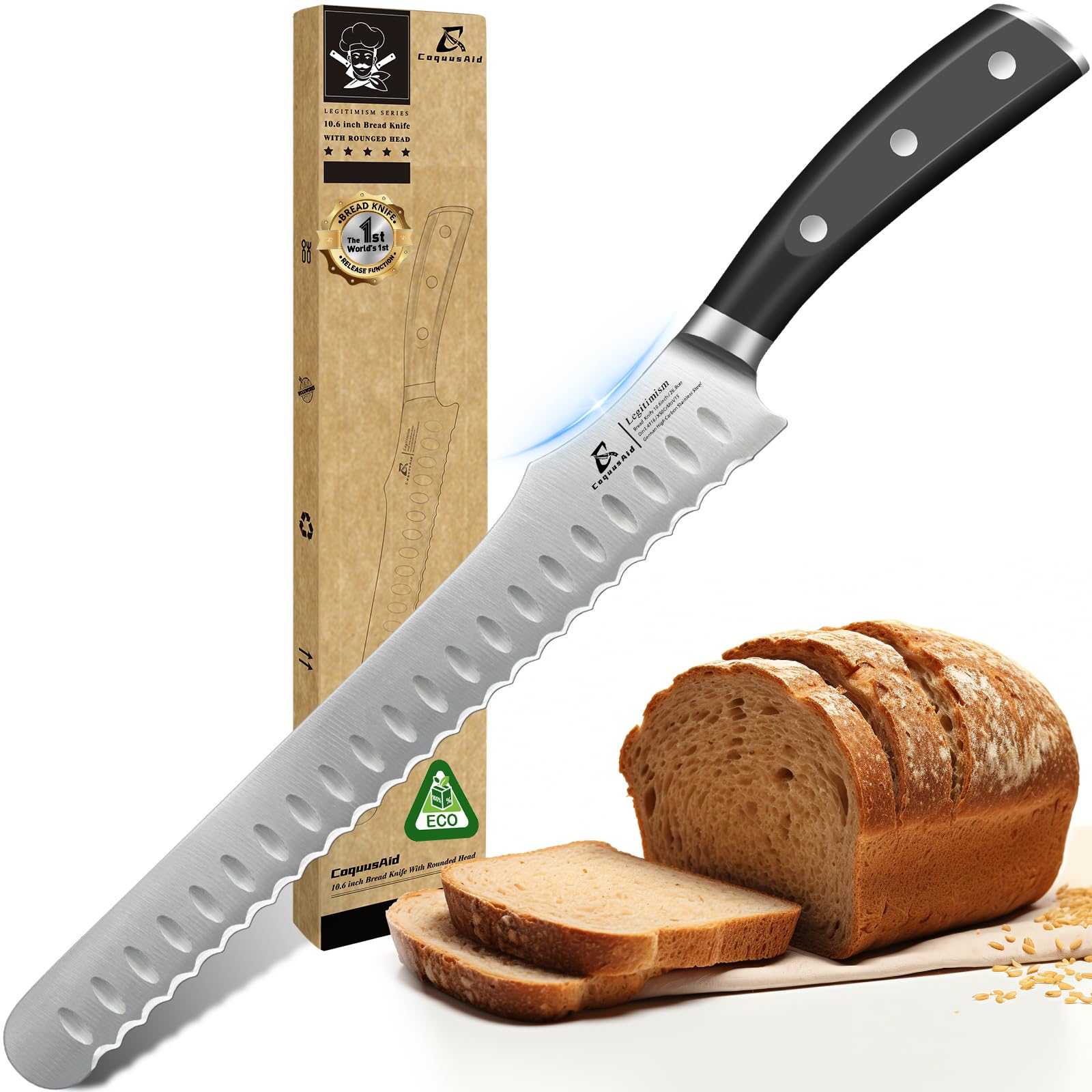
CoquusAid 10.6-Inch Bread Knife
Key Features
- Steel: German high carbon
- Weight: 12.7 oz
- Edge angle: 18 degrees
- Blade length: 10.6 inches
- Price: Budget
Most bread knives stop at ten inches. This one runs 10.6, and on a big country loaf that extra half inch is the difference between one clean pass and a sawing motion that leaves you with a wedge and a pile of crumbs. The blade also carries shallow dimples that break the suction, so a slice releases instead of clinging.
The trade is real: 18 inches end to end means a long drawer, a magnetic strip with room, or a block slot that most blocks don’t have. Check before you order. For a household that bakes wide loaves, that’s a small price to pay for a knife that finally spans them.
The claim worth knowing about is resharpenability. Instead of deep hardened scallops, the edge is a shallow wavy pattern finished at 18 degrees, and CoquusAid says it can be brought back rather than replaced — more than most serrated knives offer. We haven’t run one for years to prove it, but the geometry is plausible, and it’s the best value in this group for anyone cutting oversized loaves.
Pros
- Longest blade here for wide loaves
- Shallow wavy edge can be resharpened
- Dimpled blade releases each slice
Cons
- Heaviest knife here at 0.36 kg
The longest blade here, and the one we reach for when a loaf is wider than the board — just check it fits your drawer before you order.
Best for Dishwasher Households
HENCKELS Statement 8-Inch Bread Knife

Key Features
- Weight: 6.4 oz
- Blade length: 8 inches
- Construction: Stamped
- Dishwasher safe: Yes
- Price: Midrange
HENCKELS rates this knife for the dishwasher, and that one line separates it from most of this group. The Mercer’s warranty explicitly excludes dishwasher damage; this one is sold as stain- and rust-free in the machine. If your knives go in the rack at the end of the night, that’s worth more than a marginally keener edge.
It’s a stamped 8-inch blade at 6.4 ounces, with a stainless handle and a lifetime warranty against manufacturing defects. Sourdough goes through cleanly, and the shorter length is handy for bagels, brioche and cutting a tomato without flattening it — the usual side jobs a serrated knife picks up.
What you give up is authority. It’s lighter and springier than the forged knives here, and on a very thick crust it asks for more effort than the HOSHANHO or the Mercer. For everyday sandwich bread and the occasional loaf, we never found that to matter.
One detail we liked: the stainless handle is shaped over a full tang, so it doesn’t have the hollow, tinny feel of cheap stamped knives and stays comfortable through a long loaf. It’s a household knife rather than a baker’s knife, and for most households that’s the right answer.
Pros
- Rated for the dishwasher by the maker
- Full tang under a comfortable steel handle
- Lifetime warranty against defects
Cons
- Only eight inches of blade for wide loaves
The bread knife for a household that won’t hand-wash anything: HENCKELS rates it for the dishwasher, and it still cuts a clean slice of sourdough.
Best for Even Sandwich Slices
RAPSAKEMOH Bow Bread Knife

Key Features
- Handle: Acacia wood
- Includes: Blade cover
- Blade length: 10.6 inches
- Overall length: 15.6 inches
- Price: Budget
This isn’t a long straight knife, and that’s the whole idea. The blade is held taut across a wooden bow, so instead of sawing you set the loaf in the gap and draw the whole frame down through it, with the blade locked at the same angle every time. The result is a slice of even thickness without measuring anything.
The details are better than the price suggests. The handle is acacia wood, the blade reverses for left-handed use with a screwdriver and spare screws in the box, and there’s a cover — which we’re glad of, because the edge is sharp and the shape invites a careless grab. It also has a hanging loop, so it doesn’t take drawer space.
The limitation is geometry. Your loaf has to fit inside the 15.6-inch frame, so a long baguette, a very wide boule or anything you want to cut on the diagonal is out, and it won’t carve a chicken. This is a sourdough and sandwich-loaf tool, not a replacement for a straight bread knife — and if everything you bake is a bâtard or a pan loaf, you’ll never miss the extra length.
Within that boundary we like it a lot. If you bake one or two sandwich loaves a week and want every slice the same thickness for toast and lunch, it’s more consistent than any straight knife here, and cheaper than most of them.
Pros
- Even slice thickness with no measuring
- Reversible blade for left-handed bakers
- Cover and hanging loop included
Cons
- Switching hands means unbolting the blade
A bow-style slicer that gives even, bakery-neat slices of sourdough — as long as your loaf fits inside its frame.
How We Tested 14 Bread Knives Over Four Months
We started by rounding up every bread knife we could find from brands we already trust in the kitchen, plus a handful of well-reviewed budget options, then cut the list down on specs: blade length (8 to 10 inches covers a whole boule and still fits a sandwich loaf), serration shape, handle material and rivets, and whether the knife was actually available at a reasonable price. Fourteen made the final cut. Each one went into my kitchen and two colleagues’ kitchens, where it lived alongside the everyday knives for four months.
The slicing test was identical every time: a loaf of sourdough within an hour of coming out of the oven, the same loaf a day later, then a soft sandwich bread, a baguette, and a ripe tomato. We watched whether the blade bit into the crust on the first stroke or skated across it, whether the crumb stayed open or got compressed, and how much debris ended up on the board. The tomato was our sharpness check—a good serrated edge splits the skin on the first draw, while a dull one slides until you press hard enough to squash the flesh.
Each knife was weighed on a kitchen scale, then used to slice an entire loaf in one sitting, since a blade that feels fine for two cuts can drag by the tenth. We noted where the balance sat and how the handle fit different hand sizes and grips. Durability came from ordinary use rather than a lab: hand washing, an occasional accidental run through the dishwasher, handles and rivets checked for wobble or hairline cracks, and the serrations re-examined at the end of four months to see whether they still grabbed or had gone smooth.
How to Choose a Bread Knife
Every bread knife is a saw, so the choices that matter are how long the saw is, how its teeth are shaped, and how much it bends under a hard crust.
Match the blade to the loaf you actually bake
An eight- or nine-inch boule is the standard shape in a home oven, and a blade shorter than the loaf has to saw, which compresses the crumb and produces that wedge-shaped first slice. Ten inches is the length that finishes a big loaf in one stroke. If your bread is mostly bagels, buns and pre-sliced sandwich loaves, an eight-inch blade is easier to control and far easier to store, so a shorter knife is the sensible choice rather than a compromise.
Watch the overall length, not just the blade. Some long knives run past 18 inches from tip to handle end and won’t fit a standard in-drawer insert or a block slot. Measure the drawer or the magnetic strip before you order, because this is the one specification people get wrong.
Read the teeth before anything else
Wide, deep scallops bite into a hard crust and then carry through without tearing the crumb; fine, closely spaced teeth suit delicate work such as angel food cake, brioche and a ripe tomato. Neither is the better design, and a knife sold as professional tells you nothing about which one you’re getting.
The practical rule: choose the tooth pattern that matches the bread you cut most weeks, then accept that the other job is a compromise. A wide-scallop knife will shred a sponge cake, and a fine-toothed one will smear a wet, crusty sourdough.
Weight and stiffness beat sharpness
Past a certain point, sharpness stops being what separates one bread knife from another. A thin, light blade can flex inside a dense loaf and wander off line, and the slice comes out uneven; a heavier forged blade keeps tracking. That’s why an eight-ounce knife can feel easier on a hard crust than a three-and-a-half-ounce one, even though the lighter knife is nimbler everywhere else.
Go heavy if you bake dark, crusty loaves and slice them on a board. Go light if your bread is soft, if you slice in the air over a plate, or if anyone in the house has small or arthritic hands.
Handles, washing and storage
A textured rubber or wood handle is the safer choice when your hands are wet and floured; a smooth all-steel handle looks better and gives you less to hold onto. Check the care line as well, because more than one maker excludes dishwasher damage from the warranty even though the knife survives the cycle.
Storage deserves more thought than it gets. A ten-inch serrated blade loose in a crowded drawer is a cut waiting to happen, so keep the guard if one comes in the box and budget for one if it doesn’t — not every knife here ships with a guard.
Frequently Asked Questions
Can you sharpen a serrated bread knife?
Not the way you sharpen a chef’s knife. A honing steel skates over the scallops and does almost nothing, and a flat stone only reaches the tips of the teeth. A tapered rod run through each groove can revive a shallow wavy edge, and a knife built that way is the realistic candidate for a proper sharpening. Deep, hard scallops usually mean a new knife, so don’t overpay for one.
Do I need a bread knife if I already have a chef’s knife?
A chef’s knife gets through a baguette, but it splits the crust under pressure and crushes the crumb, so the cut face comes out ragged. A serrated blade saws the crust instead and leaves the interior open. If you buy or bake whole loaves more than occasionally, it’s the least expensive real upgrade in the kitchen, and it keeps your good chef’s knife off the crust.
Can I use a bread knife for anything besides bread?
Yes, and it does those jobs well. A serrated edge bites through tomato skin instead of pressing it flat, cuts angel food cake without compressing it, and halves a bagel cleanly. The limit is fine work: it won’t dice an onion or trim a chicken breast neatly. Use it for anything with a crust, a skin or a delicate crumb.
How do you get even slices through a crusty loaf?
Use long strokes and let the teeth cut. Pressing down compresses the loaf and gives you a wedge, which is the commonest reason home slices look ragged. Start the cut at the corner of the loaf rather than the middle of the crust, keep the blade level, and turn an over-wide loaf on its side to cut down through the base. Bread a few hours old slices more evenly than one straight from the oven.
Final Verdict
Buy the Mercer. Ten inches of stiff blade with wide scallops clears a whole boule in one stroke and leaves the crumb intact, and nothing else in this group matches it on a crusty loaf for the money. If nobody in your house will hand-wash a knife, take the HENCKELS instead — it’s rated for the dishwasher and still cuts sourdough cleanly.
And if your baking leans to brioche and cake rather than sourdough, the Tojiro’s thin blade is the better tool; just don’t ask it to take on a dense whole wheat loaf.