This post contains affiliate links. We may earn a small commission when you buy through our links — at no extra cost to you.
You pack a lunch you’re proud of, zip the bag, and find out at 3 p.m. that the whole thing tipped sideways and something pink has been marinating in your kid’s backpack since 11. That’s the real job of a kids’ bento box: not looking cute on the counter, but keeping compartments sealed when the bag gets slung into a cubby, stacked under a coat, and kicked across a cafeteria floor. A good one also holds the right amount of food for a kid who has about 20 minutes and no adult help, and comes apart easily enough that leftovers don’t come home baked onto the corners.
I’ve packed a lot of these lunches, and my team spent the last six months living with 14 bento boxes to see which ones survived the routine. The pattern was pretty clear: the boxes kids could open and close on their own got emptied, the ones with stiff latches came home full, and the ones with a lid that sealed in one confident click never once ruined a backpack. A quiet bit of wisdom from all that packing: a bigger box is not a better box. Oversized compartments invite you to overfill them, and food a kid can’t finish is food they’ll throw away.



Best for Preschool and Kindergarten
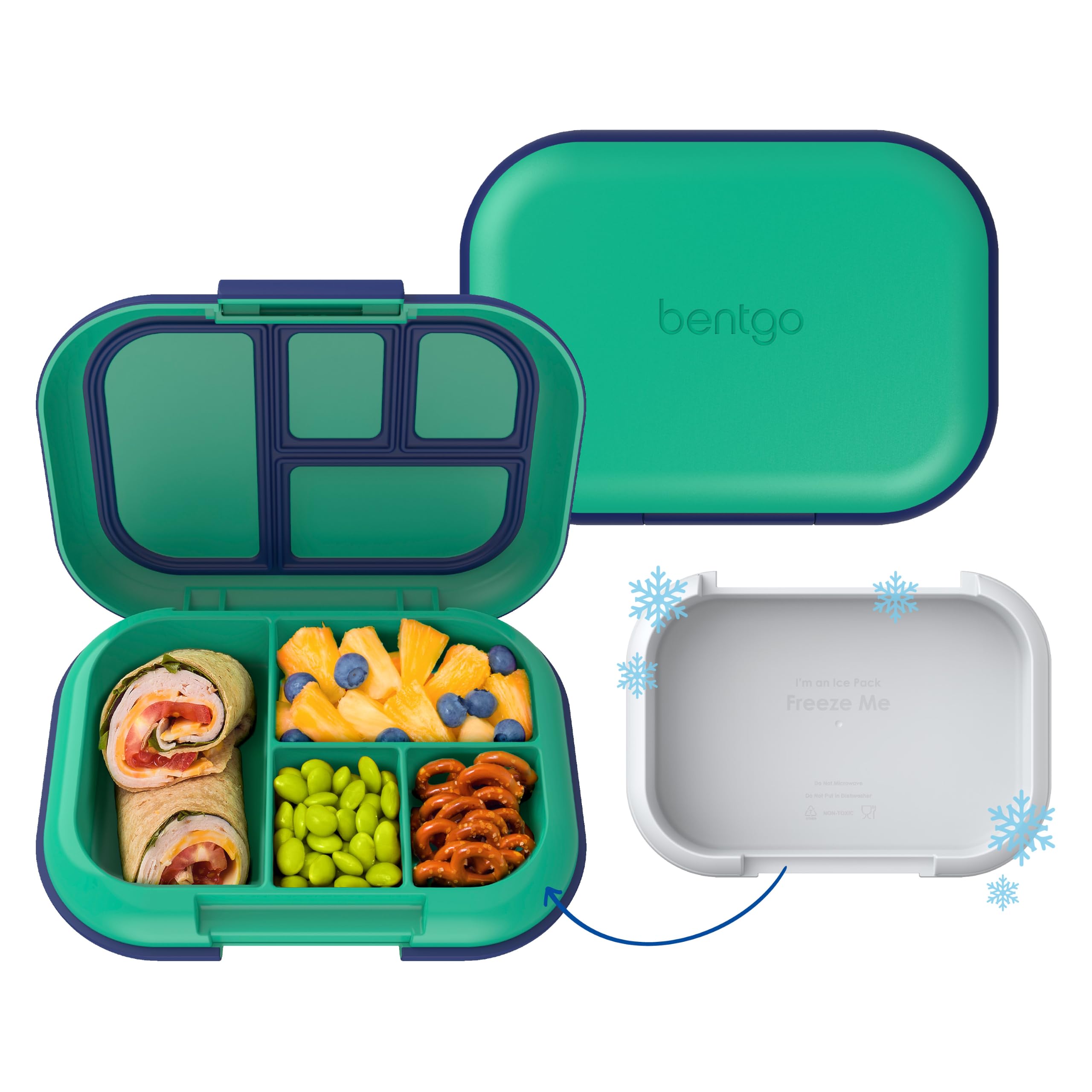
Bentgo Kids Prints
Key Features
- Weight: 1.3 lb
- Capacity: 2.4 cups
- Dimensions: 8.5 x 6.5 x 2 in
- Compartments: 5
- Price: Midrange
Five compartments holding 2.4 cups is the whole design argument, and it’s aimed at one stretch of childhood: roughly ages three to seven. A half sandwich fills the long section, fruit goes in one of the smaller ones, and a yogurt sits in the well without creeping into the crackers. We think the tight portioning is the feature rather than the compromise — a lunch that comes home empty beats a bigger box that comes home half full.
The latches got most of our attention, because a child opens and closes this box twice a day with nobody helping. Two chunky clips with a rubber bumper around the rim flip easily under small fingers, and the tray lifts out in one piece for the top rack or a minute in the microwave. The outer shell is hand-wash only, which is the one chore the box adds to your evening.
Two inches of depth with a lid that sits straight on the tray leaves nowhere to put an ice pack, so this is the box for a lunch that doesn’t need one. Past second grade the sections start to look thin and the Itopor becomes the better buy. Until then, the rubber-coated edges and 1.3-pound weight make it something a small kid can carry — and, realistically, drop.
Pros
- Keeps yogurt and dips out of the crackers
- Latches small fingers can flip alone
- Tray lifts out for dishwasher and microwave
- Portions matched to preschool appetites
Cons
- Outgrown by about second grade
- Outer shell has to be hand-washed
Our pick for preschool through early elementary: kid-sized portions, compartments that keep wet and dry apart, and latches small hands can work without help.
Best for Hot Lunches
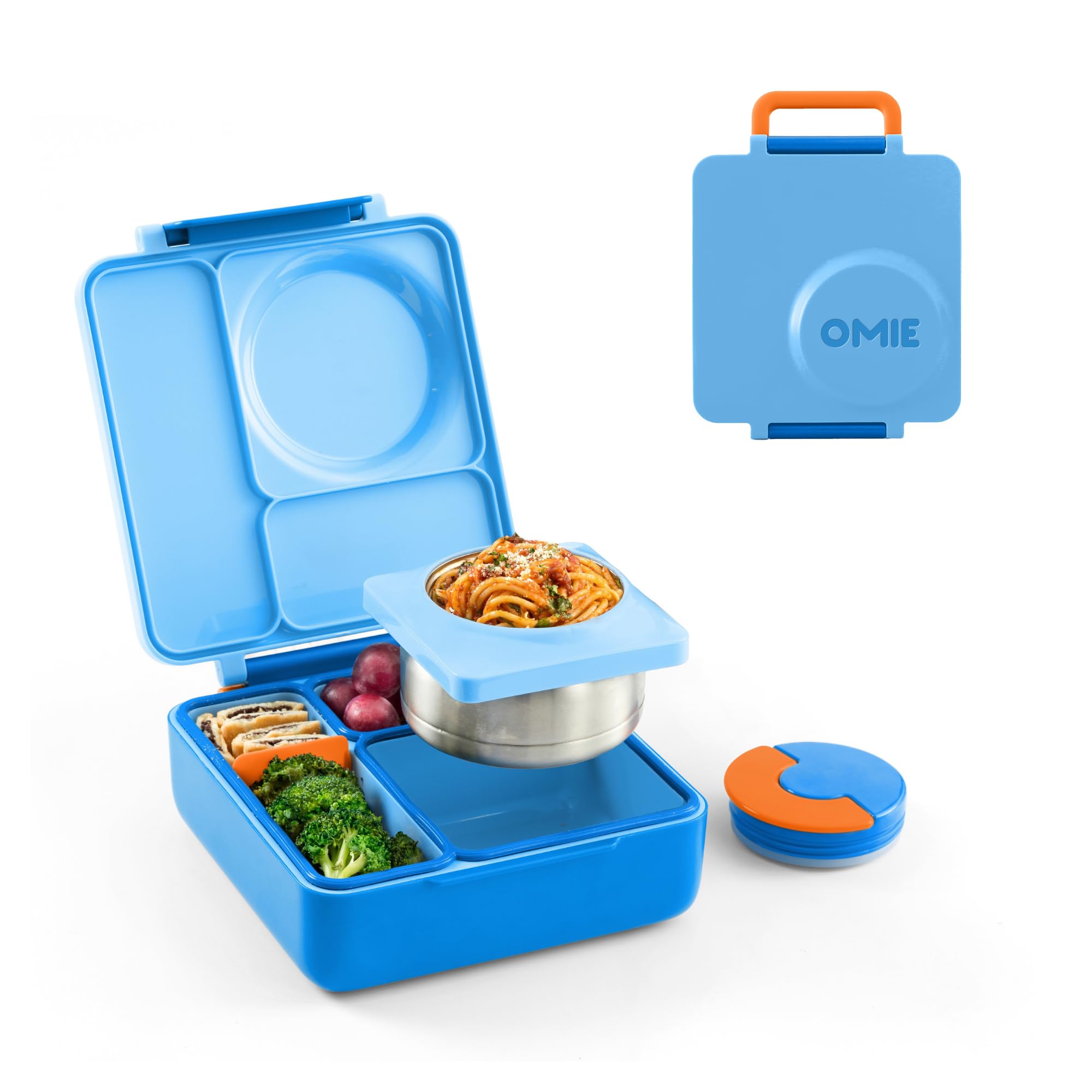
Omie OmieBox
Key Features
- Weight: 1.8 lb
- Dimensions: 8.5 x 7.5 x 3 in
- Compartments: 3
- Insulated jar: Included
- Price: Premium
The most expensive box here solves a problem the rest of this group only half-solves: a hot main and cold sides in one container you carry by the handle. An insulated jar sits in the box beside the cold compartments, so noodles, soup, or last night’s rice travels warm while the fruit stays cold next to it. Nothing else in this group does both in a single box.
What the money buys is easier lunch prep. If a cold sandwich comes home untouched but a thermos of pasta comes home empty, this ends the morning scrounge for something that survives at room temperature. Everything comes apart and the silicone seals lift out, which matters for a box with this many joints and edges.
What you accept is weight and fuss. At 1.8 pounds empty it’s the heaviest box here before the jar is filled, and we found the lid needs a firm, even press to seat — kids pop it open without trouble, but closing takes practice, and a rushed five-year-old will hand back a lid that isn’t latched. It’s leak-resistant rather than leak-proof, so very runny food belongs in the jar: a small thing to plan around, and the cost of being the only box here that does hot lunch.
Pros
- Hot main and cold sides in one box
- Food arrives warm at lunchtime
- Seals lift out for a proper clean
Cons
- Heaviest box here at 1.8 pounds empty
- Lid needs a firm, even press to close
Buy it if your child will eat soup, pasta, or leftovers at school — nothing else here handles a hot main and cold sides in one box.
Best for Cold Lunches
Bentgo Chill Kids
Key Features
- Capacity: 3.33 cups
- Ice pack: Built-in, removable
- Dimensions: 8.9 x 6.5 x 2 in
- Compartments: 4
- Price: Midrange
A frozen ice pack that lives in the box is the reason to choose this over the standard Bentgo Kids. The pack slides out, goes back in the freezer overnight, and drops into place in the morning — no separate cooler pack to remember, no gel sleeve to lose in the drawer.
The catch shows up at packing time. With a frozen pack in place the lid is stiffer, and it only latches when the tray is seated all the way down; press from the middle of the lid rather than the edges, and leave the tallest compartment slightly shy of full. Four compartments and 3.33 cups make it a step bigger than the standard Kids box, still aimed at the three-to-seven range.
Cold retention is the payoff — a yogurt, cut fruit, and a cheese stick come out of the bag in the state they went in — and the tray still lifts out for the top rack and the microwave. Our recommendation is narrow and confident: this is the box for the child whose lunch sits in a backpack until noon, and the one to skip if lunch is a sandwich and a bag of chips, because the pack adds stiffness for a job that doesn’t need doing.
Pros
- Built-in ice pack, nothing extra to remember
- Keeps yogurt and cut fruit cold
- Tray goes in the dishwasher and microwave
Cons
- Lid is stiff to close with the pack frozen
For a lunch that waits five hours in a backpack, this is the kids’ box we point to: a built-in ice pack, four compartments, and a lid that needs a firm press.
Best for Big Appetites
Itopor Bento Box
Key Features
- Weight: 9.76 oz
- Capacity: 46 fl oz
- Dimensions: 8.9 x 6.1 x 2.4 in
- Compartments: 3
- Price: Budget
Forty-six ounces across three compartments, in a box that weighs under ten ounces empty. That’s roughly double the food of the Bentgo Kids at less weight, and it’s why we move a child up to this one around third grade — a whole sandwich, two sides, and room to spare without a heavier bag.
The layout suits a real lunch rather than a snack tray: one long section, two shorter ones, a fork that stows inside the tray, and a lid held by four snap latches. The fork well is the one spot that can let a runny food through to the next compartment, so keep dressing out of it. Everything else is straightforward — wheat-straw composite, dishwasher-safe, light in the hand.
Latches are the weak spot. They hold when the box is carried flat, but a child pressing down on the lid can pop them, so a lunch that gets stuffed into a full backpack needs a check. Durability is the other question mark: the lid and base can crack under a hard drop. At the bottom of the price range for this much volume, that reads as a fair trade rather than a dealbreaker.
Pros
- 46 ounces across three deep compartments
- Lightest box here at under ten ounces
- Fork stores inside the tray
- Most volume for the least money here
Cons
- Clips can pop when the lid is pressed
- Can crack under a hard drop
The box to buy once your child outgrows a preschool portion: 46 ounces, three deep compartments, and the lightest carry here.
Best for Sandwich and Drink
Munchkin Bento Lunch Box
Key Features
- Weight: 1.3 lb
- Utensils: Stainless fork and spoon
- Dimensions: 9.25 x 8.9 x 3.25 in
- Compartments: 5
- Price: Midrange
Real stainless utensils snap into the underside of the lid — a fork and a spoon that stay with the lunch instead of migrating to the bottom of a backpack. That one detail says who the box is for: a kid who wants a proper fork for pasta, and a parent who has finished buying plastic cutlery by the packet.
Five compartments is the most here, one of them shaped to hold a juice box, and there’s a carrying handle on the end. Add the best durability showing in this group, a body built for the top rack, and a stated starting age of 18 months, and it’s the box we reach for when lunch is a sandwich, a drink, and a few sides, and the bag gets treated badly.
The size is the trade. At 9.25 by 8.9 by 3.25 inches it has the biggest footprint here — it wants a proper lunch bag rather than a side pocket, and it’s the box most likely to feel bulky in a small child’s backpack. Get the bag right and a second grader can carry a full sandwich, a drink, and three sides without a single baggie.
Pros
- Stainless fork and spoon store in the lid
- Only box here with a juice-box slot
- Best durability showing in this group
- Carrying handle for the walk to school
Cons
- Biggest footprint here; needs a full-size bag
- Compartments are not reliably watertight
The sturdiest box here, and the only one with a slot for a juice box and metal utensils in the lid — if your child has a lunch bag big enough for it.
Best for First Bento
Jelife Bento Lunch Box

Key Features
- Weight: 14 oz
- Capacity: 1100 ml
- Dimensions: 8.6 x 5.9 x 2.8 in
- Compartments: 4
- Price: Budget
One wide clip, one click, and a three-year-old can open it alone. That’s the case for this box, and it’s a case the fancier ones don’t always make: the latch is soft enough for a small hand to flip and firm enough that it stays shut once it’s closed.
Inside there are four compartments plus a small well in the middle for a dip, and 1100 ml is a sensible kindergarten lunch — half a sandwich, fruit, a handful of crackers, a yogurt. At 8.6 inches long and 5.9 wide it sits inside most kids’ lunch bags without a fight.
Two things to know before you buy. The middle well is the weak point in the seal, so keep it for hummus or yogurt rather than a thin dressing. And the clasps are the part that gives out, which is why this reads as a first box rather than a hand-me-down.
None of that changes our read. At the bottom of the price range you’re buying one season of school lunches and a way to learn whether your child likes eating from compartments at all. If the answer is yes, the next box can be a Bentgo. If it’s no, you’ve spent the least of anything here finding out.
Pros
- Easiest latch in this group for small hands
- 1100 ml suits kindergarten portions
- Least expensive box here
Cons
- Clasps are the weak point
- Middle well can leak into other sections
The cheapest way to find out whether your child takes to a bento box: a latch a three-year-old can work, kindergarten portions, and a build we treat as a one-year box.
Best for Hot Lunch Kit
wiwens Bento Lunch Set

Key Features
- Hot jar: 12 oz
- Capacity: 35 oz
- Compartments: 5
- Insulated bag: Included
- Price: Midrange
Six pieces arrive together: the 35-ounce lunch box, a 12-ounce stainless food jar, a fork and spoon, a sauce cup, an insulated bag, and ten little note cards to tuck in with lunch. If your child wants soup one day and a sandwich the next, this is the shortest route to that.
The jar is the useful half. It’s double-walled stainless with a threaded lid, and it holds a hot main through the morning, which turns the set into a real hot-lunch kit rather than a box with extras. The box itself has five compartments once the two dividers are in, and the tray lifts out for washing.
We think it’s the sensible middle path on hot food: the box, jar, and bag together land near what a mid-range box costs on its own, and well short of the OmieBox. For a family that hasn’t bought a thermos or a lunch bag yet, that’s a genuinely convenient way to start.
The trade-offs are on the outside of the set: a thin, soft-sided bag, and clips and hinges that put durability among the weakest here. Since the box is doing the work and the bag is the piece you’d replace anyway, none of that is fatal — but plan on a year or two rather than three.
Pros
- 12-ounce insulated jar included
- Bag, utensils, and sauce cup in the same purchase
- Hot food stays warm to lunch
Cons
- Clips and hinges are the weak point
- Included bag is thin rather than structured
The one-purchase hot lunch: a 12-ounce insulated jar, the box, and a bag in a single set, for about the same money as a mid-range box on its own.
Best for Older Kids
MISS BIG Bento Box

Key Features
- Weight: 8.5 oz
- Capacity: 1150 ml
- Dimensions: 8.66 x 5.9 x 2.2 in
- Compartments: 3
- Price: Budget
There’s a lot of lunch in here for the money: 1150 ml, about 39 ounces, across three deep compartments, the longest of them big enough for a whole sandwich. For a child who comes home hungry and a household that doesn’t want to spend much, that combination is the pitch.
Depth is what makes it work. The sections are 2.2 inches deep, so a wrap or a tub of rice sits below the lid line instead of pressing against it, and the whole box weighs 8.5 ounces empty — one of the lightest here.
Cleaning is where it quietly wins: the tray goes through the dishwasher and comes out clean without a soak first, and the interior is smooth enough to wipe out in a hurry on a Sunday night.
The latches are what hold it back. They’re stiff clip-on buckles that need real pressure, and a five-year-old hands the box back rather than fight them; older kids manage fine. The lid closure is also the part that ages fastest, and a box that stops snapping shut is finished. Our recommendation follows from that: nine and up, or a younger child who is happy to ask for help.
Pros
- 1150 ml across three deep compartments
- Comes out of the dishwasher clean
- Light for its size at 8.5 ounces
Cons
- Stiff clips are hard for younger children
- Lid can stop snapping shut over time
A lot of lunch for very little money, best for a nine- or ten-year-old who can work a stiff clip — not the box for small hands.
How We Tested the Best Kids’ Bento Boxes
We started by narrowing the field to boxes actually sold for school lunches, checking compartment layouts, listed capacities, dishwasher claims, and lid designs, then cross-referencing parent reviews for complaints about hinges snapping or latches popping. We cut anything that only came in one oversized size, anything with a lid that required two hands and a prayer, and anything priced well above what a box that gets lost in March is worth. That left 14 boxes, which we rotated through six months of real lunches, roughly September through March of a school year.
Leak testing came first because it drives everything else. We filled each compartment with yogurt, applesauce, and oil-based dressing, sealed the box, shook it for a full minute, then turned it upside down and left it that way for an hour. The survivors went into a backpack alongside a water bottle and a pair of sneakers for a morning of errands before we opened them over a white dish towel and looked for rings. For temperature retention, we packed hot soup and cold yogurt at 7 a.m., then checked both at noon with an instant-read thermometer to see how much ground each box lost over five hours.
Size and capacity got measured rather than guessed. We weighed each box empty and packed, noted how many of our standard lunch items actually fit without crushing, and then watched kids between five and ten years old open, eat from, and re-close each one without help, timing how long the lid took and whether the latches lined up on the first try. Durability came from use: hinges flexed hundreds of times, boxes dropped from counter height onto tile, and we counted dishwasher cycles while watching for warped lids, cloudy plastic, and seals that stopped sitting flat. To test ease of cleaning, we left a yogurt-smeared box sealed in a warm car overnight, then washed it the way a tired parent would and checked the inner corners and gasket grooves for residue.
Food came home uneaten in the boxes with stiff latches and confusing compartments, and that finding shaped every pick on this list. The ones still in rotation are the ones that sealed, opened, and cleaned without anybody thinking about them.
How to Choose a Kids’ Bento Box for School Lunch
The right box is the one your child can open, close, and finish on their own, so choose by appetite, latch, and temperature rather than by compartment count.
Match the box to the appetite, not the grade
Capacity here runs from 2.4 cups to 46 ounces, and the gap isn’t marketing — it’s the difference between a preschool lunch and a fourth grader’s. A box that’s too small comes home with a hungry kid; one that’s too big comes home half full and heavy.
Buy for what your child actually finishes now. A sandwich, a fruit, and a snack is a normal preschool lunch and fits the 2.4 to 3.3 cup boxes. A whole sandwich plus two sides wants 40 ounces and up. Expect to buy again around third grade, when most kids have outgrown a preschool box.
The latch is the part your child uses every day
Most leaks are a lid problem rather than a compartment problem: a box that isn’t latched all the way down will pass liquid between sections and into the bag. What actually matters is whether your child can shut it at school, without a teacher’s help.
Watch the mechanism, not the leak-proof promise on the box. A single wide clip is easiest for small hands, two chunky side latches come next, and four snap buckles need a firm press that suits older kids. Before the first week, pack it, latch it, and have your child open and close it three times — a child who can’t manage it in the kitchen won’t manage it in a cafeteria.
Cold and hot are separate purchases
A sandwich and fruit are fine at room temperature, and most of these boxes assume exactly that. Cold food staying cold means buying an ice pack — built into the Bentgo Chill, a separate pack elsewhere. Hot food means buying insulation: the OmieBox carries a jar inside the box, and the wiwens set adds a jar and a bag.
The trap is trying to buy both jobs in one product. An ice pack makes a lid stiffer to close, and a thermos only helps if your child will actually eat what’s inside it. Decide which lunch your child eats before paying for temperature control.
Cleaning decides how long you keep using it
The removable tray is the feature that matters most after the first month. A tray that lifts out can go on the top rack; the shell around it usually can’t, and hand-washing a lunch box every night gets old by October.
Check which parts the maker lists as dishwasher-safe, and whether the silicone seals lift out. Gaskets that come away can be rinsed properly; ones that don’t will hold onto last week’s curry. If the box goes to school five days a week, two boxes beat one.
Frequently Asked Questions
Is a kids’ bento box worth it?
Worth it if you pack lunch most mornings. One box replaces a stack of small containers and a handful of baggies, and the compartments keep wet and dry food apart, which is what stops a lunch turning to mush by noon. Plan on one box per child, plus a spare if you’d rather not wash it every night — that’s cheaper than a drawer of single containers that never quite fit.
Can you microwave a kids’ bento box?
Only the parts the maker allows. On nearly every box here that means the removable tray or base, with the lid, outer shell, seals, and any ice pack left on the counter. Reheat in short bursts, since plastic heats unevenly, and check the underside of the base for a microwave-safe mark before the first reheating — it’s usually molded right into the plastic.
Will a bento box fit in a school lunch bag?
Measure the bag’s main compartment, not the bag as a whole. The boxes here run 8.5 to 9.4 inches long, 5.9 to 8.9 inches wide, and 2 to 3.25 inches tall. A bag needs roughly 9 by 6 inches of flat floor for most of them; the Munchkin, at 8.9 inches across, is the one that genuinely needs a large bag.
Final Verdict
For most families with a child in preschool or the first years of school, the Bentgo Kids Prints is the box to buy: portions that match a small appetite, compartments that keep yogurt away from crackers, and latches a four-year-old can work without help.
Move up to the Itopor when the appetite outgrows 2.4 cups, and to the OmieBox only if hot food is what actually gets eaten at school. Everything else here is a good answer to a narrower question.