This post contains affiliate links. We may earn a small commission when you buy through our links — at no extra cost to you.
The crust on a great steak doesn’t come from the steak — it comes from the pan. Meat needs a surface that’s screaming hot and completely dry, or it steams in its own juices and turns gray. That one fact narrows the field quickly, and it explains the tradeoff no product listing mentions: the pans that sear hardest tend to be the heaviest, the slowest to heat evenly, and the quickest to rust if you leave them wet.
Getting the right pan is what turns steak night from a project into a routine. I’ve spent the past six months searing in 12 of them with my team, weighing each one, scrubbing each one afterward, and tracking how the surface held up cook after cook. Size surprised me most: two thick steaks crowded into a small pan drop the temperature and never recover. The picks below are the ones I’d buy again, sorted by what each is actually good at.
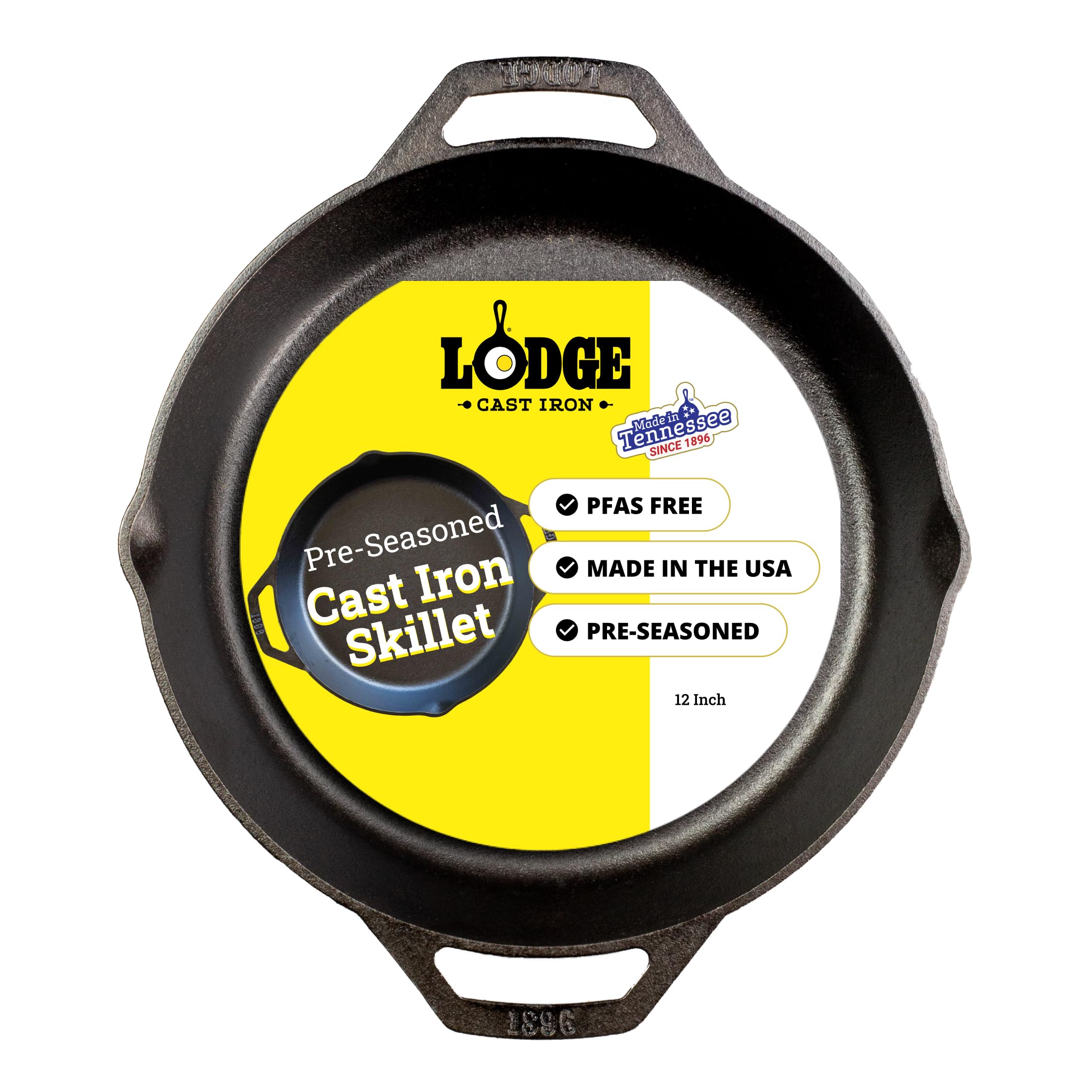


Best for Two Thick Steaks
Lodge 12-Inch Dual Handle Skillet
Key Features
- Weight: 6.6 lb
- Handles: Two cast iron loops
- Diameter: 12 inches
- Material: Pre-seasoned cast iron
- Price: Budget
The real test for a steak pan comes in the first thirty seconds: a cold two-inch ribeye lands, the surface temperature drops, and the pan either holds its heat or gives up. This 12-inch Lodge holds it. At 6.6 pounds there is enough iron to keep searing through the second steak, and the flat cooking surface leaves room for two good-sized cuts without them touching.
Two loop handles are what make it livable day to day. A pan this heavy with one long handle is a wrist workout, and lifting it out of a hot oven one-handed is how people get burned; with a loop on each side you use both hands and a pair of mitts and never think about it. What you trade away is the one-hand tilt you need to spoon butter over a steak as it finishes.
It arrives pre-seasoned, so it goes straight onto the stove, and the surface only gets better: a month of steaks and a metal spatula will do more for it than any special routine. Induction, gas, the oven, the grill, and a campfire are all fair game, which is why this is the pan that stays out on the stove rather than in the cupboard.
Sauce is where it hands off to the clad pans. Stainless leaves a cleaner fond to deglaze, and this one is better at the crust than at what comes after it.
Pros
- Holds heat through a second steak
- Two loop handles make a heavy pan manageable
- Pre-seasoned and ready out of the box
- Induction, oven, grill, and campfire safe
Cons
- No long handle for tilting and basting
- Needs drying and oiling after every wash
We tell anyone who asks to start here: two steaks, a hard crust, and two handles to lift 6.6 pounds of iron with.
Best for Pan Sauce
All-Clad D3 12-Inch Fry Pan with Lid
Key Features
- Weight: 4.7 lb
- Diameter: 12 inches
- Oven safe: 600 °F
- Construction: Bonded tri-ply stainless
- Price: Premium
Take a steak out of a stainless pan and the best part of dinner is still in the pan: a dark, sticky layer of fond that turns into a sauce the second wine or stock hits it. That is the argument for the All-Clad D3, and it is why we reach for it when the meal is more than meat on a plate. The fully bonded tri-ply heats evenly and, just as usefully, backs off fast when you turn the burner down.
Where cast iron bullies the heat, this pan negotiates with it. We found the responsive surface makes it easier to hold a steady medium-high instead of overshooting into burnt butter, and the 600 °F oven rating means a thick strip can start on the stove and finish in the oven. At 4.7 pounds it is lighter than any cast iron here, and the lid that comes with it is genuinely useful for finishing and for holding a sauce warm.
It is not nonstick and never will be. A cold steak in a cool pan will weld itself to the surface, so preheat until a drop of water beads and skitters across the pan, dry the steak thoroughly, and leave it alone until it releases on its own. Do that and cleanup is a short soak and a scrub; skip it and you will be scraping with a spatula and cursing the pan.
Pros
- Leaves clean fond for pan sauce
- Even tri-ply heat that responds fast
- Oven safe to 600 °F, lid included
- Lighter than any cast iron here at 4.7 pounds
Cons
- The most expensive pan here
- Hand wash only
Buy this one for the sauce: it sears a steak and then hands you the fond to build dinner on.
Best for Grill Marks
Lodge 10.5-Inch Square Grill Pan
Key Features
- Size: 10.5 inches square
- Weight: 6.5 lb
- Surface: Ridged
- Material: Pre-seasoned cast iron
- Price: Budget
The first thing you notice is the marks: dark bars across the steak, the look you get from a restaurant grill, and a channel underneath for the fat to run into instead of pooling around the meat. This is a 10.5-inch square of cast iron, which suits a long strip loin better than a round pan of the same width, and the ridges keep the steak out of its own drippings.
We think the trade is worth it for weeknight steaks and pork chops. It is cast iron through and through at 6.5 pounds, so it holds heat the way the top pick does, and it moves from the stove to the oven, the grill, or a fire without complaint. The marks come out crisp, and the fat that collects in the channel is easy to spoon off before it burns.
Cleaning gets easier once you stop treating the grooves like dishes. A stiff brush and hot water while the pan is still warm lift the residue before it sets; a soak is what turns a two-minute job into a scrubbing session. Dry it on the burner afterward and the seasoning keeps building instead of flaking.
Pros
- Deep ridges leave clear grill marks
- Channels fat away from the meat
- Square shape fits long steaks
- Oven, grill, and campfire ready
Cons
- Ridges cut contact, so less crust than a flat pan
- Heavy at 6.5 pounds
We keep this one for the look and the fat: crisp grill marks, a channel for the drippings, and a square that fits a long strip.
Best for Batch Searing
Amazon Basics 15-Inch Cast Iron Skillet
Key Features
- Weight: 11.5 lb
- Capacity: 5.9 quarts
- Diameter: 15 inches
- Oven safe: 500 °F
- Price: Midrange
Fifteen inches across and 5.9 quarts of capacity make this the biggest cooking surface in the group, and it is the pan we pull out when four people want steak and nobody wants to eat in shifts. Three steaks fit with room between them; four fit if you keep them moving.
A pan this thick needs a long preheat, and on a burner smaller than the base the outer ring lags behind the middle, so we rotate it a quarter turn as it comes up and again between batches. Do that and the crust is as good as the smaller cast irons here. It is pre-seasoned, oven safe to 500 °F, and the flared sides make pouring off the fat easier than ladling it out.
What you give up is agility. This is not the pan for one steak on a Tuesday, because heating 15 inches of iron to searing temperature for a single piece of meat is a lot of stove for not much dinner. It is a batch pan, and it is very good at being one.
Pros
- Fits three or four steaks at once
- Pre-seasoned and oven safe to 500 °F
- Flared sides make pouring off fat easier
Cons
- Heavy at 11.5 pounds, even empty
- Needs drying and oiling after every wash
We pull this out when everyone wants steak: 15 inches of iron that sears three or four at once.
Best for Smooth Surface
Backcountry Iron 12-Inch Cast Iron Skillet
Key Features
- Weight: 7 lb
- Diameter: 12.25 inches
- Material: Pre-seasoned cast iron
- Oven safe: 500 °F
- Price: Midrange
The cooking surface here is finished smoother than the pebbly texture most new cast iron ships with, and that difference shows up in the first week. A smoother face gives food fewer places to grab and the seasoning a flatter base to build on, so a steak releases more readily while the pan is still young. It is a 12.25-inch pan, 7 pounds, pre-seasoned with a proprietary oil blend.
We think that surface is worth paying a little more for if you cook steak often and do not want to fight the pan through its first month. It works on gas, electric, and induction, goes in the oven and under the broiler, and is rated to 500 °F. Seven pounds of iron also means the heat is still there for the second steak.
The included handle sleeve is a small thing that turns out to matter, because cast iron handles get hot fast and having a cover in the box saves you buying one separately.
Pros
- Smoother cooking surface than most new cast iron
- Pre-seasoned and induction compatible
- Oven and broiler safe to 500 °F
- Comes with a handle sleeve
Cons
- 90-day warranty is short for cast iron
- Costs more than the basic cast iron here
If a new pan’s pebbly surface drives you up the wall, this is the cast iron we point to: it arrives smoother and seasons faster.
Best for High-Heat Stainless
Made In 12-Inch Stainless Fry Pan

Key Features
- Weight: 4.4 lb
- Oven safe: 800 °F
- Construction: 5-ply stainless clad
- Cooking surface: 9.5 inches
- Price: Premium
Twelve inches sounds generous until you read the other number: the cooking surface is 9.5 inches across, because the walls flare steeply away from a narrower base. That matters if you plan to lay two ribeyes side by side. They fit, but there is less room than the 12-inch cast irons here give you.
What the narrow base buys you is responsiveness. Five bonded layers heat fast and evenly, the pan is rated to 800 °F, the highest here, and at 4.4 pounds it is easy to move around a hot stove. The 1.75-inch depth is useful too: you can sear a steak and then throw in shallots and butter without chasing them over the rim.
One thing to do before the return window closes: set the pan on the counter and check that it sits flat. A warped base is the failure to watch for on this one, and a rocker on a glass cooktop is maddening to cook on. If it is flat, it is a beautiful piece of cookware that will take whatever heat you give it.
Pros
- 5-ply clad heats evenly and responds fast
- Oven safe to 800 °F
- Lighter than any cast iron here at 4.4 pounds
Cons
- Hand wash only
- Premium price given the cooking surface
We recommend this to cooks who want clad responsiveness and 800 °F of headroom, and who can live with a 9.5-inch cooking surface.
Best for Easy Cleanup
Cooks Standard 11-Inch Grill Pan

Key Features
- Size: 11 inches square
- Weight: 3.2 lb
- Material: Hard-anodized aluminum, nonstick
- Oven safe: 500 °F
- Price: Midrange
Not everyone wants to dry and oil a pan after dinner. This is the grill pan for those cooks: hard-anodized aluminum, 3.2 pounds, a handle that stays cool, and a ridged nonstick surface that wipes out with a sponge. It does indoors what a grill does outside, without the seasoning ritual.
We like it for what it is, and it is honest about its ceiling. The coating means you sear at medium-high rather than the screaming heat a cast iron pan takes, so the crust is good rather than spectacular; the marks, the fat drainage, and the easy cleanup are the real draw. It is oven safe to 500 °F, which is enough to finish a thick steak, and the ridges leave clean lines with barely any oil.
One thing to check before you buy: this pan is not induction compatible, so gas, electric, and ceramic cooktops are the ones it serves. It is light enough to hang, small enough for a cramped cabinet, and the kind of pan that earns its place a few nights a week rather than every night.
Pros
- Stay-cool handle on a 3.2-pound pan
- Ridges leave clear grill marks
- Oven safe to 500 °F
- Wipes clean with no seasoning ritual
Cons
- Not induction compatible
For grill marks without the seasoning ritual, we like this light, cool-handled pan, as long as you do not expect cast iron crust.
Best for Long-Handle Skillet
Utopia Kitchen 12-Inch Cast Iron Skillet

Key Features
- Weight: 7.6 lb
- Diameter: 12 inches
- Material: Pre-seasoned cast iron
- Oven safe: 450 °F
- Price: Budget
A long handle changes how you cook a steak. With one hand on the handle and the pan tilted, you can spoon foaming butter over a thick cut for the last minute, and that baste is what gives a steakhouse crust its gloss. This 12-inch pan has that handle, the surface to fit two steaks, and the closest thing here to the classic single-handle skillet.
Where we land is that it is a good second skillet rather than a first one. The size and the handle are genuinely useful, but the factory seasoning is a starting point rather than a finished surface. Give it a month of cooking and a thin coat of oil after each use and it settles into something reliable; expect the first few steaks to stick a little while it gets there.
Check your cooktop before ordering, because this one does not state induction compatibility and the pans here that name it explicitly are the safer bet on an induction stove. Everything else about it is plain, heavy, honest cast iron that will keep working long after the handle on a cheap pan has gone loose.
Pros
- Long handle makes tilting and basting easy
- 12-inch surface fits two steaks
- Pre-seasoned with vegetable oil
Cons
- Pre-seasoning can arrive thin and uneven
- Oven safe only to 450 °F
We point budget shoppers here for the long handle and the tilt-and-baste it allows, with a warning to expect to season it yourself.
How We Tested the Best Pans for Searing Steak
We started with a list of about 40 pans — cast iron, carbon steel, and clad stainless in the 10- to 12-inch range — and cut it down by reading spec sheets for cooking-surface thickness, handle construction, oven-safety ratings, and whether the pan arrived pre-seasoned. Price factored in too, since a pan that costs twice as much should sear twice as well. Twelve made the final cut, and we cooked in them for six months.
Every pan got the same workout: two 1 1/2-inch steaks, dried overnight and salted, seared one after another on gas and induction burners. We timed how long each took to build a brown crust, read surface temperature with an infrared thermometer before and after the second steak went in, and finished half the tests in a 500-degree oven. Each pan was weighed empty and again with a steak in it, because a 10-inch cast iron and a 12-inch carbon steel feel nothing alike after twenty minutes on the stove.
Then came the part nobody films. We scrubbed every pan by hand, ran a few through the dishwasher on purpose, and left two wet in the sink overnight to see what bloomed by morning. We deglazed with wine and vinegar to watch whether the seasoning held, then fried eggs the next day to check non-stick in plain terms — did the egg slide or did it stick. Appearance got tracked across the whole six months: patchy seasoning, flaking, discoloration, handles that loosened.
Durability and versatility were judged in real meals rather than on a bench — cornbread, roast chicken, stir-fried vegetables, a pan sauce left sitting too long. We noted which pans handled all of it, which only did one thing well, and whether the factory pre-seasoning was good enough to cook on straight out of the box or needed a weekend of work first.
How to Choose a Pan for Searing Steak
The pan that sears best is the one that stays hot when a cold steak lands in it, and most of the other choices follow from how you get there.
Cast iron or clad stainless?
Searing is a heat-transfer problem. The surface has to be hot enough to brown the crust fast, and it has to stay that way once a two-inch steak starts pulling heat out of it. Bare cast iron wins on sheer mass: a 6- to 7-pound skillet barely notices the steak, which is why it turns out the darkest, most even crust of anything here.
Clad stainless, with an aluminum or copper core bonded between layers of steel, holds less heat but answers the burner in seconds, so you can pull the temperature down before the butter burns, and it leaves a clean fond for a pan sauce. Choose cast iron if the crust is the whole point; choose clad if you want a sauce in the same pan and more control.
How big, and flat or ridged?
Crowding is the most common way to ruin a good steak in a good pan. Two steaks want roughly 10 to 12 inches of flat surface with a finger’s width between them; any tighter and they steam instead of searing. A 15-inch skillet is a batch tool for four or more people, and it needs a burner to match.
Ridges are a separate decision. Every groove is surface the meat never touches, so a ridged pan trades crust for grill marks and a channel for the fat to run into. If you want maximum crust, go flat. If you want the look and less fat on the plate, ridges earn their keep.
The heat ceiling, and the nonstick trap
Here is what buyers get wrong: a nonstick pan is not a searing pan, however it is marketed. The coating sets a ceiling, and dry-searing at the heat that gives the best crust is hard on it. The nonstick grill pan we recommend is rated to 500 °F in the oven, and it makes a fine indoor grill, but it will not give you the crust that bare iron or clad stainless does.
If a hard, dark crust is the goal, buy bare metal and use an oil with a high smoke point. Save the coated pan for fish, eggs, and the nights when cleanup matters more than char.
Handles, weight, and oven time
A 12-inch cast iron skillet weighs 6 to 7 pounds before the steak goes in, and a single long handle puts all of that on one wrist. Helper handles and double-loop designs are not a gimmick; they are the difference between moving a hot pan with one hand and needing two.
If you plan to finish in the oven, check two numbers: the maximum oven temperature, which runs from 450 °F to 800 °F across the pans here, and the handle material. Stainless and cast iron handles get hot, so keep a dry towel or a sleeve within reach, and never grab a hot handle with a wet cloth.
Where the money goes
Cast iron is the least expensive route to a great sear, and the gap between a budget skillet and a midrange one is mostly surface finish, casting quality, and warranty rather than cooking ability. Clad stainless is where the money goes: you are paying for even heat, a lighter pan, and a base that resists warping.
If you cook steak once a week and little else in the pan, buy the iron. If the pan is also your sauce pan, your roasting pan, and the thing you deglaze every Tuesday, the clad pan earns its price over years of use.
Frequently Asked Questions
How do I keep a cast iron steak pan from rusting?
A little mild dish soap will not hurt a seasoned pan, so wash it, rinse it, and then dry it on a low burner for a minute instead of leaving it in the rack. Wipe a thin film of oil across the cooking surface while it is still warm.
Never soak it overnight and never put it in the dishwasher. Standing water is what turns iron orange, and a rusted pan needs a full re-season before it cooks well again.
How do I sear steak without smoking up the kitchen?
Some smoke is unavoidable, because a pan hot enough to crust a steak is hot enough to scorch oil. Pat the steak bone dry, use an oil with a high smoke point rather than butter, and heat the pan until the oil just shimmers instead of billowing.
Turn the vent on before the pan goes on the stove, and use the burner nearest the window. Butter belongs in the pan at the end, off the heat.
Can I use these pans on an induction cooktop?
Most of them. Cast iron is naturally magnetic, and the Lodge pans, the Backcountry Iron, the All-Clad, and the Made In pan are all rated for induction.
The exception here is the Cooks Standard grill pan, which is not induction compatible. Check the base before ordering, because a pan that is not rated simply will not heat on induction, and it is easy to miss in a listing.
Does a steak pan need a lid?
Not for searing. A lid traps steam, and steam is the enemy of crust, so leave it off while the steak is browning.
A lid earns its place afterward: deglaze the pan, add stock or wine, and reduce it while the meat rests. It is also handy for melting butter over a thick cut without burning it. If you are choosing between a lid and a bigger cooking surface, take the surface.
Final Verdict
Buy the Lodge 12-inch dual-handle skillet first. It costs less than any clad pan here, holds its heat through a second steak, and gives you two handles for 6.6 pounds of iron, which is the shortest route from a cold ribeye to a dark crust.
If you want a sauce built in the same pan, or a lighter pan that answers the burner instantly, the All-Clad D3 is the upgrade worth paying for. Everything else on this list is a shape, a size, or a convenience you choose after those two decisions are made.