This post contains affiliate links. We may earn a small commission when you buy through our links — at no extra cost to you.
Weekend mornings are for lazy breakfasts, not for hauling out a deep fryer. That’s the appeal of a donut maker: it turns a messy project into something you can pull off on a Tuesday. But not all are worth the counter space. Some cook unevenly, some are a nightmare to clean, and some are too complicated for kids to help with. I’ve spent the last six months testing 14 donut makers with my family, and the best ones heat evenly, clean up easily, and are genuinely fun to use.
I also paid attention to size—how much counter space each one takes up—and to value for money. A few models came with recipes, a nice bonus, but others left you to figure out the batter yourself. The ones that made the cut are the ones my kids ask for by name, and that I don’t dread cleaning afterward. Keep reading for the picks that earned a permanent spot in our kitchen.
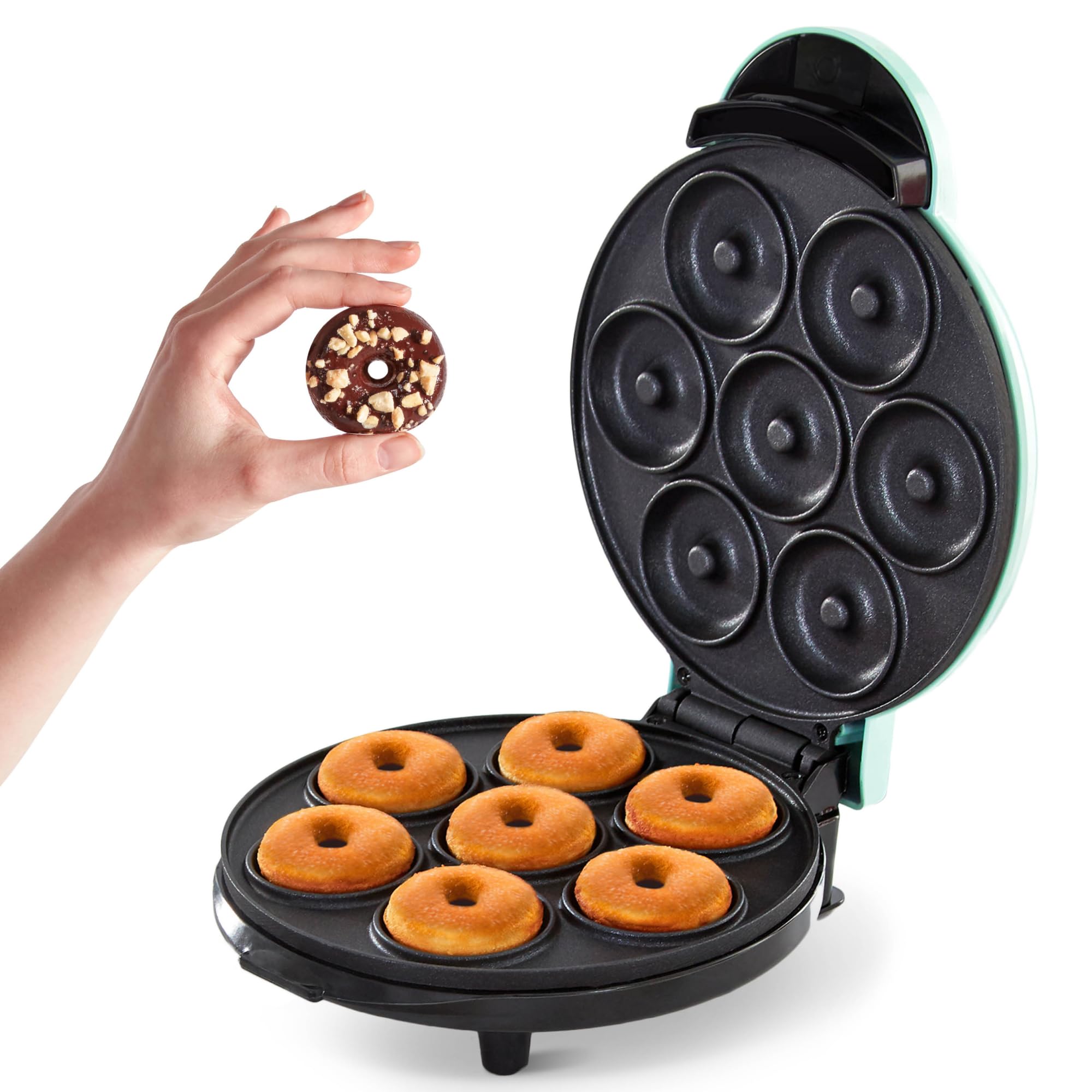


Best for Family Snacks
Dash Express Mini Donut Maker
Key Features
- Weight: 3.3 lb
- Footprint: 10.6 x 8.7 x 3.9 in
- Baking surface: Double-sided nonstick
- Donut capacity: 7 mini donuts
- Price: Budget
The Dash Express is the machine we reach for when the goal is a quick kitchen project rather than a bakery production run. Seven shallow wells, a 10.6-by-8.7-inch footprint, and a 3.3-pound body mean it earns counter space without taking over, and it tucks into a cupboard when the novelty wears off. A batch is small enough for two kids to decorate and quick enough to justify pulling out on a Sunday morning.
That balance is why it’s our top pick. The nonstick plates release cleanly, cleanup is a wipe once the machine cools, and the whole thing is simple enough for a child to help with under supervision. We especially like that it doesn’t demand a dedicated donut recipe: cake mix, brownie batter, and simple scratch batters all produce a snack-sized result. The catch is the donut itself: these are small, one-or-two-bite rings, so a batch disappears faster than you expect.
Where the Dash falls down is volume. Seven donuts won’t carry a party, and a family will bake two or three rounds; if that’s your routine, the JOVELL’s 16 wells make more sense. The aqua finish is a small bonus in a category full of black boxes, but the practical case is the compact size and unfussy cleanup. For the typical home baker, this is the one we recommend first.
Pros
- Compact enough for small kitchens
- Nonstick plates wipe clean
- Simple for supervised kids
- Works with cake mix or scratch batter
Cons
- Browning can vary from well to well
Our top pick for family snacks: seven small donuts, a compact footprint, and simple cleanup make the Dash the easiest first donut maker to live with.
Best for Budget Kitchens
KEINVE Mini Donut Maker
Key Features
- Weight: 2.4 lb
- Footprint: 8.95 x 7.37 x 4.23 in
- Baking time: 4 to 6 minutes
- Donut capacity: 7 mini donuts
- Price: Budget
The KEINVE’s appeal is texture at a budget price. The seven wells bake in four to six minutes, the nonstick plates release cleanly, and the mini donuts come out light and fluffy rather than dense. For a machine this simple, that texture is the difference between a novelty and something you bring out on a weekend.
At 2.4 pounds and under nine inches deep, it’s one of the easiest machines here to park on a small counter or stash in a cupboard. We like that the controls and cleanup stay out of the way: the surface wipes clean, the lid closes simply, and the batch size is right for a snack rather than a production line. It doesn’t feel like a toy, even though the price puts it in impulse-buy territory.
The seven-donut batch is right for a couple or a small family, not a crowd. If you already have a cake mix or a favorite batter, the KEINVE is a lot of machine for the money. We recommend it to anyone who wants a low-cost way into mini donuts and doesn’t need extras. The simple build is the point.
Pros
- Light, fluffy mini donuts
- Small 2.4-pound body
- Quick four-to-six-minute batches
- Easy nonstick cleanup
Cons
- No recipe booklet; basic instructions
- Small donuts disappear quickly
A strong low-cost choice for light, fluffy mini donuts and a small counter footprint, as long as you bring your own recipes.
Best for First-Time Bakers
Chef Buddy Mini Donut Maker
Key Features
- Wattage: 1000 watts
- Footprint: 11 x 8 x 4 in
- Donut capacity: 7 mini donuts
- Donut diameter: 2 inches
- Price: Midrange
A recipe booklet is a small inclusion that changes how quickly a new donut maker gets used. The Chef Buddy comes with one, plus 2-inch wells and simple red and green indicator lights, so the first batch doesn’t depend on guesswork. Seven wells, 1000 watts, and a nonstick surface put it in the same practical territory as the Dash.
We like it for first-time bakers because it removes two common hurdles: what to make and when the plates are ready. The cool-touch handle is a sensible touch, and the compact 11-by-8-inch footprint fits a normal counter. Donuts come out even and release without a fight. It isn’t the most flexible machine here, since the Babycakes does cake pops and cupcakes, but it’s the straightforward one we hand to someone who just wants a dependable donut maker.
The upside is that it heats quickly and the recipe booklet gives you a starting point instead of a blank page. For a household that wants a classic mini donut maker with a little guidance included, the Chef Buddy is an easy recommendation. It doesn’t try to be the most versatile machine here; it just does the donut job without fuss.
Pros
- Recipe booklet included
- Simple red and green lights
- Cool-touch handle
- Even, easy release
Cons
- Two-inch donuts are snack-sized
- Only seven donuts per batch
The friendliest first donut maker for many buyers, thanks to a recipe booklet, clear controls, and a cool-touch handle.
Best for Tiny Kitchens
DSP Mini Donut Maker
Key Features
- Weight: 16 oz
- Wattage: 750 watts
- Footprint: 9.9 x 7.9 x 3.62 in
- Donut capacity: 7 mini donuts
- Price: Budget
At 16 ounces, the DSP is the machine we move around the kitchen without a second thought. It slides into a cupboard, sits on a crowded counter without dominating it, and still bakes seven mini donuts. The cool-touch handle and red-and-green indicator lights make the start-and-wait rhythm easy to follow.
That light build doesn’t feel flimsy in use. The nonstick plates release donuts cleanly and wipe down after they cool, and the layout is best for a quick breakfast or an after-school snack rather than a party. The simple controls make it easy to bring out, use, and put away, which matters more than another feature on a machine this small.
The DSP is the pick when storage matters more than batch size. The JOVELL makes more sense for a crowd; the DSP makes more sense for a small kitchen that wants donuts occasionally. That’s a narrow but useful brief, and it fills it well.
Pros
- 16-ounce body is easy to store
- Simple red and green lights
- Nonstick plates wipe clean
Cons
- No recipe booklet included
- Small donuts are gone in a few bites
The storage-friendly pick for tiny kitchens: a 16-ounce body, simple lights, and seven decent mini donuts.
Best for Party Batches
JOVELL 16-Hole Mini Donut Maker
Key Features
- Wattage: 1400 watts
- Dimensions: 13.3 x 11.4 x 13.3 in
- Hole diameter: 1.97 inches
- Donut capacity: 16 mini donuts
- Price: Midrange
Sixteen wells is the number that defines the JOVELL. Where most machines here bake seven or eight mini donuts, this one turns out a full tray at once, and the 1.97-inch holes keep each donut in one-or-two-bite territory. For a birthday table or a batch to freeze, that capacity changes the rhythm: you’re filling one large plate instead of running three cycles.
The 1400-watt element and double-sided plates are built for that volume, and the package includes a brush and mini oven gloves. The nonstick surface released cleanly in our batches, and the wells are close enough together that a full tray feels manageable rather than fussy. A full tray also means more donuts to glaze before the next round goes on.
We recommend the JOVELL to the cook who wants donuts for a crowd. It isn’t the machine for a casual single batch; the Dash and DSP are easier to bring out day to day. But when volume is the job, the 16-hole layout is the reason to choose it.
Pros
- Bakes 16 mini donuts at once
- 1400 watts for high-volume batches
- Double-sided nonstick plates
- Brush and mini gloves included
Cons
- Large body needs dedicated counter space
The batch machine to choose when you need 16 mini donuts at once and have the counter space to support it.
Best for Ceramic Release
AshGlen 8-Hole Mini Donut Maker

Key Features
- Footprint: 8.7 x 8.7 x 3.5 in
- Baking surface: Ceramic nonstick
- Donut capacity: 8 mini donuts
- Donut diameter: 2 inches
- Price: Budget
The AshGlen’s ceramic-coated plates are the reason to look at it. Most mini donut makers here use a dark nonstick surface; this one uses a ceramic coating, and the eight 2-inch wells give it one more slot than the seven-donut machines. The 8.7-inch square footprint and 2.7-pound body keep it in the same small-appliance class as the Dash.
We’re drawn to the idea of a ceramic surface for easy release and cleanup, and the compact shape is easy to live with. The 750-watt element is at the lower end of this group, so it doesn’t compete on power; the case for the AshGlen is the coating and the extra well, not brute force. It also includes a brush for the plates, which is a sensible pairing for ceramic.
If you want the safest default, choose the Dash. If the coating is what sells you, this is the compact way to get it. The eight wells are still small, and the batch is still a snack rather than a party spread, but the design gives you a reason to consider it beyond the usual black box.
Pros
- Ceramic-coated nonstick plates
- Eight wells instead of seven
- Compact 8.7-inch square body
Cons
- Long-term durability still unproven
A compact ceramic-coated alternative for buyers who want an eight-well plate and a different release surface.
Best for Cake Pops Too
Babycakes 3-in-1 Treat Maker

Key Features
- Footprint: 10.35 x 8.35 x 4.65 in
- Treat types: Cake pops, cupcakes, donuts
- Donut capacity: 7 mini donuts
- Interchangeable plates: 3 nonstick plates
- Price: Premium
The Babycakes earns its place by refusing to be only a donut maker. Three interchangeable nonstick plates let it bake seven mini donuts, seven cupcakes, or 12 cake pops, and the plates are removable and dishwasher-safe. That versatility is the whole pitch; the donut plate alone would put it in a crowded field.
As a donut maker, it bakes seven small rings in about five minutes, with even results and a nonstick surface that releases cleanly. The 4-pound body and 10.35-by-8.35-inch footprint make it heavier and a little bulkier than the simplest machines, but the removable plates are a genuine cleanup advantage. The cake-pop and cupcake plates are not afterthoughts either; they give the appliance a second life for parties.
The donuts are still mini, closer to a vanilla wafer than a bakery doughnut, so this is not the pick for someone who wants a big, yeasty donut. And if donuts are the only thing you’ll make, the other plates won’t earn their keep. That is the boundary of the recommendation.
For a family that wants one appliance for cake pops, cupcakes, and donuts, though, the Babycakes is the most flexible machine here. We recommend it to the household that already knows it will use the other plates, not to the shopper who just wants the simplest donut maker. The removable plates make the extra bulk easier to justify.
Pros
- Three removable nonstick plates
- Bakes donuts, cupcakes, and cake pops
- Dishwasher-safe plates
- Even donut baking
Cons
- Higher cost than dedicated donut makers
The most flexible pick here for families who want donuts plus cake pops or cupcakes from one removable-plate appliance.
How We Tested the Best Donut Makers
To build our shortlist, we researched the best-selling and highest-rated donut makers on the market, filtering by price, size, capacity, and features like removable plates and timers. From about 30 models, we chose 14 to test, from compact single-donut machines to larger batch models. Each one lived in our kitchens for six months, used for weekend breakfasts, after-school snacks, and birthday party prep.
To check heat distribution, we baked plain cake donuts and looked for even browning across the surface—no pale patches or scorched edges—and timed how long each took to preheat. For ease of use, we noted how clear the controls were and whether the machine beeped or shut off automatically. We also had kids help pour batter and press buttons under supervision; the models that felt safest and most intuitive for small hands rose to the top. Fun mattered, too: we watched which machines the kids asked to use again and which ones made the process feel like a chore.
For cleaning, we checked whether the plates were removable, how easily donuts released, and whether we could wipe the exterior without scratching it. We measured each machine’s counter footprint and storage size, and compared price against performance to judge value for money. We also noted which models included recipes and which left you to figure out the batter yourself. The ones that made our final list were consistent, easy to clean, and genuinely enjoyable to use—not just another appliance gathering dust.
How to Choose a Mini Donut Maker
The right donut maker is the one whose batch size, footprint, and cleanup match the way you actually snack, not the one with the longest feature list.
Match Capacity to the Way You Serve
Seven wells is the sweet spot for a couple or a small family: you get a warm batch in minutes, and a second round doesn’t feel like a project. A 16-hole machine such as the JOVELL is for parties, bake sales, or freezing a stash; it takes more counter space and makes more donuts before you’ve finished glazing the first one. Remember that these are mini donuts, often two inches across. Judge capacity by how many rounds you’ll realistically bake, not by how many donuts fit in one go.
Watch Even Browning, Not Just Wattage
Double-sided heating is standard here, but power ratings don’t guarantee an even tan. A 1400-watt machine may recover heat faster, while a 750-watt model can still bake a good batch; what matters is how the plates distribute heat across the wells. Check the first batch at the low end of the suggested time, and expect some variation on wide plates. Glaze and cinnamon sugar hide small differences. If you want plain, evenly colored rings, stay with a smaller plate and check early rather than chasing the highest wattage.
Measure the Counter and the Cupboard
Footprints range from about 8.7 inches square to more than 13 inches deep, and weight runs from 16 ounces to nearly five pounds. A light seven-donut maker is easy to pull out and put away; a 16-hole machine tends to live on the counter. Measure the spot with the lid open, not just closed, and check the height under your cabinets. Removable plates, as on the Babycakes, make cleanup easier, but fixed nonstick plates only need a wipe once they cool.
Plan for Kids and Hot Plates
A donut maker is a good family project because the work is simple: pour, close, wait, decorate. It is still a hot appliance. Keep supervised children at the decorating end, use cool-touch handles, and unplug the machine before cleaning. The Dash and KEINVE are easy to bring into that routine; the bigger JOVELL needs more clear space around it. Small donuts are tempting to grab straight from the plate, so give them a minute to cool before anyone reaches in.
Frequently Asked Questions
Why do donuts from a mini maker taste more like cake than fried donuts?
They’re baked, not fried. The batter sets against hot plates, so the result is closer to a small cake or cookie than a yeasty raised doughnut. That’s why glaze, cinnamon sugar, and flavored icing do so much work here. If you want the light, airy texture of a fried doughnut, this is the wrong appliance; if you want a warm, cakey snack in minutes, it delivers.
Can I use cake mix or pancake mix in a donut maker?
Yes, and cake mix is the easiest place to start. Keep the batter thick enough to spoon rather than pour, fill each well about two-thirds full, and check the first batch at the low end of the time range. A loose batter needs less time, not more. Brownie mix and pancake batter can work too, but treat the first batch as the test.
Do I need to grease a nonstick donut maker?
A thin coat of oil helps, especially on the first batch and on ceramic plates. Brush or spray lightly, then wipe away any pooling before it burns. The Chef Buddy instructions call for cooking spray, and the JOVELL includes an oil brush. Don’t use a heavy layer to compensate for a cold plate; preheat fully and let the donuts set before opening the lid.
Final Verdict
Buy the Dash Express if you want our best all-around pick for a home kitchen. It’s compact, simple, and budget-friendly against the rest of this group, and its seven-donut batches suit family snacks better than a giant machine that lives in a cupboard. The trade-offs are real, including small donuts and browning that can vary, but they don’t outweigh the ease.
If you regularly bake for a crowd, choose the JOVELL for its 16 wells. If recipes and a calm first experience matter more, the Chef Buddy is the friendlier choice. The Dash remains the default because it fits the most kitchens and the most ordinary Sunday mornings.