This post contains affiliate links. We may earn a small commission when you buy through our links — at no extra cost to you.
Many yogurt makers today fix their temperature around 110–115°F, which works fine for standard yogurt but kills delicate probiotic strains like L. Reuteri that need 97–100°F. If you’re buying a machine to make specific health-focused yogurts, you’ll quickly discover that preset temperature is a hard barrier.
The real choice in this category isn’t between different brands—it’s between machines that let you dial in the exact temperature and time, and those that simply incubate at a single heat. The first group gives you control over probiotic viability and recipe flexibility. The second group offers simplicity and lower cost.
This guide helps you decide which approach fits your kitchen routine, whether you’re after L. Reuteri with 36-hour ferments or just want a reliable batch of plain yogurt every week.


Best for Precise Probiotics
Ultimate Probiotic YM
Key Features
- Temperature Control: Adjustable 68-131°F
- Capacity: 2 quarts (2 jars)
- Timer / Auto Shut-Off: Up to 48h, auto shut-off
- Included Accessories: 2 glass jars
- Price: Mid-Range
Adjustable temperature from 68°F to 131°F and a timer that runs up to 48 hours give this machine the flexibility to ferment anything from standard yogurt to heat-sensitive probiotic cultures like L. Reuteri. The dual 1-quart glass jars hold a full 2 quarts, and the temperature holds steady enough to produce consistently thick, creamy results.
The interface is straightforward: set the temperature and time, press start. Cleaning is simple because the glass jars are dishwasher-safe, and the exterior stays cool during operation. The lifetime warranty backs the build, though the unit itself feels solid from the start.
This machine suits health-conscious cooks who want to experiment with probiotic strains that require specific incubation temperatures — the simpler preset machines can’t do that. It’s also a good fit for households that go through 2 quarts of yogurt per batch. The tradeoff: temperature calibration may vary by 2–3°F between units, so anyone needing lab-grade accuracy should verify with an external thermometer. For everyday probiotic yogurt, the variance doesn’t affect results.
Where the fixed-temperature classics offer simplicity at a lower price, the Ultimate Probiotic Maker trades that simplicity for precision. For anyone who has attempted to culture L. Reuteri or similar strains in a standard yogurt maker and gotten watery results, this machine solves that problem directly.
Pros
- Adjustable temperature (68–131°F) and 48-hour timer enable culturing a wide range of probiotic strains.
- Consistently produces thick, creamy yogurt with a clean taste.
- Simple to use and clean — glass jars are dishwasher-safe and the interface requires only two settings.
- Solid build quality with a lifetime warranty that covers long-term use.
Cons
- Temperature calibration can vary by 2–3°F between units, which matters if you need lab-grade precision.
For anyone serious about fermenting yogurt at specific temperatures, this machine delivers the control that preset models lack, backed by a warranty that covers the long haul.
Best for Budget Beginners
Euro Cuisine YM80
Key Features
- Temperature Control: Preset ~115°F
- Capacity: 42 oz (7 jars)
- Timer / Auto Shut-Off: Built-in (no digital)
- Included Accessories: 7 glass jars
- Price: Budget
The YM80’s appeal lies in its simple design: seven glass jars, a heating base, and a single switch. It lacks temperature adjustments, making it a different proposition than programmable machines that allow precise heat control.
For basic yogurt cultures, the machine delivers consistent results with minimal effort. The seven 6-ounce jars are easy to fill and store, and the glass material avoids plastic concerns. Users find setup and cleanup easy. However, because the heating element is fixed at approximately 115°F, anyone aiming to ferment probiotic strains that require lower temperatures may encounter issues with culture viability.
This model is best for first-time yogurt makers and budget-conscious households who want straightforward portion control. If your goal is to cultivate specific probiotics like L. Reuteri, the preset temperature runs too hot — consider a model with adjustable settings.
Pros
- Consistent results for standard yogurt making at a budget price.
- Easy to operate and clean with no complicated settings.
- Good value for a complete yogurt making kit with seven glass jars.
Cons
- For fermenting delicate probiotic cultures, the fixed ~115°F temperature may inactivate them.
- Jars can heat unevenly, leading to occasional inconsistency across the batch.
Good value for a simple yogurt maker — suited for beginners who don’t require temperature control.
Best for Greek Yogurt
Bear Greek Yogurt Maker
Key Features
- Temperature Control: Preset ~104°F
- Capacity: 2 quarts (2 jars)
- Timer / Auto Shut-Off: Up to 14h, auto shut-off
- Included Accessories: 2 glass jars, strainer
- Price: Mid-Range
The Bear Greek Yogurt Maker sets itself apart by combining fermentation and straining in a single appliance, thanks to the included 100-mesh stainless steel strainer. Unlike the top pick in our lineup, which offers adjustable temperature from 68–131°F, the Bear is fixed at approximately 104°F – ideal for standard yogurt and cheese ferments, but not for specialty probiotic strains that require lower temperatures. It also handles fruit wine and cheese, adding versatility beyond yogurt.
This machine suits Greek yogurt lovers who want a streamlined process without buying a separate strainer. The all-in-one design reduces cleanup and counter clutter. However, if you plan to ferment probiotics like L. Reuteri, the fixed temperature is a barrier. Additionally, while many units perform well over time, some have reported the heating element ceasing to function after months of regular use – a durability consideration for daily heavy use. For moderate weekly yogurt making, the convenience may outweigh this risk.
Pros
- Produces smooth, creamy Greek yogurt with the included strainer
- Easy to use with one-touch digital controls and timer
- Can also make cheese and fruit wine
Cons
- Temperature is preset to ~104°F – not adjustable for specialty probiotic ferments
- Heating element may cease to function after months of regular use
A practical pick for dedicated Greek yogurt makers who prefer a combined straining solution over temperature flexibility, provided they accept potential long-term durability variance.
Best for Digital Convenience
Euro Cuisine YMX650
Key Features
- Temperature Control: Preset (no adjustment)
- Capacity: 42 oz (7 jars)
- Timer / Auto Shut-Off: Up to 15h, auto shut-off
- Included Accessories: 7 glass jars, date lids
- Price: Mid-Range
The Euro Cuisine YMX650 upgrades the classic yogurt maker with a digital timer that runs up to 15 hours and an auto shut-off, plus date-marked lids that help track freshness. Unlike basic on/off models, this one lets you set the incubation duration and walk away, returning to finished yogurt without having to watch the clock.
This machine is best suited to individuals or couples who prefer single-serving glass jars and want a consistent, hands-off process. The fixed temperature works well for standard cow or goat milk yogurt, but it cannot be adjusted for probiotic strains that require cooler or warmer conditions. The six-ounce jars produce 42 ounces total – enough for a week of yogurt for one or two people.
The digital interface is intuitive: press to set hours, then the machine maintains a stable incubation environment. Glass jars heat evenly, and the lids seal securely for transferring to the fridge. Results are consistently thick and tangy batch after batch, with no need to monitor temperature or worry about overheating.
Pros
- Digital timer with auto shut-off eliminates guesswork – set up to 15 hours and walk away.
- Glass jars with date-marked lids simplify storage and tracking.
- Produces consistently thick, smooth yogurt without fuss.
Cons
- Single preset temperature cannot be adjusted for probiotic strains or specialty ferments.
If you want consistent yogurt with a timer and date-tracked jars, and you don’t need adjustable temperature, this model delivers without unnecessary complexity.
Best for Japanese Ferments
Iris Ohyama KYM-014
Key Features
- Temperature Control: Preset (no adjustment)
- Capacity: ~1 quart
- Timer / Auto Shut-Off: None (manual)
- Included Accessories: 1 container
- Price: Premium
Unlike the adjustable-temperature models from the same brand, the KYM-014 keeps incubation simple: a fixed temperature and a single on/off switch. That simplicity makes it a natural choice for traditional Japanese ferments like natto and koji, where steady warmth over 12–24 hours matters more than precise temperature curves. The 1-liter single-container design also eliminates the hassle of multiple jars.
This machine suits Japanese cooking enthusiasts who want an authentic domestic appliance for making natto, amazake, or yogurt. The tradeoff: all instructions are in Japanese, and the unit is rated for 100V AC – a step-down transformer is needed for standard 120V outlets in North America. For those comfortable with a translation app and a converter, it delivers consistent results with traditional ferments.
Customers note successful batches of natto, koji, and yogurt using the KYM-014. The plastic body is easy to clean, and the compact size tucks away easily. Without a timer or adjustable temperature, you’ll need to monitor ferment duration manually – the indicator light simply shows the unit is on. For the 12–24 hour ferments typical of Japanese home cookery, the fixed incubation temperature holds steady.
Pros
- Compact and lightweight – fits small kitchens and stores easily.
- Simple on/off operation with no settings to misconfigure.
- Capable of natto, koji, and amazake in addition to yogurt.
Cons
- Instructions and controls are entirely in Japanese – translation needed.
- No temperature or timer adjustments – fixed incubation only.
- Premium-priced for a basic yogurt maker compared to domestic alternatives.
For Japanese fermentation enthusiasts who value authenticity over adjustability, the KYM-014 is a focused tool. If you need temperature control or a US-friendly interface, the adjustable-temperature model from the same brand is worth the extra cost.
Best for Large Budget Batch
JoyMech 2 Quart

Key Features
- Temperature Control: Preset ~115°F
- Capacity: 2 quarts (2 jars)
- Included Accessories: 2 glass jars
- Price: Budget
The JoyMech delivers exactly what its name promises: two 1-quart glass jars for making yogurt in large batches—a rare capacity at this budget price point. Operation is simple: fill the jars, add starter, and press the one-touch button. However, the preset temperature hovers around 115°F, which suits standard yogurt cultures but is too high for probiotics that require lower heat. The lack of a timer means you’ll need to track incubation manually. This is a basic machine for straightforward yogurt, not for fine-tuned ferments.
Pros
- Two 1-quart containers for making up to 2 quarts of yogurt at once
- Simple one-touch operation – plug in and press start
- Glass jars are dishwasher-safe for easy cleanup
Cons
- Fixed incubation temperature (~115°F) can kill probiotic cultures that need lower heat
- No timer to set incubation duration – requires manual tracking
Best for budget-conscious households making large batches of standard yogurt who don’t need precise temperature control or a timer.
Best for Cheapest Entry
JoyMech 1 Quart

Key Features
- Temperature Control: Preset ~120°F
- Capacity: 1 quart
- Included Accessories: 1 stainless steel pot
- Price: Budget
At under $20, the JoyMech offers a no-frills way to make small batches of yogurt. It produces good-tasting yogurt when you pre-heat the milk correctly. However, the fixed incubation temperature runs too hot for certain probiotic cultures (reaching over 120°F), and durability is a concern: some units have been noted to stop heating after a few months. This suits occasional use or a low-cost trial, but not consistent results or specific probiotic strains.
Pros
- Very affordable and simple to use
- Makes good-tasting yogurt when user follows proper milk heating steps
Cons
- Fixed temperature can exceed 120°F, too high for some probiotic cultures
- Durability concerns: units have been noted to stop heating after a few months
Best for one-off experiments or occasional use where price is the primary concern and temperature precision isn’t critical.
Best for Off-Grid Use
Country Trading Thermal

Key Features
- Temperature Control: None (thermal)
- Capacity: 1 quart
- Included Accessories: Recipe book
- Price: Mid-Range
This stainless steel jar keeps milk at incubation temperature after a brief pre-heat, yielding thick, tangy yogurt without plugging into anything. Its compact size fits in a backpack or small cabinet, making it a practical option for camping or off-grid kitchens.
The tradeoff is hands-on timing: you must preheat both the milk and the glass jar to the right temperature before pouring, and the insulated chamber may not hold enough heat in a cold room. For electric yogurt makers, consistent temperature is automatic — this requires more attention.
Pros
- No electricity needed – works as a thermos for off-grid use
- Produces thick, tangy yogurt with good temperature retention
- Compact stainless steel design fits easily in cabinets
Cons
- Temperature retention may be inconsistent in cold kitchens – yogurt may not set
- Requires precise pre-heating of milk and jar; more hands-on than electric models
Best for campers, off-grid kitchens, or anyone who wants to avoid adding another corded appliance to the counter.
Best for Budget Multifunction
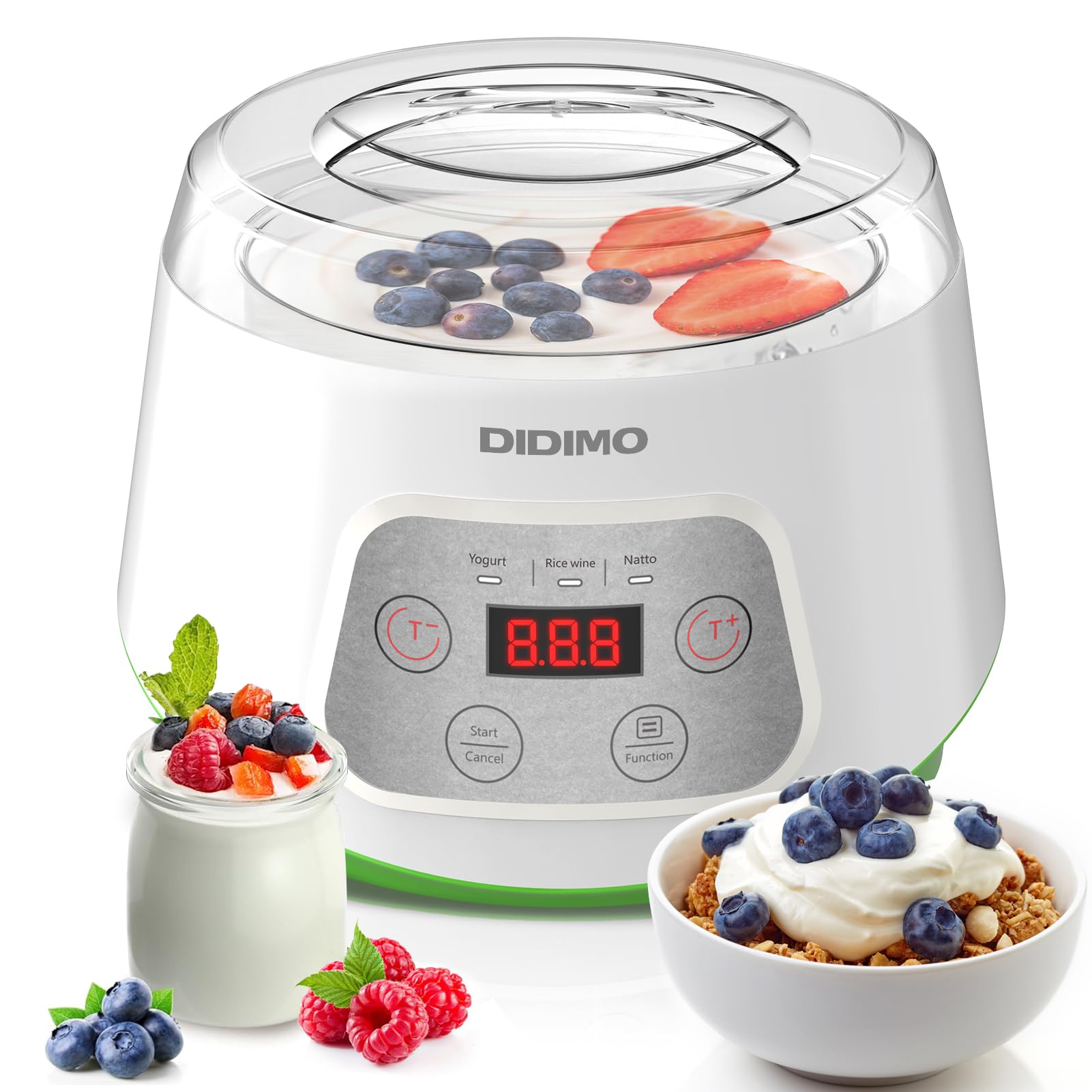
DiDimo Yogurt Maker
Key Features
- Temperature Control: Preset (fluctuates)
- Capacity: 1 quart
- Timer / Auto Shut-Off: Adjustable timer
- Included Accessories: Strainer, stainless liner
- Price: Budget
The DiDimo Yogurt Maker bundles a timer, built-in strainer, and stainless steel liner at an entry-level price. It can produce yogurt with a pleasant taste and consistency when conditions align. However, the incubation temperature swings widely — from 95°F to 117°F in some cases — which may kill the delicate probiotic cultures needed for therapeutic yogurts. Long-term durability is also uncertain, with occasional reports of heating elements failing after a few months. This unit suits someone who wants an inexpensive tool for basic yogurt and isn’t reliant on precise probiotic yields.
Pros
- Includes timer and strainer at a budget price
- Capable of producing yogurt with pleasant taste and consistency
Cons
- Incubation temperature can fluctuate significantly, hindering probiotic development
- Some units may stop working after just a few months of use
Only consider this model if your budget is extremely tight and you are willing to accept temperature inconsistency and potential early failure for the sake of low upfront cost.
Best for Advanced Ferments
Iris Ohyama IYM-012

Key Features
- Temperature Control: Adjustable (Celsius)
- Capacity: ~1 quart
- Timer / Auto Shut-Off: Up to 8h
- Included Accessories: 1 container
- Price: Luxury
The Iris Ohyama IYM-012 stands out for its adjustable temperature control, enabling precise ferments like natto and amazake that most yogurt makers can’t handle. However, it is a Japanese domestic unit with instructions only in Japanese and rated for 100V—using it on 120V requires a step-down transformer to avoid potential overheating. The maximum timer of 8 hours is also short for long probiotic ferments like L. Reuteri. At a premium price, this is a niche tool for enthusiasts of Japanese fermentation techniques rather than a general yogurt maker.
Pros
- Adjustable temperature range supports natto, amazake, and other traditional Japanese ferments.
- Fine-grained Celsius control allows precise incubation for specialty cultures.
Cons
- Timer shuts off after 8 hours, too short for probiotic ferments needing 36+ hours.
- Japanese-only instructions and 100V rating require a step-down transformer for US outlets.
Best for dedicated home fermenters focused on natto, koji, or amazake who can accept the short timer and voltage requirements.
Best for Basic Yogurt
Iris Ohyama IYM-016

Key Features
- Temperature Control: Preset (no adjustment)
- Capacity: ~1 quart
- Included Accessories: 1 container
- Price: Premium
This machine does one thing: heat milk and maintain temperature for yogurt incubation. It produces consistent results for standard yogurt, similar to the previous KYM-014 model. However, the design is unchanged – no timer, no temperature control. The plastic construction is lightweight but can absorb odors after repeated use. Capacity is not specified, so expect around one liter. The main drawback is that the older model has a longer history of use, so its durability is better established – this newer version has less accumulated real-world experience, making it a riskier pick for those prioritizing long-term reliability.
Pros
- Simple on/off operation for straightforward yogurt making
- Compact footprint fits easily on most countertops
Cons
- Plastic body can absorb yogurt odors over time
- Capacity is not listed, so some users may find it smaller than expected
This yogurt maker suits buyers who want the latest Iris Ohyama design and trust the brand’s consistency, but those who value a proven track record should look to the older KYM-014 model.
How to Choose
The biggest differentiator in yogurt makers is whether the temperature can be adjusted—preset machines work for basic yogurt but fail for specialty probiotics.
Temperature Control
Choose between adjustable and preset temperature. Adjustable models let you set a precise temperature, typically between 68°F and 131°F, which is essential for probiotic strains like L. Reuteri that need 97–100°F. Preset machines fix the temperature at 110–115°F, suitable for standard yogurt but too hot for delicate cultures.
If you plan to make only plain yogurt, a preset machine saves money. But if you want to experiment with different probiotic strains or longer ferments, adjustable temperature is a must. Even a 2–3°F variance can affect culture viability.
Capacity
Capacity determines how much yogurt you can make per batch. Machines range from 1 quart (single jar) to 2 quarts (two jars) or multiple small jars totaling around 1.3 quarts. Small individual jars offer portion control but can have temperature variation between jars, leading to inconsistent results. A single large container heats more evenly.
Timer and Auto Shut-Off
A timer allows you to set the fermentation duration and have the machine shut off automatically. For basic yogurt, 8–15 hours is sufficient. For probiotic strains that require 36 hours or more, you need a timer that supports up to 48 hours. Budget models often lack a timer or have a fixed cycle, which means you must manually monitor the process.
Included Accessories
Most yogurt makers come with glass jars, but some include strainers for Greek yogurt. Glass jars are dishwasher safe and more durable over time than plastic. Strainer meshes are delicate and require gentle hand-washing. Date-marked lids help track freshness. Evaluate whether the included accessories match your routine or if you’ll need to buy extras.
Warranty
Warranty length signals the manufacturer’s confidence in the product. Lifetime warranties (rare) suggest high build quality, while 3-year warranties are common for mid-range machines. Many budget models have no stated warranty, which may indicate a shorter lifespan. If you plan to use the machine weekly, a longer warranty provides peace of mind against heating element failure.
FAQ
Can I make L. Reuteri yogurt in any yogurt maker?
No, L. Reuteri requires a steady temperature of 97–100°F for up to 36 hours. Most preset machines run at 110–115°F, which kills the culture. You need a machine with adjustable temperature, like the Ultimate Probiotic Maker, that can maintain low heat for long periods.
Why does my yogurt maker run too hot and kill the culture?
Many budget and mid-range yogurt makers fix the temperature at 110–115°F, which is too high for probiotic strains like L. Reuteri. Check the spec for ‘adjustable temperature’ before buying. Even preset machines can vary, so using an external thermometer helps verify actual temperature.
How do I know if my yogurt maker temperature is accurate?
Place a reliable kitchen thermometer in a jar of water inside the machine during a cycle. Compare the reading to the set temperature. If it’s off by more than 2–3°F, you may need to adjust your recipe or consider a machine with a wider range.
Is a non-electric yogurt maker as effective as an electric one?
Non-electric thermal models rely on pre-heating milk and jar, and then maintaining heat through insulation. They work well in warm kitchens but can struggle in cold environments. They lack precise temperature control, so they’re best for basic yogurt only, not for specialty probiotics.