This post contains affiliate links. We may earn a small commission when you buy through our links — at no extra cost to you.
Most induction burner specs list wattage and temperature steps but stay silent on noise. Yet that high-pitched whine or loud fan is the top frustration buyers discover after unboxing — a trade-off that turns a fast-boiling burner into a kitchen annoyance.
Quiet operation doesn’t have to mean lower power. The trick is matching the burner’s cooling system, coil design, and build materials to your cooking volume. A commercial-grade stainless steel unit with a well-insulated fan can run silently on 1800W, while a budget glass-top model with the same wattage may force you to raise your voice.
This guide cuts through the spec sheets to highlight the real differences: which burners keep noise low without sacrificing heat, and where you’ll need to trade temperature granularity for a quieter kitchen.


Best for Quiet, Durable Cook
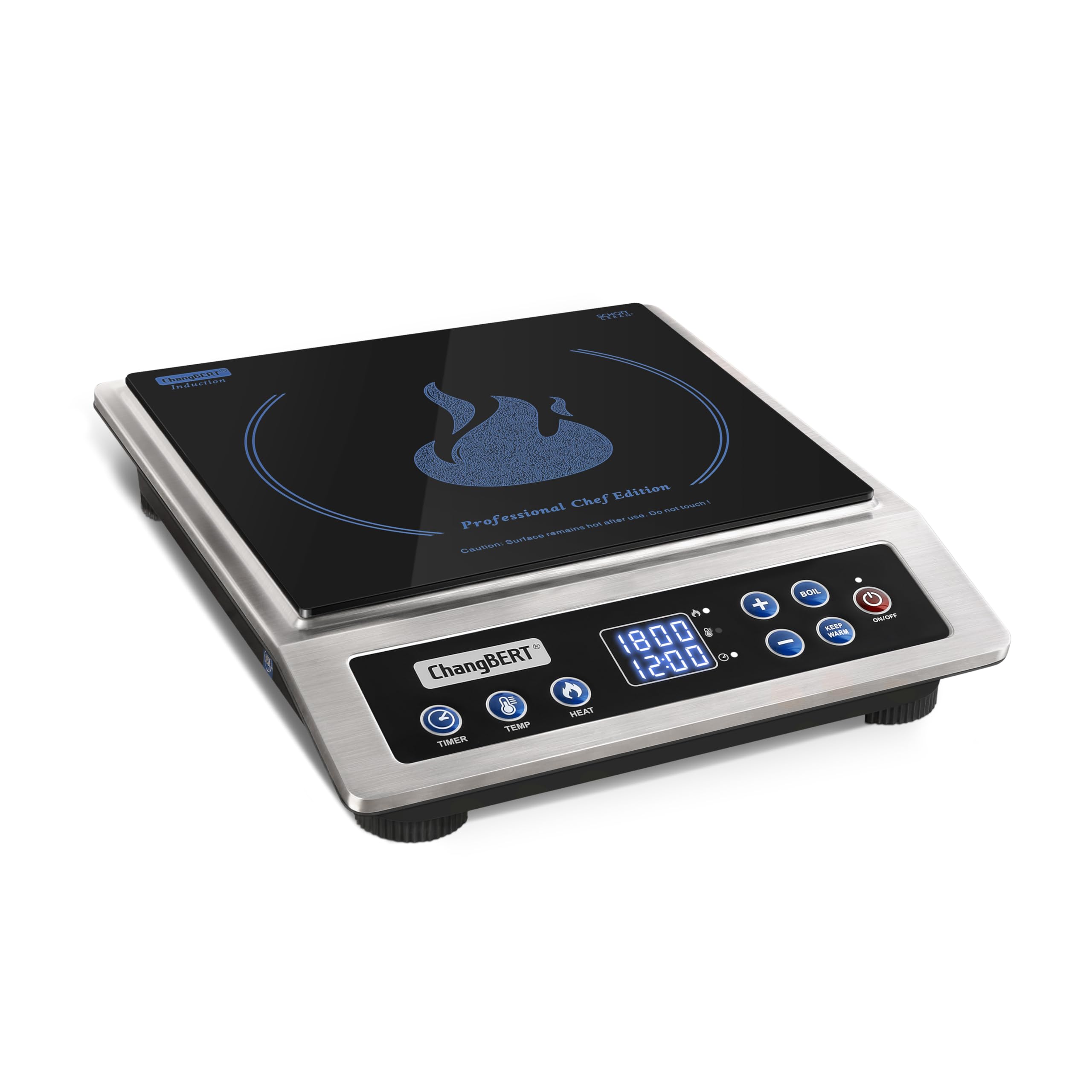
ChangBERT CIB-80
Key Features
- Power: 1800W
- Temp Control: 18 steps, 20°F inc.
- Burners: 1
- Noise: Low
- Build Material: Stainless steel
- Price: $$
The ChangBERT CIB-80 is notably quiet for an induction burner, with minimal fan noise and no high-pitched coil whine. Its 1800W heating coil brings water to a boil fast and sears meat with authority, while the stainless steel housing and NSF certification suggest it can handle daily use without showing wear.
Temperature control is stable: set a target and the burner holds it without significant fluctuation over a 10-hour timer. The 20°F adjustment steps (120–460°F across 18 increments) cover most cooking needs, though melting chocolate or maintaining a precise low simmer requires a more granular step than what’s offered here. The 8-inch coil accommodates larger pans without cold spots.
This burner suits home cooks who want the power of induction without the noise that often comes with it. It’s a strong fit for RVs, campers, or outdoor kitchens where a quiet appliance matters. The 20°F temperature steps are a clear boundary—those who frequently work with narrow temperature windows (candy making, delicate sauces) may find the increments too wide. NSF certification adds peace of mind for light commercial use or for buyers who value third-party durability verification.
Compared to popular budget induction burners, the CIB-80’s stainless steel body feels more robust, and its fan runs at a level that won’t interrupt conversation. It lacks the multi-burner flexibility of dual-zone units, but as a single high-performance burner it delivers on the core promises: heat fast, stay quiet, last.
Pros
- Fan and coil operate quietly, even at high power settings.
- Stainless steel housing and NSF certification indicate commercial-grade durability.
- Temperature holds steady once set, with minimal fluctuation during cooking.
- Heating is fast: boils water and sears meat in a fraction of the time of electric coils.
Cons
- Temperature adjustment steps are 20°F, which may be too coarse for extremely delicate tasks like melting chocolate.
- Some units have experienced electronic or fan failure after a few months of use.
Quiet, powerful, and built to a commercial standard—if you can work within 20°F steps, this is the burner to buy.
Best for Budget Cooking
Duxtop BT-180G3
Key Features
- Power: 1800W
- Temp Control: 15 steps
- Burners: 1
- Noise: High
- Build Material: Glass top
- Price: $
The Duxtop BT-180G3 has accumulated a massive user base over years of service, making it the most vetted entry-level induction burner available. It boils water rapidly and heats evenly across the pan surface, handling everyday tasks like frying, pasta, and stir-fry without complaint. The push-button controls are straightforward – no learning curve, no surprises.
Where this burner saves money, it also makes noise. The cooling fan and coil produce a high-pitched whine that will be noticeable in a quiet kitchen or open-plan living area. This limits its appeal to those who can tolerate audible background hum – campers, RVers, or anyone using it in a garage or well-ventilated space won’t mind. The 15 temperature steps (200–1800W power) are sufficient for boiling, searing, and medium-heat cooking but feel coarse when you need to hold a delicate simmer or melt chocolate.
Despite the noise limitation, the BT-180G3 delivers consistent performance that has kept it on kitchen counters for years. The glass top cleans easily, and the unit runs without error codes or erratic heating in normal use. For the price, you get a solid workhorse that handles 90% of cooking tasks without fuss – just not the quietest or most precise tool for the job.
Pros
- Exceptional value – the most affordable entry into 1800W induction cooking with a long track record.
- Heats quickly and evenly – boils water in under two minutes and browns consistently.
- Simple push-button controls with no menu diving or touchscreen lag.
- Durable build that holds up to daily use over several years.
Cons
- In a quiet kitchen, the fan and coil produce a high-pitched whine during operation – less bothersome in loud or outdoor spaces.
- 15 temperature steps limit fine control for delicate sauces or holding a low simmer – acceptable for general cooking.
If you need a no‑nonsense induction burner for everyday boiling, frying, and quick meals and can live with audible fan noise, this is the most cost‑effective choice with a proven track record.
Best for Precision Cooking
Nuwave Flex
Key Features
- Power: 1300W
- Temp Control: 5°F inc., 45 temps
- Burners: 1
- Noise: Mid
- Build Material: Ceramic glass
- Price: $$
The Nuwave Flex delivers precisely controlled heat with 45 temperature settings in 5°F steps, letting you dial in exact temperatures for delicate tasks like melting chocolate, holding hollandaise, or cooking eggs without guesswork. That level of fine control is rare at this price point, and it heats pans quickly for its 1300W rating — sauces come up to temperature fast once the coil engages.
The tradeoff for that precision is lower maximum wattage compared to 1800W models, which means boiling a large pot of pasta takes noticeably longer. The 6.5-inch heating coil also limits pan size; wider pans may have cooler edges. And while many units perform well over time, some owners have encountered error codes (E1, E7) after several months of use — worth factoring into your purchasing decision.
This burner suits home cooks who value exact temperature control for sauces, eggs, and chocolate more than raw boiling speed. It’s also a strong fit for RVs, dorms, or anyone who needs a lightweight, portable burner that doesn’t hog counter space. If you regularly boil large pots or want an appliance built for daily heavy use over years, a higher-wattage model with better long-term track record is a safer call.
Pros
- Fine 5°F temperature control for delicate cooking
- Heats pans quickly despite 1300W limit
- Lightweight and portable — easy to pack or store
- Good value for entry into precision induction
Cons
- 6.5-inch coil may leave larger pans with uneven heat distribution
- 1300W limit means slower boiling of large pots compared to 1800W burners
- Some units may develop error codes (E1, E7) after several months, suggesting unit variance
Best for home cooks who want laboratory-like temperature precision without spending triple the price — just be prepared for slower large-pot boiling and occasional unit variance.
Best for Griddle Cooking
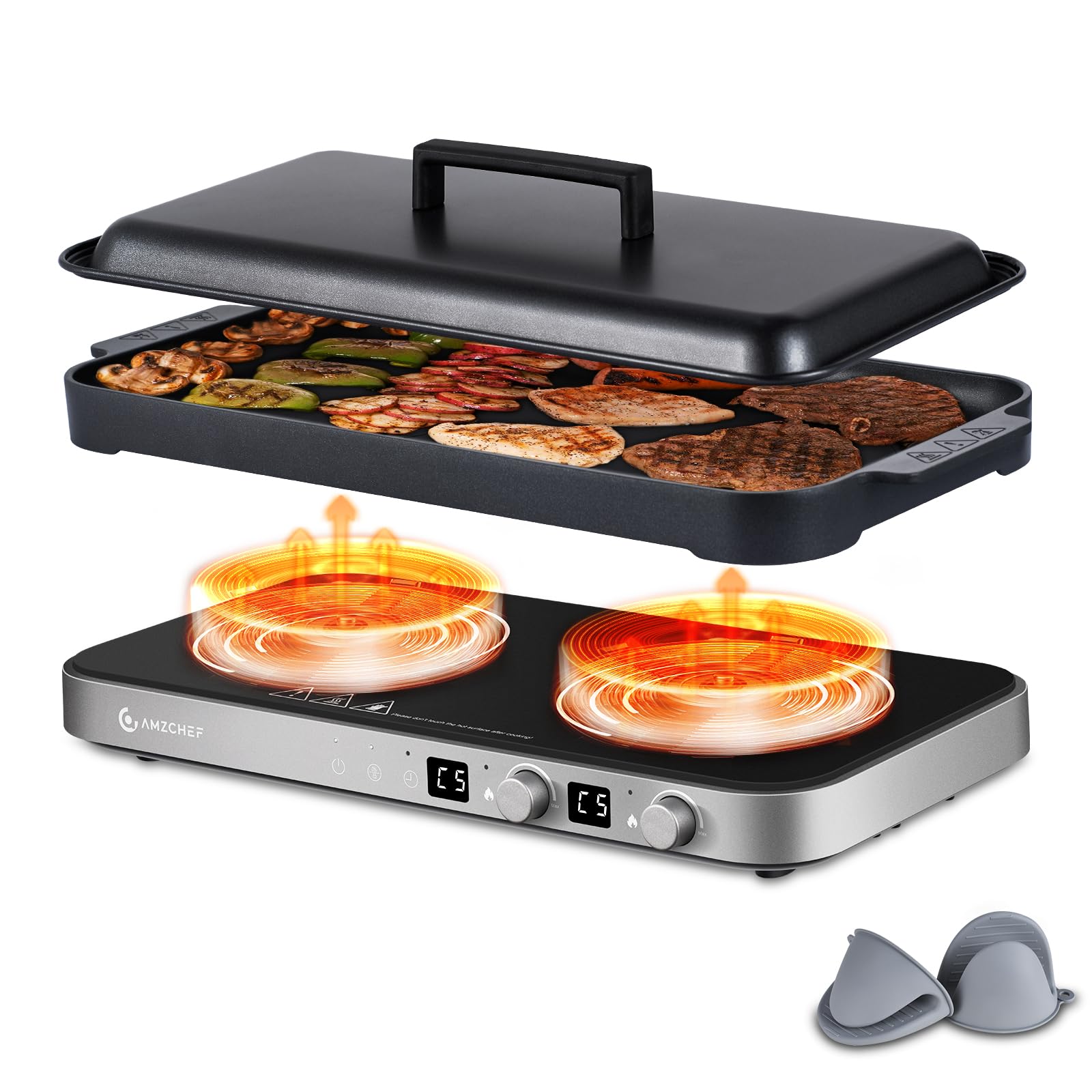
AMZCHEF Double Griddle
Key Features
- Power: 1800W shared
- Temp Control: 9 levels
- Burners: 2
- Noise: Mid
- Build Material: Glass top
- Price: $$
The AMZCHEF Double Griddle combines two induction burners and a detachable non-stick griddle in one unit, offering a space-saving alternative to separate cookware. Unlike dedicated dual-zone induction cooktops that prioritize precise temperature control, this model focuses on versatility for multi-item breakfasts and one-pan meals.
The 1800W total power is shared between the two burners, so when both are on high, each delivers less output than a single standalone burner. This makes the AMZCHEF less suited for tasks requiring simultaneous high heat—like rapidly boiling two large pots—but for typical breakfast cooking (griddling bacon on one side while simmering eggs on the other), the heat distribution is consistent and reliable.
This unit fits families, campers, or RVers who want one appliance that handles both griddle and stove cooking. The power sharing means it’s not ideal for heavy dual-zone use, but for morning routines, burgers, and simple stir-fries, it delivers predictable results without requiring extra pans.
Pros
- Two burners plus a detachable non-stick griddle in one appliance — simplifies cooking pancakes, eggs, and bacon.
- Heats up quickly and distributes heat evenly across the griddle, producing consistent browning.
- Smooth glass top and non-stick griddle wipe clean easily after cooking.
Cons
- The 99-minute timer is shorter than some competitors’ options — not a concern for most meals but a limit for long slow-cooking sessions.
A smart pick for households that want a single appliance for griddle and stove cooking, as long as you don’t need full power on both burners at once.
Best for Premium Build
ChangBERT Pro
Key Features
- Power: 1800W
- Temp Control: 18 steps, 20°F inc.
- Burners: 1
- Noise: Low
- Build Material: Schott glass, stainless steel
- Price: $$$
The ChangBERT Pro sets itself apart from the standard ChangBERT with a Schott Ceran glass surface and full stainless steel body. This gives it a noticeably more premium feel and added durability for frequent use. It shares the same 1800W heating coil and core induction performance as the top pick, so heating speed and temperature stability are on par.
This burner is best suited for home chefs who prioritize build quality and quieter operation over cost. The 20°F temperature steps are adequate for most cooking tasks, but may be too coarse for delicate work like melting chocolate or holding a precise low simmer. Those who need finer control should consider models with smaller increments.
Fan noise is minimal compared to many budget induction burners, making it a better fit for open kitchens or dining areas. The large 8-inch heating coil accommodates most pan sizes, and the 12-hour timer adds convenience for slow cooking. With only 18 temperature steps, you’ll rely more on power-level adjustments for precision.
Pros
- Commercial-grade build with Schott glass and stainless steel
- Holds set temperature without drifting
- Heats rapidly for boiling and searing
- Operates quietly with minimal fan noise
Cons
- 20°F temperature steps can be coarse for low-temperature cooking like melting chocolate or holding a gentle simmer
If premium materials and quiet operation are priorities and the coarse temperature steps are acceptable, the ChangBERT Pro delivers a commercial-grade experience.
Best for Feature-Rich
Duxtop 9600LS

Key Features
- Power: 1800W
- Temp Control: 20 steps
- Burners: 1
- Noise: High
- Build Material: Glass top
- Price: $$
The Duxtop 9600LS delivers the widest temperature granularity (20 steps from 100–460°F) and a 10-hour timer among single-burner induction models. Its LCD sensor touch interface responds quickly, and heating speed outperforms gas or electric equivalents. The tradeoff comes with noise: a high-pitched coil whine and loud cooling fan are noticeable in quiet kitchens. Combined with a mid-range price that sits above the quieter, commercially certified ChangBERT CIB‑80, this burner suits home cooks who want maximum control and are willing to accept audible operation.
Pros
- 20 power and temperature levels for precise heat adjustments.
- Boils water significantly faster than gas or electric burners.
- Intuitive touch controls with a 10-hour programmable timer.
Cons
- High-pitched coil whine and loud fan may be distracting in quiet spaces.
- Higher cost than the top pick, without NSF certification or commercial features.
Best for home cooks who prioritize temperature precision and a 10-hour timer over quiet operation or commercial certification.
Best for 20-Step Control
Duxtop BT-M20B

Key Features
- Power: 1800W
- Temp Control: 20 steps
- Burners: 1
- Noise: High
- Build Material: Glass top
- Price: $$
The Duxtop BT-M20B offers 20-step power and temperature control in a mid-range package that bridges the gap between the basic BT-180G3 and feature-heavy models. Its responsive heating and intuitive controls make daily cooking straightforward, but the same fan and coil whine present in other Duxtop burners carries over here — this is not a quiet appliance. Temperature cycling on low settings can also throw off delicate simmering. Priced higher than the BT-180G3 and still noisier than the ChangBERT CIB-80, it makes sense for buyers who specifically want those extra temperature steps and the timer without jumping to a premium tier.
Pros
- 20 power levels and temperature settings offer more precision than budget induction burners.
- Glass top wipes clean quickly after spills or splatters.
- Heating responds instantly to power changes, reducing waiting time during cooking.
Cons
- In quiet kitchens, the fan and coil whine will be noticeable; less of an issue with ambient noise.
- Low-power temperature cycling may affect delicate simmering, though less pronounced at higher settings.
If you need extra temperature steps and a timer over the budget BT-180G3 and don’t mind background fan noise, this Duxtop is a reliable mid-range option.
Best for Long Timer
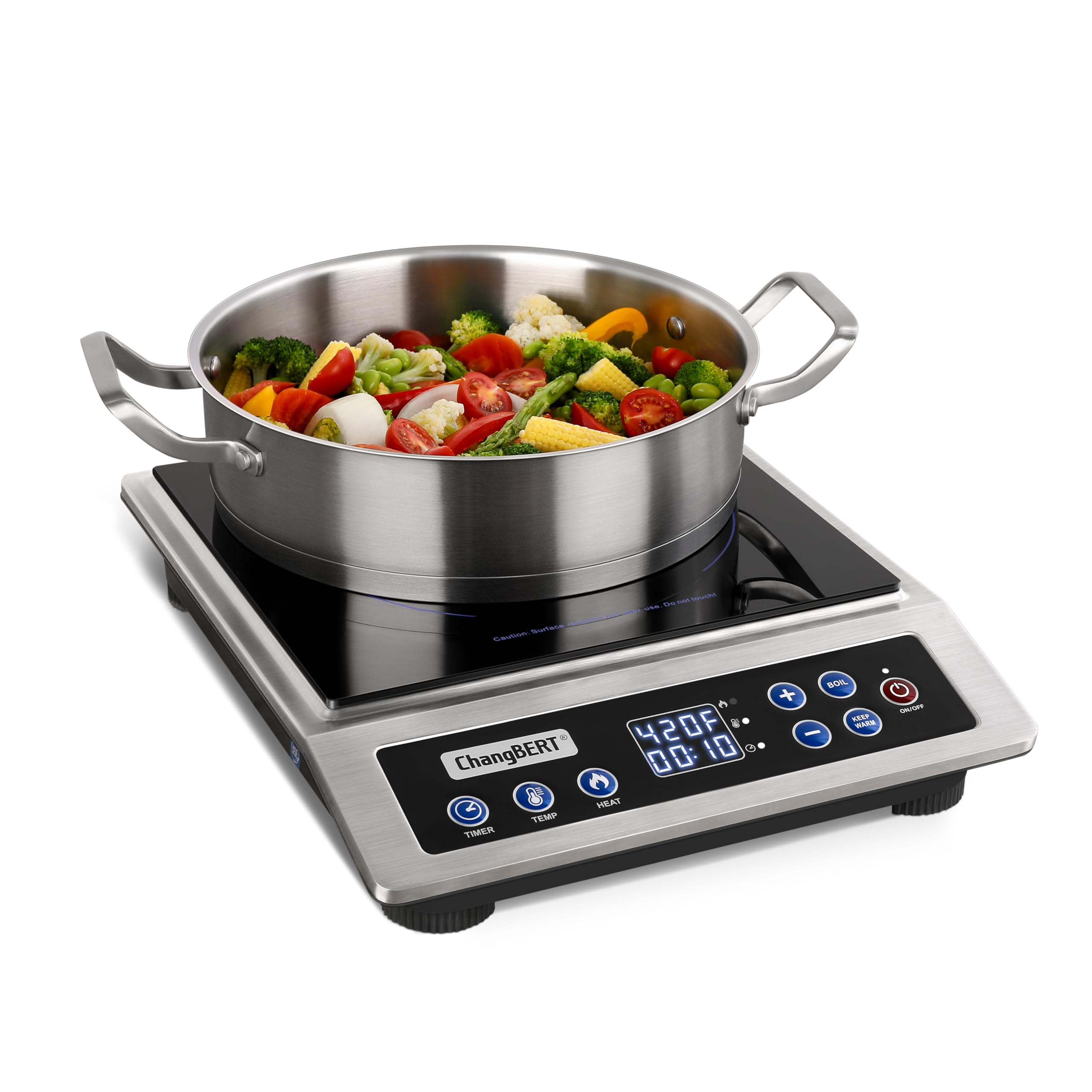
ChangBERT Plus
Key Features
- Power: 1800W
- Temp Control: 18 steps, 20°F inc.
- Burners: 1
- Noise: Low
- Build Material: Stainless steel
- Price: $$
This enhanced ChangBERT brings a larger 8-inch coil and a 12-hour timer to the same quiet, NSF-certified platform as the top-pick CIB-80. The one-click max power button gets you 1800W instantly, and the physical buttons work reliably even with wet hands. It heats fast and evenly across larger pans, with a low fan noise that keeps the kitchen conversation-friendly.
Where it slips is value: the nearly identical CIB-80 costs less and covers the same ground for most tasks. The 20°F temperature steps (120–460°F in 18 increments) are too coarse for delicate work like melting chocolate or holding a low simmer — the same limitation shared with the top pick. Buyers who need fine control should look at models with 5°F or 10°F steps instead.
Pros
- Very quiet fan operation suits open kitchens and noise-sensitive spaces.
- Large 8-inch coil provides fast, even heating across bigger pans.
- Sturdy stainless steel build with commercial certification feels durable.
Cons
- 20°F temperature steps are too coarse for delicate cooking like melting chocolate or holding a low simmer.
- Higher price than the nearly identical CIB-80 without meaningful performance gains for most buyers.
Best for slow-cooking enthusiasts who need a 12-hour timer and want a quiet, commercial-grade burner — skip it if fine temperature control matters or if the standard CIB-80 fits your needs.
Best for 5°F Precision
Nuwave Gold

Key Features
- Power: 1500W
- Temp Control: 5°F inc., 96 temps
- Burners: 1
- Noise: Mid
- Build Material: Ceramic glass
- Price: $$
The Nuwave Gold delivers an unmatched level of temperature granularity for an induction burner — 96 steps from a gentle 100°F keep-warm to a 575°F sear. This makes it a strong fit for home cooks who need precise heat for delicate sauces, melting chocolate, or low-temperature frying. The selectable wattage (multiple power levels) also suits RVs or kitchens with shared circuits where peak draw matters.
What holds it back from a higher recommendation is two-fold: the max 1500W output means noticeably slower boiling than 1800W competitors, and long-term control panel durability has shown vulnerabilities in some units. For a buyer whose priority is fine heat control rather than rapid heating or multi-year heavy use, this remains a capable option — but not the one to bet the kitchen on.
Pros
- 96 temperature settings in 5°F increments enable precise control from gentle warming to high-heat searing.
- Selectable wattage lets you adjust power draw for different electrical setups, ideal for RVs or shared circuits.
- Glass top and intuitive controls make daily use and cleanup straightforward.
Cons
- 1500W max output means slower boiling compared to 1800W models; less suited for tasks where speed matters.
- Control panel durability has shown vulnerabilities in some units after a year or two of moderate use.
A precision-focused burner for home cooks who prioritize fine temperature control over boiling speed or long-term heavy-duty use; best when occasional control panel replacement risk is acceptable.
Best for Ultra-Budget
Mueller RapidTherm

Key Features
- Power: 1800W
- Temp Control: 8 levels, 40°F inc.
- Burners: 1
- Noise: High
- Build Material: Glass top
- Price: $
This burner delivers fast heating for the price and straightforward preset buttons, making it easy to boil water or pan-fry. However, the temperature control uses 40°F steps, so low simmer is difficult to maintain. Some units have stopped working after months of use, and the fan noise is louder than on mid-range models. It suits emergency use, dorms, or camping, but not daily cooking that demands precision or durability.
Pros
- Lowest price among 1800W induction burners – great for tight budgets.
- Heats water quickly for its price point.
- Simple preset buttons make operation easy.
Cons
- Fan noise is noticeable during operation, especially in quiet environments.
- Temperature control uses 40°F steps; maintaining a low simmer can be difficult.
- Some units have developed issues within months of use.
Ideal as a low-cost backup burner for occasional boiling or frying, but not for anyone who needs consistent low-temperature cooking or long-term daily use.
Best for Dual Precision
Nuwave PIC Double

Key Features
- Power: 1800W shared
- Temp Control: 5°F inc., 106 temps
- Burners: 2
- Noise: Mid
- Build Material: Ceramic glass
- Price: $$$
Two independent zones offer 5°F temperature increments and programmable memory for repeatable recipes. However, the 1800W total is shared, so each burner cannot run at full power simultaneously – a limitation for large pots on both sides. Temperature stability at low settings may require monitoring, and some units have been noted to develop operational issues over time. The premium price reflects the advanced control, but the power sharing and occasional reliability concerns mean it’s a niche tool for precision-oriented cooks who work within its bounds.
Pros
- Two independent zones with fine 5°F temperature steps for precise control.
- Programmable memory slots (50 per burner) for repeatable recipes.
- Heats quickly and boils water fast.
Cons
- Power is shared between burners – using both limits each zone to under 1800W total.
- Temperature consistency at low settings can vary, requiring occasional adjustment for gentle simmering.
Best suited for cooks who value exact temperature repeatability across two zones and can work within the power-sharing limits – not for those needing full simultaneous power for large pots.
Best for Power Sharing
Nuwave Double Pro

Key Features
- Power: 1800W shared
- Temp Control: 5°F inc.
- Burners: 2
- Noise: Mid
- Build Material: Ceramic glass
- Price: $$$
The Nuwave Double Pro brings two independent cooking zones in a sleek, glass-top package that heats faster than gas or traditional electric. Its Dynamic Watt Technology allows one burner to draw full power while the other simmers, making it useful for multi-dish meals on a compact counter. However, temperature consistency can vary between units — a few owners have noted erratic heating or unexpected shutdowns, which makes this a riskier pick than more established dual-burner options like the Duxtop 9600LS. For buyers who prioritize smart power management over long-term track record, it’s worth a look, but not a safe bet for heavy daily use.
Pros
- Heats significantly faster than gas or traditional electric burners.
- Ceramic glass surface wipes clean easily and looks premium on the counter.
- Smart power sharing lets one side boil while the other holds a low simmer without tripping breakers.
Cons
- Temperature consistency may drift on some units, with occasional spikes or automatic shutdowns during use.
If you need a dual-zone induction burner with flexible power distribution and don’t mind accepting a less-proven reliability profile, the Nuwave Double Pro can handle varied cooking tasks on a small counter.
Best for Professional Accuracy
Breville Control Freak

Key Features
- Power: 1800W
- Temp Control: 1°F inc. with probe
- Burners: 1
- Noise: Low
- Build Material: Stainless steel
- Price: $$$$
This induction cooktop delivers 1°F temperature increments via a probe and through-glass sensor, a level of accuracy typically found in lab equipment. It handles sous-vide, sugar work, and deep frying with exceptional consistency. However, the price puts it beyond most home kitchens, and the interface requires patience with smaller cookware – best suited for professionals or dedicated enthusiasts who need repeatable results.
Pros
- 1°F temperature precision for critical cooking tasks
- Commercial-grade build with twin fan cooling
- Quiet operation compared to most induction burners
Cons
- Price restricts it to professional kitchens or serious hobbyists
- Can be finicky with small cookware and has a learning curve
For pastry chefs, sous-vide enthusiasts, or anyone who needs repeatable 1°F precision, this is the only portable induction burner that delivers – if the budget allows.
Best for Basic Cooking
Amazon Basics

Key Features
- Power: 1800W
- Temp Control: 8 levels, 40°F inc.
- Burners: 1
- Noise: High
- Build Material: Glass top
- Price: $
The Amazon Basics induction cooktop delivers fast heating and a compact profile that tucks away easily after use. At this price point, it’s one of the most affordable ways to get a portable burner for occasional tasks like boiling water or searing meat.
Where it falls short is temperature control — the 40°F steps make low-temperature simmering impractical, and the burner only accepts cookware between 5.7 and 8.2 inches in diameter. Some units may develop operational issues within months, which is worth factoring in if you need a daily driver. This burner works best as a backup or emergency option for straightforward boiling and frying, not for recipes that demand gentle heat or larger pans.
Pros
- Very affordable price point for an 1800W induction burner
- Heats up quickly and sears well
- Compact and lightweight for easy storage
Cons
- Coarse 40°F temperature steps make low simmering difficult
- Limited to cookware diameters from 5.7 to 8.2 inches
A suitable backup for boiling and frying on a tight budget, but not for daily cooking or recipes that need precise heat or larger pans.
How to Choose
The quietest induction burner isn’t the most expensive — it’s the one with the best fan insulation and power management.
Power (Wattage)
1800W is the standard maximum on a 15A household circuit and the sweet spot for fast boiling and searing. Lower wattage (1300W–1500W) models heat more slowly but often allow finer temperature control and quieter fans because they don’t push the circuit to its limit.
If you frequently boil large pots of pasta or need a quick rolling boil, stick with 1800W. For delicate simmering or occasional use, a 1300W burner can run cooler and quieter, and may work better on shared circuits (e.g., RVs).
Temperature Control Granularity
More temperature steps (e.g., 20 vs. 8) give you finer control over heat, but the real differentiator is the increment size. 5°F steps let you hold a perfect simmer or melt chocolate without a probe, while 40°F steps force on-off cycling that can scorch sauces or cause temperature swings.
If precision matters — for eggs, sauces, or candy — look for models with at least 15 temperature settings or 5°F increments. For everyday boiling and frying, 10–15 steps are sufficient.
Number of Burners
Double-burner induction cooktops add convenience but share a single 1800W supply between both zones. Running both burners on high means each gets roughly half the power — enough for pancakes and simmering but not for boiling two pots simultaneously.
If you cook full multi-burner meals regularly, consider a model with dynamic watt sharing (e.g., 1100W + 700W) or stick to a single powerful burner and use a separate hot plate.
Noise Level
No induction burner is silent, but fan and coil noise varies dramatically between models. Budget units often use loud, small fans that run continuously, while commercial-grade models have larger, insulated fans that cycle less. High-pitched whine comes from the coil and is more common in compact designs.
If you cook in an open-plan kitchen or have noise-sensitive household members, prioritize models with explicit low-noise design (e.g., ChangBERT, Breville). For occasional use, moderate noise is manageable.
Build Material
Glass-top burners are easy to clean but can crack if dropped or if a heavy pot is slammed down. Stainless steel housings are more durable and often include thicker glass (like Schott Ceran) that resists thermal shock better.
Stainless steel also dissipates heat more effectively, reducing fan runtime. For daily heavy use, invest in a model with a metal body and proprietary glass. For light use, a simple glass top is fine.
FAQ
Why does my induction cooktop make a high-pitched noise?
The high-pitched whine comes from the induction coil vibrating at a frequency in the audible range (usually 20–30 kHz). It’s more noticeable on budget models with less insulation and coil shielding. This is not a defect — but if it bothers you, look for models with thicker glass or active noise damping (e.g., ChangBERT CIB-80 or Breville Control Freak).
How many watts do I really need for a portable induction burner?
1800W is the standard maximum for a 15A household circuit and provides fast boiling and searing. For daily heavy cooking, 1800W is ideal. If you mostly simmer, make sauces, or use smaller pots, a 1300–1500W burner runs quieter and offers finer temperature control. Avoid anything under 1300W if you need to boil water quickly.
Can I use an induction cooktop with a portable power station or generator?
Yes, but only if the power station can handle the surge current. Induction burners draw high inrush power (up to 1800W+). Most portable power stations under $500 cannot sustain 1800W for more than a few minutes. You’ll need a model with at least 2000W continuous output (e.g., Jackery 2000 or larger). For generators, a 1500W continuous rating is the minimum.
What’s the difference between 1800W and 1300W induction burners for everyday cooking?
1800W models boil water about 30–40% faster and can achieve higher searing temperatures. However, they tend to be noisier and have larger temperature increments (e.g., 20°F steps). 1300W models are quieter, offer finer temperature control (5°F steps), and handle delicate cooking better. Choose 1800W for speed, 1300W for precision and quiet.