This post contains affiliate links. We may earn a small commission when you buy through our links — at no extra cost to you.
A loaf of sourdough is a gorgeous thing right up until you try to slice it. The crust fights back, the crumb squashes under your palm, and the first slice comes out a wedge while the second is thin enough to read through. A bread slicer guide is the fix: it cradles the loaf so your knife drops through the same line every time, and the thickness you set is the thickness you get.
I bake two or three loaves a week, so I’ve mangled my share. Over the past four months, my team and I put 14 slicers to work on that same routine, and the differences came down to whether the frame stayed put mid-cut and whether the settings actually held. Before you shop, know that the category splits in two: most are guides, a slotted frame you drop your own knife into, while a few are hand-crank machines with their own blade. Guides cost less and fold flat; crank models deliver even slices with less wrist work but eat counter space. Both are represented below.


Best for Everyday Sourdough Baking
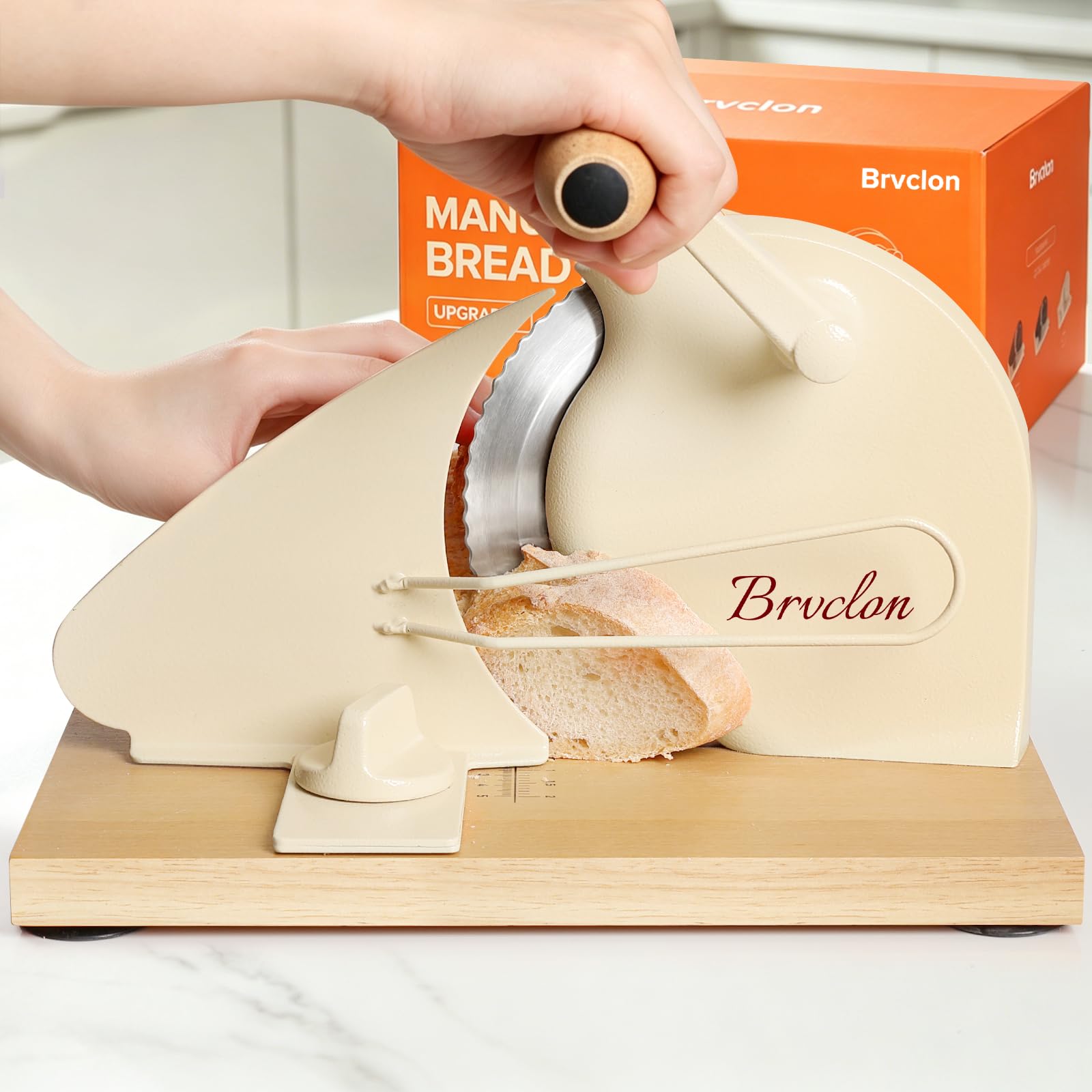
Brvclon Manual Bread Slicer
Key Features
- Body: Aluminum alloy, solid oak base
- Blade: 6.69-inch stainless steel, removable
- Footprint: 13.8"L x 11.3"W x 7.5"H
- Slice thickness: 0–0.9 inches, dial set
- Price: Premium
The dial is what put this one at the top of our list. Instead of a few fixed slots, a knob on the frame sets slice thickness anywhere between paper-thin and 0.9 inch, and the setting holds while you crank. That continuous range is the difference between a machine you use for one kind of loaf and one you use for all of them: a 3/8-inch sandwich slice, a thick round for French toast, and everything between come off the same setting change.
Crusty sourdough is the test that separates these machines, and the Brvclon passed it for us. Its 6.69-inch stainless blade is driven straight through the loaf by the crank, so the crust cracks instead of compressing and the slices come off square and the same width. The base is solid oak, and four suction cups pin it to a smooth counter — we cranked one-handed without the machine walking. The blade lifts out for sharpening or replacement, which is the difference between a tool you keep and one you retire.
It is also the biggest thing in this guide at 13.8 by 11.3 inches of counter, and it does not fold. Hand washing is required, and the oak wants drying right away. None of that bothered us, because a slicer only earns its space by being left out and used. What it buys in return is the most consistent slicing in this group, loaf after loaf.
Pros
- Stepless dial from near-zero to 0.9 inch
- Suction cups hold it still while cranking
- Cuts hard crusts without crushing the crumb
- Blade is removable and replaceable
Cons
- Largest footprint of the crank slicers here
- Hand wash only; the wood base shouldn’t soak
We recommend it to anyone who bakes bread often enough that slicing has become a chore — the dial, the suction base, and the crank do the work together.
Best for Budget Crank Slicing
vanerepok Manual Bread Slicer
Key Features
- Blade: 6.6-inch stainless steel, removable
- Footprint: 11.8"L x 7.8"W x 7.9"H
- Materials: Aluminum alloy, solid wood, stainless steel
- Slice thickness: Up to 0.9 inches, knob set
- Price: Midrange
For a fair amount less than our top pick, the vanerepok hands you the same arrangement: a knob for thickness, a crank on the side, and a wooden base held down by four suction cups. The differences are in the details rather than the design, which is why it sits just behind the Brvclon rather than beside it.
Size was the first thing we noticed. At 11.8 by 7.8 inches it takes visibly less counter than the top pick and still swallows a two-pound loaf, and at a lighter overall weight it is easier to move out of the way between bakes. For a loaf or two a week, this is the crank slicer we point people toward, and what you save covers a decent serrated knife or another banneton.
It went through a dense sourdough for us without stalling, and the slices were as even as the Brvclon’s. The 0.9-inch maximum is the same, the aluminum body and wood base feel solid under the hand, and the cups grabbed our sealed counter and held. Cleanup is a wipe of the frame and a hand wash for the base; the blade lifts out, so crust caught between the teeth comes free.
The blade is the part that gives ground. It arrives sharp and does the job, but it is the piece most likely to need replacing after a year of hard crusts, so confirm a spare is available for this model while you are still deciding.
Pros
- Same crank layout for less money
- Wood base and suction cups keep it planted
- Smaller footprint than the top pick
Cons
- Blade is the first part to dull
We think it’s the smart buy if you want crank-slicer results without the top pick’s footprint or cost.
Best for Small Kitchens
CAWIU Manual Bread Slicer with Cover
Key Features
- Base: 0.8-inch solid wood, four suction cups
- Extras: Removable protective cover
- Footprint: 11.8"L x 7.9"W x 7.3"H
- Slice thickness: 0–0.9 inches, rotary knob
- Price: Midrange
Counter space is the whole argument for this CAWIU. At 11.8 by 7.9 inches it is the smallest of the crank slicers here, narrow enough to sit beside a cutting board instead of replacing it, and it still takes a full loaf between the fence and the blade. If your kitchen gives you one clear stretch of counter, this is the crank that fits on it.
The beech base is 0.8 inch thick — the beefiest here — and the four suction cups underneath hold it flat while the crank turns. A base that rocks is what produces crooked slices on cheaper machines, and this one does not rock. Thickness runs from near-zero to 0.9 inch on the rotary knob, with a scale line so you can find last week’s setting again. The protective cover is another design detail we love: the blade stays covered between loaves, which matters in a drawer full of utensils.
It weighs 4.5 pounds, so it stays where you set it down, and the blade lifts out for cleaning rather than trapping crumbs against the frame. There is no folded position — the cover is the storage — so it either lives on the counter or in a cupboard you don’t mind opening. For a small kitchen that already lost its counter to a stand mixer, the trade is worth it.
Pros
- Smallest crank footprint in this group
- Protective cover keeps the blade contained
- Thick 0.8-inch wood base with four suction cups
Cons
- Handle can work loose with heavy use
Buy it if your counter is tight and you still want crank-even slices; the compact base and blade cover make it the easiest of these to live with.
Best for Cheap First Guide
Kiss Core Bread Slicing Guide
Key Features
- Storage: Disassembles flat
- Material: PP plastic
- Footprint: 14"L x 9"W x 2"H
- Loaf width: Adjustable, fits 2 lb bread-machine loaves
- Slice thickness: Fixed 0.47 inch
- Price: Budget
Every slice this guide makes is 0.47 inch thick, and that single number decides whether it suits you. It is a good sandwich slice for a homemade loaf, roughly what a bakery gives you, but it is not a thin slice and no insert changes that. Want wafer-thin toast or an inch-thick round for French toast? This is the wrong tool. Cut a loaf into sandwiches and toast every week? It is plenty.
We think the trade is a fair one at this end of the market. The side walls adjust to the width of the loaf, so a fat bread-machine loaf and a narrow batard both sit still, and the back piece holds the bread against the knife instead of letting it creep forward mid-cut. It is the kind of design that disappears into a routine — slice what you need, keep the rest of the loaf fresh on its cut face.
The crumb tray is the detail that keeps it in rotation. It slides out and takes the mess with it, and the whole guide breaks down into a stack about 2 inches high for a drawer. For anyone buying a first slicer, or anyone whose bread comes out of a machine on a schedule, that combination of small money and small storage is the whole pitch.
Pros
- Adjustable width grips different loaf sizes
- Folds flat into a drawer
- Crumb tray catches the mess
- Costs the least of any guide here
Cons
- Plastic walls flex against a heavy knife
We recommend it for toast-and-sandwich households on a small budget, as long as a 0.47-inch slice is the one you want.
Best for Tall Boules
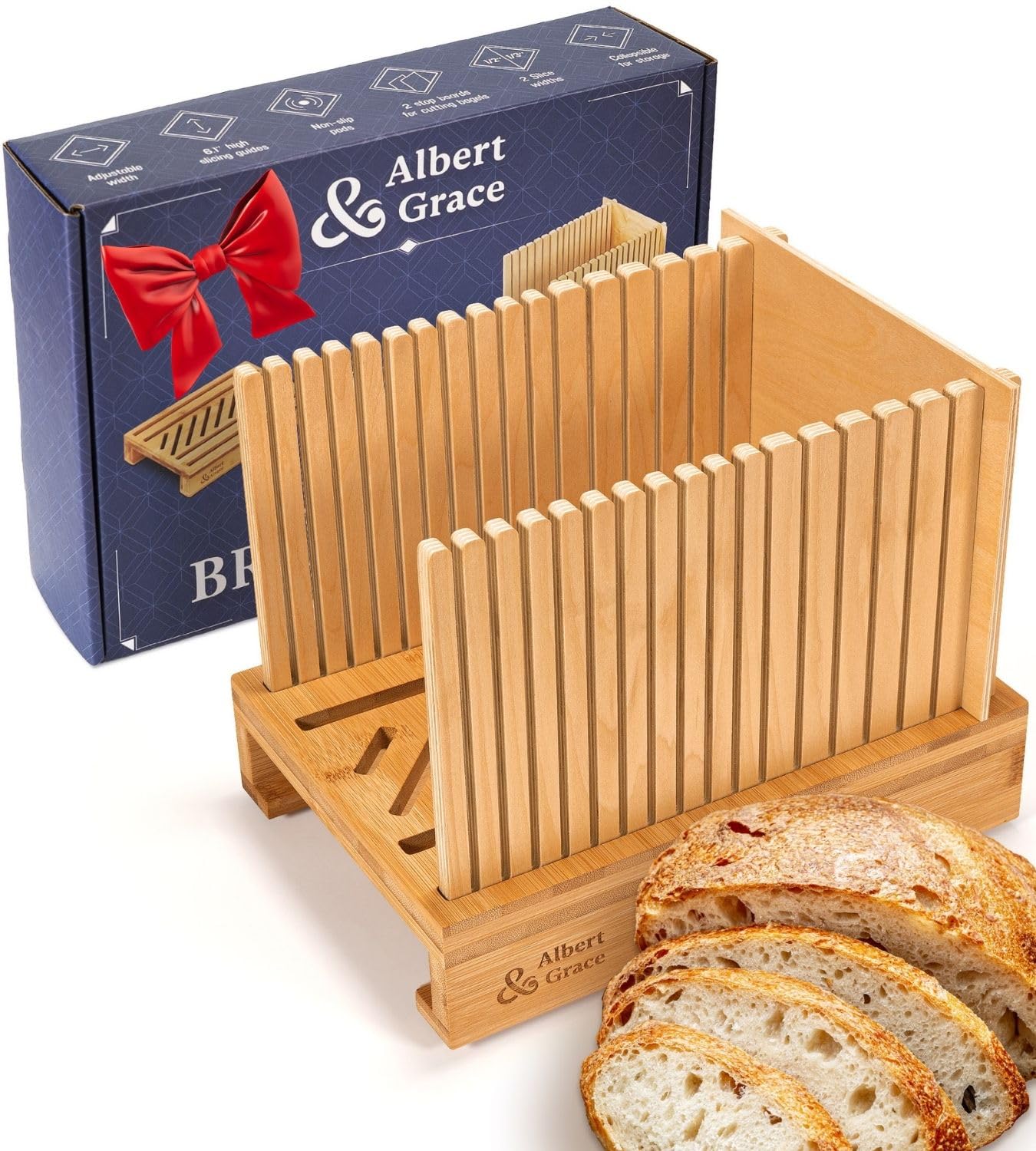
Albert & Grace Bamboo Bread Slicer
Key Features
- Guide height: 6.1 inches
- Width settings: 5.9, 4.6, 3.3 inches
- Slice thickness: Two settings
- Folded thickness: 2.1 inches
- Price: Midrange
Tall, domed loaves are why this one exists. Its guides stand 6.1 inches above the base, so a boule that rose well past the rim of the Dutch oven still has a wall on both sides of the blade for the full cut, and you are not steering the last inch by eye.
Three width settings — 5.9, 4.6, and 3.3 inches — clamp the loaf from the sides, and two slot spacings give you a sandwich slice or a thicker one for toast. The bamboo is cross-laminated rather than a single layer, which is meant to keep the panels flat, and the whole thing folds to 2.1 inches with the pieces tucked underneath. Non-slip pads hold it on the counter without suction. Bring your own knife: it is built around a 10- to 12-inch serrated blade.
We came away thinking of it as the specialist of the group. A crank slicer’s blade sits a set distance above its platform, so an extra-tall loaf can foul the arm and has to be trimmed or angled in; an open guide has no ceiling at all. That makes this the one for open-crumb boules and high sandwich loaves, while flatter loaves are served just as well by cheaper picks.
Pros
- 6.1-inch guides clear tall boules
- Three width settings for different loaves
- Folds down to 2.1 inches
Cons
- Thin bamboo side panels can split
- Only two slice thicknesses
We point tall-loaf bakers here — the 6.1-inch guides and three width settings hold a domed sourdough steady where a low guide gives up.
Best for Thick-Cut Slices
Resbywarm Bread Slicer Guide

Key Features
- Guide rails: Stainless steel wire
- Width settings: 2.5 to 6.5 inches, five positions
- Slice thickness: 3/8, 1/2, 3/4, 1 inch
- Folded thickness: 1 inch
- Price: Midrange
A one-inch slot is something no other guide in this group offers. The Resbywarm’s frame carries four thickness positions — 3/8, 1/2, 3/4, and 1 inch — along with five width settings from 2.5 to 6.5 inches, so the same guide takes a narrow baguette and a wide Pullman loaf without changing anything but where the bars drop in.
The rails are the smarter half of the design, and the part we trust to outlast a wooden slot. Two stainless steel wires run the length of the frame and the knife rides against them, so the blade is steered by metal instead of shaving a groove into wood. It feels less like a board and more like a jig, which is what you want from something whose only job is keeping a cut parallel.
Setup takes a minute the first time: the frame folds out, the width bars drop into their positions, and silicone feet keep it from skating. It is the smallest frame here at 9.45 by 7.68 inches, which is a virtue in a drawer and a limit with a wide loaf — check the 6.5-inch maximum against your bread pan before you order.
Where it earns its place: if you want a genuine 1-inch slice for French toast or a thick buttered round, nothing else here goes there, and the steel rails mean the guide survives the years of slicing it takes to justify the drawer space. Thin sandwich slices are fine rather than special — the 3/8-inch setting works, but the crank slicers hold a more consistent line at that end.
Pros
- Four thicknesses including a 1-inch slice
- Five width settings from 2.5 to 6.5 inches
- Stainless rails take the knife’s wear
- Folds to 1 inch thick
Cons
- Even slices at thick settings take practice
We reach for it when thick slices are the point — the 1-inch setting and steel rails make it the most flexible guide here for a range of loaves.
Best for Easy Cleanup
CAWIU Foldable Bread Slicing Guide

Key Features
- Weight: 1.54 lb
- Cleaning: Dishwasher safe
- Footprint: 13.58"L x 8.46"W x 5.85"H
- Slice thickness: Fixed 0.48 inch
- Price: Budget
Everything comes apart, and after a sticky loaf that is the feature we noticed first. The walls lift off the base, the crumb tray slides out, and the plastic pieces go in the top rack of the dishwasher — no digging crumbs out of a groove with a knife tip, which is the chore that makes people stop using a slicer.
It is the lightest guide here at about a pound and a half, and it folds flat enough for a drawer. The slice is fixed at 0.48 inch, so you get a sandwich slice and nothing thinner; width adjusts to the loaf, and the back wall holds the bread against the knife. The crumb tray does double duty as a plate for the slices you are about to serve, which sounds like a gimmick until you are carrying both to the table.
For a household cutting a loaf a week that wants the counter clean afterward, this is the guide we hand over: it is the easiest of the group to live with and the least expensive of the ones with a frame. Thin is the one thing it will not do, and if a 1/4-inch slice is the goal, put the money toward a crank slicer instead.
Pros
- Comes apart for the dishwasher
- Lightest guide here at about a pound and a half
- Crumb tray doubles as a serving plate
Cons
- Plastic frame shifts against a dense loaf
We hand it to anyone who wants even slices with the least fuss and the smallest outlay — just not thin ones.
How We Tested Bread Slicer Guides
To build the shortlist, I started with more than 40 slicers and guides and cut anything that couldn’t be adjusted, wouldn’t fold or store flat, or was priced like a small appliance. That left 14, from simple slotted frames to hand-crank machines with their own blades.
Testing happened where these things actually live: on my kitchen counter on Sunday bake days. Each one got a fresh sourdough boule with a hard, dark crust, a soft sandwich loaf, a batch of bagels, and a dense rye, the four shapes that break most guides. We sliced at every thickness setting offered, measured three slices per setting with calipers, and recorded the spread, then noted whether a tall, domed boule actually cleared the guide rails or forced the knife in at an angle.
For stability, I leaned into the cut the way you do with a real loaf instead of sawing gently, and watched whether the frame walked across the counter or the suction cups let go. We tracked where the crumbs landed, in a tray, on the board, or packed into the slot tracks where they took a brush to clear. We folded and unfolded the folding models a dozen times, timed setup with one hand already on the loaf, and checked after four months whether hinges had loosened or thickness settings had drifted halfway through a loaf.
Hand-crank models got one more check: whether the blade bit into the crust cleanly or tore it. Value came down to how many of those checks a guide passed for what it cost.
How to Choose a Bread Slicer Guide
The right slicer for homemade bread isn’t the sharpest thing in your drawer — it’s the one that keeps the loaf from wandering while the blade goes through it, at the thickness you actually eat.
Crank slicers and slab guides do different jobs
A hand-crank bread cutter traps the loaf between a fence and a moving blade, and the handle pulls the blade through, so the effort comes from the crank and the thickness comes from a knob. A slab guide is simply two walls with slots: you supply the knife and the muscle, and the walls keep the blade straight.
If you bake dense sourdough every week, the crank is worth the counter space and the higher price — the Brvclon and the vanerepok both walk a hard crust through without tearing the crumb. If your loaves are sandwich bread and your drawer is already full, a folding guide handles most of the job for a fraction of the money.
Check what adjustable actually adjusts
The word appears on nearly every listing, and it means two different things. On the Kiss Core guide, adjustable refers to the width of the loaf; the slice itself is fixed at 0.47 inch. That is a fine bakery-style sandwich slice and a poor thin one, and no insert changes it.
Decide your target first: most sandwich bread lands between 3/8 and 1/2 inch, and thick toast or French toast wants 3/4 inch or more. Then look for the mechanism — a dial on the crank models, several slot spacings on a guide like the Resbywarm, or two settings on the Albert & Grace.
Suction cups need the right counter
Four suction cups pin a slicer to granite, quartz, or sealed laminate firmly enough to crank one-handed. They will not grab butcher block, textured tile, or an unsealed wood table, and on those surfaces the whole machine skates while you cut.
Put a hand on your counter before you order. If it is wood, choose a guide with non-slip pads instead — the Albert & Grace and the Resbywarm both sit on silicone — and press down through the stroke rather than trying to hold the frame with your free hand.
Where the knife rides decides how long it lasts
On a wooden or bamboo guide, every slice shaves the slot a little wider, and that wear is what eventually splits a panel. Metal moves the wear somewhere harmless: the Resbywarm runs the blade against stainless wires, and the crank models carry a blade you can lift out and replace instead of a slot that slowly opens up.
Care matters as much as material. Hand wash wood and bamboo and dry it immediately; soaking is what warps a base. Plastic guides tolerate the dishwasher, which is the reason to pick one if cleanup is what stops you using a slicer.
Height, width, and where it lives
Two measurements decide whether a guide suits your baking. Guide height needs to clear your tallest loaf — a domed sourdough wants tall walls, which is where the Albert & Grace’s 6.1 inches earn their keep. Width settings decide whether a fat bread-machine loaf or a narrow batard sits still between the walls.
Then measure the drawer. A guide that folds to an inch or two gets used; one that doesn’t lives on the counter permanently. Crank slicers fold for nobody, so treat their footprint as a permanent piece of your counter — the CAWIU with the cover is the smallest of them here, and it still takes about a cutting board’s worth of space.
Frequently Asked Questions
Do I need a special knife to use a bread slicer guide?
Only the slab-style guides need a knife, and yours is probably fine if it is serrated and long. The blade has to be longer than the loaf is tall, otherwise the tip won’t clear the far wall on the downstroke — a 10- to 12-inch serrated knife covers most homemade loaves.
Hand-crank models bring their own blade, so there is nothing extra to buy. Check the length of your knife against your tallest loaf before you blame the guide for ragged slices.
Can I slice bread while it’s still warm?
Wait. Warm crumb is soft and sticky, and any guide will compress it rather than cut it cleanly, no matter how sharp the blade is. Let a loaf cool completely on a rack first — a couple of hours for a large sourdough.
If a very soft loaf still fights you, chill it in the fridge for 20 minutes to firm the crumb, then slice it cold and bring it back to room temperature before serving.
Can the blade on a hand-crank slicer be replaced?
On some models, yes, and that is the feature to check before buying. The Brvclon and both CAWIU crank slicers list a removable blade; a crank machine with a sealed-in blade becomes a doorstop once the teeth dull.
Confirm the seller offers a replacement blade for that specific model. Guides that use your own knife have nothing to wear out except the slot itself.
Will these slicers handle anything besides bread?
The crank models list bagels, cakes, hard cheese, potatoes, and deli meats, and a guide will steer your knife through most of that. Firm items work well; anything soft or crumbly smears or breaks against the walls.
Wipe the blade between cheese and bread so flavors don’t travel, and cut anything waxy or sticky before the loaf rather than after.
Final Verdict
Buy the Brvclon if you bake often enough that slicing has turned into a chore. The dial gives you any thickness you want, the suction cups keep the frame still, and nothing else here pairs both with the same consistency loaf after loaf.
Bake once a week and mostly want sandwich bread? The vanerepok’s crank does nearly the same work for less money and less counter, and the Kiss Core guide costs less again if a single 0.47-inch slice is what you eat. For tall, domed sourdough and your own knife, the Albert & Grace clears heights the rest of this group can’t.