This post contains affiliate links. We may earn a small commission when you buy through our links — at no extra cost to you.
The first time you try to light a stove on a windy ridge, claimed boil times start to look optimistic. A backpacking stove has to hold a full pot steady, simmer without scorching, and keep working after a week in a pack. The tradeoff is built in—the lightest models feel like balancing dinner on a coin, while sturdier stoves add ounces you’ll feel on the climb. A good one turns a cold stop into hot food and coffee, and that’s worth its weight.
I’ve cooked on featherweight titanium burners and all-in-one systems, and after nine months with 12 stoves, the pattern is clear: the best ones stay lit in a gust, hold a full pot without wobbling, and pack down small. Value matters, too—a cheap stove that fights you every morning is no bargain, and a spendy one that saves ounces but tips over isn’t either. Peak BTU numbers are the least useful spec on the box; how a stove behaves in wind tells you more. Here’s what survived wind, bumpy drives, and burned oatmeal.



Best for Most Backpacking Trips
MSR PocketRocket 2
Key Features
- Fuel: Isobutane-propane canister
- Boil time: 1 L in 3.5 min
- Folded size: 2 x 2 x 3 in
- Packed weight: 2.6 oz (4.2 oz with case)
- Price: Midrange
Folded down, the PocketRocket 2 measures about 2 by 2 by 3 inches and weighs 2.6 ounces, so it disappears into a 750-milliliter pot alongside a small canister and a lighter. That’s the whole case for it in one sentence: you stop budgeting pack space for your stove.
We think that’s the right trade for most backpackers. It boils a liter in roughly three and a half minutes, the valve turns down far enough to simmer rice without scorching it, and the serrated pot supports span wide enough for anything from a titanium mug to a two-liter pot. Nothing about it is fussy, which is exactly what you want at the end of a long day.
What it doesn’t have is an igniter, so a mini lighter lives in your cook kit — and a spare, because the one time it matters is the one time it’s damp. Otherwise setup is thread it on, open the valve a quarter turn, light, adjust. No priming, no pumping, no preheating.
The hard-shell case is a small thing we came to appreciate: it keeps the folded supports from snagging the inside of a pack. And when the forecast turns genuinely cold, the stoves built for it — the SOTO and the MightyMo — earn their extra ounces in a way this one can’t match.
Pros
- 2.6 ounces and genuinely pocket-size folded
- Boils a liter in about 3.5 minutes
- Serrated supports hold a range of pots
- Simmers as readily as it boils
Cons
- No built-in igniter — pack a lighter
We recommend the PocketRocket 2 to almost anyone carrying a canister stove: 2.6 ounces, a liter boiled in about three and a half minutes, and pot supports that hold a real pot without complaint.
Best for Windy, Cold Camps
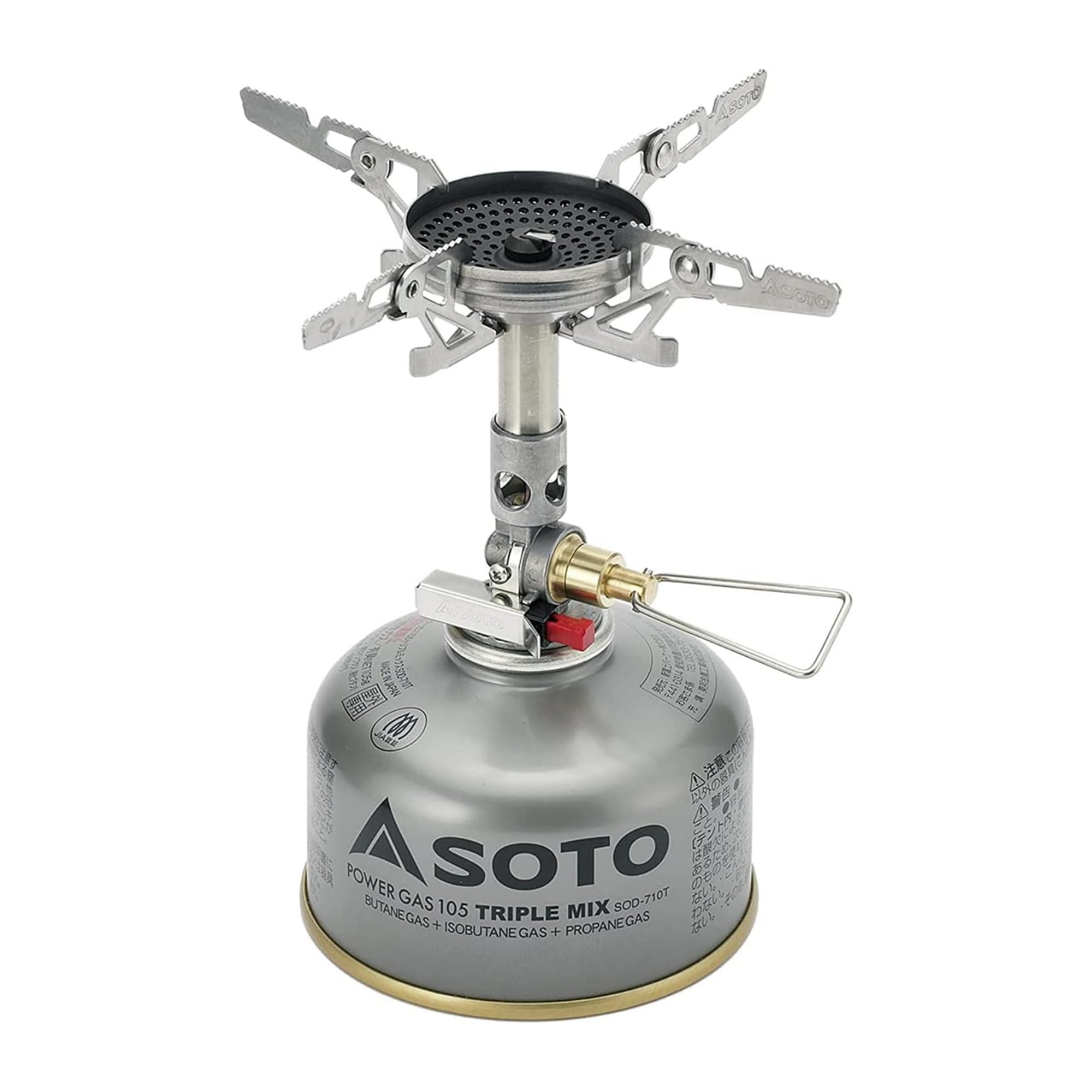
SOTO WindMaster
Key Features
- Output: 3,260 W
- Weight: 3.07 oz
- Igniter: Built-in stealth igniter
- Pot support: 4Flex included
- Price: Midrange
Put the WindMaster beside our top pick on an exposed ridge and the gap opens in about a minute. The burner head is concave and sits close under the pot, so it makes its own shelter, and the regulator holds a steady flame as the canister chills. On trips where the weather isn’t cooperating, this is the camp stove we want with us.
The 4Flex support is the other half of the argument. It’s a separate wire cradle that clips on and grips a wide pot or a small frying pan far more securely than the folding arms on the ultralight stoves here, and the burner runs quiet.
The price is 87 grams and a premium spot on the shelf. If you’re shaving every ounce for a fast-and-light trip, the BRS-3000T or the PocketRocket gets you down the trail lighter. If you’ll be melting snow, cooking in shoulder season, or camping where the wind never stops, 87 grams buys a stove that behaves the same in bad weather as in good. One rule to know: SOTO does not approve it for 100 percent propane, so read the canister label.
Pros
- Regulated flame holds steady in wind and cold
- 4Flex cradle grips wide pots and small pans
- Built-in igniter tucked into the burner post
- Quiet burner and reliable lighting
Cons
- 87 grams, well above the ultralight picks
- Not for 100 percent propane canisters
Buy the WindMaster if your trips run into wind and cold — its regulated burner holds a steady flame when the canister chills, and the 4Flex cradle grips a full pot.
Best for Fast One-Pot Meals
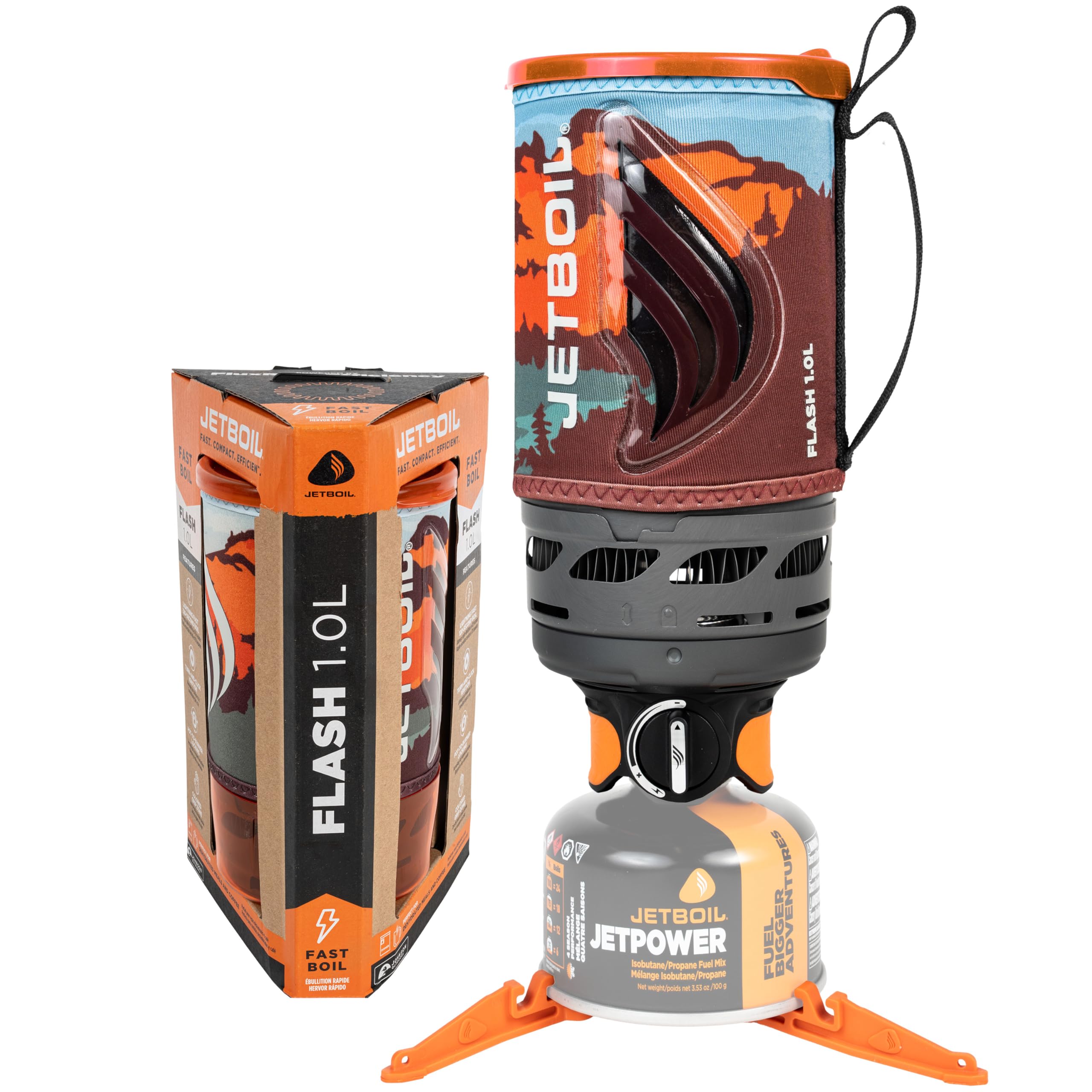
Jetboil Flash
Key Features
- Fuel: Isobutane-propane canister
- Ignition: Turn-and-click auto ignition
- Boil time: 16 oz in 2 min
- System weight: 13.1 oz
- Price: Premium
Sixteen ounces of water, two minutes, one knob. The Flash is the closest thing here to an appliance: the 1-liter pot, burner, and insulated cozy lock together at three points with a visual indicator, and you turn and click instead of hunting for a lighter.
The efficiency is easy to underestimate. Because the burner is matched to its own pot and the cozy holds heat in, the same boil asks less of the canister than an open burner and a generic pot would — which is the argument for it on any trip long enough that you’re weighing fuel. Everything nests, too: burner, 100-gram canister, lid, bottom cup, one object in the pack. The rubberized Safe-Touch zone stays cool enough to grab while the water is still going.
What it isn’t is a general-purpose cooker. The matched pot is what you cook in, so a frying pan and a real dinner aren’t part of the plan, and the canister is sold separate. The 13.1-ounce system weight looks worse than it is — the pot it includes is one you’d be carrying anyway — and the locking ring means the pot that ships with it is the pot you use.
Pros
- Two-minute boil for 16 ounces
- Everything nests inside the 1-liter pot
- Turn-and-click ignition, no lighter needed
- Insulated cozy keeps water hot longer
Cons
- 13.1 ounces is heavy for one person
- Matched pot limits it to boiling and one-pot meals
The Flash is for anyone who wants boiling water to be one motion: turn, click, two minutes, no lighter, no windscreen, and no extra pot to wash.
Best for Ultralight Trips
BRS-3000T
Key Features
- Output: 2,700 W
- Weight: 0.88 oz
- Boil time: 1 L in 2 min 58 sec
- Folded size: 3.2 x 1 x 5.5 in
- Price: Budget
Twenty-five grams. The BRS-3000T weighs less than the stuff sack most stoves ship in, and it nests with a 110-gram canister inside a 750-milliliter pot — the entire cooking kit, fuel included, at roughly the size of a large coffee mug. If your trips are measured in base weight, this is the stove that moves the number.
Nothing in the spec sheet is a gimmick. The burner puts out 2,700 watts, brings a liter to a boil in just under three minutes, and the valve gives a usable range from a hard roll down to a low simmer. It is happiest doing what most backpacking dinners actually need: boil water, pour it in the bag, put the lid back on.
The compromise is at the pot supports, which are short and narrow. A full two-liter pot sits on them with more wobble than we’re comfortable with, and the small burner head loses the fight in a real breeze. Match it to a pot it can actually hold — a 750-milliliter titanium mug is ideal — pick a sheltered spot, and it’s a remarkable little burner for the money.
Pros
- 25 grams, the lightest stove in this group
- Boils a liter in just under three minutes
- Nests with a canister in a 750 ml pot
- The lowest-priced stove here
Cons
- Short, narrow supports feel tippy with a full pot
- Small burner head struggles in wind
Get the BRS-3000T if grams are the deciding number — 25 grams, three-minute boils, and a price that leaves room for a better canister.
Best for Budget Camp Cooking
Coleman Classic 1-Burner
Key Features
- Output: 10,000 BTU
- Weight: 8.32 oz
- Boil time: 1 L in 3.25 min
- Pan support: Fits a 6-in pan
- Price: Budget
This is the stove for someone who wants one burner that lives in the garage, goes car camping in June, and gets handed to a Scout in July. It folds flat, runs on LPG, and puts out 10,000 BTUs — more raw heat than most of the canister stoves here — while costing less than the midrange picks.
We like it for the plainness of it: one adjustable burner, a three-year limited warranty, and PerfectFlow, Coleman’s regulator that keeps output steady when the temperature drops. A liter boils in about 3.25 minutes, right in line with the midrange stoves here. For a beginner or a family kit, that’s a lot of camp stove for the outlay.
Where it gives ground is bulk. At 8.3 ounces it isn’t the heaviest thing in this guide, but it’s a wider, clunkier package than a canister stove, and it takes up more room in a pack than the folded competition. For a weekend basecamp or a car-adjacent trip, that’s a fair trade for the price and the warranty; for a long thru-hike, it isn’t.
Pros
- 10,000 BTUs of heat
- Boils a liter in about 3.25 minutes
- Three-year limited warranty
- PerfectFlow steadies output in the cold
Cons
- Three-point support favors a small pan
The Classic is the value pick for campers who want one durable burner for the driveway and the trailhead, with heat and a warranty that outclass its price.
Best for Simmering Real Food
Jetboil MightyMo
Key Features
- Weight: 3.36 oz
- Ignition: Push-button igniter
- Pot support: Takes FluxRing pots directly
- Regulated to: 20°F
- Price: Midrange
No pot, no cozy, no cup: the MightyMo is a bare 3.36-ounce burner, and that’s the point. It threads onto a canister like any open stove, but the four-turn regulator gives a range of flame most backpacking burners don’t — a low, steady simmer you can sauté greens over, then a full roll for the pasta water.
Cold mornings are where that regulator earns its keep. Jetboil rates the stove for consistent performance down to 20 degrees Fahrenheit, and the push-button igniter sits protected inside the burner instead of hanging off the side where it gets bent. It also takes a Jetboil skillet or a FluxRing pot directly, no separate pot support needed.
What it lacks is shelter. There’s no windscreen in the box, and a bare burner in a breeze is a bare burner — the flame control is good enough that we wanted to cook with it, and that’s exactly when a gust is most annoying. Find a rock or a stump and it’s a better kitchen than anything else here at its weight.
Pros
- Four-turn regulator gives a true simmer
- Rated for consistent output down to 20°F
- 3.36 ounces with a protected igniter
- Takes a Jetboil skillet without a pot support
Cons
- No windscreen in the box
- Premium price for a bare burner
If you want to cook rather than rehydrate, the MightyMo is the pick — its four-turn regulator simmers properly and holds steady down to 20 degrees.
Best for Group Cooking
Facitsolvit 6800W Stove

Key Features
- Fuel: Isobutane, butane, or 1-lb propane
- Output: 6,800 W
- Weight: 15.2 oz
- Hose length: 50 cm
- Price: Budget
The burner sits at the end of a 50-centimeter hose, with the valve and the canister downwind and on the ground. That layout is why this stove handles a group pot: the load goes onto three wide feet instead of on top of a canister, and you’re not reaching across a flame to adjust the gas.
Fuel flexibility is the other reason it earns a place. It runs on isobutane, butane, or a 1-pound propane bottle with the included adapters, and 6,800 watts brings a liter to a boil in under two minutes. Three brass burners spread the heat rather than concentrating it, which helps with anything wider than a mug.
Two things to know before you pack it. At 430 grams it is more than five times the weight of the PocketRocket, so it belongs on trips where the load is shared or simply isn’t the constraint. And the flame control is touchier than the rest of this group — we found the low end narrow enough that food scorches if you step away.
For two or three people cooking one big pot, this is the stove that makes dinner easy, and it does it for less than half what the premium picks cost. Plan on being the one who watches the flame.
Pros
- Remote burner on a 50 cm hose stays stable
- 6,800 W boils a liter in under two minutes
- Runs on isobutane, butane, or 1-pound propane
- Three wide feet hold large pots
Cons
- 430 grams is too heavy for solo trips
- Touchy flame control at the low end
The Facitsolvit is the group-cooking pick: a hose-mounted burner that stays stable under a big pot and runs on everything from isobutane to a 1-pound propane bottle.
How We Tested Backpacking Stoves
We started by researching about 40 stoves, filtering out models that were too heavy for solo trips, too bulky for a 750-milliliter pot, or priced well above what most backpackers spend. That left 12 stoves, which we bought at retail and tested over nine months. We took them on weekend trips in the Appalachians, used them on exposed ridges and in a friend’s windy backyard, and cooked on them in cold morning temperatures when canisters tend to falter.
Back at home, we weighed every stove on a kitchen scale and packed each one into a 750-milliliter pot with a small canister and a lighter to see what actually fit. We timed how long two cups of water took to boil, first in calm air and then with a fan blowing across the burner, and noted whether the flame sputtered or held. To check flame control, we tried to hold a bare simmer long enough to cook rice without scorching the bottom of the pot. For stability, we set a full one-liter pot on each stove and gave it a gentle nudge to see how much wobble it took before the pot slid.
Durability and quality came down to handling: we packed and unpacked each stove 20 times, dropped them from waist height onto a rock, and checked the pot supports, threads, and valve feel for wear. We also compared what each stove cost against what it delivered—packed size, wind performance, and whether it needed a separate pot or came as a system. The stoves that scored best weren’t always the lightest or the most expensive; they were the ones that lit reliably, held a pot steady, and still felt solid after months of abuse.
How to Choose a Backpacking Stove
The stove that earns its place in your pack is the one you stop thinking about: it lights, it holds the pot you actually brought, and it is cold again before your pack is closed.
Weigh the Whole Kit, Not the Stove
Two stoves can sit two ounces apart and land in exactly the same place in your pack, because the weight that counts is the fuel and the pot. A 25-gram burner still needs a canister; a 13-ounce integrated system carries its own pot and boils on a matched burner. For a weekend, compare the complete camp stove kit — stove, case, canister, pot, lighter — rather than the number on the box.
For a week or a thru-hike the math shifts, because fuel you don’t burn is weight you don’t carry. That is where a matched pot and an insulated cozy start to earn back the ounces you set off with, and where a bare ultralight burner stops looking like the lightest answer.
Regulation Is What You Pay For in Bad Weather
Wind and cold ruin more dinners than any menu does. A pressure-regulated stove holds its output as the canister chills and empties; an unregulated one fades. Our SOTO WindMaster and Jetboil MightyMo both carry regulators and are built for gusty, cold conditions, and the difference shows up on a 30-degree morning when everyone else is still waiting for a boil.
If you only camp in summer, that money is better spent on fuel. If your season runs into the shoulder months, or you cook where the wind never stops, regulation is the feature worth paying for before any other.
Match the Pot Support to the Pot You Own
The lightest stoves here hold a titanium mug beautifully and a shared two-liter pot badly. Before you buy, picture the pot you actually carry: a 750-milliliter mug suits the BRS-3000T and the PocketRocket 2, while a big shared pot wants a wide cradle like the SOTO’s 4Flex or the hose-mounted burner on the Facitsolvit.
A pot that overhangs its supports is a pot that eventually dumps dinner in the dirt. Set your pot on the stove before the first trip, not at camp in the dark.
Igniters Are a Convenience, Not a Promise
A piezo igniter is worth having — the Jetboil Flash reduces lighting to a single click. But it is the part that fails first on any stove, usually when the electrode bends or the tip fouls with soot. Carry a lighter on every trip and treat the built-in igniter as a bonus rather than the plan.
Fuel: What You Can Buy Where You’re Going
Threaded isobutane-propane canisters are the standard for most stoves here, and MSR notes that self-sealing threaded fuel is sold in most countries — which is not the same as every country. Check what your destination stocks before you commit to a stove, and read labels: SOTO does not approve the WindMaster for 100 percent propane.
If a stove takes a 1-pound propane bottle as well, as the Facitsolvit does, you gain refill options at the cost of carrying a much heavier canister.
Frequently Asked Questions
How much fuel do I need for a weekend?
For one person over two nights, a 100-gram canister is the usual starting point; two people sharing a pot generally move up to the 230-gram size. The BRS-3000T is rated at roughly 140 grams an hour at full output, so even the small canister holds a long stretch of boiling time.
Wind, cold, and melted snow all push that number up. In shoulder season, carry the next size canister rather than planning a resupply you can’t reach.
Can I fly with a fuel canister?
No. Fuel canisters can’t go in carry-on or checked baggage, so plan to buy fuel after you land. Confirm the nearest outfitter stocks threaded isobutane before you commit to a canister stove — call ahead if you’re flying into a small town, because a stove you can’t fuel is dead weight.
Do backpacking stoves work at high altitude?
Yes. Canister stoves light and burn fine at altitude; the boil just takes longer, because water boils at a lower temperature the higher you go. Wind and cold still matter more than the altimeter.
Keep the canister inside your jacket before lighting it, cook behind a windbreak, and carry a little more fuel than you’d use at sea level.
Final Verdict
The MSR PocketRocket 2 is the stove we point most backpackers to. It does everything a canister stove needs to do at 2.6 ounces and no drama: three and a half minutes to a liter, supports wide enough for a real pot, and a folded size that vanishes into your cookset. Spend the difference on fuel.
Change one requirement and the answer changes. Trips that run into wind and shoulder-season cold justify the SOTO WindMaster, whose regulated burner is the difference between dinner and a lukewarm soak. If speed matters more than versatility, the Jetboil Flash turns boiling water into a single motion.