This post contains affiliate links. We may earn a small commission when you buy through our links — at no extra cost to you.
I once owned a rice cooker big enough to steam a whole chicken and used it maybe twice a year. The small one that replaced it earns its counter space three or four times a week. That’s the trade they ask of you: less capacity, but rice cooked to order instead of a week’s worth at once.
The catch is that the small end of the market is crowded with impulse buys that scorch the bottom inch, spit starchy water across the counter, and hide a nonstick pot you can’t lift out to wash. Over the past four months, we cooked our way through 14 small rice cookers — from one-button two-cup models to fancier machines with steamer baskets — and price predicted very little.
Here’s what first-time buyers get wrong: the cups on the box are the little rice-cooker cups, so a 3-cup model feeds two or three people, not six. The rest comes down to a pot that lifts out for washing and a keep-warm that doesn’t bake the bottom layer crisp. The ones worth the counter space are below.
Best for Couples and Small Families
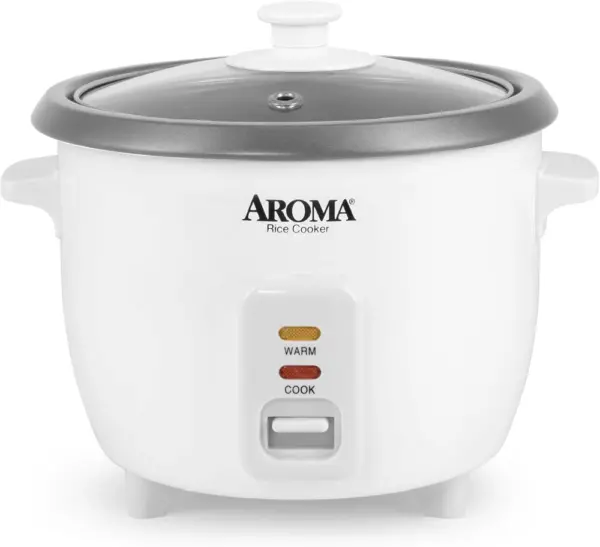
AROMA ARC-363NG
Key Features
- Pot: Ceramic nonstick, PFAS-free
- Controls: One-touch with auto keep warm
- Footprint: 8.9"W x 8.13"D x 8"H
- Capacity (cooked): 6 cups (3 cups raw)
- Price: Budget
Measuring lines are printed right into the pot, so dinner goes rice first, water up to the line, no scoop to count and nothing to eyeball. That small piece of thoughtfulness runs through the whole machine, and it’s a big part of why this is the one we recommend first. Three cups of raw rice come out as six cups cooked in a 1.5-quart pot — the right size for two people having rice with dinner plus a container for tomorrow’s lunch. At eight inches tall and under nine wide, it tucks beneath a cabinet without crowding the toaster.
Cooking is the simple thermostat kind: press the one button, a 500-watt element takes the pot to a boil, and the machine flips to keep warm when the water is gone. White rice lands in the 20-to-30-minute window the one-touch cookers all live in, and the CoreCoat ceramic interior — PFAS-free, per AROMA — releases rice with the spatula and rinses clean in seconds. Keep warm is the thing to manage, because it runs hot enough to toast the bottom layer if rice sits for hours. Fluff it and unplug once everyone has eaten, and the pot never gets that chance.
Against the other picks, it’s middle of the road on size and at the front of the pack on value. The Dash makes a third as much for a few dollars less; the Amazon Basics costs several times as much for brown-rice settings and a locking lid. If your rice is white and your household is one to three, none of that extra machinery buys you a better bowl. The measuring cup and spatula nest inside the pot, so it stores as one piece instead of three.
Pros
- Six cups cooked suits two to three people
- Measuring lines simplify the water ratio
- Ceramic pot releases rice and rinses clean
- One button with automatic keep warm
Cons
- Some units quit within months
- Pot and lid are hand-wash only
For one to three people, this is the small rice cooker we point to first: six cups cooked, a truly nonstick ceramic pot, and rice that comes out right without a learning curve.
Best for Single Servings
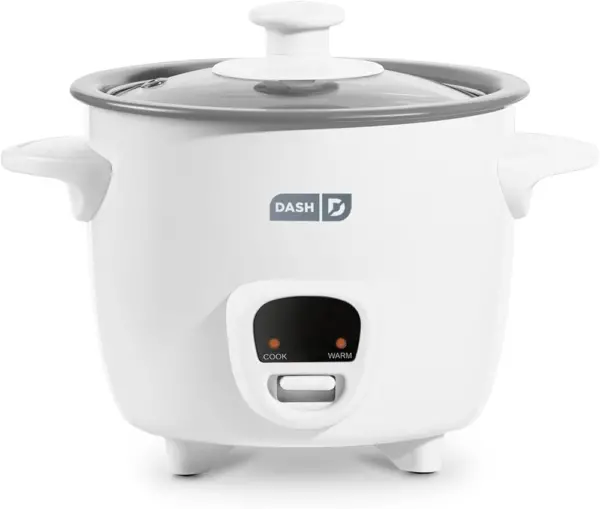
Dash Mini Rice Cooker
Key Features
- Pot: Removable ceramic nonstick
- Weight: 2.2 lb
- Footprint: 8.27"W x 6.6"D x 6.5"H
- Capacity (cooked): 2 cups (1 cup raw)
- Price: Budget
Two cups of cooked rice is the entire story: one cup of raw rice goes in, a single generous bowl comes out, or enough for two people having rice as a side. That’s the Dash’s ceiling and also its point. The body is 8.27 by 6.6 inches and 6.5 inches tall, so it occupies counter space the way a toaster does, and the ceramic pot lifts out by the handle for washing.
For one person eating rice a few nights a week, we think this is the smartest buy in the group. A 15-to-20-minute cook, a switch, an indicator light that tells you it’s done, and keep warm taking over on its own — there is nothing to learn and nothing to stand over. It treats oatmeal and quinoa with the same indifference, which matters more than it sounds when the alternative is a saucepan and a burner you have to watch. The glass lid is a nice touch on a cheap machine: you can watch the water drop and know you’re nearly eating.
Where it disappoints is volume, and the complaints about its size are really complaints about that. Two cups cooked is a meal, not meal prep; cook for a family and you’ll be running batches back to back. If rice is a daily habit, the AROMA costs a few dollars more and holds three times as much. As a personal rice maker — the phrase Dash uses, and it’s accurate — this one is small enough to leave out and modest enough to justify on a whim.
Pros
- Tiny footprint for a single cook
- Cooks a batch in 15-20 minutes
- Removable ceramic pot washes easily
Cons
- Two cups cooked is the hard ceiling
- Pot must be washed by hand
If it’s just you and a bowl of rice, this is the pick: the smallest batch here, the smallest footprint, and one switch between you and dinner.
Best for Brown Rice and Porridge
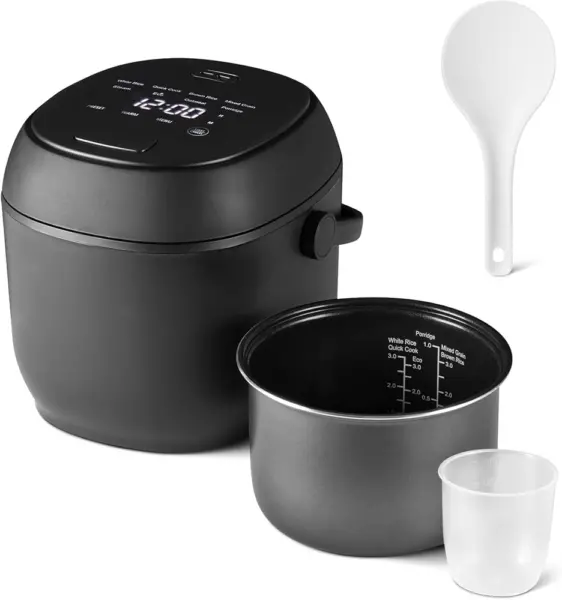
Amazon Basics Micom Rice Cooker
Key Features
- Pot: Ceramic nonstick aluminum
- Modes: 8, including brown rice and porridge
- Controls: Fuzzy logic, locking lid, detachable cord
- Capacity (cooked): 6 cups (3 cups raw)
- Price: Premium
The price is the first thing to get straight, because this cooker costs several times what the one-touch models here do. What the money buys is a microcomputer in place of a thermostat — fuzzy logic — that reads temperature and adjusts time across eight modes: white rice, quick cook, brown rice, mixed grain, steam, eco, oatmeal, and porridge. There’s also a ceramic-coated aluminum pot, a detachable cord, and a thermal fuse.
The difference shows up on anything that isn’t plain white rice. Brown rice and mixed grains get the longer, gentler cycle they need rather than the boil-until-the-water-is-gone treatment, and porridge doesn’t scorch on the bottom the way it does in a pot with no brain. We were struck by how much sturdier the whole thing feels than the budget cookers: it’s the heaviest machine here, and it sits still on the counter instead of skating when you stir. The lid locks, which makes carrying a full pot to the table a one-hand job.
The trade-off is speed and simplicity. White rice takes longer here than it does in the cheap pots, because the cycle is built for consistency rather than hurry, and eight modes is more menu than a one-button cook wants to think about at six in the evening. We think it earns its price for households that cook brown rice, barley, or congee regularly, or that have already retired a budget cooker. If your rice is always white and always jasmine, save the money and take the AROMA.
Pros
- Eight modes including brown rice and porridge
- Fuzzy logic adjusts time and temperature
- Locking lid and detachable cord
- Heavier build that stays put
Cons
- Slower white-rice cycle than the one-touch pots
- Most expensive cooker in this group
The one to buy if you cook more than white rice: fuzzy logic, eight modes, and a locking lid, at a price that only makes sense if you’ll use them.
Best for Rice Plus Vegetables
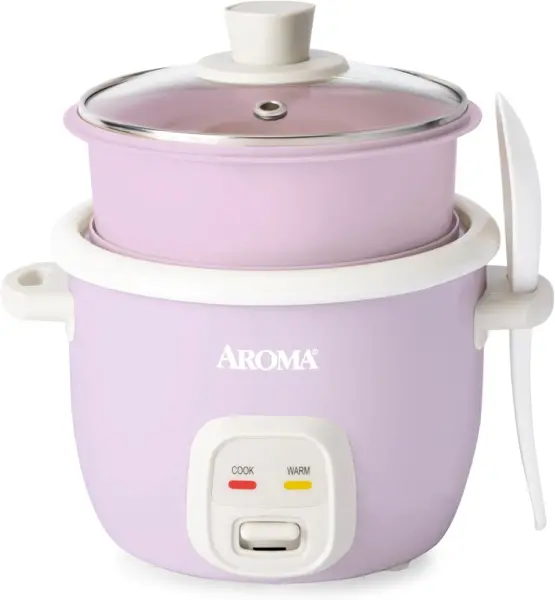
AROMA ARC-302CUL
Key Features
- Pot: Ceramic nonstick, PFAS-free
- Steamer: Pop-up basket that nests inside
- Footprint: 8.5"D x 7"W x 8.38"H
- Capacity (cooked): 4 cups (2 cups raw)
- Price: Budget
The lilac finish gets noticed, but the reason this cooker is on the list is the steamer basket. It stacks on top of the pot rather than dropping inside, so a full batch of rice doesn’t crowd out the vegetables, and it collapses down and nests for storage. We like that combination for a one- or two-person dinner: rice below, broccoli or frozen dumplings above, one appliance on the counter instead of two.
The pot is the same CoreCoat ceramic AROMA uses across its line, PFAS-free and properly nonstick, and the capacity is two cups raw to four cups cooked in a one-quart bowl — enough for two people with a little left over, not enough for a family. One touch starts it, the sensors switch to keep warm at the end, and the whole thing weighs two pounds, so it moves from cabinet to counter without a second thought. The steamer tray itself is plastic, which is our one real reservation: fine for vegetables and dumplings, less appealing for anything you want browned.
Compared with the larger AROMA above, you give up two cups of cooked rice and a little headroom in exchange for the steamer and a smaller body. If your dinners are rice plus something green, that’s a fair trade; if you batch-cook for lunches, take the bigger pot. Rice quality is the same either way — fluffy separate grains with a rinse, stickier if you skip it.
Pros
- Steamer stacks above the rice, not in it
- Basket nests inside for compact storage
- Ceramic pot is PFAS-free and nonstick
- Light two-pound body in cheerful colors
Cons
- Plastic steamer tray
- Four cups cooked at most
For rice and steamed vegetables out of one small pot, this is the one we reach for — the basket stacks above the rice and disappears inside it for storage.
Best for Dishwasher Cleanup
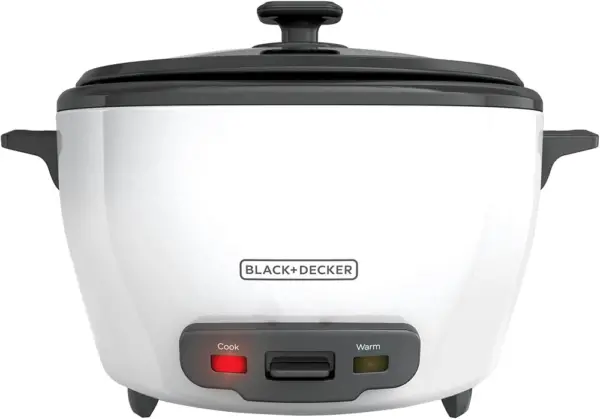
BLACK+DECKER RC506
Key Features
- Pot: Removable nonstick, dishwasher-safe
- Steamer: Basket included
- Footprint: 10"W x 5.5"D x 9"H
- Capacity (cooked): 6 cups (3/4-cup scoop)
- Price: Budget
The dishwasher-safe inner pot is what separates this from the rest of the cheap cookers. The nonstick bowl lifts out, goes in the rack, and the base wipes down; every other machine here asks you to wash the pot by hand. For anyone who cooks rice three or four times a week, that single difference is worth more than a feature list.
Beyond that it’s a conventional one-touch cooker with a steaming basket, a tempered glass lid, a keep-warm mode, and a steam vent angled to send steam away from your upper cabinets instead of straight up into them — a small thing we appreciate every time, because steam straight up means wiping the cabinet doors. Three cups of rice take 20 to 30 minutes, and the controls are a single lever that a kid can work.
Here’s what the six-cup label is worth: BLACK+DECKER measures with the three-quarter-cup scoop in the box, and the pot tops out around four cups of cooked rice in standard measurements. That’s still more usable rice than the smaller cookers here, and it’s plenty for four people as a side, but a six-cup dinner party means two batches. The two-year warranty is the longest in this group, which is some comfort in a price class where elements give out. It’s also the widest machine here at ten inches, so measure the gap between the fridge and the wall before you commit.
Pros
- Removable pot is dishwasher safe
- Steamer basket included for vegetables
- Two-year limited warranty
- Steam vent aimed away from cabinets
Cons
- Ten-inch width eats counter space
- Basic nonstick rather than ceramic
If you want the pot to go in the dishwasher and enough rice for four, this is the pick; just don’t expect six cups in real measurements.
Best for Countertop Style
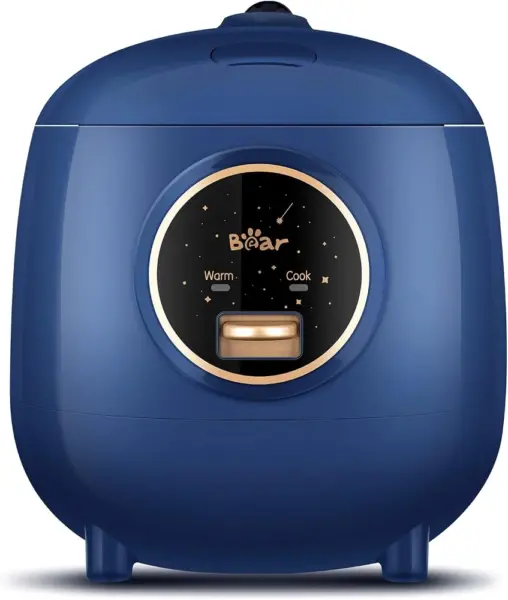
Bear Mini Rice Cooker
Key Features
- Pot: Removable nonstick, BPA-free
- Weight: 3.1 lb
- Cook Time: 25 minutes
- Capacity (cooked): 4 cups (2 cups raw)
- Price: Midrange
Fill it near the top line and this little cooker spits: starchy water climbs out of the steam hole and lands on the counter. Keep the water at or below the lower mark and it behaves, which is the kind of thing you learn in the first week and then stop thinking about. One more quirk worth knowing before your first batch: the included cup is 150 milliliters, smaller than a standard rice cup, so trust its own scoop rather than the measurements in a recipe.
The rest of the package is genuinely nice. A 25-minute cook is the fastest claim in this group, the liner is thickened and curved for more even heat, the inner lid detaches for washing, and the finish looks better than the plastic on most of these machines. At 1.2 liters it makes four cups of cooked rice, enough for two people with leftovers, and the body is 8.5 inches square — not actually smaller than the cheaper AROMA, just taller and heavier at a little over three pounds.
What you’re paying for is the look and the speed, not the capacity. The Dash makes half as much for roughly half the money, and the AROMA makes more for less. We think the Bear earns its place when the cooker lives on your counter and you want something you don’t mind looking at, and when your rice is white or your oats are quick. It is a pleasant machine to own; it is not the sensible one.
Pros
- Fast 25-minute cooking cycle
- Detachable inner lid simplifies cleaning
- Four cups cooked for two people
- Finish that looks good on the counter
Cons
- Costs more than larger cookers here
- Keep warm can overcook a small batch
A good-looking, fast little cooker for two, as long as you don’t mind paying more per cup than the AROMA asks.
How We Chose and Tested Small Rice Cookers
We started with every small cooker we could find in the 2- to 4-cup uncooked range, then cut the list by reading spec sheets alongside the one- and two-star reviews. Models with a permanently attached pot, a lid that doesn’t come off, or no keep-warm setting dropped out early. That left 14 machines, spanning one-button two-cup cookers to slightly fancier ones with steaming baskets and locking lids.
Each cooker ran the same routine for four months, in our test kitchen and in our own kitchens: at least two batches a week, one of them on a weeknight when we were hungry and not feeling generous. We cooked long-grain white, jasmine, short-grain, and brown rice, and made oatmeal and quinoa in the models that claimed to handle them.
We timed every batch from button press to beep, then checked the rice ten minutes into keep warm to see whether the bottom had dried into a crust. To test leakage, each cooker sat on a paper towel through a full batch and we looked for rings of starchy water afterward. For cleaning, we let the pot sit for an hour before washing and counted how much rice had glued itself to the rim, the hinge, and the seam where the lid meets the base.
Portion size was measured, not eyeballed — we weighed the cooked rice against what the box claimed. We washed the nonstick pots by hand and, where the maker allowed it, in the dishwasher, then checked for scratches and sticking after a month of steady use. Cook time, evenness, and cleanup decided most of the close calls, and value followed from those: the cheapest cookers that leaked or scorched were nobody’s bargain.
How to Choose a Small Rice Cooker
Two numbers decide most of this purchase: how many cups of cooked rice you actually eat in a sitting, and how much you mind washing a pot by hand.
Do the capacity math before anything else
The figure on the box is cooked rice, and the cups are rice-cooker cups of about 180 milliliters, roughly three-quarters of a US cup. So a two-cup cooker makes one generous bowl, a four-cup model covers two people with a little left over, and a six-cup pot is the right size for two or three people who want rice for lunch the next day.
Count the cups you’ll eat at one meal, then add one for leftovers. Buying for the biggest dinner you might host is how a small cooker turns into a large one you resent storing, and buying for a single bowl is how you end up cooking two batches on a Tuesday. If you cook rice more than twice a week, the extra capacity is almost always worth the extra four inches of counter.
One-touch or fuzzy logic
A one-touch cooker runs on a thermostat: it boils until the water is gone, the temperature climbs past the boiling point, and a switch flips it to warm. It is cheap, fast, and reliable at white rice. A fuzzy-logic machine uses a thermistor and a small computer to adjust time and temperature, which is what makes brown rice, mixed grains, and porridge come out properly instead of scorched or crunchy.
That is the whole case for spending more. If your rice is white and your grains are rice, the cheap thermostat does the job and does it faster. If you cook barley, oats, or congee, or if you have already retired one budget cooker, the microcomputer is money well spent — the Amazon Basics here is the model in this group that makes that argument.
The coating decides how much you’ll enjoy cleanup
Ceramic-coated aluminum pots release rice with almost no persuasion and are usually the easiest to rinse, which is why so many of the picks here use one; several are also made without PFAS. Standard nonstick is slick when it is new and less forgiving once it has been scrubbed a few hundred times, but it is the coating that tends to be rated for the dishwasher.
Whichever you choose, use the plastic spatula the cooker ships with, and replace a pot whose coating is scratched or lifting rather than living with rice that sticks. Dishwasher-safe parts are a genuine convenience, not a marketing line — the BLACK+DECKER is the model here that spares you the hand wash.
Treat keep warm as a short leash
Nearly every cooker in this category switches to warm when the rice is done, and nearly every one of them runs that warm cycle hot enough to brown the bottom layer within an hour or two. The rice nearest the pot dries out first, then toasts, and the smell is unmistakable.
Fluff the rice when the cycle ends, unplug the machine or switch it off if you can, and serve within the hour. If you need rice to hold for a long evening, cook it later rather than earlier — a warm cycle is a convenience between finishing the stir-fry and sitting down, not a holding cabinet for the afternoon.
Check the counter and the cabinet
A small cooker still runs eight to ten inches across and seven or eight inches tall, and you need clearance for the lid to open plus a few inches for the steam. Rice cookers parked directly under upper cabinets leave those cabinets damp, which is a worse problem than the footprint.
Measure the height with the lid up, not closed, and check the vent direction — some lids send steam forward and some send it up. If the machine lives in a cabinet between uses, note the diameter and the weight: the lightest two-pound models are the ones you’ll actually put away.
Frequently Asked Questions
Is a small rice cooker worth it if I already cook rice in a pot?
It buys you three things a saucepan doesn’t: a burner you can use for something else, a machine that switches itself off while you finish dinner, and consistent results without watching a boil. The small ones draw only 200 to 500 watts, so the running cost is minimal.
If you cook rice once a month, keep the pot. If it’s twice a week or more, a two- or four-cup cooker earns its counter space fast, and it makes oatmeal and quinoa just as easily.
Do I need to rinse the rice before cooking?
Rinse until the water runs mostly clear — usually three or four passes in a bowl. That washes off surface starch, which is what makes grains glue together, foam at the lid, and spit starchy water out of the vent.
Skip it if you want sticky rice or sushi rice with cling. For jasmine, basmati, and long-grain, rinsing is the difference between separate grains and a lump, and it keeps a small pot from boiling over.
What else can I cook in one besides rice?
Oatmeal, grits, quinoa, polenta, and hot cereal all work on the same rice setting, though you should watch the first batch for boil-over. Models with a steamer basket will cook broccoli, dumplings, or shrimp above the rice at the same time.
A one-touch machine is limited to boiling until the water is gone, so anything that needs a long simmer with a lid on — beans, steel-cut oats — is better on a fuzzy-logic cooker or the stove.
How long does a batch take?
Fifteen to twenty minutes for two cups in the smallest cookers, twenty to thirty for a full pot in the larger one-touch models, and noticeably longer in a fuzzy-logic machine that deliberately slows the cycle for brown rice and grains.
Add a few minutes for rinsing and for the rest at the end of the cycle. If speed is the priority, the small one-touch pots are the faster machines; if texture is, the slower ones win.
Final Verdict
If you want one answer, it’s the AROMA ARC-363NG. Six cups cooked, a ceramic pot that releases rice instead of clutching it, measuring lines that make the water ratio obvious, and one button — for one to three people it does more of the job than anything else here.
Two exceptions earn their keep. If you cook brown rice, barley, or congee, the Amazon Basics with fuzzy logic is the only machine here built for it, and it will outlast the cheap pots. If it’s just you and one bowl, the Dash makes exactly that and nothing more. Everyone else can stop comparing and buy the AROMA.