This post contains affiliate links. We may earn a small commission when you buy through our links — at no extra cost to you.
The worst part of a Sunday roast shows up on Monday, baked onto the oven floor. I’ve gone at carbonized drips with a spatula and once convinced myself a self-clean cycle would handle it—it just cooked the mess harder. An oven cleaner should soften baked-on grease until it wipes away, then rinse off cleanly enough that you’re not scrubbing the cleaner off afterward. Over four months, my team and I worked through 16 oven cleaners in real kitchens.
The thing first-time buyers miss is that the formula matters less than the dwell time and the cling. Most cleaners will loosen a light film if you leave them long enough; the ones worth buying go after baked-on spills in five to ten minutes and stay where you spray them, even on vertical walls. The other split is fumes versus muscle—fume-free formulas are gentler on your eyes but often need a second pass.
The picks below cut grease without a scrub session, rinsed away without leaving a slick film or a dull patch on the enamel, and didn’t leave the kitchen smelling like a garage all afternoon.


Best for Heavy Baked-On Grease
Easy-Off Heavy Duty Oven Cleaner
Key Features
- Formula: Heavy-duty aerosol
- Surfaces: Ovens, grills, broiler pans, stainless
- Pack size: 6 cans, 87 oz total
- Dwell time: 5 minutes
- Price: Midrange
Five minutes is the entire pitch, and in our testing that was enough. Sprayed onto baked-on spillage on an oven floor, it lifted what had been through months of roasting with nothing more than a wipe behind it. What convinced us to make this the default is the range: the same can does the oven floor, the door glass, a broiler pan, and a grill grate, so you’re not keeping three half-used bottles for one dirty appliance.
Colored enamel is where this formula can bite. On a saturated interior, a heavy application can leave a white bloom that takes several rinses to shift, and it reads as damage until it lifts. Spray an inconspicuous corner first, hold to the label’s five minutes rather than letting it sit while you do something else, and rinse with a wet cloth before going back over the same spot.
The pack is the other thing to weigh. Eighty-seven ounces across six cans is a multi-year supply for a household that deep cleans twice a year — handy, and also a stack of aerosols to store where kids and pets can’t reach them. The bulk is the only real compromise, and it stops mattering the first time you finish an oven with a can to spare.
Pros
- Lifts baked-on grease in about five minutes
- Works on ovens, broiler pans, grills, and stainless
- Six cans totaling 87 ounces covers years of deep cleans
Cons
- Strong fumes; open windows and wear gloves
- Heavy carbon sometimes needs a second application
We recommend it for the worst oven in the house: five minutes of dwell, a wipe, and baked-on carbon gives way. Nothing else here does as much in one pass.
Best for Small Kitchens
Easy-Off Fume Free Oven Cleaner
Key Features
- Size: 24 oz
- Gloves: Not required
- Formula: Fume-free aerosol
- Surfaces: Ovens and air fryers
- Price: Budget
If your kitchen is a rental with one window, a basement galley, or just small enough that a caustic aerosol would fill the whole apartment, this is the can to keep. There’s no chemical punch when you spray — a light lemon smell at most — and no gloves to pull on, which is why we found ourselves grabbing it for a fast pass before guests arrived. It works on a cold oven too, so nothing has to heat up first.
The trade is time. On a week’s worth of roasting spatter it’s spray, wait, wipe, done. On genuine baked-on carbon it needs hours rather than minutes, and leaving it overnight is the version that actually finishes the job. We think that’s a fair swap for not fumigating a small kitchen, though it does mean the heavy-duty can still wins the genuinely awful ovens.
Twenty-four ounces is the pro-size can, and that matters more than it sounds in a double oven or on a rack you have to go over twice. It’s also mild enough to use as a spot cleaner rather than a twice-a-year event, which is the difference between a can that lives under the sink and one that lives out in the garage.
Pros
- No harsh fumes and no gloves required
- Works on a cold oven with no preheat
- 24-ounce pro can suits double ovens and repeat jobs
Cons
- Cap and sprayer can fight you
We hand the fume-free can to anyone who cannot open up the kitchen and air it out; it trades speed on carbon for air you can actually breathe.
Best for Racks and Hoods
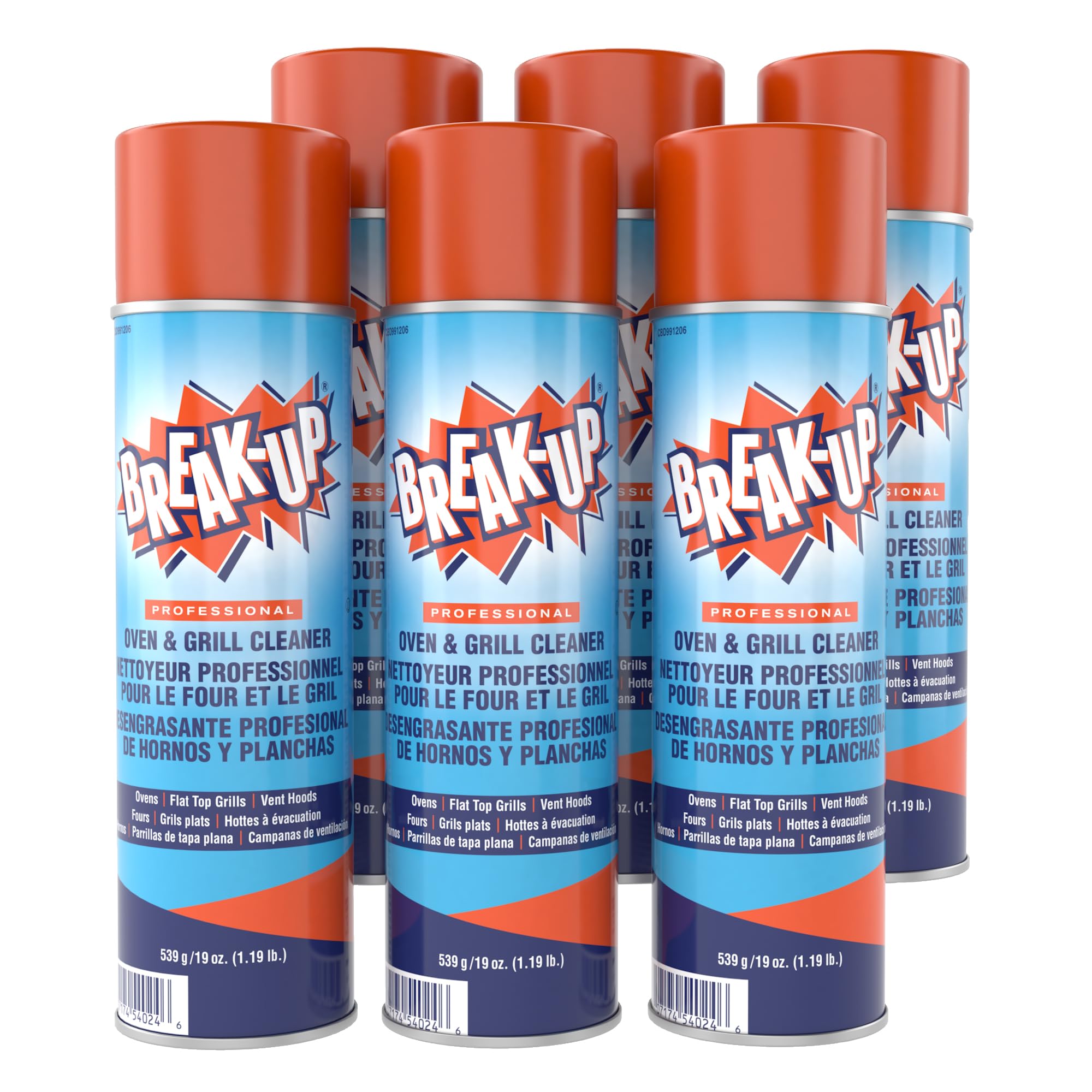
Diversey Break-Up Oven & Grill Cleaner
Key Features
- Formula: Clinging foam
- Surfaces: Ovens, grills, vent hoods
- Pack size: 6 cans, 19 oz each
- Certifications: NSF listed, Kosher
- Price: Premium
Everything else here arrives as a mist or a thin spray. Break-Up arrives as a foam that stays where you put it, which is the whole reason it made this list. On the back wall of an oven, on rack rungs, on a vent hood, on grill grates, a clinging foam keeps working instead of running down and pooling somewhere useless. Cold surfaces are fine, and the NSF listing and Kosher certification matter if the equipment has to pass an inspection.
It isn’t the cleanest wipe of the group. Break-Up can leave a haze that needs a second pass with fresh water, and the fix is to rinse harder than feels necessary rather than to spray again. What we kept coming back to is the dwell time the foam buys: a vertical surface is exactly where a thin cleaner gives up first, and this one is still working when a mist would have slid off.
Nineteen ounces looks small next to an eighty-seven-ounce six-pack, but foam covers differently — a lot of what you spray as a mist ends up on the oven floor within a minute. Six cans is a serious supply, the kind you buy for rental turnovers, a commercial line, or a household running two ovens and a grill through the summer.
Pros
- Clinging foam stays on vertical surfaces
- NSF listed and Kosher certified
- Handles ovens, grills, hoods, and fryers
Cons
- Cap is hard to twist off
- The priciest pick in this group
We keep Break-Up for racks, hoods, and anything vertical, where its clinging foam outlasts every mist on this list.
Best for Grill Grates
Zep Heavy-Duty Oven & Grill Cleaner

A single 19-ounce oven and grill cleaner that earns its shelf space is a useful thing to have around, and Zep’s formula is at its best on the surfaces you would otherwise attack with a wire brush: burner grates, the range top, the inside of the door. We found it lifts gunk fast enough that the brush barely comes out, and it handles a grill grate without a long soak.
Nineteen ounces goes quickly on a double oven, and the fumes are strong enough that we treat it like the heavy-duty cans — windows open, gloves on, nobody else in the kitchen. Where it pays you back is the small brutal jobs: a spray and a wipe on a burner grate instead of an afternoon of soaking.
Pros
- Cleans burner grates and range tops fast
- Wipes away gunk with minimal scrubbing
Cons
- Nozzles can clog or quit mid-can
We reach for the Zep can for grills and range tops, where it lifts carbonized crust with almost no scrubbing at all.
How We Tested Oven Cleaners in Real Kitchens
We started by pulling every oven-specific cleaner we could find at major retailers—not general-purpose kitchen degreasers—and read the review sections for recurring complaints about fumes, residue, and nozzles that quit halfway through a can. From that pool we bought 16, weighing price per ounce and pack size so the lineup covered single cans and multi-packs. Testing ran four months, in home kitchens with gas and electric ovens that had gone a few weeks without a deep clean.
Each cleaner got the same assignments: baked-on drips on an oven floor, grease-filmed door glass, wire racks soaked in a tub, and a broiler pan that had seen better days. Since several are labeled for grills, vent hoods, and air fryer baskets, we used them there too, including one genuinely neglected backyard grate. We applied each per its label, timed the dwell, and recorded what the foam or mist did in the first minute—whether it clung to the walls or slid straight to the bottom.
After the dwell, we wiped with a damp cloth and counted passes before we allowed ourselves to scrub, which is how we separated the genuinely scrubbing-free products from the ones that just said so. We noted whether the surface felt slick or squeaky afterward, how many rinse-and-wipe rounds it took to clear the residue, and whether the oven interior looked evenly clean or streaky.
We watched white enamel, stainless trim, and painted oven interiors for dulling or discoloration across the four months, and rated odor three times—at application, ten minutes in, and after the final wipe—flagging anything that sent us to open a window. Spray performance got its own tally: clogged nozzles, hand fatigue, and wide patterns that misted the whole kitchen versus narrow ones that hit the mess. We also counted full oven cleans per can to see what the price per ounce actually bought.
How to Choose an Oven Cleaner
The formula decides how much time and fresh air the job will cost you, and the can decides whether the product lands where you aim it — settle both before you pick a brand.
Pick the formula around your ventilation
Heavy-duty oven cleaners are caustic, and that is precisely why they finish in minutes. If you can open two windows, run a fan, and stay out of the kitchen for an hour, the fast stuff is the right call. If you cannot, a fume-free formula gets you most of the way there with a longer dwell and no gloves.
Foam is the third option and the most misunderstood. It clings to walls, rack rungs, and hood panels instead of running down and pooling on the floor, which is what you want for anything vertical. Match the format to the geometry of the mess, not just to the label on the front.
Dwell time does the scrubbing
The most common mistake is treating these like a spray-and-scrub surface cleaner. Set a timer and walk away: five minutes for a heavy-duty aerosol, three for professional-grade formulas, and hours or overnight when a fume-free cleaner is carrying the load. Scrubbing early does not speed anything up; it just moves the cleaner off the soil before it has finished.
When the timer goes, wipe first and scrub only what is left. If you are still scrubbing after a second application, the cleaner was never the problem — the dwell was.
Check what your oven interior is made of
Stainless steel, glass, and plain enamel handle any of these cleaners. Saturated colored enamel is the finish to be careful with: a strong application can leave a white bloom that takes several rinses to lift, and it reads as damage until it comes off.
Test a hidden corner behind the door first, keep the dwell to what the label says, and rinse with a wet cloth before you go back over the same spot. Anything you can unclip and clean in a sink or on a driveway will go faster than cleaning it in place.
Buy the can, not just the chemistry
Sprayers are where expensive cans and cheap ones both fail. A nozzle that clogs or quits with product still inside turns a five-minute job into a return, so read the hardware comments before you commit to a six-pack. Foam cans add a stiff cap that can be genuinely hard to twist off the first time.
Then match the pack to your rhythm. A single can is usually enough for a household that deep cleans twice a year; six-packs make sense for rentals, second ovens, or a grill that gets scrubbed monthly.
Frequently Asked Questions
Do I have to rinse the oven after using a cleaner?
Yes, and usually twice. Anything that touches a surface where food goes needs a wet-cloth rinse, then another pass with a clean cloth until the surface feels slick-free rather than soapy. Residue left behind bakes on the next time you preheat, and that is the smell people blame on the cleaner itself.
Give the corners, the door seal, and the channel around the glass extra attention, because that is where spray pools and where a quick wipe misses.
What is the trick to a clean oven door glass?
The streaks come from cleaner you did not rinse off, not grease you did not lift. Spray the glass, wait the full dwell, then wipe in one direction with a wet microfiber instead of scrubbing in circles. Finish with plain water and a dry towel.
Let the door cool first. Spraying a warm door sets residue faster than you can wipe it, and you will chase the haze for three passes.
Is it safe to spray oven cleaner near a gas pilot light?
No. Shut the gas off at the valve, let the oven cool completely, and keep the spray away from the pilot light, the igniter, and the burner openings. Pooled cleaner in the burner wells is hard to rinse out and harder to see.
Ventilate while you work, and do not relight until the interior has been wiped, rinsed, and the smell has cleared.
Final Verdict
We keep the heavy-duty Easy-Off six-pack on the shelf because it does the most work in the least time: five minutes of dwell, a wipe, and the oven floor is done. If your kitchen cannot be aired out — a rental, a winter with the windows sealed — the fume-free can is the one to buy instead, and you trade minutes for hours on the worst buildup.
Buy Break-Up when the mess lives on racks, hoods, or the back wall, where a clinging foam stays put long enough to finish the job.