This post contains affiliate links. We may earn a small commission when you buy through our links — at no extra cost to you.
A portable blender has one job: make the smoothie where you actually are, not where the outlet is. That sounds simple until you’re standing at a gym locker with a cup of frozen strawberry mush, or realizing the leakproof lid has been leaking into your bag since the parking lot. I’ve owned three of these over the years; two of them live in a drawer now.
The fix isn’t a bigger wattage number. It’s a blade that keeps moving once frozen fruit hits it, a lid that holds when the cup rides sideways in a tote, and a battery that outlasts the first drink. We’ve spent eight months with 12 portable blenders, and the gap between good and forgettable is wide.
One thing nobody tells a first-time buyer: the cup matters as much as the motor. A jar wide enough for a brush rinses clean in seconds, while a narrow one with a shoulder near the blade turns into a five-minute scrub. The picks below earned their place on how they blend, how they clean up, and whether they still run in month seven.

Best for Everyday Cordless Smoothies
Ninja Blast Max
Key Features
- Vessel: Twist-off, detachable
- Weight: 2.6 lb
- Capacity: 22 oz
- Programs: 3 Auto-iQ presets
- Price: Midrange
The cup comes off the motor base with one twist, and that is the detail that turns this from a blender you carry into a blender you travel with. The 22-ounce vessel takes a sip lid and a handle and goes in a bag; the base stays on the counter or in the car. Ninja rates the detached cup at roughly half the weight of a motor-in-cup design, and once you have carried both kinds, that difference is the whole argument.
Power is where the Blast Max earns its keep rather than just its looks. Three Auto-iQ programs cover smoothies, crushing, and everyday blending, and Crush is the one that matters, because frozen fruit and ice are what defeat small blenders. A program that runs for a set time and keeps the blades moving is what we prefer to a button you pulse and hope over. The 1,000-watt figure on the box is a peak rating rather than countertop muscle; judge the blender by what comes out of a properly loaded cup of frozen fruit.
What you accept is a battery you think about. It is an 11.1-volt cordless machine, so the charge in the base is the number of smoothies you get, and a cup packed with ice is the heaviest thing you will ask of it. We treat charging as part of the routine rather than a spec to resent: the base lives near an outlet, and the cup is what goes in the bag. If your blender never leaves the kitchen, the corded Ganiza makes more sense and never asks about a charger.
Pros
- Cup twists off and travels on its own
- Three presets, including a dedicated Crush
- 22 oz capacity you drink straight from
- Vessel and lid are dishwasher safe
Cons
- Plastic lid and latch are the wear points
- One-year warranty on a battery-powered motor
The cordless blender we recommend to most people: a 22-ounce cup that twists off and travels, with enough power for frozen fruit and ice.
Best for Ice and Thick Blends
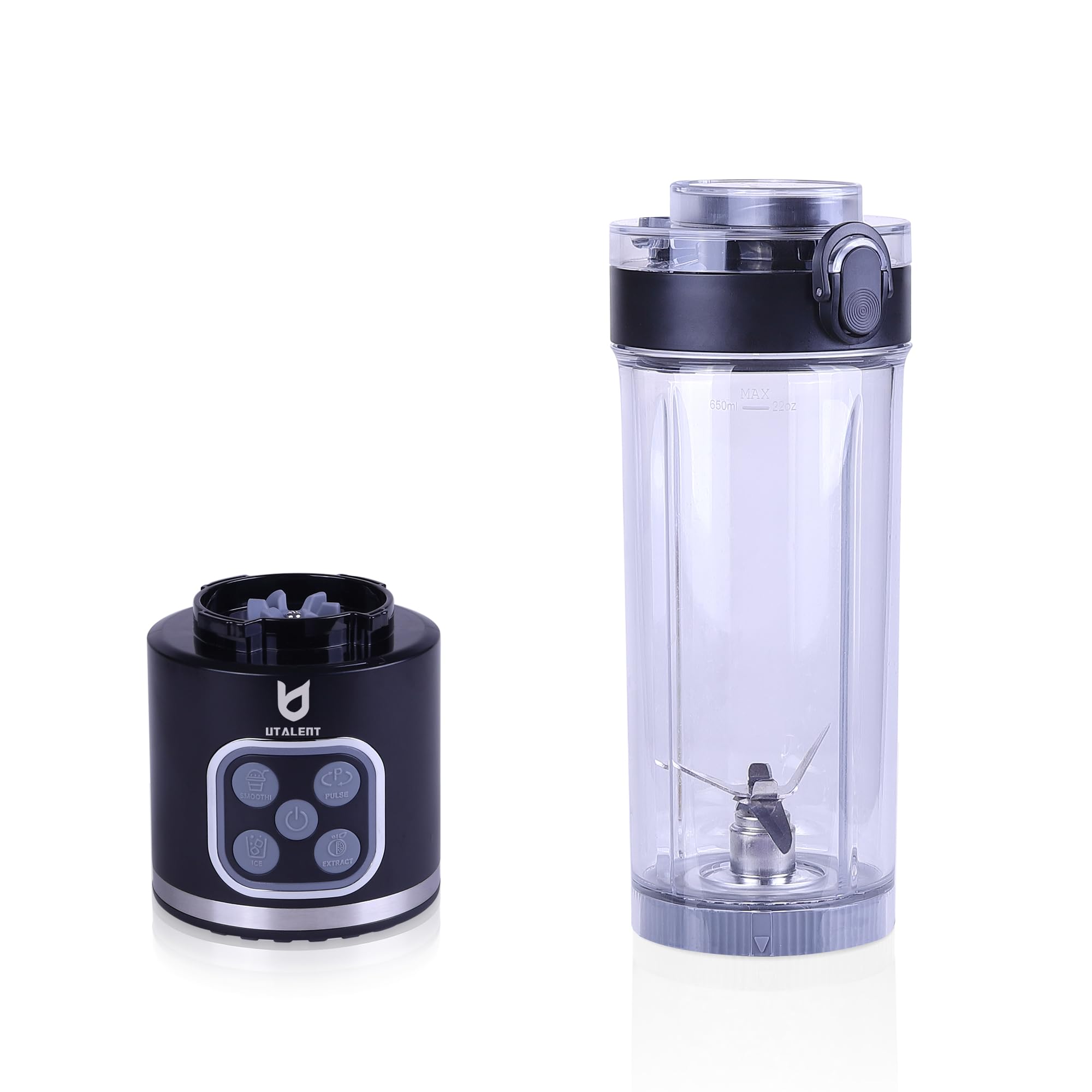
UTALENT Portable Blender
Key Features
- Motor: 700 W brushless
- Capacity: 25 oz cup, 22 oz blend max
- Charging: USB-C
- Programs: 4 presets
- Price: Premium
The cup is the biggest of the cordless picks here, and the interesting number is the second one: 25 ounces of Tritan vessel, 22 ounces of actual blending room. That gap is headroom for ice and frozen fruit, not marketing. A 700-watt brushless motor and four presets, Smoothie, Ice Crush, Extract, and Pulse, make it the most powerful cordless option in this group on paper, and the ice program is the one you will reach for most mornings.
We are fond of the safety design, too: the vessel has to be locked to the base before the motor will spin, which is the reassurance you want on a blender whose blades come with you. The base twists off for drinking, the cup measures about 3.5 inches across so it sits in a car holder, and it charges over USB-C with the same cable as your phone.
What it cannot claim is a long record. It is the priciest cordless option here and it comes from a newer brand, so you are trading some certainty for capacity and power. Charging is also the least predictable part of the package, and our advice is to top it up weekly whether or not the light asks. If a big cup and genuine ice performance matter more to you than brand history, this is the one; otherwise the Ninja is the safer spend.
Pros
- 700 W brushless motor with a dedicated ice program
- 25 oz cup with 22 oz of blending headroom
- Vessel locks to the base before it runs
- Charges over USB-C
Cons
- Newer brand with a short track record
- Runtime per charge is inconsistent
If your smoothie starts with ice, this is the cordless pick: a brushless motor, four programs, and a 25-ounce cup with room for frozen fruit.
Best for Countertop Batch Blending
Ganiza Smoothie Blender

Key Features
- Blade: Removable 4-blade cross
- Power: Corded, 900 W peak
- Weight: 3.9 lb
- Cups included: 3 (24 oz, two 17 oz)
- Price: Budget
There is a cord, and it decides who this is for. The Ganiza is a countertop personal blender with a 24-ounce cup and two 17-ounce cups, each with a to-go lid, so the cups travel while the machine stays plugged in. That is a good trade for a desk, a dorm room, or a small kitchen where the smoothie gets made and drunk in the same place, and a poor one for a gym bag or a hotel room where there is no outlet to find.
The cup math is what sold us: blend a double batch, cap both cups, and tomorrow’s breakfast is handled before you have washed anything. The four-blade cross lifts out of the cup for cleaning instead of making you scrub around a fixed blade, and there is a recipe book in the box, a better extra than another plastic ring. Nine hundred watts of peak power gets through frozen fruit and small ice, though a peak rating flatters any blender, so load the cup in layers and give it a moment.
The single speed is the compromise. There is no crush program, so a heavy load means holding the button and shaking the cup yourself, and frozen chunks take a beat longer than they do in the Ninja. That is what the savings buy, and for one smoothie at a time on a kitchen counter it is a fair trade.
Pros
- Three cups and two travel lids
- Removable blade cross for easier washing
- 900 W peak power for frozen fruit
- Lowest-cost way to get a three-cup setup
Cons
- Plastic blade socket and seals wear first
For a blender that stays on the counter, this is the useful one: three cups, a removable blade, and corded power that chews through frozen fruit.
How We Chose and Tested Portable Blenders
We started by gathering every portable blender with a real following, reading spec sheets, comparing cup capacity against what a full smoothie actually needs, and filtering out anything whose battery or motor claims didn’t hold up in customer reviews. Price mattered too, since a lot of these are bought as a second blender, so we kept the range broad without paying for features nobody uses. That left 12 units, which we bought ourselves.
Testing ran eight months and happened where these machines actually live: a desk drawer at the office, a gym bag, a carry-on, a hotel bathroom, and a kitchen counter on ordinary weekday mornings. Every unit got the same first assignment, frozen strawberries, half a banana, a few ice cubes, and a splash of milk, blended cold and again with day-old refrigerated ingredients.
We watched whether the blades kept turning or stalled and needed a shake, and how many pulses it took to get a drink without chunks. For leaks, we filled each cup, sealed it, turned it upside down over a paper towel, then carried it in a bag for a full day. Cleaning came next: how much pulp stuck to the shoulder of the jar, whether a bottle brush reached the corners, and how the parts held up in the dishwasher when the maker allowed it.
On the rechargeable models, battery life was a count, not a claim, tracking full blends per charge and how long a recharge took before the next morning. We also weighed each one loaded and checked whether it stood in a backpack pocket or a car cup holder without tipping. By the end of eight months we knew which lids still sealed, which motors had gotten louder, and which ones we’d buy again.
How to Choose a Portable Blender
Start with where you will actually press the button, because that one answer decides between a battery and a cord and makes the rest of the shopping much easier.
Cordless or Corded
A cordless blender runs a handful of blends on an 11.1- or 16.8-volt battery; a corded personal blender pulls wall power and puts more torque behind the blade for less money. The trap is the word portable, which in a listing often means a travel cup rather than a battery. A corded model with a 14-ounce jar is portable in the sense that the cup goes in your bag, not the blender.
If you will blend at a desk, in a hotel room, or in a car, pay for the battery. If the counter is the only place the button ever gets pressed, buy corded and spend the difference on capacity and extra cups.
What the Wattage Number Means
Treat the number on the box as a peak rating rather than sustained power. A 700- or 900-watt personal blender is not a 900-watt full-size machine, and the figure is measured in a burst. What separates a blender that handles frozen fruit from one that stalls is the program: a crush or ice cycle that runs for a set time keeps the mixture moving instead of pulsing once and quitting.
We put more weight on the preset list than on the wattage claim, and more weight still on a cup with headroom above the fill line so the blades have something to pull down into.
Cup Size and What You Actually Carry
Twenty-two ounces is a full smoothie. A 25-ounce cup rated for 22 ounces of blending tells you the maker left space for ice, which is what you want; a cup filled to the brim with frozen fruit is where small blenders give up.
Then look at the design, because that decides what rides in your bag. With a detachable vessel you carry a cup and leave a 2.6-pound base behind; a motor-in-cup model travels at full weight every single time.
Cleaning and the Parts That Fail
A cup, lid, and blade assembly that come apart and go in the dishwasher turn a daily chore into a ten-second job, and a splash of water plus a drop of soap run through the blades handles everything else. Seals, plastic latches, and blade sockets are the parts that go first, which is why all three blenders here carry a one-year warranty and why we check that a lid locks rather than merely sits.
If a lid leaks, reseat the gasket before you tighten harder; overtightening distorts the seal and shortens the life of the latch.
Frequently Asked Questions
Can I take a portable blender on a plane?
The blade assembly is the part security looks at, and the rules vary by airline and country. If the blades twist off with the vessel, pack that piece in checked luggage and carry the rest; if the blades are molded into the cup, plan to check the whole vessel. Confirm the policy with your airline before you pack it, because a confiscated blender is a bad start to a trip.
Why does my portable blender stall on frozen fruit?
Usually it is load order and headspace. Put liquid in first, then soft ingredients like yogurt or banana, then frozen fruit and ice on top, and stop below the maximum line so the blades have room to pull the mixture down. If it still stalls, shake the cup mid-cycle and run the ice or crush program instead of pulsing.
Can I blend hot soup in one of these?
No. These cups seal for travel and are not built to vent steam, so hot liquid pressurizes the vessel and can force the lid off. Let cooked ingredients cool to room temperature first and keep the fill under the maximum line. For hot soup, an immersion blender in the pot is the safer tool.
Is a portable blender worth it if I already own a full-size one?
If you make one 16- to 22-ounce smoothie a day and drink it away from the kitchen, yes. That is the job these do, and a full-size pitcher will not follow you to a desk. If you blend for two or more people at once, or you want silky results from tough ingredients, a full-size machine earns its counter space instead.
Final Verdict
Most people should buy the Ninja Blast Max. The cup twisting off the base is the difference between a travel blender and a heavy cup with blades in it, and 22 ounces with a real crush program covers a daily smoothie habit as long as the base lives near an outlet.
If ice is the main event and you want more capacity, the UTALENT’s brushless motor and 25-ounce cup are the step up. If the blender will never leave the counter, the Ganiza gives you three cups and a cord for less money.