This post contains affiliate links. We may earn a small commission when you buy through our links — at no extra cost to you.
A soda maker should replace the case of seltzer you keep hauling home, not become another appliance that needs babysitting. The promise is a cold, sharply carbonated glass whenever you want one; the letdown is weak fizz, a bottle that goes flat by lunch, and a machine that starts leaking after a month. I want quick carbonation, simple controls, a machine that looks presentable enough to leave out, and a footprint that doesn’t eat the whole counter. Over the past six months, my team lived with 12 soda makers to see which ones actually deliver that.
The first thing I learned is that carbonation is as much about temperature as pressure—cold water holds gas far better than lukewarm tap water, and small fizz adjustments beat one dramatic blast. I also got picky about bottle seals and cleaning, since a fussy bottle will quietly kill the habit. The picks below are the ones that earned their counter space, whether you drink plain bubbles or mix in flavor.



Best for Most Households
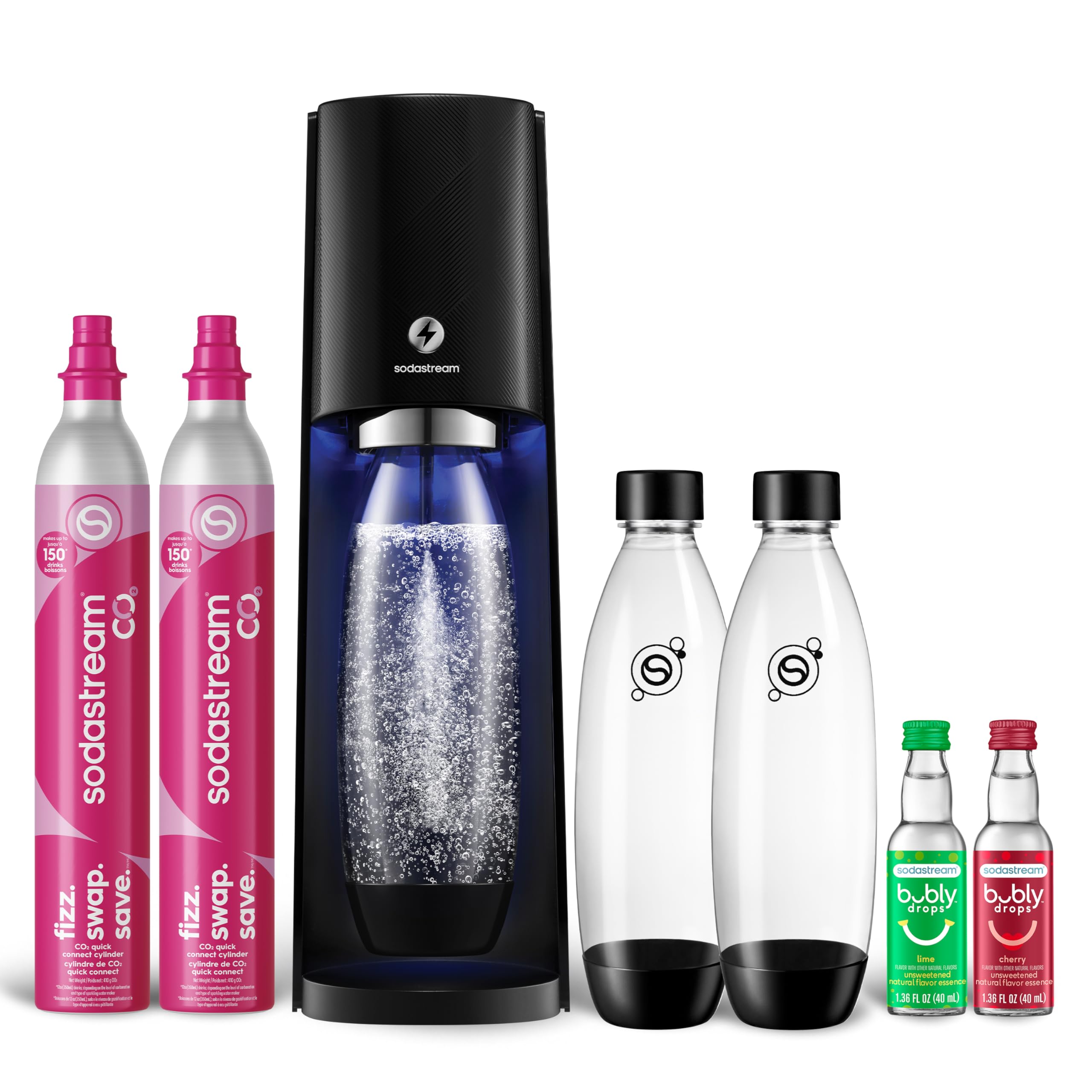
SodaStream Terra Value Bundle
Key Features
- CO2 format: SodaStream Quick Connect
- CO2 included: Two 60L Quick Connect cylinders
- Fizz control: Manual press, one at a time
- Bottles included: Three, dishwasher-safe
- Price: Budget
Two 60L Quick Connect cylinders and three dishwasher-safe bottles come in the box, and that’s the main reason the Terra is the machine we recommend to most people. Nobody has to order gas or buy a second bottle before the first glass; you fill, press, and you’re drinking seltzer the day it arrives. It’s the complete kit rather than the entry fee.
The Terra is manual, and the button controls how much gas goes in: one press for a spritzer, three or four for something with a real bite. What we noticed is that the water matters as much as the count. A bottle filled from the fridge carbonates into tighter, longer-lasting bubbles than one from the tap, and no amount of extra pressing rescues warm water. Chill first, then press.
The Quick Connect system is the one design decision to understand. The cylinder clicks in with a push instead of a thread, which is genuinely easier, but it’s SodaStream’s own format: exchanges go through SodaStream rather than a hardware store or a refill service. If cheap, locally sourced gas matters to you, the Aarke, Mysoda, and Breville take standard screw-in cylinders and give you more places to shop.
Everything else is quiet competence. Three bottles means one chills while one is on the counter and one is in the dishwasher, and the machine itself takes under eight inches of width. It doesn’t look like much beside the Aarke, but it doesn’t ask to be looked at either.
Pros
- Two cylinders and three bottles in the box
- Fizz strong enough to replace canned seltzer
- Cylinder clicks in with a single push
Cons
- Some units stop carbonating within months
We point most first-time buyers here: the Terra is the only machine that shows up with two cylinders and three bottles and still undercuts the rest as a complete setup.
Best for Fizzing Any Drink
Breville InFizz Fusion
Key Features
- Material: Brushed stainless steel
- Carbonates: Water, juice, tea, wine, soda
- CO2 included: No, standard 60L screw-in
- Bottle included: 1L with FusionCap
- Price: Premium
The InFizz Fusion is the most capable machine here, and the one that asks the most of you before the first glass. Its reason to exist is the FusionCap: a screw-on cap that lets you carbonate juice, tea, cold brew, wine, or flat soda directly, without turning the kitchen into a crime scene.
The cap does the work. It screws onto the bottle, the bottle locks in with a ring pull, and the pressure releases gradually, so a foaming liquid has somewhere to go besides the ceiling. We think that capability justifies the premium if fizzy lemonade or carbonated cocktails are why you’re shopping. For plain seltzer, you’re paying for a feature you’ll never touch.
It also feels like equipment. Brushed stainless, 7.9 pounds, and a lever instead of a button — it stays put when you pull, and it looks deliberate on the counter. Gas takes the standard screw-in 60L format, the widely exchanged kind, so running costs are as good as anyone’s.
Pros
- Fizzes juice, tea, wine, and flat soda
- Gradual pressure release keeps foamy drinks contained
- Brushed stainless body with a substantial lever
- Takes widely exchanged standard 60L cylinders
Cons
- CO2 cylinder sold separately
- Only one bottle in the box
The InFizz Fusion is the machine to buy if you want fizzy juice, tea, or cocktails and don’t mind sourcing a cylinder and a second bottle yourself.
Best for Juice and Cocktails
Drinkmate OmniFizz
Key Features
- Footprint: 8"D x 5"W x 16"H
- Carbonates: Water, juice, tea, cocktails
- CO2 included: One 60L cartridge
- Bottles included: 1L and 0.5L, BPA-free
- Price: Midrange
Carbonated orange juice sounds like a stunt until you try it. The OmniFizz is the value version of that trick: it ships with a 60L cartridge and two bottles, and its Fizz Infuser lets you carbonate juice, tea, lemonade, and cocktails directly — the same capability as the Breville, for a good deal less and with the gas already included.
The routine takes a minute to learn. Fill to the line, screw on the infuser, press in short bursts, and let it settle before unscrewing. Pulpy juice foams hard, so a chilled bottle and short presses are the difference between a treat and a cleanup. Plain water works exactly like any other machine here, with the lever giving fine control over how aggressive the fizz gets.
Where it feels its price is the body: light plastic, ordinary finish, nothing that will impress a guest. We still reach for it over prettier machines, because a household that drinks fizzy lemonade and iced tea every week gets more out of it than out of a water-only unit that costs more. If seltzer is all you want, put the money into gas instead.
Pros
- Carbonates juice, tea, and cocktails
- Cartridge and two bottles included
- Short bursts give fine control over fizz
- Cheaper than the other any-drink machine here
Cons
- Only one full-size bottle included
If you want to carbonate lemonade, juice, or cocktails without paying Breville money, the OmniFizz is the value pick and it arrives ready to fizz.
Best for Hands-Off Carbonation
SodaStream E-Terra Value Bundle
Key Features
- Footprint: 7.7"D x 5"W x 16.8"H
- CO2 included: Two 60L Quick Connect cylinders
- Fizz control: Three one-touch levels
- Bottles included: Three 32 fl oz, dishwasher-safe
- Price: Midrange
The E-Terra is the only machine here that needs a wall outlet, and that single fact decides where it lives. Give it a spot near a plug and it earns the upgrade: three buttons set light, medium, or strong carbonation, and it does the pressing for you. Of the automatic machines we compared, this is the one we think gets the balance right.
Holding a button isn’t hard, but doing it identically four times before dinner is where manual machines drift. The E-Terra produces the same fizz every time, which matters in a household where different people want different levels and nobody wants a tutorial. It’s the version to hand a grandparent or a kid and walk away.
The bundle is generous: two 60L Quick Connect cylinders, three 32-ounce bottles, and a pair of bubly drops. At five inches wide it takes less counter than the Terra, and the blue light while it carbonates is a small pleasure. The gas is still SodaStream’s Quick Connect format, so you’re in their exchange program.
Pros
- Three one-touch carbonation levels
- Repeatable results without holding a button
- Two cylinders and three bottles included
- Compact five-inch footprint
Cons
- Needs a free outlet on the counter
- Costs more than the manual Terra
For a household that wants the same fizz every time without holding a button, the E-Terra is worth the extra over the manual Terra.
Best for Countertop Looks
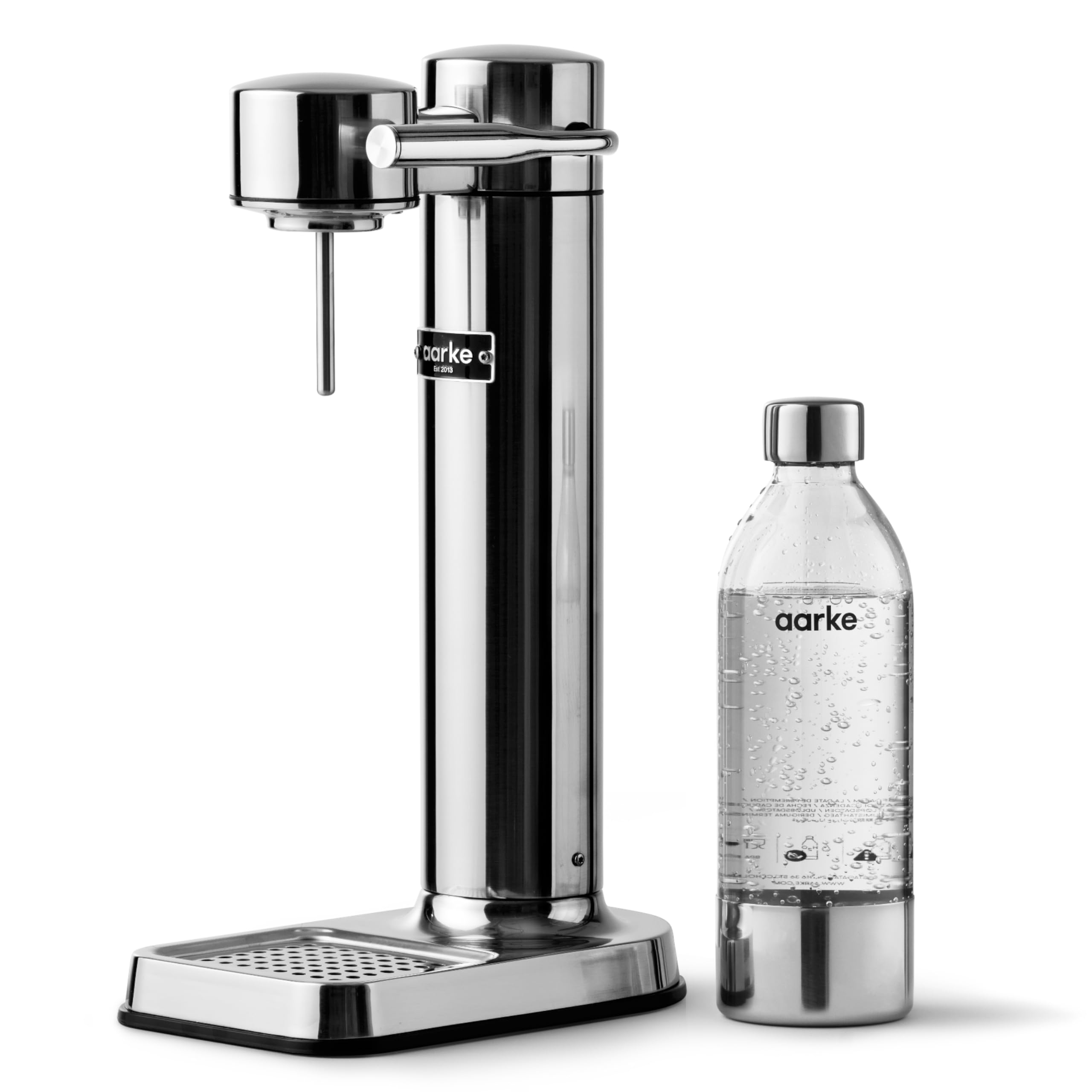
Aarke Carbonator 3
Key Features
- Material: Stainless steel
- Footprint: 10.16"D x 6.02"W x 16.3"H
- Operation: Manual, damped lever
- Bottle included: 800 ml PET
- Price: Premium
A soda maker sits out all day, so how it looks is part of what you’re buying. The Carbonator 3 is the only machine here that reads as an object rather than an appliance: a seamless stainless column, no visible plastic, and a lever that moves with a damped, weighted action. Ours drew comments from visitors before anyone had tasted the water.
The lever is the part we kept coming back to. Because it’s damped, you feel the gas going in and can stop wherever you like — a short pull for a spritzer, a long one for something sharp. That’s the difference between this and the press-and-count machines, and it’s why the Aarke is the one to buy if the ritual matters as much as the result.
The bottle is the compromise: 800 ml, a couple of glasses short of the liter machines, so a round goes faster than you expect. Everything else about the Aarke is the reason to pay for it — it’s cordless, it takes standard screw-in cylinders, and it’s the one we leave out on purpose rather than put away.
Pros
- Stainless steel body that suits an open counter
- Damped lever gives fine carbonation control
- Cordless, takes standard screw-in cylinders
Cons
- Reliability is uneven for the money
Buy the Carbonator 3 if the machine will sit in view and you want lever control; it’s the best-looking thing here and it fizzes beautifully.
Best for Small Kitchens
Mysoda Woody
Key Features
- Material: Wood composite
- Footprint: 9.5"D x 5.1"W x 16.1"H
- CO2 format: Standard 60L screw-in
- Bottle included: 1L
- Price: Budget
The Woody’s body is a wood composite, and it’s the only soda maker here that looks like furniture. It’s light, it wipes clean, and the muted green finish sits well next to a real plant or a wooden counter. It uses no power at all, so there’s no cord to hide.
At 5.1 inches across and 16.1 tall, it takes the least counter of anything here alongside the E-Terra, and Mysoda builds in noise damping: it’s a quieter machine than the SodaStream pair, though not a silent one. In a small kitchen where the machine has to live on the counter, that combination does more for daily life than an extra carbonation level.
Fizz is on par with the SodaStream machines — three firm pushes gives a properly sharp seltzer — and it takes standard 60L screw-in cylinders, so the gas is the widely exchanged kind and running costs stay in line with the rest of this group.
Where it needs care is the bottle seat. Set it down square and listen for the lock, or water sprays instead of carbonating, and it isn’t always obvious which is about to happen until you press. Do that and it’s the machine we point to for a small kitchen, and the one guests ask about.
Pros
- Wood-composite body that looks like furniture
- Narrow 5.1-inch footprint
- Dampled mechanism runs quietly
Cons
- Cylinder sold separately
The Woody is the machine we point to for a small, quiet kitchen, as long as you price in the cylinder it doesn’t ship with.
Best for Flavored Sodas
Ninja Thirsti Ultimate

Key Features
- Reservoir: 48 oz, removable
- Pour sizes: 12 oz or 24 oz
- CO2 included: One 60L cylinder
- Fizz control: Three levels plus still
- Price: Premium
If the appeal of a soda maker is a cold flavored drink without measuring syrup into a glass, the Thirsti Ultimate is the only machine here built around that. It’s a drink station rather than a bottle-and-gas machine: a 48-ounce reservoir at the back, a slot for a flavor pod, and a dispenser that pours 12 or 24 ounces at three fizz levels or none at all.
It’s genuinely convenient. Two flavors can be combined in a single pour, there’s no bottle to fill and screw in, and the still setting makes it useful for people who don’t want fizz. A household where everyone wants something different gets more from it than from any other machine on this page.
Our reservations are practical. The pods are the ongoing expense, well beyond a bottle of syrup, and this is a lot of machinery for someone who only wants seltzer. We think it’s a strong fit for a flavor-first household that will actually use the pods; for the rest of us, a bottle, a lever, and a cylinder do the same job with less to go wrong.
Pros
- Three fizz levels plus a still option
- No bottles to fill and screw in
- Combines two flavors in one pour
Cons
- Flavor pods sold separately
- Error codes can appear in the first weeks
The Thirsti Ultimate makes sense for a flavor-first household that will keep buying pods; as a seltzer machine it is more machinery than the job needs.
How We Tested Soda Makers at Home
To build the shortlist, I started with the countertop machines shoppers are most likely to compare, then looked at bottle sizes, counter footprint, CO2 cylinder availability, and replacement costs before cutting the list to 12 units. We tested them for six months in a normal kitchen, not a lab. That meant morning seltzer before work, dinner-table taste tests with plain and flavored water, and weekend batches for guests who drink a lot more bubbles than we do.
For each machine, I noted how many pushes or pumps it took to reach a standard level of fizz, how loud it was first thing in the morning, and whether the bottle sealed easily after washing. We chilled water in the same refrigerator, carbonated in batches, and tasted each batch plain and with flavor drops. We also left carbonated bottles in the fridge for 24 hours to see which lost their bite fastest, and checked seals, valves, and bottle threads for wear after repeated use.
Ease of use covered setup, bottle insertion, and cleanup; appearance was judged on how the machine looked on an open counter, not in a staged photo. Reliability meant watching for leaks, cracked bottles, and cylinders that ran out faster than expected, while build quality showed up in how solid the lever felt and whether the bottle threads stayed smooth. We factored in the cost of replacement cylinders and flavor bottles, because a cheap machine with expensive refills isn’t a value. The final picks are the ones that kept carbonating well after six months of regular use.
How to Choose a Soda Maker
The machine is the cheap part — the gas, the bottles, and how often you actually fizz decide whether it earns its counter space.
Check the gas system first
The two formats don’t mix. Quick Connect cylinders click into SodaStream machines and are exchanged through SodaStream; standard screw-in 60L cylinders fit the Aarke, Mysoda, Breville, and Drinkmate and can be swapped at big retailers, outdoor stores, and refill services. Quick Connect is easier on the hands and locks you in; screw-in is the more flexible, usually cheaper habit. Before you buy, find out what’s exchangeable within a short drive. A machine you can’t refill easily becomes a cabinet ornament.
Manual or electric comes down to repetition
Manual machines ask you to press or pull and count the pulses. That’s no hardship for a bottle a day, and it gives fine control once you know how your water behaves. Electric machines carbonate at the push of a button and repeat the same result every time, which matters when four bottles are going out before dinner or when several people use it. The trade is a cord, a higher price, and one more component that can fail. If there’s no free outlet on the counter, that decides it.
Compare what’s in the box, not the sticker
The Terra arrives with two cylinders and three bottles; the E-Terra with two cylinders, three bottles, and flavor drops; the Drinkmate with one cylinder and two bottles. The Breville and the Mysoda need gas bought separately. One bottle in the box is common, and a second is close to essential: one chills while the other is on the counter. Add the gas and the spare bottle to the total before you decide which machine is actually the cheaper one.
Only some machines can fizz more than water
Adding syrup or juice to a bottle and then carbonating is how you get a geyser. The water-only machines here — the two SodaStreams, the Aarke, and the Mysoda — want the water fizzed first and the flavor stirred in afterwards. Breville’s FusionCap and Drinkmate’s Fizz Infuser manage the pressure release so juice, tea, cold brew, and wine can be carbonated directly. If fizzy lemonade or carbonated cocktails are the point, pay for that. If you want seltzer with a dash of lime, you don’t need it.
Fit it to your counter and your glasses
Height is the specification that goes wrong: these stand 16 to 17 inches tall, so measure the gap under your upper cabinets before you choose a spot, and don’t plan on a shelf above the counter. Width matters more in a small kitchen; the Mysoda and the E-Terra are about five inches across, while the Ninja is eight wide and 13 deep. Bottle size is the quiet difference: 800 ml on the Aarke, a liter on most others, and smaller rounds mean more refills.
Frequently Asked Questions
Does the water need to be cold before carbonating?
Cold water holds carbonation better, and chilling it is the single biggest change most people can make. Fill the bottle and leave it in the fridge, or start with filtered water that is already cold. Fizz in short presses with a pause between, then cap and refrigerate. Warm water will still fizz, but it goes flat faster and tastes flatter from the first glass.
How long does one CO2 cylinder last?
A 60L cylinder is rated for 60 liters, which works out to about two months if you drink a liter of sparkling water a day. That figure assumes light-to-medium carbonation. Long presses at maximum fizz push gas out of the bottle as fast as into it, so heavy-fizz households get well under the rating. A bottle that doesn’t seat squarely wastes gas on every use as well.
Are the included flavor drops worth using?
Usually not for long. The drops in a bundle are a sampler, and flavors divide people far more than the machines do: the fizz gets praised, the syrups get complaints. Flavoring is also the one place a soda maker can cost more than the store, so buy a syrup or drops you already like rather than stocking up on a bundle. Add flavor after carbonating, never before, unless the machine is built for it.
Is a soda maker cheaper than buying seltzer?
Over a year, usually yes, if you drink fizzy water most days. The machine is a one-time cost; cylinder exchanges are the recurring one, and they land well under canned seltzer per liter. Break-even is slower than the marketing suggests for a light user, though. If the household goes through less than a liter a week, you’ll wait months between cylinders and the machine won’t earn its counter space.
Final Verdict
The Terra is the machine we recommend to most people. It arrives with two cylinders and three bottles, it turns cold tap water into sharp seltzer in seconds, and it costs less as a complete setup than the machines that make you buy gas separately. Choose the E-Terra if you want push-button repeatability and have an outlet free, the Breville or Drinkmate if fizzy juice and cocktails are why you’re shopping, and the Aarke if the machine is going to live in view.