This post contains affiliate links. We may earn a small commission when you buy through our links — at no extra cost to you.
A countertop dishwasher is a trade: a couple of square feet of counter in exchange for never standing at the sink with a sponge again. Not every model earns the space. Some swallow a whole dinner’s worth of plates and glasses; others can’t take a 12-inch dinner plate without a fight, and a few run loudly enough to end a phone call.
What they all fix is the same thing: the pile in the sink after a weeknight dinner for two, when a full-size machine feels wasteful and hand-washing feels endless. The details that matter aren’t on the spec sheet, though. I check rack clearance first, and whether a unit draws from a built-in tank or a faucet adapter — that one choice decides whether it can sit anywhere or has to live beside your tap.
We spent six months running 11 of these machines through real dinners, and the gaps showed up fast: in cleaning, in noise, in how many plates actually fit. The picks below run from no-hookup tank models to an 18-inch freestanding unit that holds close to a full set of place settings. None replaces a full-size dishwasher in a house of five, and that’s not who’s shopping here.


Best for Small Kitchens
Hermitlux Countertop Dishwasher
Key Features
- Noise: 50 dB
- Water tank: 5 L
- Max plate size: 10.25 in
- Place settings: 4
- Price: Midrange
Almost every countertop dishwasher in this price range hides the load behind a solid panel. Hermitlux puts glass in the door, and a few weeks in we stopped treating that as decoration. You can watch the spray arm sweep, spot the bowl that flipped and is blocking the water, and fix it before the cycle ends instead of unpacking a rack of gritty plates and starting over.
That window is a small part of why this is our top pick. The bigger reasons are ordinary things done well: a 5-liter tank filled from the included pitcher and funnel, an inlet hose if you prefer the faucet, five programs covering the everyday cases, and a 50 dB rating that keeps it out of dinner conversation in an open kitchen. It is rated four place settings, which undersells the interior. Plates up to 10.25 inches go in at an angle, glasses sit above them, cutlery drops in the basket, and a sink full of dishes disappears.
The catch is height. At 18.03 inches tall it will not slide under most upper cabinets, so measure the gap before you claim a spot on the counter, and anything bigger than a 10.25-inch plate is going in the sink by hand. Four settings also means a family of four runs it twice a day. What won us over is the routine: a pitcher of water, a palmful of detergent, and no hose touching the sink for the rest of the evening.
Pros
- Fills from a pitcher, no faucet needed
- Glass door shows spray coverage mid-cycle
- Quiet 50 dB cycle for open kitchens
- Takes 10.25-inch plates at an angle
Cons
- 18-inch height will not clear most uppers
- Four place settings is the smallest here
This is the portable dishwasher we hand people first: it fills from a pitcher, runs a 50 dB cycle, and the glass door shows exactly what the spray arms are reaching.
Best for Open Kitchens
EUHOMY DW001-5 Countertop
Key Features
- Size: 16.85 x 16.73 x 18.03 in
- Noise: 40 dB
- Cycles: 6
- Water tank: 5 L (1.32 gal)
- Price: Budget
Forty decibels is the number to start with. EUHOMY rates this machine at 40 dB, one of the lowest figures in this group, and in a studio or an open-plan apartment that is the difference between running a load after dinner and putting it off until you leave the room. The machines here rated at 60 dB and up clean just as well; they simply make you aware of them.
The rest of the package is built for a small kitchen. Six programs include a 29-minute quick wash and a fruit rinse, the interior takes 30-plus items, and the 5-liter tank means no hose across the counter, though a 4.92-foot inlet hose and adapter come in the box if you would rather run it off the tap. After washing it blows hot air for an hour, then ventilates for up to 73 hours, so a load finished at midnight is dry at breakfast and does not smell like last night’s curry.
Two things to know. Large rimmed dinner plates are tight, so flat 10-inch plates are fine and big bistro plates are not, and the door seal is the part to keep clean and seated, because a countertop machine that sits slightly off level will find a way to put water on your counter. Neither is a reason to skip it at this money. The quick cycle did most of our weeknight work; the full wash handled the night something baked onto a pan.
Pros
- 40 dB, among the quietest here
- Tank or 4.92-foot faucet hookup
- 29-minute quick cycle
- Hot-air dry plus 73-hour ventilation
Cons
- Tight for large rimmed dinner plates
Buy this one when the dishwasher is going into a studio or an open-plan kitchen: 40 dB is quiet enough to run during a call, and the tank keeps your only faucet free.
Best for Whole Kitchens
SPT SD-9263SS 18-Inch
Key Features
- Tub: Stainless steel
- Noise: 52 dB
- Width: 17.64 in
- Place settings: 8
- Price: Premium
Everything else on this list sits on your counter and washes a day’s dishes. The SPT is an 18-inch-wide freestanding dishwasher on casters, 35.63 inches tall, and it does what a built-in does: eight place settings, a stainless steel tub, six wash programs, ENERGY STAR, and a 52 dB rating.
The stainless interior is the part we appreciate most. Plastic tubs hold heat less evenly and pick up odors; a stainless tub dries better and does not hold on to last night’s fish. Eight place settings means a dinner party’s plates, glasses and serving bowls in one load instead of three, and there is room in the tub for stockpots that no 17-inch countertop box will take.
Hose reach is the limitation. Three feet is short, so the machine has to live within reach of the sink: fine in a galley kitchen, a basement bar, or a laundry room with a utility sink, less fine if the only tap is across the room. It also needs a threaded aerator on the faucet, and pull-down and pull-out spray faucets generally need an adapter or a faucet change before any of these machines will connect.
At 118 pounds it rolls easily on tile or vinyl and not at all up a flight of stairs, so this is a decision about where the machine lives, not where it visits. For a rental you plan to stay in, an in-law suite, or a kitchen where the only thing missing is the plumbing, it does more work per load than anything else here and asks for floor space instead of an installation.
Pros
- Eight place settings and a stainless tub
- Rolls to the sink on casters
- 52 dB and ENERGY STAR rated
- Tub takes pots countertop units cannot
Cons
- Three-foot hose ties it to the sink
- 118 pounds, and not up stairs
For a kitchen with floor space but no under-counter plumbing, this rolling 18-inch machine is the closest thing here to a real dishwasher.
Best for Tight Budgets
Hamilton Beach HBDW3208
Key Features
- Noise: 34 dB
- Width: 23.81 in
- Cycles: 2
- Place settings: 6
- Price: Budget
This is the least expensive machine on the list, and the least complicated: a white box that hooks to any kitchen tap, holds six place settings, and runs. Two cycle options, a stainless steel interior, no tank, no timer, no light show. The footprint is 21.7 by 21.5 inches, and at 19.8 inches tall the maker says it clears most upper cabinets. Measure yours, because it is the tallest countertop unit here and a quarter inch is enough to spoil the plan.
What you give up is control. Two cycles means normal or nothing: no quick wash on a hurried morning, no heavy cycle for a roasting pan, no rinse-and-hold. The rack is rated for six place settings but the plate slots sit close together, and standard 10.5-inch dinner plates are a struggle to seat. At 23.8 inches wide it is also the widest machine here, so it takes a real bite out of a small counter.
Where it earns its place is the setting. An office break room, a cabin, a first apartment where the budget is the whole decision: six place settings and a stainless interior for the least money here is a fair trade for two cycles and a big footprint. The one part to watch is the plastic door latch, which takes all the wear; close it gently and it holds up.
Pros
- Least expensive of the picks
- Six place settings, stainless interior
- Hooks to any kitchen tap
Cons
- Two cycle options only
- Widest countertop footprint here
The least expensive way to stop hand-washing dishes, as long as your plates are modest and you can spare two feet of counter beside the tap.
Best for Rvs and Boats
Midea MDC22P2ASS
Key Features
- Noise: 52 dB
- Cycles: 6 plus 2 functions
- Weight: 25.3 lb
- Place settings: 6
- Price: Midrange
Weight is the spec that decides an RV or boat install, and at 25.3 pounds the Midea is the lightest machine here, light enough to lift onto a counter or into a cabinet without help. It is also the only one with a childproof lock, which you will appreciate when a cabinet latch is all that stands between a toddler and a running cycle. Six place settings, a 52 dB rating, and a 17.25-inch height that is among the lowest here.
The cycle list is unusually complete for a compact: Auto, Heavy, Normal, Quick, Rinse and Delicate, plus Extended Dry and Power Wash functions, a timer delay, and 360-degree spray. Water use is listed at 2.77 gallons a cycle. Plate fit is honest rather than generous, with big dinner plates only just clearing the rack, so measure a dinner plate before you commit.
One note on the water supply. Midea’s description mentions a tank design, but the installation instructions describe the usual faucet quick-connect with an adapter, so plan on it living near a tap rather than on a shelf. If the machine never moves, there are quieter models here for similar money. If it moves every weekend, the pounds you save on this one add up fast.
Pros
- Lightest machine here at 25.3 pounds
- Childproof lock and timer delay
- Six place settings, six cycles plus two functions
Cons
- Large dinner plates barely fit
- Water supply is a faucet quick-connect
The pick for an RV, a cabin, or a counter you clear every night: 25.3 pounds, six place settings, and a child lock that matters once the vehicle is moving.
Best for Baby Bottles
HAVA Countertop Dishwasher
Key Features
- Noise: 60 dB
- Cycles: 6
- Water tank: 5 L
- Wash temperature: 167 °F
- Price: Midrange
A 167 °F wash is the headline, and it is not marketing math: hot water is what cuts grease and what makes a machine trustworthy for baby bottles, lids and pet bowls. HAVA pairs it with six programs (Normal, Speed, Soft, Heavy/Baby Care, Fruit and Dry), 14 spray ports, and a 5-liter tank that lets the machine run anywhere you can carry a pitcher.
The tank is the feature that changes the daily routine. Fill it, add detergent, push a button; the faucet stays free and there is no hose draped across the sink for an hour. HAVA lists 5 liters of water per cycle and heats its own water, so a cold connection is fine. At 60 dB it is audible from the next room without being intrusive, and 13 kg is manageable for one person to shift.
So the case for it is specific: bottles, sippy cups, and the greasy plastic that hand-washing never quite gets clean. For those, the high-temperature cycle is worth paying for and this is the machine we point to first. For a household whose dishes are mostly plates and mugs, our top pick is quieter, holds a similar load, and costs slightly less. The 167 °F wash is the reason to spend more here.
Pros
- 167 °F wash for bottles and grease
- Six programs including a dry cycle
- 5-liter tank, no hookup needed
- Heats its own water
Cons
- 60 dB, louder than the quietest here
- About 29 pounds to lift
Worth the money if your sink is full of bottles, lids, and greasy plastic: a 167 °F wash and a 5-liter tank do the work without touching a faucet.
Best for Two-Person Homes
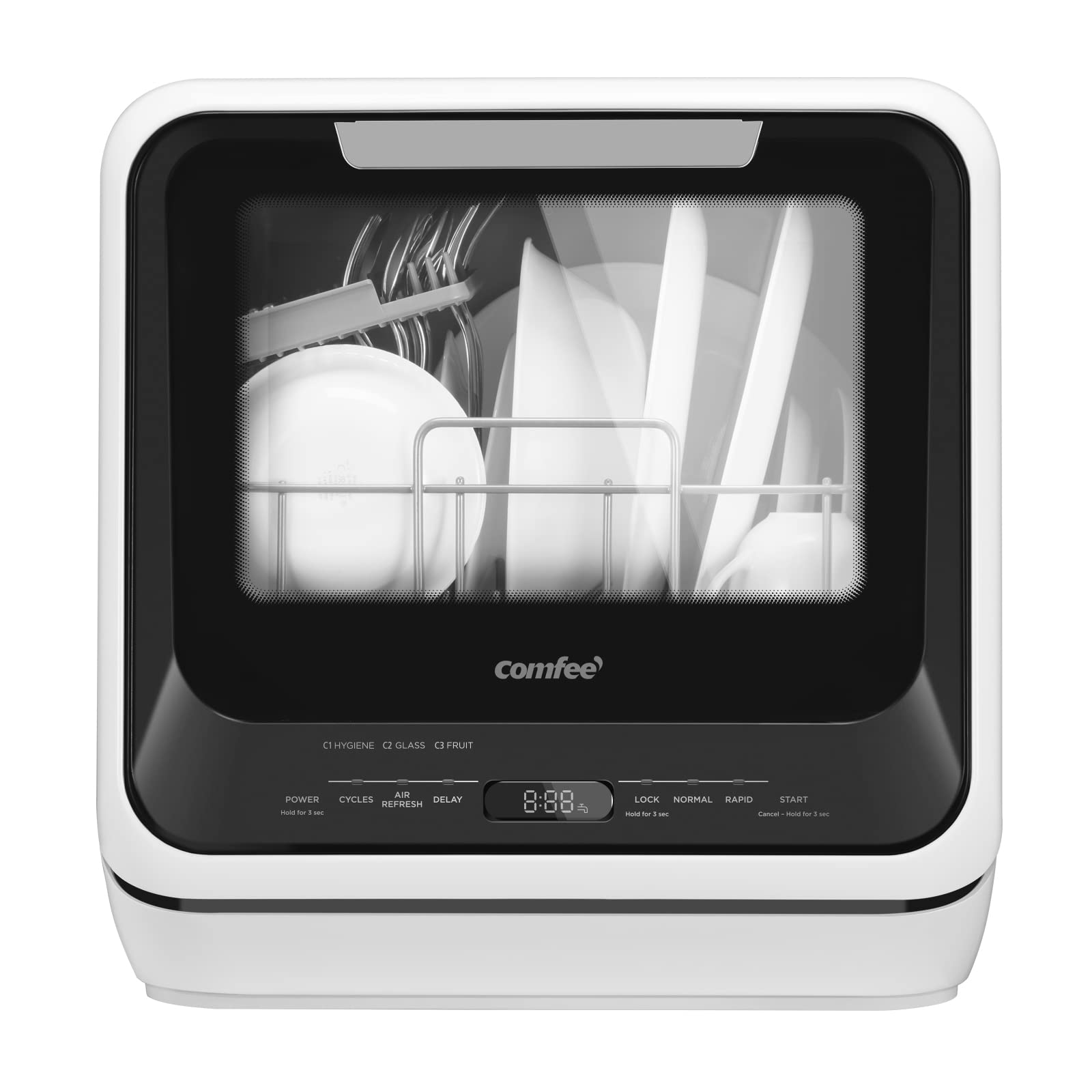
COMFEE’ CDC17P0ABB
Key Features
- Noise: 62 dB
- Weight: 36.6 lb
- Max plate size: 9.5 in
- Stated capacity: 30+ items
- Price: Budget
Nine and a half inches is where this one draws the line. That is the maximum plate diameter COMFEE’ lists, the tightest ceiling in this group, and a standard 10.5-inch dinner plate will not seat properly in the rack. If your everyday plates are smaller, or the load is mostly bowls, cups, containers and cutlery, the rest of the machine makes a lot of sense: 30-plus items, six programs including a 158 °F hygiene cycle and an air-refresh mode, and a 1.32-gallon tank that runs it with no hookup at all.
For a two-person household with modest plates, this makes more sense than a bigger, pricier machine, but you are accepting three things: 62 dB, the loudest rating here; 36.6 pounds, the heaviest countertop unit we handled; and about 17 by 16.5 inches of counter. On a boat, in a dorm, or in a kitchen where the dishwasher runs while everyone is at work, none of that matters much. In a studio where it runs after dinner, it is the loudest thing in the room.
Pros
- 30-plus items per load
- 158 °F hygiene cycle
- Tank or faucet operation
Cons
- 9.5-inch plate ceiling is the tightest here
- Loudest rating in this group at 62 dB
A capable 30-item machine with a tank and a genuinely useful hygiene cycle, provided your dinner plates are 9.5 inches or smaller.
Best for Large Dinner Plates
NOVETE TDQR01

Key Features
- Water tank: 5 L
- Hose length: 61 in
- Max plate size: 12 in
- Place settings: 4
- Price: Midrange
Plates are where countertop dishwashers usually come up short, and this one takes them up to 12 inches loaded at an angle. The next-largest claim on this page is 10.25 inches. That gap decides a lot of purchases: a 10-inch rack and 10.5-inch stoneware means you are hand-washing the plates and dishwashing the bowls forever.
The rest is a familiar, well-liked package: a 5-liter tank that fills from a pitcher or runs off the faucet, five programs including a 167 °F Baby Care/Heavy cycle, 50 dB, and 61-inch inlet and drain hoses, the longest here, which gives you more placement room than the SPT’s three-foot hose. At 28 pounds it is light enough for one person to lift onto a counter.
The part to watch is the top spray arm. It can stop turning, and since the upper arm rinses the top rack, the first sign is a load that comes out with detergent film and food still on it. Spin it by hand every couple of weeks; if it stops moving freely, use the warranty rather than living with dirty dishes.
Even with that caveat, plate size is decisive for the right buyer. Feed two people off 11-inch stoneware and the alternative is washing those plates by hand indefinitely. Four place settings is the honest limit: a day’s dishes for two, not a dinner party’s. And set it within hose reach of the sink even in tank mode, because the drain line still has to go somewhere.
Pros
- Takes plates up to 12 inches
- 167 °F Baby Care cycle
- 61-inch hoses give placement room
- 5-liter tank or faucet mode
Cons
- Top spray arm can stop turning
- Four settings, a day’s dishes for two
The one to buy if your dinner plates are 11 or 12 inches: nothing else here takes plates that big, and the tank makes it just as portable as the rest.
Best for Tiny Counters
FOHERE TDQR01A

Key Features
- Size: 16.2 x 15.5 x 17.8 in
- Noise: 50 dB
- Water tank: 5 L
- Delay start: 1-6 hours
- Price: Midrange
If your counter is already losing to a coffee maker and a drying rack, start with the footprint. FOHERE’s machine is 16.2 inches wide, 15.5 deep and 17.8 tall, the smallest box in this group, and it still takes a 5-liter tank, a 167 °F wash, six programs and 360-degree dual spray. It is also the only pick here with a delay start, adjustable from one to six hours, which is how you get a clean load at dinner without listening to it.
That combination is genuinely useful in a dorm, a small RV or a single-counter studio, and the 60-minute hot-air dry plus 72-hour ventilation means an overnight load does not greet you with a smell. Two things to weigh: at 15 kg it is heavier than the smallest machines here, and how it holds up past a couple of years is the open question, which is what the one-year warranty is for. If you do not need the delay timer, the Hermitlux costs about the same with a longer record behind it.
Pros
- Smallest footprint in this group
- 1-6 hour delay start
- 167 °F wash and 5-liter tank
- 60-minute dry plus 72-hour ventilation
Cons
- 15 kg is heavy for its size
The one for a counter with no spare inch: the smallest footprint here, plus a delay timer that lets it run while you are out of the room.
How We Tested Portable Dishwashers
We started with roughly 40 countertop and portable models and cut the list using footprint, height, water source, stated capacity, and price, plus a read through owner reviews. Anything with a pattern of complaints about water pooling under the base or control panels quitting inside a year came off first. That left 11 units, which we ran for six months — in my kitchen, in a colleague’s apartment where the only open counter sits across from the sink, and on a long weekend in an RV.
Every machine got the same load: a 12-inch dinner plate, a stockpot, two wine glasses, a casserole dish with baked-on cheese, and bowls of oatmeal left to dry overnight. We followed each manual’s recommended layout, then counted what came out clean and how many place settings truly fit, since the stated number and the real one rarely matched. We also measured rack clearance and set each unit on a 24-inch counter to see whether the door opened under the upper cabinets and whether a stockpot or a tall travel mug would clear the top rack.
Noise got judged twice, by ear during a normal conversation and with a meter at three feet. Leak checks happened after every cycle for the first two weeks and weekly after that: a paper towel under the base, a dry hand on the hose connection, a look at the tank seam on tank-fed models. We logged error codes, cloudy glasses, plastic that came out wet, and any cycle that needed a second run. Value came down to price against build — a stainless tub and metal spray arms held up differently than plastic ones — and whether the machine actually saved us time over hand-washing.
How to Choose a Portable Dishwasher
The first decision is not a brand or a cycle count; it is whether the machine fills itself from a tank or borrows your kitchen faucet for an hour.
Tank or Faucet: Where the Water Comes From
A built-in tank, 5 liters or 1.32 gallons on almost every machine here, means the dishwasher can live anywhere you can carry a pitcher, and the sink stays usable while it runs. A faucet connection means one less thing to refill, but the tap is occupied for the whole cycle, so nobody washes a pot or fills a kettle until it finishes. Several picks here do both, which is the configuration worth paying a little extra for.
The trap is the faucet itself. These machines thread onto the aerator, and pull-down or pull-out spray faucets usually do not have a compatible thread. Look at the end of your spout before you order; an adapter solves some taps and nothing solves others short of a new faucet.
What Fits: Plates, Settings, and Height
Place-setting counts, four to eight here, tell you how much crockery a machine is rated for. Plate diameter tells you whether your dinner plates go in at all, and the models in this guide top out anywhere from 9.5 to 12 inches. That spread decides more purchases than any other figure on the page. Measure a dinner plate before you shop: a 10.5-inch plate in a 9.5-inch rack is the most common way people end up disappointed.
Height is the second measurement. These units run 17.2 to 19.8 inches tall, and upper cabinets typically sit about 18 inches above the counter, so a machine that looked compact online may not slide under at all. Measure the gap, not the counter.
Noise, and Where the Machine Will Sit
Ratings here run from 40 dB to 62 dB, which is the difference between a hum you forget about and a machine you schedule around. If the dishwasher is going into a studio, an open-plan living space, or anywhere you take calls, put the noise figure near the top of your list. The quiet ones and the loud ones clean about the same.
Think about reach as well as space. A faucet-connected machine has to sit within hose distance of the sink, and hoses here run from three feet to just over five. In tank mode the drain still has to go somewhere, usually over the sink edge, so the machine stays in the sink’s neighborhood either way.
Drying and Storage Between Loads
Most machines here follow the wash with about an hour of hot-air drying and then ventilate for 72 to 73 hours, which is why you can leave a load in overnight and still find it dry and odor-free in the morning. A machine without a drying stage leaves you toweling.
That ventilation matters more than it sounds in a small kitchen, where the dishwasher often doubles as the drying rack. If you routinely leave dishes in until the next meal, treat long ventilation as a feature worth choosing rather than a spec to skim.
Frequently Asked Questions
Do I need a hot water hookup for a portable dishwasher?
No. Every machine here heats its own wash water, and the hygiene cycles run at 158 to 167 °F, so a cold connection is all the plumbing you need. A tank model needs no connection at all.
That internal heater is also why a compact machine can out-clean a sink of hot water: the temperature is held for the whole cycle instead of cooling off after the first few plates.
How much water does one load use?
About 5 liters, or 1.32 gallons, on the countertop models in this guide, which is why a tank fill takes two or three pitchers. The 18-inch SPT uses closer to 5 gallons a load.
Either way it is a fraction of a sink full of hot water. Fill the tank while you are clearing the table and the next load is ready when you are.
Can I wash pots and pans in a portable dishwasher?
Small ones, sometimes. The racks are built around plates and bowls, and the tub height, 17 to 18 inches on the countertop models, leaves little room for a stockpot, so skillets and big pots still belong in the sink.
If cookware is a priority, the 18-inch SPT is the only pick here with the interior and the eight-place-setting rack to take it.
What detergent should I use in a compact dishwasher?
Regular automatic dishwasher detergent, but less of it. With roughly a gallon of water per cycle, start at about half the amount you use in a full-size machine and adjust from there; pods and tabs work fine and are hard to overdo.
Skip hand dish soap entirely. It foams, and the foam ends up on your counter.
Final Verdict
Start with the Hermitlux unless something specific sends you elsewhere. It fills from a pitcher, runs at 50 dB, and shows you the load through a glass door, the three things that make a countertop dishwasher feel like an appliance instead of a chore you have relocated.
If your dinner plates are 11 or 12 inches, buy the NOVETE instead; nothing else here takes them. If you have floor space and a sink within three feet, the SPT is the only pick that washes like a full-size machine. And if the budget is the entire decision, the Hamilton Beach makes the least expensive case for itself, two cycles and all.