This post contains affiliate links. We may earn a small commission when you buy through our links — at no extra cost to you.
A sheet of parchment paper seems like the least important thing in your kitchen—until a batch of cookies welds itself to the pan, or the paper curls up the moment it hits the oven rack. The right roll gives you a nonstick surface that releases cleanly and turns cleanup into a single crumple. Over the past four months, my team and I baked and roasted our way through 14 rolls, and the differences in quality, size, ease of use, and value were surprisingly real.
The tricky part is that parchment paper is not just parchment paper. A roll that feels sturdy can tear along the serrated edge, cling to itself when you line a pan, or leave a patch behind on sticky caramel. Width matters too—a narrow roll leaves bare pan edges, while a wider one can bunch up in a smaller oven. The rolls I kept reaching for stayed flat, tore cleanly, and released everything from roasted vegetables to cookies without a fight; the picks below are organized around those everyday priorities.


Best for Everyday Baking
Reynolds Pop-Up Parchment Sheets
Key Features
- Reusable: Up to 3 times
- Sheet size: 13.75 x 10.75 in
- Oven safe to: 425°F
- Sheets per box: 120
- Price: Midrange
Halfway through a second tray of cookies, with flour on both hands, the pop-up box does exactly what it promises: one hand pulls a sheet, the sheet comes out flat, and it lands on the pan with no curl to chase. Each sheet measures 13.75 by 10.75 inches, there are 120 in the box, and Reynolds rates them for up to three passes through the oven.
That flat, one-handed routine is why this is our top pick. Nothing else here removes as much friction from an ordinary baking session — no scissors, no edge springing back, no measuring a length against the pan. We reached for it for sheet-pan dinners as often as for cookies, and the paper came away clean after both.
Width is the thing to check before you commit. At 10.75 inches a sheet covers most cookie sheets, toaster-oven trays, and air fryer baskets, but it stops short on a full 18-by-13 half-sheet pan, leaving a bare strip at each long edge. Overlapping two sheets fixes it; if half-sheet pans are your everyday, the 12×16 sheets below are the tidier answer.
Reuse is where a box this size starts to look generous. Rate each sheet for three bakes and 120 sheets becomes a lot of trays, so you stop rationing them — a fresh sheet for a messy roast, a second run for a dry batch of cookies. For anyone who bakes weekly, that is the practical argument over a roll you have to cut every single time.
Pros
- Comes out flat with no curling to fight
- One-handed pop-up dispensing
- Rated for up to three reuses
- Fits most cookie sheets and toaster-oven trays
Cons
- 425°F ceiling rules out broiler finishing
This is the parchment we reach for first: sheets that pull out flat and one-handed, sized for the pans most of us use every day.
Best for Half-Sheet Pans
SMARTAKE 12×16 Parchment Sheets
Key Features
- Material: Unbleached wood pulp
- Sheet size: 12 x 16 inches
- Oven safe to: 450°F
- Sheets per box: 200
- Price: Midrange
Where the Reynolds pop-up sheets stop a couple of inches short of a half-sheet pan, these 12-by-16 sheets reach the edge, and that fit is the whole reason to buy them. We lined an 18-by-13 pan and had paper across the entire flat surface with only the rim showing — no overlapping two sheets, no folding a bigger one down. If your pans are the standard half size, this is the box that makes lining effortless.
The paper is unbleached wood pulp rated to 450°F, twenty-five degrees above the Reynolds sheets, which matters if you roast vegetables hot or finish flatbreads near the top of the range. Two hundred sheets arrive in a flat, thin box that stands on its side in a cabinet; unlike a roll, nothing springs back when you pull one out, and there is no blade to keep track of.
Two hundred sheets is enough that you stop rationing them, which changes how you use parchment: a fresh sheet for a greasy tray instead of wiping and reusing. The Katbite box costs more for the same count and a heavier paper, and for most baking this thickness is all you need — cookies, vegetables, and sheet-pan chicken all release cleanly. Sticky work is the exception, and it is the one place these sheets ask for a little help.
Pros
- Covers a half-sheet pan edge to edge
- Rated to 450°F for hot roasting
- 200 sheets per box
- Flat box stores on its side in a cabinet
Cons
- Sticky glazes and caramel can grab the paper
Buy the SMARTAKE box if you bake on half-sheet pans — the 12×16 sheets cover the whole surface, so there’s no trimming and no bare corners.
Best for Roasting and Lining
Amazon Basics Parchment Roll
Key Features
- Roll size: 90 sq ft
- Roll width: 15 in
- Oven safe to: 425°F
- Price: Budget
Fifteen inches is the number that makes this roll useful. That width covers the flat area of a standard half-sheet pan with little waste, and it is three inches wider than the Reynolds roll, so most trays need one pull and a short trim rather than two overlapping pieces. You get 90 square feet — 24 yards of it — which is a generous roll, though it’s worth knowing that a 200-count box of 12-by-16 sheets actually holds more paper by area. What the roll buys you is coverage of shapes no sheet fits.
For volume, this is the roll we keep coming back to. It handles the unglamorous jobs without a second thought: lining a roasting tray, catching drips under a pie, wrapping a sandwich for the fridge, tearing off a square to cover a bowl. Cookies and roasted vegetables release cleanly and nothing sheds onto the food. What it doesn’t give you is a flat sheet for a small pan — a 15-inch roll means trimming for a 9-by-13, where a pre-cut sheet simply drops in. If you cook on big trays more than you bake small batches, that trade goes your way.
Pros
- 15-inch width covers standard pans
- 90 square feet on a single roll
- Clean release from cookies and roasted vegetables
Cons
- 425°F ceiling limits high-heat roasting
A wide 15-inch roll that covers a pan in one pull, and the one we keep for roasting trays, pies, and anything a flat sheet won’t fit.
Best for Heavy-Duty Baking
Katbite 12×16 Parchment Sheets
Key Features
- Material: FSC-certified wood pulp
- Sheet size: 12 x 16 inches
- Paper weight: 45 gsm
- Sheets per box: 200
- Price: Premium
Forty-five grams per square meter doesn’t sound like much until you compare it with the paper that shreds under a wet chicken thigh. Katbite’s sheets are 45 gsm, listed as roughly 12% thicker than typical parchment, and the difference shows up in handling: these lift with food on them instead of threatening to give way.
That extra body earns its keep on two jobs. It lets you carry roasted vegetables or a loaf from tray to platter without the paper tearing, and it keeps grease and juices on top rather than soaking through to the pan — which is the entire point of lining the thing. The sheets carry a food-grade silicone coating on both sides, so release is clean, and the pulp is FSC-certified if you care where the paper came from.
Two hundred sheets is the same count the SMARTAKE box offers; what you pay extra for here is the paper itself, and whether that is worth it depends on what you bake. Delicate cookies don’t need 45 gsm. A tray of chicken thighs, a sticky loaf, or anything you lift in one piece does. This is the box we reach for when the bake is heavy and messy, and the one we leave on the shelf for a quick batch of shortbread.
Pros
- 45 gsm paper lifts without tearing
- Two-sided silicone coating releases cleanly
- FSC-certified wood pulp
- 200 sheets fit standard half-sheet pans
Cons
- Cut for half-sheet pans; smaller trays need trimming
Our pick for heavy, messy bakes: the 45 gsm paper lifts with the food instead of tearing, and 200 sheets go a long way.
Best for Small Batches
Hiware 9×13 Parchment Sheets
Key Features
- Material: Unbleached FSC wood pulp
- Sheet size: 9 x 13 inches
- Paper weight: 45 gsm
- Sheets per box: 200
- Price: Midrange
If your oven work happens on a quarter-sheet pan or in a toaster oven, a 12-by-16 sheet is the wrong shape: too big, folding at the corners, wasting an inch on every side. Hiware cuts these to 9 by 13 inches, which drops into a quarter-sheet pan exactly, and that fit is the whole argument. We lined a toaster-oven tray and a loaf pan with no trimming at all, which is not something we can say about any other box here.
The paper is the thicker 45 gsm stock, so it behaves like the Katbite sheets — it lifts with food rather than tearing — and it is unbleached, FSC-certified pulp with no fluorescent whitening. Two hundred sheets go a long way when every bake uses one small tray, and at this size a single sheet lines a loaf pan, a brownie pan, or a toaster-oven tray with nothing left over. Small-batch cooking is where these earn their space, and it is the only place they do.
Pros
- 9×13 fits quarter-sheet pans exactly
- Thicker 45 gsm unbleached paper
- 200 sheets per box
- No greasing needed before baking
Cons
- Too small for a half-sheet pan
- Sticky foods can still cling in places
For quarter-sheet pans and toaster ovens, nothing here fits better — the 9×13 sheets drop in with no trimming at all.
Best for Bulk Baking
Baker’s Signature Parchment Roll
Key Features
- Cutter: Built-in slide cutter
- Roll size: 260 sq ft
- Roll width: 15 in
- Oven safe to: 450°F
- Price: Midrange
The cutter is the first thing to test on a bulk roll, and this one tracks straight: pull the paper to length, slide the blade across, and the edge comes out clean instead of ragged. It sounds like a small thing until you have cut a dozen liners for a bake sale. The box is sturdy enough to sit on the counter through a long session, and the blade leaves no sharp corner to catch a knuckle.
What the format buys you is freedom of size. A 15-inch-wide roll covers a half-sheet pan in a single pull, and you cut the length to whatever is in front of you — a loaf pan, a round cake tin, a roasting tray that fits nothing standard. The paper is unbleached wood pulp rated to 450°F, so it handles hot roasting and a pizza at the top of the dial without browning.
With 260 square feet on the roll, this is the largest roll in the group — a supply that suits a household roasting and baking several times a week and spares you the business of restocking boxes. It also solves the awkward-pan problem, because you cut the length you need instead of folding a sheet that is nearly right.
A cutter that tracks, a width that covers a pan in one pull, 450°F on the label — that combination keeps this roll in our rotation for anything that goes into a hot oven in volume. It is the parchment for people who cook rather than for people who bake one careful cake, and that is exactly how we have used it.
Pros
- Slide cutter gives a clean, straight edge
- 260 square feet on a single roll
- Rated to 450°F
- Unbleached natural wood pulp
Cons
- Wet dough and bread can stick to it
A bulk roll done right: the cutter tracks straight, 260 square feet lasts months, and it takes 450°F without complaint.
Best for Small Pans
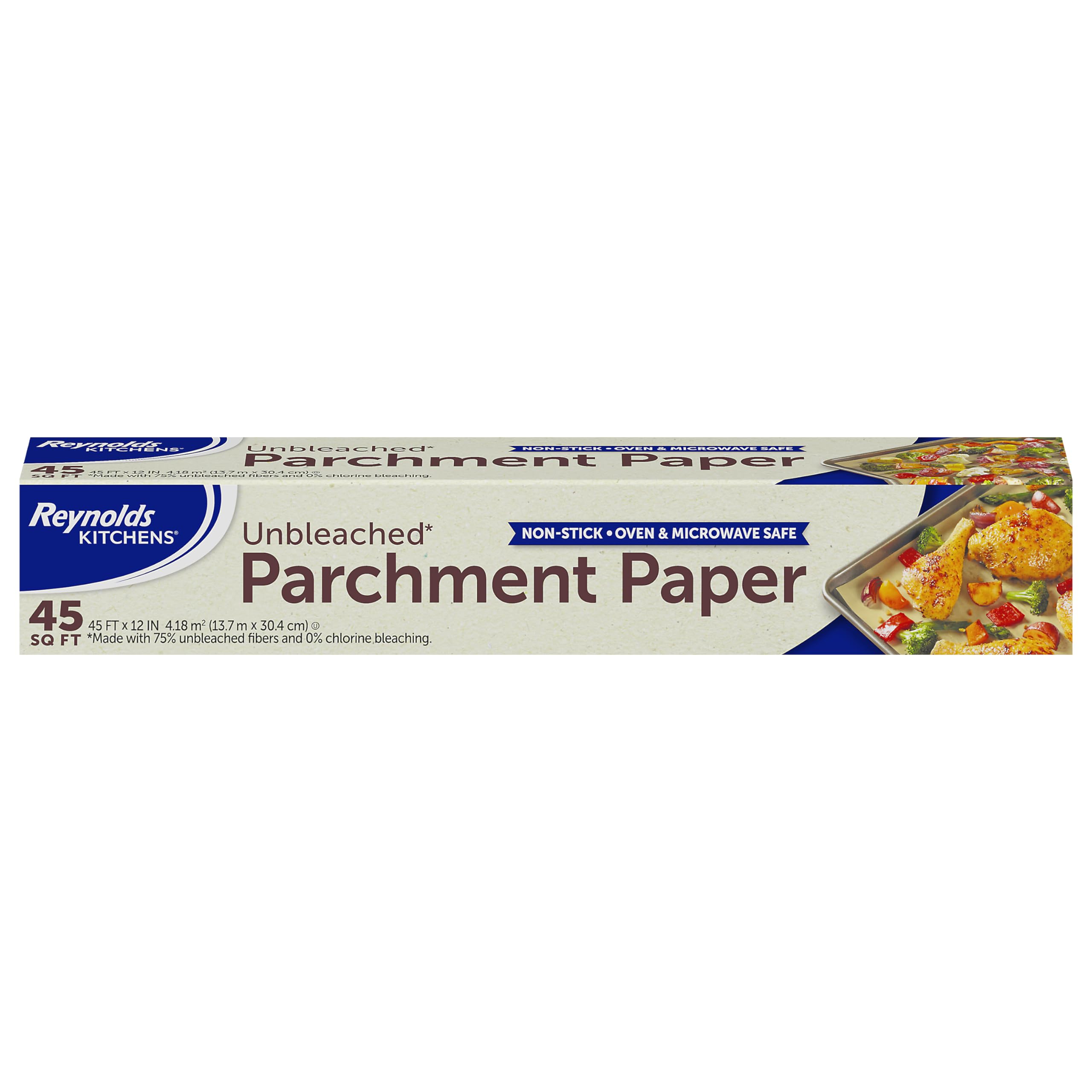
Reynolds Unbleached Parchment Roll
Key Features
- Roll size: 45 sq ft
- Roll width: 12 in
- Oven safe to: 425°F
- Price: Budget
Twelve inches is narrower than a half-sheet pan, and that is the first thing to know about this roll: on an 18-by-13 tray you get paper across the middle and bare metal at two edges. On a standard cookie sheet, or in a 9-by-13 pan, it fits with almost nothing to trim. The roll holds 45 square feet, and it is unbleached with no chlorine bleaching anywhere in its making.
What the roll does well is stay out of the way. It is a small cylinder that fits in a drawer or a crock with the foil and cling film, and at 45 square feet you are not committing to a year of the same paper. Reynolds also lists it as microwave safe, which matters more than it sounds — a square over a bowl of leftovers saves a lid and a wash, and it goes straight in the bin after.
What you are buying here is a small, unbleached roll that stores anywhere and covers the pans most people reach for on a weeknight. Cookies slide off it, roasted vegetables don’t weld themselves to the tray, and a sheet of it goes in the microwave without a second thought. If a half-sheet pan is your workhorse, go wider; for cookie sheets, toaster ovens, and small roasts, 12 inches is enough.
Pros
- Compact roll stores in a drawer
- Unbleached and chlorine-free
- Listed as microwave safe
- 12-inch width suits standard cookie sheets
Cons
- Tears more easily than thicker 45 gsm sheets
The small unbleached roll to keep in a drawer when a big box won’t fit — fine for cookie sheets, small pans, and microwave reheats.
How We Chose and Tested the Best Parchment Paper
We started by pulling together best sellers and highly rated rolls in a range of widths, then narrowed the field to silicone-coated parchment labeled oven-safe and sold in standard roll form. We ended up with 14 rolls and used them for four months in our own kitchens, not a test lab.
The testing scenes were ordinary on purpose: weeknight sheet-pan dinners, weekend cookie batches, roasted vegetables, baked fish, and the occasional cake pan. We noted whether a roll tore cleanly along its own serrated edge, whether the sheet curled back up after cutting, and whether it stayed flat against the pan instead of sliding around. We crumpled each sheet and flattened it again to check for weak spots, then measured roll width against a standard half-sheet pan and a quarter-sheet pan to see how much overhang or bare edge we got. We also compared usable square footage per roll rather than just the sticker price.
For nonstick performance, we baked sugar cookies, roasted sticky vegetables, and made a small batch of caramel on each paper, then checked whether the food lifted away cleanly or left a film behind. We pressed a corner of each sheet onto a warm pan and lifted it to see if it clung to the pan or to itself—the stickiness problem showed up most often when a roll was thin or tightly wound. The rolls that scored best were the ones we forgot about while cooking, which is the highest compliment parchment paper can get.
How to Choose Parchment Paper
The right parchment is the one that fits your pan, so start with a tape measure rather than a brand name.
Roll, Pop-Up Box, or Flat Sheets
A roll covers any shape and any size, which is why it stays the format for roasting pans and odd trays; the cost is cutting every piece and edges that curl until food weighs them down. Pre-cut sheets drop in flat and ask nothing of you, but they only work on the pans they were cut for. Pop-up dispensing, as on the Reynolds box, is the least fiddly version of a sheet.
If most of your baking happens on one standard pan, buy sheets sized to it. If you line whatever fits in the oven, buy a 15-inch roll — the extra width means one pull covers a half-sheet pan instead of two overlapping strips.
Match the Sheet to the Pan, Not the Label
Pan sizes are standard enough to buy against: a half sheet is 18 by 13 inches, a quarter sheet 9 by 13. A 12-by-16 sheet covers the flat of a half sheet with margin to spare; a 9-by-13 covers a quarter sheet exactly; a 10.75-inch-wide pop-up sheet handles cookie sheets and toaster ovens but leaves bare edges on a half sheet.
Measure the inside floor of the pan, not the outer rim, and keep the paper within it. An overhang near a heating element is how parchment scorches, and it is the most common sizing mistake we see.
Temperature and Paper Weight
Most parchment here is rated to either 425°F or 450°F, and the difference only matters if you roast hot or finish flatbreads near the top of the dial. Neither number survives a broiler.
Weight is the spec that changes how the paper feels in your hand. Standard paper tears under a wet load, while 45 gsm sheets like the Katbite and Hiware hold together when you lift dinner off the tray. Cook vegetables and whole cuts and the heavier paper pays for itself; bake cookies and cake and the lighter stuff is fine.
Bleached, Unbleached, and How Much to Buy
Unbleached paper is brown because it skips chlorine bleaching, and FSC certification on the box tells you the pulp came from a traced source. Those are the two claims worth checking; anything else on the front of the package is marketing.
Then there is quantity, which is easy to misread. A 120-count box of sheets and a 90-square-foot roll sound comparable and are not: the sheets add up to more paper by area, but the roll covers shapes no sheet fits. Rolls generally cost less per square foot, so the question is whether you are paying for paper or for convenience.
Frequently Asked Questions
Is parchment paper the same as wax paper?
No, and the difference matters in a hot oven. Wax paper carries a wax coating that melts, so it belongs in the fridge and on the counter — wrapping cheese, layering cookies, rolling dough — not on a baking sheet. Parchment is silicone-coated and rated for 425°F or 450°F. When a recipe says parchment, don’t substitute wax paper, and don’t put wax paper in an air fryer either.
Can I use parchment paper in an air fryer?
Yes, provided it stays put. Put the food on top so the fan can’t lift a loose corner into the heating element, cut the sheet smaller than the basket floor, and never preheat an empty basket with paper inside. Stay at or below the paper’s rating: 425°F for the Reynolds sheets, 450°F for the SMARTAKE, Hiware, and Baker’s Signature papers.
Can you reuse parchment paper?
Often once or twice more, if the first bake was dry. Reynolds rates its pop-up sheets for up to three uses per baking session, and heavier 45 gsm sheets hold up similarly for cookies and bread. Wipe off the crumbs and look at the surface: throw away any sheet that held raw meat or fish, has gone greasy through, or has darkened and turned brittle.
Final Verdict
No single parchment wins for every pan, so the decision comes down to what you line most. For most kitchens we point to the Reynolds pop-up sheets: flat out of the box, one-handed, and sized for the cookie sheets and toaster trays that do the daily work. If your workhorse is an 18-by-13 half sheet, switch to the SMARTAKE 12×16 sheets and get the coverage instead.
And if you roast far more than you bake, take the Baker’s Signature roll — the cutter tracks straight, the 15-inch width covers a pan in one pull, and 260 square feet means you stop thinking about running out.