This post contains affiliate links. We may earn a small commission when you buy through our links — at no extra cost to you.
The knock on electric grills has always been heat — that plugging in means pale grill marks and meat that steams instead of sears. It’s a fair worry, and it’s the first thing I check now. A good one buys you a real grill where gas and charcoal aren’t allowed — a balcony, a condo patio, a patch of pavement outside the kitchen door.
We’ve spent nine months with 12 electric grills, cooking weeknight dinners and weekend cookouts, and the differences come down to things less obvious than wattage. A lid and a heavy grate hold heat; a thin one dumps it the second you open up. Where the drip tray sits decides whether cleanup takes two minutes or twenty.
Footprint matters as much as anything when the grill shares space with a folding table. A model whose stand comes off can live on a counter for two and turn freestanding when friends show up. The picks below earned their place on heat, cleanup, and how little room they take up between cooks.
Best for Searing on Patios
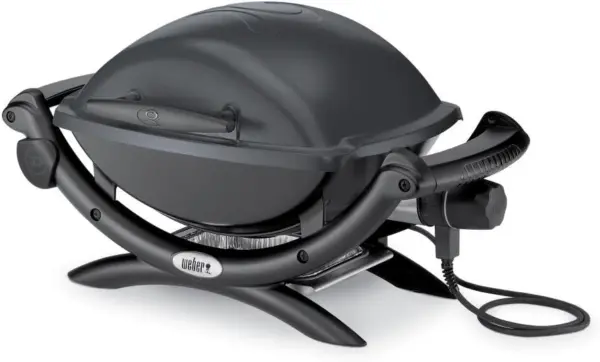
Weber Q 1400 Electric Grill
Key Features
- Grates: Porcelain-enameled cast iron
- Weight: 29.5 lb
- Cooking area: 189 square inches
- Heating power: 1,560 watts
- Price: Premium
Porcelain-enameled cast iron is the reason the Q 1400 cooks like a grill and not a hot plate. Cast iron soaks up heat and gives it back when a cold steak lands, so the surface recovers instead of sagging, and it leaves dark bars rather than pale stripes. Everything else follows that logic: a 1,560-watt element under 189 square inches of grate, an infinite control valve instead of numbered stops, a cast-aluminum body and lid, and no assembly at all, since it comes out of the box ready to plug in. Of the seven grills here, this is the one we keep coming back to.
What surprised us is how much of a gas grill’s behavior survives the switch to a cord. Crack the valve and the deck comes back hot in a few minutes; back it off and the heat falls fast enough to move chicken off the hot zone. With the lid down, 189 square inches holds dinner for three or four without a second round, and a couple of steaks plus a tray of peppers is comfortable rather than crowded.
Two things to plan around. There is no stand in the box, so the grill lives on a table, a deck box, or a cart you buy separately, and the six-foot grounded cord sets how far that table can sit from an outlet. At 29.5 pounds it is a two-handed move from the shed to the railing, not something you tuck under one arm. The catch pan slides out from under the element and the enameled grates come clean with a brush while they are still warm, which is the entire cleanup routine.
What you are paying for is the cooking surface and the control, not features: no thermometer in the lid, no side shelf, no wheels. And 189 square inches is mid-pack here. The Cuisinart CEG-115 gives you 240 square inches and a pedestal for less money, so if volume matters more to you than the hardest sear in this group, that is the trade.
Pros
- Cast-iron grates hold heat for real sear marks
- Infinite valve responds within seconds
- Arrives fully assembled out of the box
- Slide-out catch pan makes cleanup simple
Cons
- No stand or cover included
- Six-foot cord limits placement
We recommend the Q 1400 to anyone who wants food that tastes grilled rather than baked, because it sears harder than anything else in this group on a small patio.
Best for Stand-Up Cooking
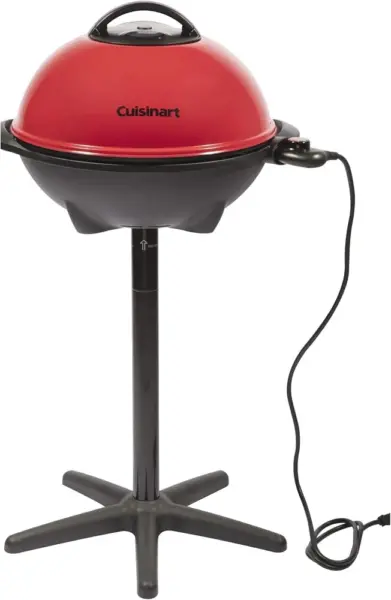
Cuisinart 2-in-1 CEG-115
Key Features
- Weight: 20 lb
- Cooking area: 240 square inches
- Configuration: Stand or tabletop
- Top temperature: 550°F
- Price: Midrange
The CEG-115’s cooking box lifts off its stand and sits on a table, and that one joint does more for daily use than any line on the spec sheet. On a narrow balcony the pedestal takes about the footprint of a dining chair; when the weather turns, the box comes off and goes under the awning. Setup is under ten minutes with no hardware, and 240 square inches is the most cooking area among the pedestal models here.
We like it for anyone who wants to walk up to a grill instead of bending over a tabletop, and the five marked stops at 350, 400, 450, 500, and 550 degrees make that easy without guesswork. 550 is hot enough to build a crust on a steak if you preheat with the lid down and then leave the meat alone. A center channel runs fat into a cup mounted below the deck, and the whole rig is 20 pounds, light enough to slide across a patio on your own.
The trade-off is the surface itself. Non-stick is why cleanup is a wipe rather than a scrub, but it will not develop the blackened character of cast iron, and it wants nylon tools. Give it a full ten minutes of lid-down preheat before a whole meal goes on: the element comes up quickly, and the metal needs the time more than the light does.
Pros
- Stand lifts off for tabletop or storage
- Five marked temperatures up to 550 degrees
- 240 square inches of cooking surface
- Assembles in under 10 minutes, no hardware
Cons
- Non-stick deck will not build cast-iron sear
- Edges of the deck can run cooler than the center
This is the one we point renters to when they want a grill they can stand at: 550 degrees, 240 square inches, and a stand that lifts off for storage.
Best for Budget Balcony Grilling
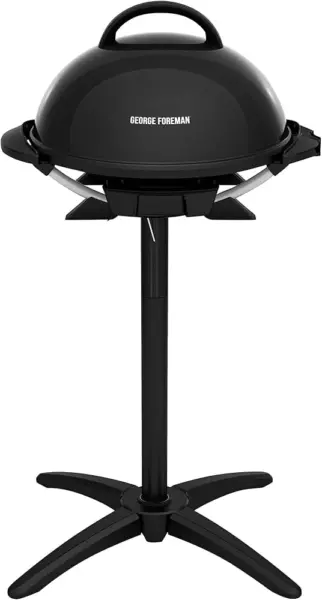
George Foreman GIO2000BK
Key Features
- Stand: Removable
- Weight: 8.7 lb
- Heat settings: 5
- Heating power: 1,500 watts
- Price: Budget
Fifteen servings is a generous reading of this grill. The unit measures about 11 inches wide and 20 inches deep, and the deck holds four burgers with a row of peppers alongside, so it is dinner for two or three rather than a party. What it actually is: an 8.7-pound electric grill that clips onto a stand for the patio and unclips to sit on the kitchen counter when the weather turns.
The rest is well judged for the money. Five heat settings and a ten-minute preheat, a nonstick surface that wipes clean while it is still warm, a drip tray under the deck, and three years of warranty coverage. The slope is the signature move: it tilts fat away from the food and into the tray as you cook, which is why the deck never turns into a shallow frying pan.
Where it earns its place is the first-grill situation: a studio balcony, a rental with rules against flame, two people who want steaks on a Tuesday without owning a chimney starter. It browns rather than chars, and it is not the grill for a family of five. Set it on something level before you cook. The fat-removing slope only drains if the grill sits flat, so check with a glass of water the first time you set it up.
Pros
- Stand detaches for countertop use
- Five heat settings and a ten-minute preheat
- Nonstick deck wipes clean while warm
- 8.7 pounds carries in one hand
Cons
- Small deck despite the 15-serving name
- Browns rather than chars
We recommend it to anyone grilling for one or two on a balcony: it heats fast, wipes clean, and leaves you money for the food.
Best for Wood-Smoke Cooking
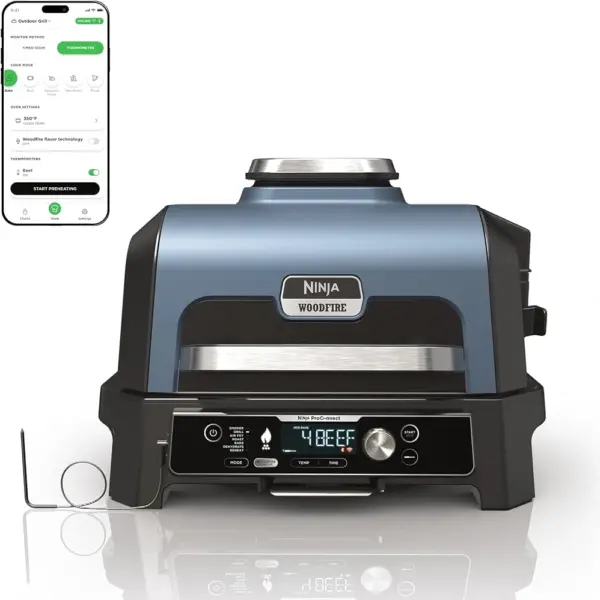
Ninja Woodfire ProConnect XL OG951
Key Features
- Weight: 38.9 lb
- Cooking area: 180 square inches
- Thermometers: 2, app-connected
- Cooking modes: 7
- Price: Premium
The Weber is a grill that happens to plug in. The ProConnect XL is closer to a small outdoor kitchen that also grills: 180 square inches of nonstick grate, a pellet-fed smoke function, a crisper basket, and two thermometers that report to an app while you are still inside.
We came away convinced it is the pick here for anyone who wants smoke rather than grill marks. A half cup of wood pellets in the drawer gives real wood flavor without a chimney or a bed of charcoal, and the probes mean a pork shoulder does not need a chair pulled up beside it, because your phone tells you when to flip and when the meat is close.
At 38.9 pounds it is a grill that stays where you set it and does not get moved for a dinner party, and the 180 square inches is quoted as two racks of ribs or ten burgers, which is enough for a family cookout. Seven modes means a menu to learn; give it two or three cooks before the smoke and air-fry settings feel obvious.
Two things worth knowing. The app wants a Wi-Fi network to pair, so if the patio sits at the edge of your signal you lose the notifications even though the grill still runs from the panel. And the plastic trim and lid are the parts to watch over time, so register the one-year warranty and keep it covered between cooks.
Pros
- Real pellet smoke without charcoal or propane
- Two probes with app alerts
- Grill, smoke, air fry, bake, roast, broil, dehydrate
- 180 square inches for a family cookout
Cons
- 38.9 pounds stays where you put it
- App pairing needs a Wi-Fi network
We point anyone who wants real wood smoke from a wall outlet to this one: it grills, smokes, and air-fries without a tank or a flame.
Best for Tiny Decks
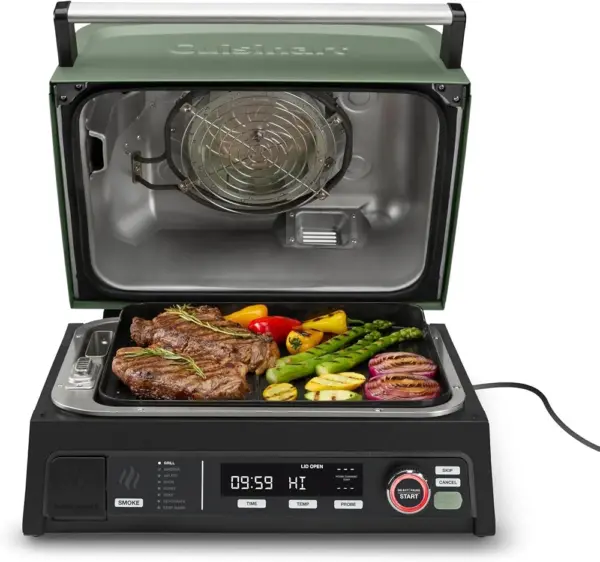
Cuisinart FlavorBoost CEG-1302
Key Features
- Weight: 30.6 lb
- Cooking area: 154 square inches
- Cooking modes: 8
- Heating power: 1,800 watts
- Price: Premium
For a deck the size of a card table, the FlavorBoost is the most capable grill here: 154 square inches of ceramic non-stick deck and eight modes, including a drawer that burns real wood pellets. That combination is the right shape for a city balcony, where a smoker and an air fryer are two appliances you do not have room for.
The probe earns its keep. Set a target temperature and the grill switches itself to keep-warm the moment the meat gets there, which is the difference between a brisket you can walk away from and one you cannot. Air-fry mode runs at 400 degrees, the drip tray slides out the front, and the moisture cup and accessories go in the dishwasher.
It is a 30.6-pound tabletop unit, so decide where it lives before the season starts and leave it there. The three-year warranty is at the top of this group, which takes some of the worry out of a grill that stays outdoors under a cover, and registering it on day one is the easiest thing you will do with this machine.
Pros
- Eight modes including a real pellet smoke drawer
- Probe switches to keep-warm on its own
- Drip tray and accessories are dishwasher-safe
Cons
- 154 square inches caps a cookout
- Grill mode tops out at 500 degrees
We recommend it where one appliance has to do three jobs, because it grills, smokes, and air-fries on 154 square inches of non-stick deck.
Best for Cheap, Big Deck
Techwood 15-Serving Electric Grill
Key Features
- Weight: 12.3 lb
- Heat levels: 3
- Cooking area: 240 square inches
- Heating power: 1,600 watts
- Price: Budget
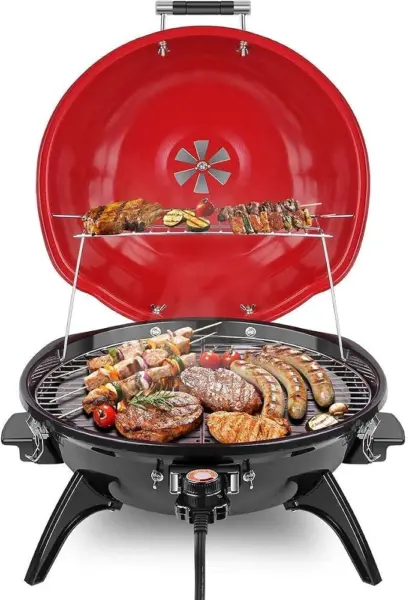
This is the least expensive grill here with a full 240 square inches of cooking surface, the same deck size as the Cuisinart CEG-115 for less than half the money. On paper it is the bargain of the group, and on a burger night it mostly behaves like one.
The 1,600-watt element heats fast, the interlocking lid traps enough heat to cook through rather than just brown, and 12.3 pounds means one hand from the closet to the balcony. Cook near the top of the three-level dial and it behaves like a grill; the lower stops are for holding. Line the base under the element with foil before the first cook, because the drip path is tucked in there and a liner turns a take-apart cleaning job into a fold-and-toss.
The money saved shows up in the fittings, and the legs are where it shows first, so lift it rather than drag it and it lasts longer than it looks like it should. What it is good at is the ordinary weeknight: burgers, sausage, a tray of peppers, wings that do not need a long cook. It heats fast enough that dinner does not feel like a project, and that, more than the price, is the argument for keeping one on the balcony.
Pros
- 240 square inches at the lowest price here
- 12.3 pounds lifts with one hand
- Heats up fast on the top setting
Cons
- Plastic legs feel fragile
We recommend it to shoppers who need 240 square inches on a tight budget, as long as the grill has a covered spot to call home.
Best for Starter Setups
CUSIMAX GR-103S Electric Grill
Key Features
- Height: 31.49 inches
- Main grate: 15.15 inches
- Warming rack: 11 inches
- Heating power: 1,600 watts
- Price: Budget
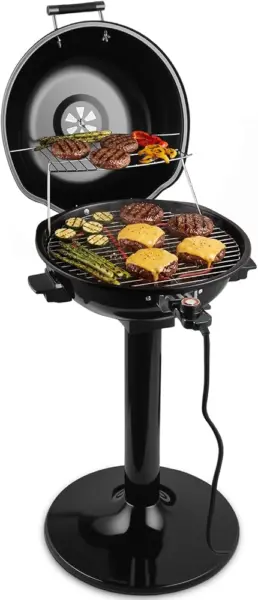
Thirty-one inches is the measurement that decides whether this grill suits you. That is the top of the lid, about five inches below a standard kitchen counter, so you set a chair beside it rather than standing over it, and it sits below a railing or a window line on a narrow deck.
We think it earns a place as a starter grill for a small outdoor space. 1,600 watts runs through two U-shaped elements under a 15.15-inch main rack, with an 11-inch warming rack above for buns and finished pieces, and the vent in the lid lets you dial airflow instead of trapping steam. It arrives pre-assembled, which is the right call at this price, and it carries 18 months of warranty coverage.
What it gets right is maintenance. The oil collector slides out from under the element without dismantling anything, and that lid vent lets heat escape so the element cycles rather than baking everything at a single temperature. Neither is exciting, and both are why it stays usable through a summer of weeknight cooking.
Pros
- Arrives pre-assembled
- Two racks plus an adjustable lid vent
- Grease collector slides out for cleaning
Cons
- Main grate is small for a group
It is a good first electric BBQ grill for a small deck: pre-assembled, two cooking levels, and an 18-month warranty, as long as your cookouts stay small.
How We Tested Outdoor Electric Grills
We started by pulling every outdoor electric grill we could find that runs off a standard household outlet, then narrowed the field by wattage, grate material, footprint, whether the stand came off, and price — including models with extra cooking modes and wood-smoke options, since that’s become a real dividing line here. That left 12 grills, which we ran for nine months.
Testing happened where these actually live: a small balcony, a condo patio, and a backyard table. We cooked burgers, chicken thighs, skewers, and vegetables for two on weeknights and for a crowd on weekends, timing preheat from a cold start with a stopwatch and checking surface temperature at the center and corners of the grate with an infrared thermometer, then again after the lid came off.
Ease of use got graded in real time: how legible the dials were with greasy hands, whether the lid opened one-handed, whether the stand went back on without a fight. After each cook we let the grill cool, wiped and scrubbed the grates, washed every removable part, and noted where grease pooled and how awkward the drip tray was to reach. Over nine months we tracked hinge and handle wobble, cord wear, and whether the coated surfaces still released cleanly.
For size, we measured each footprint with the stand on and off, weighed them, and carried them up and down a flight of stairs. At the end we set price against what each one actually delivered — how many people it fed and whether the extras earned their keep.
How to Choose an Outdoor Electric Grill
Nearly every decision here comes down to three things a product photo will not show you: the outlet you will plug into, how hot the grate gets rather than the element, and where the grease goes.
Check the Outlet Before You Check the Specs
These grills pull 1,200 to 1,800 watts, which is most of a standard 15-amp circuit. Put one on the same line as a garage refrigerator or a window air conditioner and you will trip the breaker halfway through a cook. Look for a dedicated outdoor GFCI outlet before you fall in love with a model.
Cord length sets your radius: the Weber Q 1400 gives you six grounded feet, enough for a patio table and short enough to matter on a long deck. If you must use an extension cord, make it a grounded 12-gauge outdoor cord and unplug it afterward. A thin household cord running 1,800 watts is a fire waiting for an excuse.
Heat Is the Whole Argument
The temperature a maker advertises is usually the element, not the grate, and the grate is what cooks your food. A 550-degree claim on a thin non-stick deck behaves nothing like the same number on cast iron, which stores heat and gives it back when a cold steak lands. That is why the Weber Q 1400’s grates matter more than any figure on its listing.
Whatever you buy, preheat with the lid down for a full ten minutes. Most electric grills reach their best searing temperature only after the metal, not just the element, is hot, and a cold grate steams meat instead of browning it.
Tabletop, Pedestal, or Cart
Match the shape to where the grill lives. A pedestal puts the deck at hip height, which matters if you cook standing up twice a week, and the Cuisinart CEG-115’s cooking box lifts off so the same grill works on a table. Tabletop models save floor space and go into a closet for the winter, but they need a sturdy, heat-safe surface, and a glass patio table is not one.
Measure the footprint and then measure the path from storage to patio. A 40-pound grill does not go up and down a stairwell twice a summer, so if yours has to move, make weight part of the decision.
Smoke, Grease, and Cleanup
Every electric grill smokes a little when fat hits a hot element, and that is where grilled flavor comes from. What varies is where the grease goes. A sloped deck draining into a catch tray, as on the George Foreman, or a center channel running into a cup, as on the Cuisinart CEG-115, keeps fat off the element and cleanup down to a wipe.
Removable drip trays and dishwasher-safe parts are worth more day to day than an extra cooking mode. If you want real smoke rather than the occasional wisp, look for a pellet drawer like the Ninja and the FlavorBoost have, and keep the grill away from the door.
How Much Grate You Actually Need
Cooking area is quoted in square inches, and the numbers climb fast. Around 154 square inches is a two-person deck, 240 is a family dinner with a little room to spare, and anything past 300 is a cookout. Judge by what fits at once rather than by the total, since a second round of burgers costs you another preheat.
A warming rack adds usable space above the deck for buns and finished pieces, and on a small grill it is the difference between cooking and juggling.
Frequently Asked Questions
Can I use an outdoor electric grill on an apartment balcony?
Usually, but the rule that decides it is your lease, not the product page. Many buildings ban open flame, which rules out propane and charcoal while leaving electric alone, and some ban all grills on balconies no matter the fuel. Get the answer in writing from your property manager, then check whether your city fire code adds anything.
If you are shopping for a balcony specifically, the George Foreman and the CUSIMAX are the two smallest-footprint picks here.
How much does it cost to run an electric grill?
A 1,500-watt grill draws 1.5 kilowatt-hours in an hour at full heat; an 1,800-watt model draws 1.8. Most cooks run 20 to 40 minutes, so a meal uses well under a kilowatt-hour. Multiply that by the per-kilowatt-hour rate printed on your electric bill and you have the number.
The recurring costs that surprise people are accessories rather than electricity: a cover, and a stand if the grill does not include one.
Can I leave an electric grill outside in the rain?
The cooking box usually survives; the controls and the cord are what suffer. Unplug it, cover it, and bring the temperature probe and any detachable controller indoors.
A fitted cover matters more than the finish does, because water sitting in the grease tray is what you are trying to avoid. Check the tray and the element housing at the start of each season.
Can you use an electric grill indoors?
Only if the maker says so. The George Foreman and the Techwood are both sold for indoor and outdoor use; the Weber, both Cuisinarts, the Ninja, and the CUSIMAX are outdoor grills and should stay outside.
Indoors you also need real ventilation, since even a low-smoke grill puts grease vapor into the air. Under a range hood is the only sensible spot.
Final Verdict
The Weber Q 1400 is the grill we point most people to: cast-iron grates, an infinite valve, and 189 square inches that sear like a gas grill and clean up like a pan. It is the safest money in this group for anyone with a small patio and an outlet within six feet.
If standing at a pedestal is what makes you cook, the Cuisinart CEG-115 gives you 240 square inches and 550 degrees for less. And if smoke is the point rather than sear, the Ninja Woodfire ProConnect XL earns its premium with real pellets and two probes.