This post contains affiliate links. We may earn a small commission when you buy through our links — at no extra cost to you.
Olive oil is the rare pantry staple that can be past its prime before you ever twist the cap. Labels shout about cold-pressing and sun-drenched groves, but most bottles never tell you when the olives were actually harvested, and a clear-glass bottle sitting under bright store lights is already losing the fight. What you want is simpler than the shelf makes it look: an oil that tastes like something, holds up in a hot pan, and earns what you pay for it.
My team and I spent four months with 16 bottles — tasting them neat, whisking them into vinaigrette, and roasting vegetables in them until the kitchen smelled like a trattoria — and the spread between the best and the rest genuinely surprised me. The first thing I’d tell any shopper is to hunt for a harvest date rather than a best-by date. The second is that the peppery catch at the back of your throat is a good sign, not a flaw.


Best for Everyday Cooking
Pompeian Smooth Extra Virgin, 3 L
Key Features
- Size: 101 fl oz (3 L)
- Grade: Extra virgin, first cold pressed
- Flavor: Smooth, delicate
- Certification: NAOOA certified, Non-GMO Project Verified
- Price: Midrange
Do the arithmetic on the big jug and it stops looking like a restaurant-size indulgence: 101 fluid ounces, and the lowest cost per ounce in this roundup by a clear margin. That alone would earn it a place on the list. What made it our top pick is that the oil inside is genuinely all-purpose — a smooth, delicate extra virgin that seasons a pan of vegetables without turning the whole dish into a statement about olive oil.
We cooked with it the way most people actually cook: a slick for sautéing, a drizzle over roasted vegetables, a straight swap for vegetable oil in a cake. It’s first cold pressed and certified for authenticity by the North American Olive Oil Association, with Non-GMO Project verification on the label — paperwork that matters more in olive oil than in most pantry staples. Where it gives ground to the more characterful bottles here is at the table: it’s too quiet for dipping.
The jug is the one thing to plan around. It’s tall, it’s plastic rather than glass, and a three-liter container of anything sees more light and air than a small bottle does. Our routine is to keep a small dark bottle by the stove and refill it from the jug, storing the big one low and out of the light. Done that way, the size is an advantage rather than a chore.
Pros
- Lowest cost per ounce here
- Mild enough for sautéing, roasting, and baking
- Certified for authenticity and Non-GMO verified
Cons
- Too mild for dipping or finishing
- Bulky plastic jug needs decanting
If you cook most nights, start here: a smooth, certified extra virgin at the lowest cost per ounce in this roundup, mild enough for sautéing, roasting, and baking.
Best for Dressings and Marinades
Pompeian Robust Organic Extra Virgin, 32 oz
Key Features
- Size: 32 fl oz
- Grade: Organic extra virgin, first cold pressed
- Flavor: Robust, full-bodied
- Certification: USDA Organic, NAOOA certified
- Price: Budget
Where the big smooth Pompeian disappears into a dish, this one argues with it. Robust is the right word: the oil is full-bodied and grassy enough to taste through vinegar, garlic, and mustard in a vinaigrette, and it holds its own in a marinade instead of fading under the herbs.
It’s USDA Certified Organic and first cold pressed, and among the organic bottles here it’s the least expensive per ounce — unusual for certified organic oil. That combination makes it the one we reach for when a dish needs the oil to contribute something rather than just keep things from sticking: salad dressings, chicken marinades, a finishing pour over white beans.
The boldness is also the limit. Anything delicate — a light fish, a cake, a mild mayonnaise — gets taken over, and 32 ounces is small enough that a household frying several times a week will empty it faster than the jug. That doesn’t make it a lesser oil; it makes it the second bottle in a two-bottle kitchen rather than the only one.
Pros
- Organic and cold pressed at a low price
- Bold enough to survive vinegar and garlic
- Built for marinades, vinaigrettes, and pasta
Cons
- Too assertive for baking and delicate dishes
- 32 ounces empties quickly for frequent fryers
Buy this when you want the oil to taste like something: an organic, full-bodied extra virgin that stands up in dressings and marinades for very little money.
Best for Controlled Pouring
Graza Sizzle Extra Virgin, 750 ml
Key Features
- Size: 25.3 fl oz (750 ml)
- Grade: Extra virgin, cold pressed
- Flavor: Mellow
- Container: Squeeze bottle
- Price: Midrange
A squeeze bottle sounds like a gimmick until you’ve spent a year wiping oil off the side of a glass bottle. A short, controlled squirt into a hot pan is easier to aim than a glug from a wide mouth, and we found ourselves using less oil because we could see exactly how much was going in. That’s why this one is here: the package makes everyday cooking tidier.
The oil suits the format. Sizzle comes from mature, mid-season olives, so the flavor is mellow — grassy but not aggressive — and the smoke point is high enough for roasting and pan-frying. It’s single-origin Spanish, single-varietal, and cold pressed soon after harvest, and the bottle is plastic, which means nothing breakable on a crowded counter.
You won’t mistake it for a finishing oil; there’s none of the peppery punch the Atlas delivers. That’s the trade: it’s the bottle for sheet-pan vegetables, fried rice, and chicken cutlets, where you want olive oil’s richness without its personality. At 750 milliliters it’s mid-size, about right for a household that cooks a few nights a week.
Pros
- Squeeze bottle gives a controlled pour
- Mellow flavor won’t dominate a dish
- Single-origin Spanish olives, cold pressed
Cons
- Spout and cap can crack
- Plastic bottle rather than glass
The most pleasant bottle to use every day: a squeeze-top, single-origin extra virgin with a mellow flavor and enough heat tolerance for roasting and pan-frying.
Best for Dipping and Finishing
Atlas Organic Moroccan Extra Virgin, 1 L
Key Features
- Size: 34 fl oz (1 L)
- Grade: Organic extra virgin, cold pressed
- Flavor: Peppery, high polyphenol
- Origin: Moroccan olives
- Price: Premium
The first taste is a burn at the back of the throat that fades after a few seconds — the pungency people chase when they go looking for a high-polyphenol oil. Atlas puts that claim on the label, and the peppery finish backs it up. If your reference point is supermarket extra virgin, we were surprised by how long the heat lingers.
It’s organic, cold pressed from a single pressing of Moroccan olives, and it arrives in a dark glass bottle, the best container in this group for keeping light out. The aroma is more complex than anything else here — herbal and grassy, with the almond and citrus notes the label promises. We used it where the oil is the point: bread, tomatoes, white beans, a bowl of soup.
This is the bottle we keep for the table rather than the pan. Per ounce it’s the most expensive oil here, and a liter at that price is a finishing budget, not a frying one; the heat that’s thrilling on a tomato is far too much in a cake or a delicate sauce. Buy it in a size you’ll use while it’s still lively, because a liter goes a long way when all it touches is bread and salad.
Pros
- Big peppery finish, labeled high polyphenol
- Organic, cold pressed, single-origin Moroccan olives
- Dark glass bottle protects the oil
Cons
- Most expensive per ounce here
- Pungency overwhelms mild dishes
Worth the premium if you want a peppery, high-polyphenol oil for dipping and finishing — it’s the boldest bottle here and the least suited to all-purpose cooking.
Best for Small Kitchens
Bertolli Rich Taste Extra Virgin, 16.9 oz
Key Features
- Size: 16.9 fl oz
- Flavor: Rich, full-bodied
- Container: Dark glass bottle
- Smoke point: 392°F
- Price: Budget
Bertolli puts a number on the label that most olive oils leave you guessing about: a 392°F smoke point. That’s the figure that matters when the pan is already hot and you’re about to sear something, and it’s a large part of why this small bottle earned a spot over bigger, cheaper ones.
It’s cold pressed and Non-GMO, and the flavor is full-bodied in the way the name promises — rich and fruity without the aggressive pepper of the Atlas. In a 16.9-ounce dark glass bottle it’s the easiest of these to handle and the least likely to sit around long enough to go stale, which is a real advantage in a one- or two-person kitchen. On those grounds we rank it the best small bottle here.
Volume is the trade-off. Cook for a family several nights a week and you’ll be rebuying constantly, and the dark glass hides the level until the bottle is nearly empty — a small annoyance we noticed about a week in. Neither is a dealbreaker if this is the searing bottle rather than the only bottle.
Pros
- Stated 392°F smoke point suits searing
- Dark glass bottle in an easy-to-handle size
- Rich, fruity flavor
Cons
- 16.9 ounces runs out fast
The one to buy for a small kitchen or a hot pan: a 392°F smoke point, a dark glass bottle, and a rich flavor that still tastes like olive oil.
Best for Organic Everyday Cooking
365 Organic Mediterranean Extra Virgin, 33.8 oz

Key Features
- Size: 33.8 fl oz
- Grade: Organic extra virgin, cold pressed
- Standard: Tested to IOC standards
- Container: Glass bottle
- Price: Midrange
Bitterness is the first thing to say about this one. The 365 organic extra virgin has a grassy, slightly bitter edge that some people will love and others will find too much on a plain salad — a matter of palate rather than a defect, but the reason it sits below our top picks rather than beside them.
What it has going for it is certification at a fair price: USDA Organic, cold pressed, tested to International Olive Council standards, in a glass bottle with an easy-pour opening. It stands up to garlic and herbs in a way a milder oil doesn’t, so chimichurri and vinaigrette are where it makes sense, and 33.8 ounces is a sensible size for a household that doesn’t want a three-liter jug on the counter.
Heat softens the bitterness, so it’s a smaller problem in a sauté than on a raw salad. Our reservation is flavor, and it’s why this one is an also-consider rather than a runner-up: for most cooks the smooth Pompeian is more versatile and the Atlas is more exciting. Buy the 365 when organic certification and a glass bottle matter more to you than a gentle taste.
Pros
- USDA Organic, cold pressed, IOC-tested
- Glass bottle with an easy-pour opening
- Stands up to garlic and herbs
Cons
- Noticeably bitter, grassy edge
A solid organic bottle for cooks who like a bitter, grassy edge, though the flavor won’t suit everyone and milder oils here are easier to love.
Best for Budget Cooking
Amazon Grocery Italian Extra Virgin, 16.9 oz
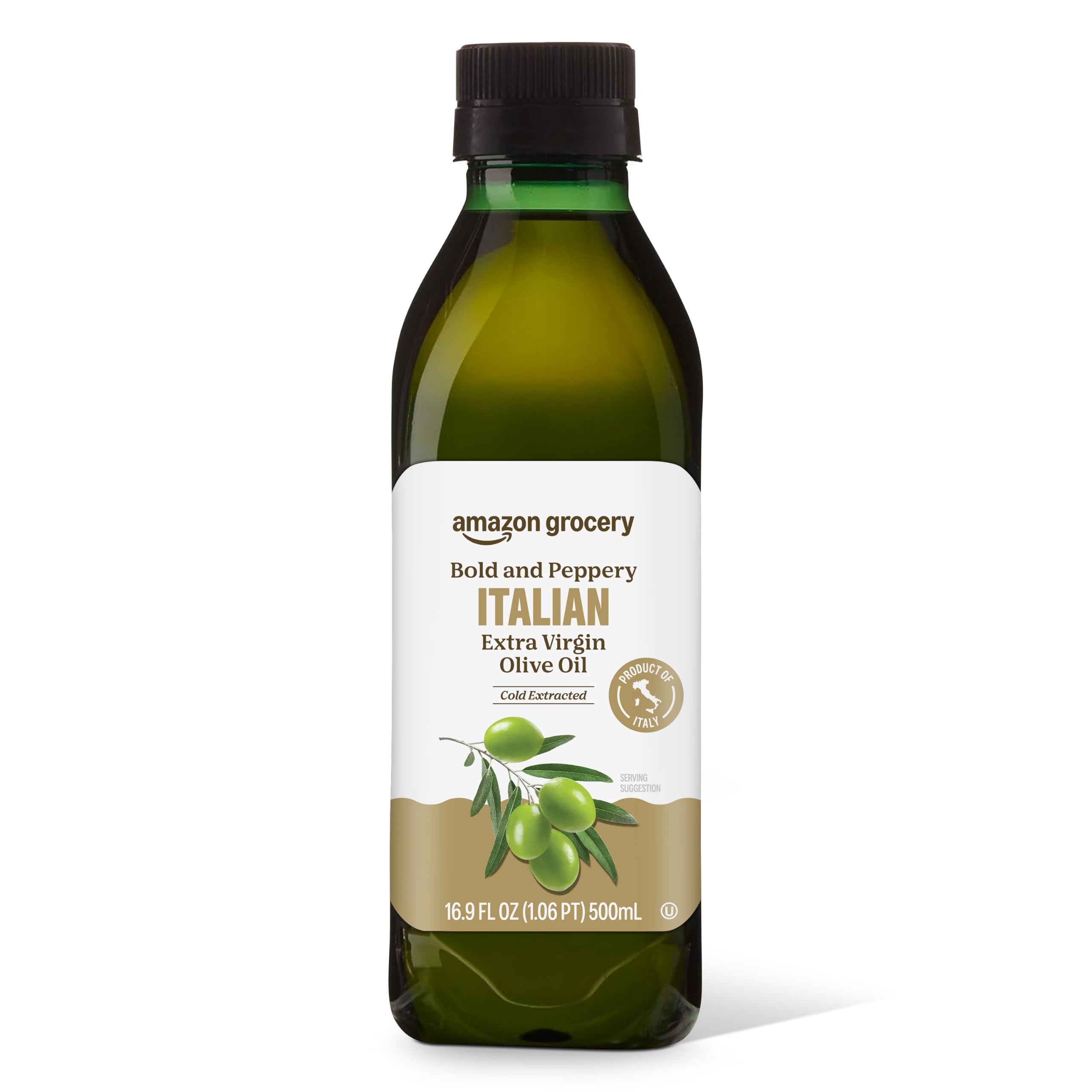
Key Features
- Size: 16.9 fl oz
- Grade: Extra virgin, cold extracted
- Origin: Pressed and bottled in Italy
- Container: Plastic bottle
- Price: Budget
This is the cheapest bottle here by a wide margin, and it’s pressed and bottled in Italy — not a combination you see often. If the oil is going into a hot pan and you don’t want to think about it, that’s a real argument in its favor.
The flavor is what the price suggests: a smooth, mild blend with a little pepper and herb, closer to neutral than distinctive. It won’t wow anyone at a tasting and it won’t ruin anything either. We found it most useful as a second bottle, the one for gravies, sauces, and everyday frying while something with more character sits beside the stove.
Packaging is the compromise. It comes in plastic, which is lighter and safer to ship but less protective against light than the dark glass bottles here, so keep it in a cupboard rather than on a sunny counter. The bottle is small too; a household that cooks daily will go through it quickly.
Even so, it earns its place as the budget option. It’s good enough for the jobs where olive oil is a cooking medium rather than a flavor, and at this price the risk is low. Just don’t buy it expecting the peppery lift of the Atlas or the smooth consistency of the Pompeian.
Pros
- Cheapest bottle in this roundup
- Pressed and bottled in Italy
- Mild enough for sauces and everyday frying
Cons
- Plastic bottle offers less light protection
- Mild flavor lacks character
The bottle to buy when the budget is tight: a mild, Italian-bottled extra virgin that’s good for frying and sauces, sold in plastic and priced to match.
How We Tested the Best Olive Oils
We began with roughly 60 bottles and cut the field to 16 by reading labels closely. A printed harvest date, a third-party certification seal, and a legible lot code were the first filters; from there we sorted by price per fluid ounce and favored dark glass over clear. Anything that couldn’t tell us when it was made or where it came from didn’t make the cut.
Tasting happened in my kitchen over four months, not on a lab bench. Each bottle got poured into a small glass, warmed in my hands for a minute, and smelled before I tasted it — I noted whether the aroma read green and grassy or flat and waxy. Sips taken neat told us about bitterness and that peppery finish, and bread drizzled at room temperature showed the texture, whether the oil felt silky, coating, or thin.
Then we cooked. We sautéed onions, roasted vegetables at high heat, and made vinaigrette every week, watching whether the flavor held or went dull and whether the oil turned greasy in the mouth. Value came down to price per fluid ounce weighed against how often we reached for the bottle. At the end of four months we re-tasted every open one, since an oil that goes flat in six weeks is a poor buy no matter what it costs — and the boldest, bitterest bottles were consistently the ones with the most recent harvest dates.
How to Choose an Olive Oil
The best olive oil is the one you finish while it’s still fresh, which for most kitchens means a big neutral bottle for the pan and a smaller, more characterful one for the table.
Start with the grade, not the adjective
Extra virgin means the oil was pressed from olives without chemical refining, so it keeps the polyphenols and the flavor that make olive oil worth using. Bottles labeled light or mild are a different product: lighter in flavor and aroma, typically refined and blended, and not lower in calories or fat. That’s the trap. If you want oil that tastes like olives, buy extra virgin, and keep a mild one only if you genuinely dislike the flavor in baking and high-heat frying.
Choose a flavor you’ll actually finish
Olive oil runs from delicate and buttery to grassy and peppery, and the difference isn’t quality so much as purpose. A smooth extra virgin like the Pompeian jug disappears into a sauté and won’t fight a cake, while a robust one like the Pompeian Organic Robust or the Atlas is built for vinaigrettes, marinades, and bread. We think two bottles beat one compromise: a big neutral workhorse and a smaller bottle with a point of view. Buy the loud one in a size you’ll finish in a few months.
Match the bottle to how fast you cook
Light and air are what age olive oil, so the container matters as much as the contents. Dark glass is the best protection; plastic is lighter and safer to ship but lets more light through, and a clear bottle left on a sunny counter is the worst home for any oil. Size is the other half of the decision: a three-liter jug is the best value here only if you cook most nights. If you don’t, buy 16 to 34 ounces and finish it.
Heat, smoke point, and frying
Extra virgin olive oil handles more heat than its reputation suggests, but smoke points vary by bottle. Bertolli states 392°F on the label, and that’s a figure worth having when you’re searing. The practical rule is to keep the pan below the point where the oil starts smoking, and not to reuse oil that has. For long frying sessions a mild or light olive oil is the more economical choice; save the peppery bottles for the raw and finishing side of the meal.
Frequently Asked Questions
Does olive oil need to be refrigerated?
No. A closed cupboard away from the stove is better than the fridge. Cold makes olive oil cloud and thicken, and while that’s harmless, the repeated warming and condensation afterward aren’t doing it any favors. What the oil needs is darkness and a tight cap. If the fridge is your only option, let it come back to room temperature before you cook with it.
What do the seals on an olive oil bottle actually mean?
They certify different things. North American Olive Oil Association certification, which the Pompeian bottles carry, is about authenticity: that the bottle holds the grade it claims. USDA Organic covers how the olives were grown. The International Olive Council standard the 365 bottle cites is a quality benchmark. None of them proves freshness, so check for a harvest or best-by date as well before you buy.
Is organic olive oil worth the extra money?
It depends what you’re paying for. Organic certification is about farming practice, not flavor or freshness, so buy organic if that matters to you: the Pompeian Robust Organic is the least expensive organic bottle here, and the 365 is the mid-priced one in glass. If it doesn’t matter, a conventional extra virgin like the Pompeian Smooth covers the same cooking jobs for less per ounce.
Final Verdict
For most kitchens the decision is easy: the Pompeian Smooth three-liter jug is the best olive oil here for everyday cooking, because it’s certified, mild enough for everything from a sauté to a cake, and cheaper per ounce than any other bottle in this roundup. Then add a second, louder bottle for the table.
If you want peppery and high-polyphenol, that’s the Atlas. If you want bold flavor without the premium, the Pompeian Robust Organic is the bold bottle to buy on a budget.