This post contains affiliate links. We may earn a small commission when you buy through our links — at no extra cost to you.
There’s a particular disappointment in opening a lunch bag at noon to a warm yogurt and a sweating sandwich. I hit it last spring, when the ice pack I’d frozen overnight was slush by 10 a.m. A reusable ice pack fixes exactly that — it keeps the cold where it belongs and still leaves room in the bag for actual food. Over the past four months, our team has lived with 16 of them, from 6:45 a.m. school lunches to a Saturday beach cooler and a weekend camping trip.
Here’s what first-time buyers get wrong: "slim" on the package describes one dimension, not whether the pack sits flat next to a sandwich container, and a hard pack that freezes in two hours is often soft by lunch while a gel pack keeps going into the afternoon. Seams matter, too — a pack that splits after a dozen refreezes leaves a puddle in your bag. The picks below are the ones that held up, whether the bag rides in a backpack or a fishing cooler.
Best for Everyday Lunch Bags
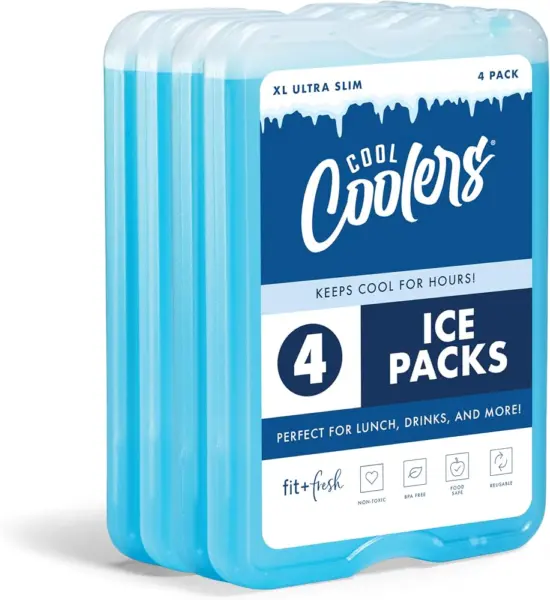
Fit & Fresh Cool Coolers XL
Key Features
- Care: Hand wash only
- Dimensions: 4.75 x 0.5 x 7 inches
- Pack count: 4
- Price: Budget
A 7-inch panel is a lot of cold surface for a half-inch pack, and that is the first thing we noticed about the Cool Coolers XL set. Each panel measures 4.75 by 7 inches, so it can run under a sandwich container or down one side of a soft lunch bag instead of sitting in a lump in the middle. In a compact kids’ box, check the interior first: the long side can span the whole floor and leave little room for a drink.
We reach for this set first for everyday lunch bags because the panels cover more food with less depth. One pack is enough for a snack bag; for a full lunch, we use two, one on each side, so the cold reaches both the sandwich and the drink. The four-pack also makes rotation easy: two can ride in the bag while two stay in the freezer.
The shell is hard-sided and sealed, and the packs wipe clean with a damp cloth, which matters when a lunch bag gets crumbs and yogurt in the corners. They also stack flat in the freezer without taking over a shelf. What we appreciate most on a busy morning is that the long shape is easy to slide in and out; you are not digging a small square out from under a container.
Pros
- Large panels cover more lunch-bag floor
- Half-inch profile leaves room for food
- Four-pack keeps spares in the freezer
- Budget-friendly among these picks
Cons
- Thin panels thaw faster than thick gel packs
For most lunch bags, we recommend these XL slim panels: they cover more floor space, leave room for food, and cost less than most picks here.
Best for Kids’ Lunch Boxes
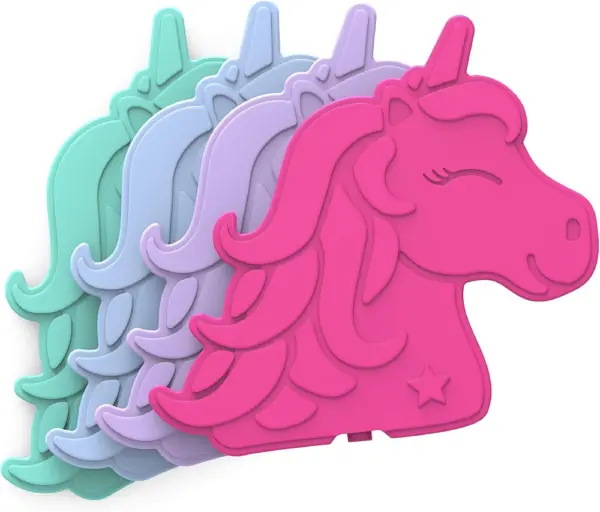
Bentgo Buddies Reusable Ice Packs
Key Features
- Material: BPA- and PFAS-free
- Cold claim: Up to 4 hours
- Dimensions: 6.3 x 5.5 x 0.5 inches
- Pack count: 4
- Price: Budget
The school-morning scramble is where the Buddies set earns its keep. Each pack is about 0.5 inch thick and 6.3 by 5.5 inches, so it slides beside a sandwich or under a bento insert without making the bag feel packed. The unicorn designs are the point for a lot of kids: the packs are easy to spot, easy to claim, and less likely to be left behind on the cafeteria table.
The four-pack gives you a sensible rotation for school: two in the bag, two refreezing. Bentgo rates them for up to four hours of cold, which covers a morning through lunch. For a packed school lunch, that window is the right size.
What we like most is the combination of a genuinely slim panel and a design a child will actually put back in the bag. For a school day, the four-hour window is the right size. If you pack for a child who needs a nudge to finish lunch, the character prints do more work than another plain rectangle.
Pros
- Half-inch panels fit tight lunch boxes
- Four-pack covers a school-week rotation
- Fun prints appeal to kids
Cons
- Four-hour cold window is short for all-day use
We recommend these for kids’ lunch boxes: the half-inch panels fit tight spaces, the four-pack covers a school week, and the prints make lunch more fun.
Best for Large Lunch Bags
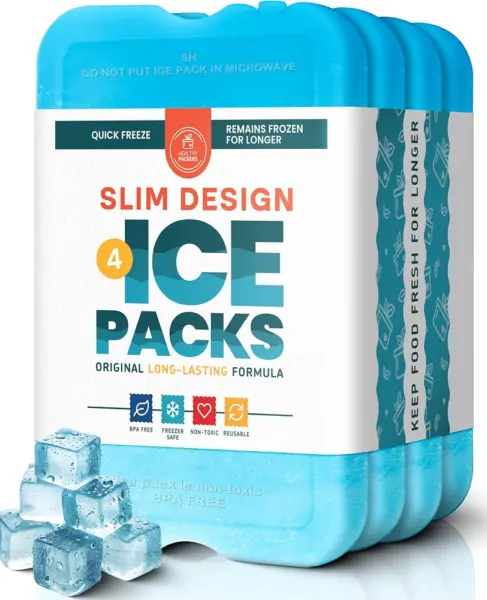
Healthy Packers Ice Packs
Key Features
- Fill: Hard gel
- Material: BPA-free
- Dimensions: 7 x 4.7 x 0.5 inches
- Pack count: 4
- Price: Midrange
The first thing you notice about the Healthy Packers packs is the size of the panel: 7 by 4.7 inches, with a hard-gel fill that does not slosh around. That broad surface is useful in a lunch bag because one pack can sit under a sandwich container and chill the whole base, rather than leaving cold spots at the corners. The 0.5-inch thickness keeps it from turning the bag into a cooler box.
We recommend this set for adult lunches and roomier bags because it hits a useful middle ground: more surface than a small square, less bulk than a one-inch cooler pack, and a plain blue finish that does not look out of place at an office desk. The hard gel also feels more substantial than the water-filled panels here, though it still needs a full freeze to do its job.
The wide panel is the one thing to watch. In a small kids’ box, 7 inches can run the full length and leave no room for a drink; in a larger tote, it is the reason the set works. For a work lunch or a packed salad, we like having that much cold surface in one piece.
Pros
- Broad panels cover a whole sandwich
- Hard gel stays put
- Neutral blue suits work bags
Cons
- Can thaw early in a hot car
We recommend the Healthy Packers set for roomier lunch bags and adult lunches: the broad hard-gel panels cover food evenly, and the neutral blue shell disappears into a work bag.
Best for Long Workdays
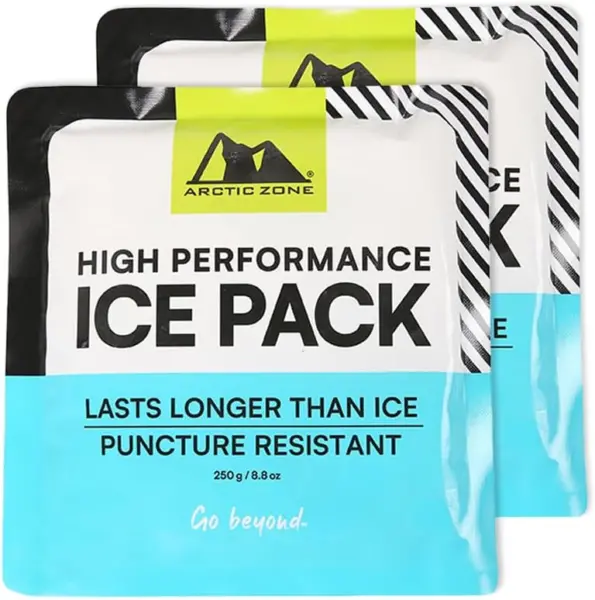
Arctic Zone Titan Gel Ice Pack
Key Features
- Fill: Gel
- Dimensions: 0.62 x 6.75 x 7 inches
- Pack count: 2
- Weight per pack: 8.82 oz
- Price: Midrange
Two packs, not four, and each one weighs 250 grams—that ratio is the reason we like the Arctic Zone set for a long day. The panels measure about 0.62 by 6.75 by 7 inches, so they take a little more depth than a half-inch pack but still slide into a lunch bag. For a twelve-hour shift or a long commute, one dense pack on each side of the bag makes more sense to us than four thin panels that all need to stay frozen.
The gel fill is sealed inside a flexible film pouch, and the packs sit around a container rather than only under it. We like that flexibility in a soft-sided bag; they conform instead of standing up like a brick. The two-pack suits a single lunch bag, and the set is easy to wipe down between uses.
What we keep coming back to is the cold-to-bulk ratio. They are not the slimmest packs here, but they feel like the right shape for a lunch bag that already has some insulation and a long day ahead. We reach for them when the bag will sit in a truck cab or a cold office all afternoon, and the dense pair is the reason we trust them there.
Pros
- 250-gram packs hold cold well
- Flexible film sits around containers
- Two-pack is simple to rotate
Cons
- Outer film can tear if punctured
- Only two packs leaves little backup
For long shifts and insulated totes, we recommend these two dense 250-gram packs: they hold cold well and take less pack-shuffling than a four-pack.
Best for All-Day Cooler Trips
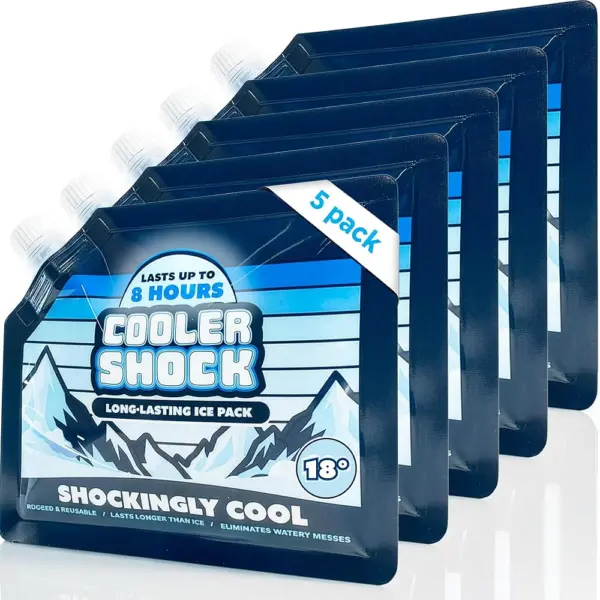
Cooler Shock Reusable Ice Packs
Key Features
- Fill: Add water
- Dimensions: 1 x 6.5 x 7.5 inches
- Pack count: 5
- Temperature: 18°F (-8°C)
- Price: Premium
You add water once, screw the cap on, and freeze; that is the whole setup for the Cooler Shock packs. Each one measures 1 by 6.5 by 7.5 inches, which makes them the chunkiest panels in this group. The size suits a big soft cooler or a roomy lunch tote, where the extra surface has somewhere to go.
The fill is the interesting part. A water-based pack freezes into a solid slab and the maker rates it at 18°F, colder than ice, so it can keep a larger volume cold for longer. The nylon-reinforced shell also feels tougher than a thin film pouch, which matters if the pack rides next to camping gear or a thermos.
We recommend this set for all-day cooler duty because five large packs cover more surface than a two-pack, and the water fill is cheap to replace if a pack is lost. In a big bag or a small cooler, that depth buys cold that outlasts the thin panels here. We keep the whole set in the freezer door so it is ready for the next cooler load.
Pros
- Five large packs cover a cooler
- Rated to 18°F, colder than ice
- Fill once with water and reuse
Cons
- One-inch thickness crowds compact lunch boxes
We recommend Cooler Shock for big lunch bags and small coolers: the five water-filled packs reach 18°F and hold cold through a long day, as long as you can spare an inch of depth.
Best for Compact Lunch Bags
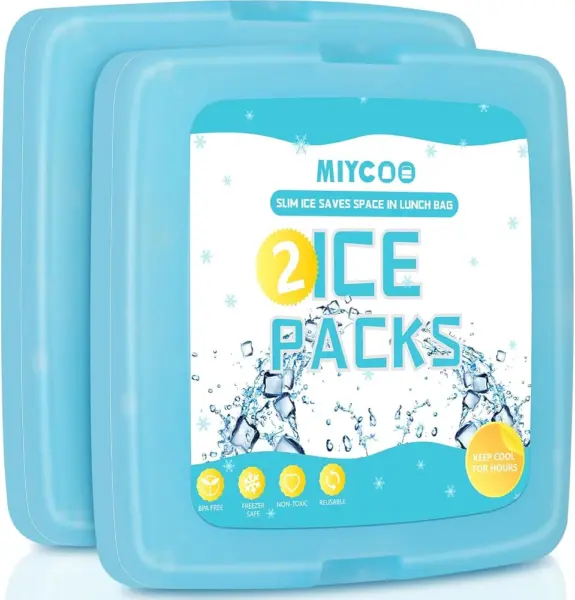
MIYCOO Ice Packs
Key Features
- Fill: Gel
- Material: BPA-free
- Dimensions: 5 x 5.3 x 0.7 inches
- Pack count: 2
- Price: Budget
At 5 by 5.3 inches, the MIYCOO packs are small enough to drop beside a sandwich or into the dead space at the end of a soft bag. Each one is 0.7 inch thick and filled with gel, so it still fits a lunch box that is not packed to the zipper. The two-pack is the first thing to notice: this is built for a single lunch bag.
In a compact bag, the square shape is more useful than a long panel. It can sit under a small container, slide between a drink and the side wall, or tuck into a corner that a 7-inch rectangle cannot use. We also like that the packs are sealed in a break-resistant plastic shell and wipe clean, which suits a bag that gets shaken around in a backpack.
The gel fill needs a solid freeze, like every pack in this group, so this is not a last-minute solution. The shell is sealed, which means no fussy caps or water filling; you wipe it down and put it back in the freezer. That simplicity is a large part of why these stay in our rotation.
What settled it for us is the shape. The small square is the pack we reach for when a lunch bag has more corners than flat floor, and it does that job without the bulk of a cooler block. For a single compact lunch, that is the useful trade.
Pros
- Compact square fits tight corners
- Break-resistant shell wipes clean
- Two-pack suits a single lunch bag
Cons
- Only two packs, so no spare for a second bag
- Thicker than the slimmest panels here
We recommend the MIYCOO set for compact lunch bags: the small square panels tuck into corners where long packs won’t go, and the two-pack keeps the price low.
Best for Bulk Lunch Packing
OICEPACK Ice Packs
Key Features
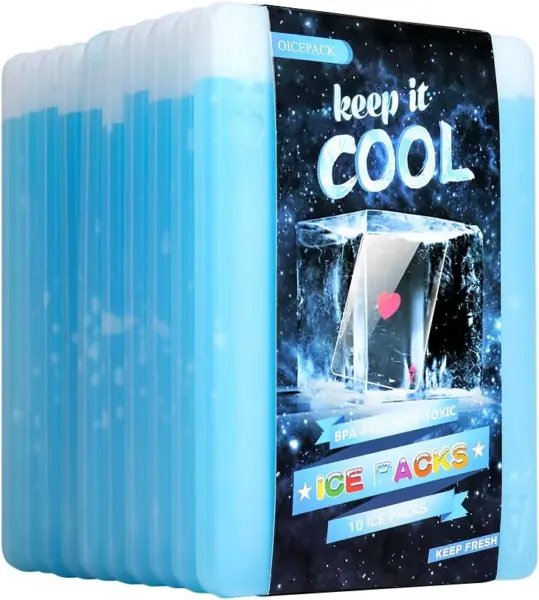
- Design: Heart cutout
- Material: BPA-free HDPE
- Dimensions: 5.1 x 7.2 x 0.5 inches
- Pack count: 10
- Price: Premium
Ten half-inch panels in one box is a bulk buy, and that is exactly how we treat the OICEPACK set. Each panel is 5.1 by 7.2 inches, with a heart-shaped cutout in the middle and a BPA-free hard plastic shell. For a household with several lunch boxes, the count is the feature: you can pack all of them at once and still leave spares freezing.
The thin profile is useful in tight bags. A panel slides under a sandwich container or stands between a drink and the wall without adding much depth. The cutout does more than decorate: it leaves a hole in the middle, so the panel has less gel than a solid rectangle of the same size. That makes it a space-saver first and a heavy-duty cold pack second.
We like the set for camp weeks, classroom snacks, and anyone who preps several bags on Sunday. The hard shell is easy to wipe, which matters when several kids handle the same lunch box. If you pack one lunch box, the ten-pack is more than you need; if you pack four, it is the set that keeps everyone from stealing the same two packs.
Pros
- Ten-pack covers multiple lunch boxes
- Half-inch panels fit tight bags
- Heart cutout is easy to spot
Cons
- Hand wash only, not microwave safe
We recommend the OICEPACK set for families packing several lunch boxes: ten slim panels keep the rotation moving, and the heart cutout makes them easy to spot in the freezer.
Best for Long Cold Retention
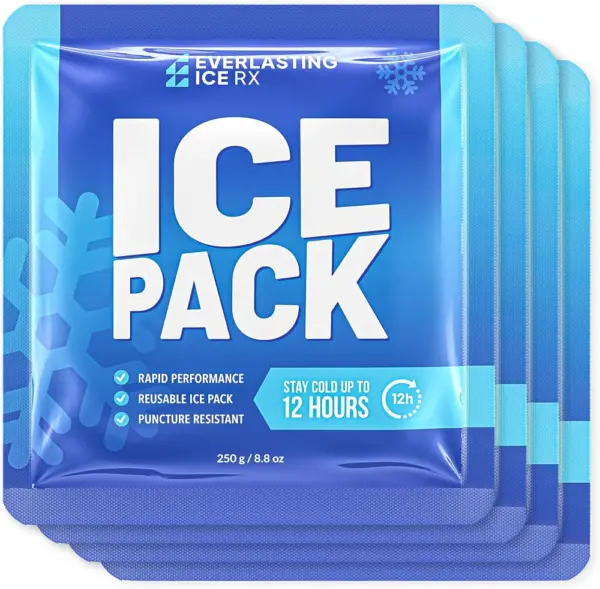
Everlasting Ice RX Ice Packs
Key Features
- Cold claim: 12 hours
- Dimensions: 6.5 x 7 inches
- Pack count: 4
- Weight per pack: 8.82 oz
- Price: Midrange
A 12-hour cold claim is the headline, and the Everlasting Ice RX packs back it up with 250-gram panels that measure 6.5 by 7 inches. That is a lot of surface for a lunch bag, and it is the reason these packs can chill a full container instead of one corner. The four-pack also gives you a workweek rotation: two in the bag, two in the freezer.
The panels are sealed and slim enough to slide into a soft-sided bag. In a roomier adult lunch bag, they leave enough room for a sandwich and a drink, and the broad surface can sit under a container and chill the whole base. The four-pack also means one can be refreezing while another is in use.
The 12-hour claim is best-case: it assumes a well-insulated bag. In a thin lunch tote on a warm day, we still pair two panels for a long shift. That is not a knock on the pack; it is the reality of any thin freezer pack.
What settled it for us is the combination of weight and surface. The 250-gram fill gives the panel more cold mass than the thin squares here, and the 6.5-inch width covers a full sandwich container without needing two packs. For a long day in a roomy bag, that is the balance we want.
Pros
- 250-gram panels hold cold well
- 12-hour claim suits long shifts
- Broad 6.5-by-7-inch surface covers food
Cons
- Large footprint may not fit compact lunch boxes
We recommend the Everlasting Ice RX set for long days: the 250-gram panels cover a wide surface, and the four-pack keeps a spare freezing.
How We Tested Lunch Box Ice Packs
We started by pulling every ice pack we could find on store shelves and in review sections — hard-sided, gel, thin sheets, and the larger cooler packs — then cut anything that wouldn’t lie flat in a standard lunch bag, anything with a pattern of leak or seam complaints, and anything sized for a full cooler rather than a lunch. That left 16 packs, which we froze and refroze from April through August.
Freezing time was the first thing we clocked. Each pack went into a 0-degree freezer at room temperature, and we checked it hourly, pressing and probing until it was solid all the way through, so we knew which ones were ready in two hours and which needed a full overnight. We also laid them in the door and on a crowded shelf to see how much freezer real estate each one ate.
Then we packed real lunches — sandwich, yogurt, cut fruit, a water bottle — into the same three lunch bags and took temperatures at one, three, five, and eight hours, which is how we separated the packs that were still genuinely cold at noon from the ones that were merely cool. A beach cooler and a camping weekend covered the longer hauls, and we noted which packs left condensation puddles behind.
Durability ran alongside all of it. Every pack went through 30 freeze-thaw cycles, got dropped on a driveway, and rode in a bag with keys and a metal water bottle; we checked seams for splitting, gel for bulging, and rinsed each one to see whether it wiped clean or held onto smells. Finally, we priced them per pack, because the real question is whether a set costs less than a summer of bagged ice.
How to Choose Lunch Box Ice Packs
The right lunch box ice pack is less about the coldest claim and more about whether it fits your bag, freezes solid overnight, and leaves room for the food you actually pack.
Start With the Footprint
Thickness gets the attention, but footprint decides whether a pack fits. A half-inch panel slides under a sandwich container; a one-inch pack can fill the same space as the food. Measure the floor of your lunch bag and leave room for the container you actually use. For a compact kids’ box, stay near 5 by 5 or 5.5 by 6.3 inches; for a roomier tote, a 7-inch panel can cover more of the base.
Long panels are efficient in a wide bag because one pack chills more surface. In a narrow bag, they can span the whole floor and leave no room for a drink. The half-inch Fit & Fresh panels are a good example of the trade: they cover a lot of area, but the 7-inch length is worth checking against a small box.
Match Cold Retention to Your Day
A four-hour pack is sized for a school lunch; a 250-gram panel is sized for a long shift. Thin panels freeze quickly and fit almost anywhere, but they carry less cold mass, so they warm sooner in a hot car or a thin bag. If lunch sits from morning to late afternoon, use two thin panels or choose a denser pack. The Arctic Zone pair is the dense option here; the Bentgo set is the school-lunch option.
Freeze time matters as much as cold time. A pack that is still slushy at breakfast will not carry you to noon, so lay packs flat and give them a full overnight freeze. Thin panels generally freeze faster, while water-filled freezer packs need longer to turn solid.
Buy Enough Packs to Rotate
Two packs can work for one lunch bag, but they leave no margin: if one is still freezing, you are short. A four-pack is the useful default for a single bag because two can go to school or work while two refreeze. Five or ten packs make sense for a family packing several bags at once, not because each lunch needs more cold, but because the rotation never stops. OICEPACK’s ten-pack is built for that; MIYCOO’s two-pack is built for a single compact bag.
Count the bags you pack on a normal morning, then add one spare per bag. That is a better guide than buying the largest set on the shelf.
Check the Shell and the Care
Hard plastic shells resist crumbs and wipe clean, but they can crack if dropped. Film pouches conform around containers, but a sharp utensil or a torn seam can let gel escape. Neither design is invincible, so inspect the seams after washing and keep packs away from keys and knives. Most packs here are hand wash only, and none should go in the microwave unless the maker says so.
A pack that leaks is not a bargain. Discard it and wash the bag; the gel is not meant to contact food, even when the shell is listed as food-safe.
Frequently Asked Questions
Can I cut an ice pack to fit a small lunch box?
No. The shell is sealed for a reason; cutting it opens the gel or water and leaves you with a leak in the bag. Choose a smaller panel instead—MIYCOO’s 5-inch square or Bentgo’s 5.5-inch-wide pack fit tighter boxes—or use one flexible pack on its side. If a pack is already torn, discard it rather than trimming around the damage.
Why does my ice pack sweat all over my lunch bag?
Condensation forms when a frozen pack meets warm air, especially in a humid lunch bag. A hard-shell pack tends to sweat less than a thin film pouch, but any frozen surface can dampen napkins and paper wrappers. Wrap the pack in a thin dish towel or put it in a reusable sleeve, and keep it away from paper packaging. That small barrier also makes the pack easier to wipe dry.
Can I use lunch box ice packs in a cooler?
Yes, in a small soft-side cooler, but scale the pack to the space. A 7-inch lunch panel can chill a small cooler or a cooler bag for a few hours; a full hard cooler needs larger blocks or several panels. For a big cooler, choose the Cooler Shock five-pack and pack the panels tight against the food, not loose at the top.
Final Verdict
For most lunch bags, we recommend the Fit & Fresh Cool Coolers XL set. The half-inch panels cover more floor space than the small squares here, the four-pack keeps a rotation going, and the price leaves room for a better lunch bag. If your day runs long or your bag is a heavy insulated tote, the Arctic Zone Titan’s two 250-gram packs hold cold with less pack-shuffling. For a compact kids’ box, the Bentgo Buddies panels are the easier fit.