This post contains affiliate links. We may earn a small commission when you buy through our links — at no extra cost to you.
Late August is when the tomatoes come in faster than I can eat them, and for years I handled the overflow with a blender and a fine-mesh strainer — a two-step mess that produced pink foam and a sink full of parts. A food mill does it in one pass: crank cooked tomatoes, berries, or apples through a perforated disc and the skins, seeds, and fiber stay behind while the smooth purée drops into the pot below. That’s the whole appeal — silky sauce without peeling, seeding, or babysitting a strainer.
I’ve spent the past nine months cranking eleven mills, from counter-clamping models to three-legged ones that straddle a stockpot, and the differences show up quickly: how much force the crank takes, how many seeds sneak through the finest disc, whether the clamp creeps under load. The spec most first-time buyers overlook is disc hole size — a set of three discs is what lets one mill handle both tomato sauce and mashed potatoes. The picks below are the ones I kept reaching for.


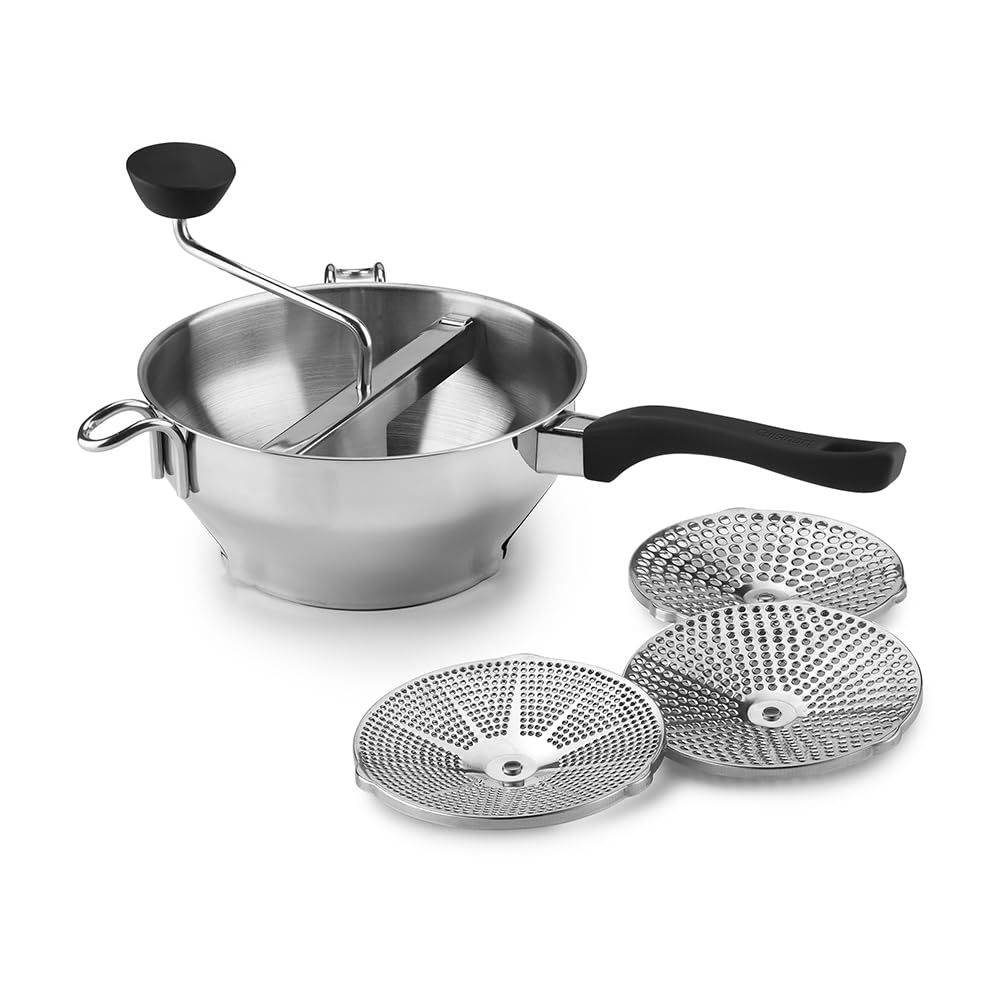

Best for Everyday Milling
Hungry Artisan 3-Disc Food Mill
Key Features
- Weight: 2.8 lb
- Material: Stainless steel
- Dimensions: 15.5 x 8 x 3.5 in
- Milling discs: 3 stainless steel
- Price: Budget
The first thing we noticed about the Hungry Artisan is how little fuss the three-disc setup adds. Drop a disc in, load cooked apples or tomatoes, and crank; the mill pushes the soft pulp through while skins, seeds, and cores stay behind. That is the whole job, and doing it without an outlet or a second bowl is why it became the mill we kept reaching for.
We recommend it as the default because it covers the widest range of everyday jobs at the least complication: coarse for chunky applesauce, medium for tomato sauce, fine for jam bases and baby food. The stainless body, discs, and crank feel substantial in hand, and the 2.8-pound weight is enough to stay put without making it a chore to lift. Cleanup is straightforward once it comes apart; a quick rinse keeps tomato acid from sitting on the metal.
Our testing found the crank turns smoothly and the discs swap without a fight, which matters when you are moving from a pot of tomatoes to a batch of apples. The mill sits over a bowl or pot rather than clamping to the counter, so you need a stable vessel underneath. That is normal for this design, and the payoff is being able to mill straight into the same pot you cooked in.
Where it gives up ground is capacity: this is a mill for ordinary home batches, not a full harvest day. The Mirro’s 3.5-quart bowl is the better fit when you need to keep a big pot moving. For most cooks, the lighter body and simpler cleanup are the better trade, and the three discs do the work of a more complicated machine.
Pros
- Three discs cover coarse to fine
- All-stainless body and crank
- Straightforward cleanup
Cons
- Small washer is easy to lose
We recommend the Hungry Artisan as the default because its three stainless discs and all-metal build cover applesauce, tomato sauce, and jam without a premium price.
Best for Milling over Pots
OXO Good Grips Food Mill
Key Features
- Capacity: 2.3 quarts
- Material: Stainless steel with plastic exterior
- Stability: Three non-slip legs
- Milling discs: 3 stainless steel
- Price: Midrange
We reach for the OXO when the pot is hot and the batch is messy. Its three non-slip legs grip bowls and pots up to 11 inches across, and the mill sits high enough to clear the food below, so you can crank directly over the vessel instead of transferring pulp to a second bowl. The stainless bowl has a plastic exterior that keeps heat off your hands; that detail matters more than it sounds when you are working over steam.
The three stainless discs cover fine, medium, and coarse textures, and the spring-loaded lever makes swapping them and taking the mill apart easier than the wire-rim designs. We found the OXO stable and comfortable to turn through applesauce and tomato sauce. Cleanup is one of its better qualities: the parts come apart quickly and are dishwasher safe.
The OXO is happiest with cooked apples, tomatoes, and berries; firm or fibrous food can process unevenly, so it is not the mill for every harvest. Still, the over-the-pot design is the reason it stays in our rotation. If you make sauce in the same pot you cook in, the OXO saves an extra vessel and a sticky transfer.
Pros
- Non-slip legs grip pots up to 11 inches
- Spring-loaded discs swap quickly
- Dishwasher-safe parts
Cons
- Smaller 2.3-quart bowl
We reach for the OXO when we’re milling directly over a hot pot; the non-slip legs and spring-loaded discs make it the steadier choice.
Best for Texture Variety
Küchenprofi Stainless Food Mill
Key Features
- Material: 18/10 stainless steel
- Warranty: 5 years
- Dimensions: 15.5 x 8.75 x 4.75 in
- Milling discs: 4 interchangeable
- Price: Premium
Four discs is the reason to look at the Küchenprofi. Most mills here give you three, and two give you fewer; the extra sieve on this one widens the gap between a rustic sauce and a fine puree. The 18/10 stainless body has a heavy, planted feel, and the 15.5-inch length gives the crank a long sweep without feeling unwieldy.
The build is the other draw. This is a thick-gauge mill with a traditional hand-crank layout, and the 5-year warranty is longer than most here. We found the parts fit together positively and the discs swap without a fight. It is the mill we reach for when we want the texture to be the variable, not the equipment.
We recommend it to cooks who make several textures and want a mill that feels like it will outlast the trend. The four discs are genuinely useful for moving from chunky applesauce to a fine tomato sauce, and the stainless construction is easy to rinse before pulp dries. It is not the simplest one-texture tool, but that is not the buyer we have in mind.
If you only make one texture and want the simplest tool, the Hungry Artisan or Cuisinart makes more sense. If you want a broad disc range and a substantial feel, the Küchenprofi is the one we point to. The extra disc earns its keep when you move between sauces and purees in the same session, and the long crank makes a big pot feel less tedious.
Pros
- Four discs widen texture range
- Heavy 18/10 stainless construction
- Five-year warranty
Cons
- Heavier and bulkier than compact mills
We recommend the Küchenprofi to cooks who want the widest texture range and a heavy, all-stainless mill that feels planted on the counter.
Best for Fast Premium Milling
Rösle 16252 Food Mill
Key Features
- Capacity: 3 liters
- Material: 18/10 stainless steel
- Supports: 3 lower supports
- Milling discs: 2 grinding discs
- Price: Premium
The Rösle’s blade sits almost flush with the sieve, with barely any gap for food to ride up the side. That close fit is the whole point: the blade scrapes the screen as it turns, so soft food moves through instead of being pushed around. In our testing, that made short work of cooked apples and tomatoes, and the crank felt direct rather than spongy.
The rest of the mill is equally solid. It is made from 18/10 stainless steel, has a 3-liter capacity, and sits on three lower supports that grip a bowl without scratching it. The two grinding discs are enough for a fine puree and a slightly coarser sauce. Assembly is intuitive, and the parts come apart for cleaning without hidden crevices.
The 3-liter bowl is generous but not as large as the Mirro’s 3.5-quart capacity, so a huge harvest still takes more reloading. The Rösle is also finished to a higher standard, and that is the reason to choose it. If you mainly make one style of sauce or applesauce, the simpler controls are a feature rather than a limitation.
We like the Rösle best for fast, close-tolerance milling when you have already decided you want a premium manual mill. It is the one that feels most like a precision tool in the hand, and the lower supports make it steadier over a bowl than the simpler wire-leg designs. Buy it for the two textures you actually make, not for a disc collection.
Pros
- Near-flush blade speeds milling
- Lower supports steady it over a bowl
- Generous 3-liter stainless bowl
Cons
- Only two discs limit texture range
We like the Rösle for fast, close-tolerance milling; its two discs are enough for sauces and applesauce, but not for every texture.
Best for First Food Mill
Cuisinart CTG-00-FM2 Food Mill
Key Features
- Handle: Soft grip
- Capacity: 2.3 quarts
- Material: Stainless steel
- Milling discs: 3 cutting discs
- Price: Budget
We think the Cuisinart is the smart entry point for someone who wants to try food milling without committing to a premium tool. It keeps the essentials: a 2.3-quart stainless bowl, three cutting discs, and a soft-grip handle that is comfortable to turn. The mill is light enough to lift with one hand, which makes it easy to move from the pot to the sink when a batch is done.
The three discs cover fine, medium, and coarse textures, and the bowl hooks onto a pot or bowl to stay in place. It handled cooked tomatoes and apples well in our testing, though it is not as planted as the OXO when the mixture gets heavy. The soft-grip handle is a real improvement over bare metal if you are cranking through a second batch.
The 2.3-quart bowl is on the small side for a big harvest, and the mill can shift unless you hold the base when the mixture gets heavy. Those are fair trade-offs for a first mill, and the light body makes it easy to store. If you already know you make sauce every weekend, the OXO or Küchenprofi is the better long-term buy.
Pros
- Three discs at the budget end
- Soft-grip handle is comfortable
- Light body is easy to handle
Cons
- Fruit can ride up the sides
- Leaves more flesh on skins
We think the Cuisinart is the smart entry point if you want three discs and a comfortable crank without spending much.
Best for Small Batches
GEFU Flotte Lotte Food Mill
Key Features
- Capacity: 2 liters
- Material: 18/10 stainless steel
- Milling discs: 2 perforated disks
- Dishwasher safe: Yes
- Price: Premium
The Gefu Flotte Lotte is the compact one: a 2-liter all-stainless body that takes up less shelf space than the long-crank mills here. It comes with two perforated discs, 2.0 mm and 3.0 mm, and the parts come apart completely for cleaning. That simple construction is the appeal if you make applesauce or tomato sauce in modest batches.
We found the Gefu easy to live with. The stainless steel has no plastic parts to crack or stain, and the mill rinses clean without a lot of scrubbing. The crank turns smoothly, and the 2-liter bowl is sized for a standard pot rather than a harvest. It is also one of the lighter mills here, which makes it easy to move around.
We recommend the Gefu for small kitchens and small batches, as long as its two discs match the textures you make most. The 2.0 mm disc is fine enough for applesauce and many sauces, while the 3.0 mm disc leaves a little more body. It is not the mill for a bushel of tomatoes, and the two-disc range is narrower than the Küchenprofi’s four.
For apples, pears, and tomatoes, it does the job with less bulk than the larger mills. If storage space is tight, that trade is easy to make. The 2-liter bowl also means you are not lifting a heavy mill when it is full.
Pros
- Compact 2-liter all-stainless body
- Two discs cover fine and medium
- Easy to disassemble and clean
Cons
- Small seeds can pass through
We recommend the Gefu for small batches and tight storage, as long as its two discs match the textures you make most.
Best for Large Harvests
Mirro 50025 Foley Food Mill

Key Features
- Weight: 2.1 lb
- Capacity: 3.5 quarts
- Material: Stainless steel
- Dimensions: 15.47 x 9.06 x 6.5 in
- Price: Midrange
The Mirro Foley is the capacity play. Its 3.5-quart bowl is the largest here, big enough to take a full batch of apples or tomatoes without stopping to empty the mill. The stainless steel body has a simple, old-fashioned look, and the 2.1-pound weight is lighter than you might expect for a bowl that size.
We see the Mirro as a big-batch specialist, not the everyday default. The wide bowl and simple crank make short work of a harvest, and the stainless body rinses clean. It is also one of the few mills here with enough capacity for a full pot of sauce in one pass, which is the reason to choose it.
Against the 2- and 3-quart mills here, the Mirro’s advantage is simple: fewer reloads. That is the whole case. If you make sauce once a year and freeze it in big batches, the capacity earns its shelf space. If you make small batches weekly, the extra bowl is more mill than you need.
Pros
- 3.5-quart capacity for big batches
- Stainless steel body
- Light for its size
Cons
- Build quality varies, especially at the handle
We recommend the Mirro when capacity is the priority: its 3.5-quart bowl takes a full harvest, and the simple crank is easy to live with.
How We Tested 11 Food Mills (and What Went Through Them)
We started by gathering every food mill we could find that was actually built to be used — stainless or heavy-gauge tin bodies, three or more interchangeable discs, and either a clamp or sturdy legs. Decorative models and mills with a single fixed disc got cut, leaving 11 that spanned the design and price range, from compact 1-quart mills to 2-quart workhorses.
Testing ran nine months and followed the seasons: tomatoes in late summer, applesauce in fall, mashed potatoes at Thanksgiving, squash purée in winter. Every mill processed at least five pounds of cooked tomatoes on the finest disc, and we counted the seeds that made it into the bowl and timed each batch. We also handed the crank to whoever happened to be in the kitchen — including my mom, who has bad wrists — and noted whether the mill needed a second hand to stay put.
Cleaning got its own session. We took each mill apart, scrubbed the disc and the underside of the blade with a bottle brush, then ran the parts through the dishwasher wherever the maker allowed it, checking afterward for pulp trapped in seams. To judge sturdiness, we deliberately overloaded each one with four pounds of potatoes and cranked hard, watching for legs that skipped across the pot and clamps that slipped on a thick rim. We measured footprint and capacity so you know how much pot or counter space a mill really eats, then weighed all of it against what each one costs.
How to Choose a Food Mill
The right food mill fits the batch size you actually cook and the pot you already own; everything else is texture control.
Match capacity to the batch you actually cook
A food mill’s bowl size sets how often you stop to empty it. The 2- to 2.3-quart mills here, like the OXO and Cuisinart, are sized for a standard pot of apples or tomatoes; the 3- to 3.5-quart mills, including the Rösle and Mirro, make more sense when you process a harvest in one go. Bigger is not automatically better: a wide bowl takes more cupboard space and can be awkward to lift when full. Measure the pot you plan to mill over and the shelf where the mill will live, then choose the smallest bowl that keeps a normal batch moving. If you regularly can bushels, capacity outweighs compactness.
Pick discs for the textures you make
Three discs is the useful baseline: fine for jam and baby food, medium for tomato sauce, coarse for chunky applesauce. A fourth disc, as on the Küchenprofi, widens the gap between textures, but it only earns its keep if you actually switch. Two-disc mills like the Rösle and Gefu can be excellent when their fine and coarse settings match your cooking. The trap is assuming a finer disc guarantees seed-free results; small berry seeds can still pass through, and fibrous pieces may clog a screen. Choose the range you will use, not the largest count.
Stability over the pot matters more than weight
A manual mill needs a steady perch because you are applying force sideways while the food pushes back. Legs or supports that grip the rim of a pot or bowl keep the mill from skating, and the mill must sit high enough to clear the food underneath. The OXO’s non-slip legs are rated for vessels up to 11 inches across; the Rösle uses three lower supports to hold a bowl without scratching it. Before buying, check the diameter of your widest pot and the height of its rim. A mill that does not sit securely is one you will avoid using.
Plan for cleanup and storage
Pulp dries into a cement-like film on screens, so choose a mill that comes apart without tools and has no hidden crevices. Stainless steel rinses clean and does not pick up tomato acid, while plastic exterior parts can be easier on hot hands but need the same thorough rinse. Dishwasher-safe parts are a real convenience after a canning session; the OXO, Gefu, and others here are built for that. Storage is the other half: a 15-inch mill with a long crank takes drawer or shelf space, so measure before you commit. Rinse promptly and cleanup stays short.
Crank effort, handle comfort, and the manual trade-off
A food mill rewards a steady, unhurried crank. The trade-off is time and forearm effort, especially with a large batch or a firm puree. A longer crank and a comfortable handle make the work easier; the Cuisinart’s soft-grip handle and the Hungry Artisan’s simple rotary crank are both designed for repeat turns. If you process occasionally, a manual mill is simple, quiet, and easy to store. If you make sauce by the bushel, accept that you are choosing a slower tool.
Frequently Asked Questions
Do I need to peel or seed produce before milling?
No. Cook apples, tomatoes, and similar produce until soft, cut them into pieces that fit the hopper, and let the mill separate skins and seeds. Large tomato cores and hard stems should still be removed. If a recipe calls for a very clean puree, run the pulp through a second time on the finest disc. Raw or undercooked pieces can clog the screen, so cook first and avoid forcing the crank.
Why use a food mill instead of a blender or food processor?
A blender or processor pulverizes skins and seeds into the puree; a food mill pushes the soft flesh through a screen and leaves the tough parts behind. That is why it is better for smooth tomato sauce and applesauce with no peel. Use a blender when you want everything incorporated, and a food mill when separation is the goal.
Final Verdict
For most cooks, the Hungry Artisan is the food mill to buy: three stainless discs, a simple crank, and a build that covers applesauce, tomato sauce, and jam without the fuss of a premium tool.
If you mill directly over a hot pot, the OXO’s non-slip legs are worth the step up. If you want the widest texture range and a heavier all-stainless mill, choose the Küchenprofi. The Mirro only makes sense when capacity matters more than a sure build.