This post contains affiliate links. We may earn a small commission when you buy through our links — at no extra cost to you.
The reward for pulling a good shot is the thwack that comes right after it: the puck drops clean, the basket comes out empty, nothing needs wiping. The wrong knock box turns that into a daily annoyance — it skates across the counter, tips when you hit it with any conviction, or holds onto a ring of wet grounds that sets by evening. What you actually want is a box that stays put, takes the hit, empties without a scraper, and doesn’t look like a workshop offcut sitting next to your machine.
I’ve been pulling shots at home for years, and over the past four months my team and I knocked out several hundred pucks into 14 different boxes. The thing first-time buyers miss is the bar: it takes all of the force, and on cheaper models it’s a thin piece of chrome that dents or rattles loose within weeks. Capacity matters too, but only against your counter — a box that hogs the space beside the grinder is worse than a small one you empty every other day. The picks below run from compact to generous, and each one earned its place.




Best for Busy Home Bars
MHW-3BOMBER Knock Box
Key Features
- Base: Silicone anti-slip pad
- Capacity: 1.2 liters
- Knock bar: Removable, rubber-sleeved metal
- Puck capacity: 15 pucks
- Price: Midrange
The 1.2-liter bin is the largest capacity in this set, and it is the main reason the MHW-3BOMBER is our top pick. Fifteen pucks is the stated figure, and the square body makes it believable: there is no shoulder narrowing the well, so the volume you see from above is close to the volume you get. In a house pulling several doubles a day, that is the difference between emptying when it suits you and emptying every morning.
The slanted mouth is the detail we appreciated most once we started using it. Knock boxes fail at the rim, where a puck leaving the portafilter at an angle catches the edge and throws grounds across the counter, which is the exact mess the box exists to prevent. MHW cuts the front on a slope and raises the back, and in our sessions it kept the spray in far better than the open cylinders here. The knock bar is a metal rod in a thick rubber sleeve, which takes the ring out of the strike and protects the portafilter’s finish.
Cleaning is quick. The interior is a plain box with no ledge for dried grounds to collect in, and MHW says the whole thing can be rinsed without taking it apart, which is mostly how we cleaned it. The silicone pad underneath held it planted on a wood counter and on tile, even with a firm knock.
It is also compact enough to sit beside a machine rather than be fetched out of a cupboard, which we cannot say for every bin here. Pull two shots a week and it is more capacity than you need; pull four a day and it is the one that keeps the emptying off your list.
Pros
- Largest bin here at 1.2 liters
- Slanted mouth cuts splatter at the rim
- Rubber-sleeved metal bar protects the portafilter
- Silicone base stays planted
Cons
- Bar takes a firm tug to lift out
This is the one we reach for first: a genuinely large bin that keeps grounds in and holds days of pucks without eating counter space.
Best for Breville Owners
Breville Knock Box 10
Key Features
- Material: Stainless steel and plastic
- Knock bar: Removable
- Dimensions: 7 x 7 x 7 in
- Puck capacity: 10 pucks
- Price: Premium
Brushed stainless over a plastic body, a rounded profile, and a knock bar that lifts straight out: the Knock Box 10 is the piece that makes a coffee corner look assembled on purpose. At 7 inches square it also sits on the drip tray of most Breville machines when it is not in use, which is a better storage answer than a cupboard.
We liked the finish more than we expected to, since it keeps a brushed look rather than the plasticky sheen of cheaper bins, and the inner vessel is a plain curve with no seam to scrape grounds out of. The habit it asks for is a gentler knock: swing hard and grounds clear the rim and land on the counter. Two deliberate taps do the same job and keep everything inside.
It is the most expensive bin in this set, and part of what you are paying for is the badge and the finish rather than capacity or hardware. That is a fair trade if the box lives on the counter in plain sight; if it lives in a cupboard, a plainer bin does the same work for less.
Pros
- Brushed stainless finish holds its look
- Removable bar leaves a smooth interior
- Stows on a Breville drip tray
Cons
- Realistic fill is six or seven pucks
A brushed-steel bin that looks right beside a Breville machine and wipes out cleanly, and we recommend it for small kitchens that care how the counter looks.
Best for Tiny Kitchens
Dreamfarm Grindenstein
Key Features
- Weight: 8.6 oz
- Cleaning: Dishwasher safe, top rack
- Knock bar: Fixed, rubber-sleeved
- Dimensions: 4 x 4 x 4 in
- Price: Premium
Four inches on each side and eight and a half ounces: the Grindenstein is built to live on the machine’s drip tray rather than beside it. That is the whole idea, and it is a good one in a kitchen where the espresso setup already competes with a toaster and a kettle.
There is no removable bar. The body is one piece with a thick rubber sleeve over the striking edge, and that construction is why it is so quiet, since the hit goes into rubber and plastic rather than a metal rod rattling in a cradle. It also means nothing to lose, nothing to refit, and no seam where old grounds collect. It goes on the top rack of a dishwasher, though a rinse usually does it.
We think it is the right box for one or two drinks a day and the wrong one for a household pulling rounds for four. What you get in exchange is the least obtrusive object on the counter: it tucks under the machine, drops below eye level, and asks nothing of you between rinses.
Pros
- Smallest footprint here at 4 inches square
- Quiet, cushioned knocking
- One-piece body leaves no seams
Cons
- Holds about four or five pucks
For one or two shots a day and almost no spare counter, we think this is the one to own.
Best for Hidden Storage
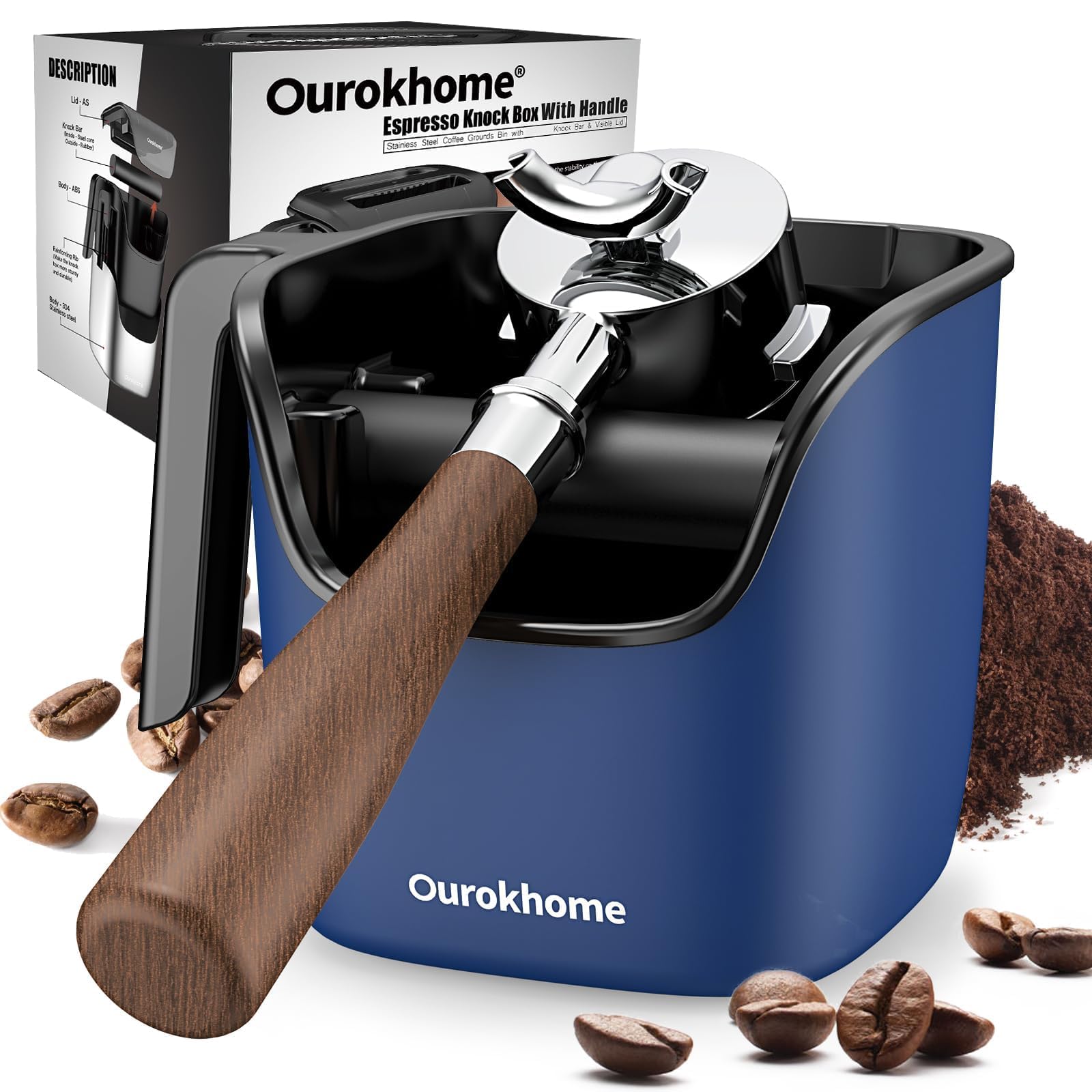
Ourokhome Knock Box
Key Features
- Lid: Included
- Weight: 1.54 lb
- Knock bar: Removable, rubberized
- Dimensions: 4.7 x 4.7 x 5.5 in
- Price: Midrange
A lid and a side handle, which no other bin here pairs. The lid keeps spent pucks out of sight between empties, and that matters more than it sounds when the coffee bar is in the kitchen you actually cook in. The handle means you carry the box to the bin instead of tipping it over the edge of the trash.
We think that combination earns its midrange price by itself. Under the lid it is a thickened 304 stainless shell with a rubberized knock bar that lifts out, and at a pound and a half it stays where you put it. The exterior has held up in daily use without the smudging cheaper coatings pick up.
It is 4.7 inches square and 5.5 inches tall, so it takes a small patch of counter and sits tall enough to tuck beside a machine or against a wall. The well is deep rather than broad, which makes emptying a quick tip and rinse rather than a scrape.
Pros
- Lid keeps grounds out of sight
- Side handle makes emptying easy
- Stainless shell adds stability
- Removable rubberized bar
Cons
- Narrow mouth is unforgiving with wide portafilters
We recommend this to anyone who wants spent grounds out of sight between empties and a handle for the walk to the bin.
Best for Ninja Luxe Owners
Ninja Luxe Cafe Knock Box
Key Features
- Base: Non-slip
- Knock bar: Removable, rubber-coated
- Dimensions: 5.65 x 5.65 x 5.76 in
- Puck capacity: 10 double-shot pucks
- Price: Premium
Most knock boxes announce the strike: a portafilter against a metal rod makes a clack that carries through a quiet kitchen. The Ninja’s bar wears a heavy rubbery coating that swallows most of that, and the non-slip base keeps the bin from skating when you hit it. Of the bar-style boxes here, this is the quietest one we handled.
The rest is fit and finish. A 5.65-inch cube in matte black, it sits against a Ninja Luxe Cafe machine like it came in the box, and the dark interior hides the pucks so it keeps looking clean between empties. The bar lifts out for a rinse, the rounded interior has no corners to dig into, and the whole thing wipes down without a brush.
Pros
- Heavy rubberized bar quiets the knock
- Non-slip base keeps it steady
- Dark interior hides spent pucks
- Matches Ninja Luxe Cafe machines
Cons
- Stated 10-puck capacity runs closer to six or eight
- Brand-name price for a plastic-bodied bin
If your machine says Ninja on the front, we think this is the tidy, quiet match for it; on any other machine the brand fit buys you nothing.
Best for Budget Buyers
IAOSEN Knock Box
Key Features
- Weight: 13.7 oz
- Cleaning: Dishwasher safe
- Knock bar: Removable, rubber
- Package dimensions: 5.39 x 5.35 x 5.2 in
- Price: Budget
A wide opening over a deep well is the IAOSEN’s whole pitch, and it gives you more usable space than the small cubes here. It is 5.39 inches across and 5.2 tall, with a mouth wide enough to take a puck without aiming.
The body is ABS with a removable rubber bar and a rubberized ring around the base, and it is dishwasher safe. The bar comes out for a proper wash and the interior is a plain cylinder, so a rinse deals with most of it.
We think it is the right first knock box for someone who is not ready to spend much: it holds roughly a week of grounds for three adults, so emptying never becomes a daily chore, and it does the one job without fuss. If you want a lid or a metal finish, look further up this list; if you just want the mess to stop, this is enough.
Pros
- Wide mouth and deep well hold plenty
- Lowest price in this set
- Removable bar and dishwasher safe
Cons
- Light body can slide on a hard knock
The cheapest bin here also holds about a week of grounds for a small household, and that is why we send budget buyers to it.
Best for Silent Knocking
homeffect Knock Box

Key Features
- Weight: 6.35 oz
- Capacity: 600 ml
- Dimensions: 4.8 x 4.8 x 4.6 in
- Knocking surface: Rubber pad, no bar
- Price: Midrange
There is no bar to hit on the homeffect. You knock the portafilter against a rubber pad set under a raised back panel, and the puck drops through a wide slot into a 600 ml well. It sounds odd written down and feels obvious in use: nothing to aim at, nothing to miss.
The pad is soft enough that the strike is barely audible, and the anti-slip rubber underneath means it stays where you set it. There is also nothing to dismantle, with no bar to pull out and no cradle to refit, so cleaning is a rinse and, when it needs more, a trip through the dishwasher.
At 4.8 inches square and 4.6 inches tall it fits a drip tray or a narrow gap, and the raised back did real work deflecting grounds in our sessions. Treat it as a one-machine, one-household bin rather than a cafe’s.
Where we land: for a quiet kitchen and a bar-free routine this is a genuinely pleasant thing to use, and it kept its place on the counter long after the comparisons were finished. Nothing about it feels like a gadget, which is the highest compliment we can pay a box that catches coffee.
Pros
- Silent, cushioned knocking pad
- No bar to remove or refit
- Raised back panel deflects grounds
- Dishwasher safe
Cons
- Holds about four pucks before filling
- Base can crack and leak with daily use
We liked the bar-free design more than we expected, and it is the quietest way in this set to empty a portafilter.
Best for Stainless Steel Look
DIBTSA Knock Box

Key Features
- Base: Non-slip rubber
- Material: Stainless steel
- Knock bar: Removable, rubber-wrapped steel
- Dimensions: 4.5 x 4.5 x 4.5 in
- Price: Midrange
The body is stainless steel rather than plastic, 4.5 inches across and 4.5 tall, with a rubber-wrapped steel bar and a rubber foot. Next to the plastic bins here it reads as the more expensive object, and it feels it in the hand.
It also holds more than its size suggests, taking a dozen or so pucks before it needs emptying, which is the useful kind of surprise in a small kitchen. The raised rear wall behind the bar catches most of what comes off the portafilter.
The bar itself drops into notches cut in the steel rim rather than sitting in a full cradle. That means it can shift under a hard knock and wants reseating after you empty the bin: a two-second habit rather than a fault, but worth knowing before you buy.
We point metal-finish buyers here, particularly anyone working with a narrow gap beside the machine, since 4.5 inches square is among the smallest footprints in this set. If you want the bar and the rim to feel like one solid piece, the molded bins further up this list are the safer choice.
Pros
- Stainless steel body and bar
- Holds about a dozen pucks
- Heavy with a non-slip base
- Small 4.5-inch footprint
Cons
- Tight mouth for wide portafilter baskets
Stainless steel, a dozen pucks of room and one of the smallest bodies in this set, and we point metal-finish buyers here.
How We Tested 14 Espresso Knock Boxes
We started by rounding up every knock box we could find from espresso-focused brands and general kitchen lines, then filtered by the specs that actually change daily use: bar material and how it’s mounted, footprint, stated capacity, and whether the removable parts are dishwasher safe. That left 14 boxes, from compact singles to wide double-drawer designs, and we’ve lived with them for four months.
Each box sat in the same spot beside the grinder, and we knocked out pucks the way anyone does — one shot before work, three or four back to back on weekend mornings when friends were over. To judge stability we deliberately hit each one harder than necessary and watched whether it walked, rocked, or tipped; the ones with thin rubber feet or a light body lost ground here. We also checked the bar every couple of weeks for flex, dents, and wobble where it meets the body, since that’s usually the first thing to fail.
For size we measured footprint against the counter space left next to a standard grinder and counted how many pucks each box swallowed before the pile reached the bar. Messiness came down to how far grounds flew on a hard knock and whether a back wall or shield caught them. Cleaning was the most revealing test: we emptied each box at the end of the day, ran the dishwasher-safe parts through a full cycle, hand-washed the rest, and noted which ones kept a smell or a grey ring after a week. We also looked at how the finish held up, and whether the price felt fair against the bar, the build, and the availability of replacement parts.
How to Choose an Espresso Knock Box
A knock box earns its counter space by doing three things well: staying put when you strike it, keeping the grounds inside, and coming apart for a rinse without a fight. Capacity and looks decide which one you actually want.
Capacity: count your shots, not the listed pucks
Every listing quotes a puck count, and every one of those counts is optimistic. Pucks land at angles and stack in the middle, so a bin rated for ten often takes six or seven before it is full. Work from your own habit instead: one or two drinks a day suits a four- to five-inch bin that lives on the drip tray, while four or more doubles a day is where a 1.2-liter bin like the MHW-3BOMBER earns its footprint, because you empty weekly rather than daily.
Bigger is not automatically better. A wide bin eats counter you may not have, and a tall one has to clear the machine above it. Decide which matters more before you fall for a capacity figure.
The strike: removable bar, fixed bar, or a pad
Three designs do the same job differently. A removable bar is the most common: a metal or plastic rod, usually rubber-sleeved, sitting in a cradle or in notches, and it lifts out so you can reach the bottom of the well. A fixed bar means no parts to lose and no cradle to refit, at the cost of reaching around it. A knock pad, like the homeffect’s, does away with the bar entirely.
Whatever the design, look at how the bar is held. A rod that sits in open notches can shift under a hard knock, and a rubber sleeve wears fastest where it rubs against steel, so a full cradle usually lasts better than two small slots.
Stability and splatter are what you notice daily
A light bin with a bare base walks across the counter, and a puck knocked loose at an angle throws grounds over an open rim. Look for a rubber or silicone foot and enough weight that the box does not skate: at a pound and a half, the Ourokhome stays put in a way the lighter plastic bins do not.
For splatter, the useful shapes are a raised back wall, a three-quarter wrap, or a slanted mouth, all of which put something between the strike and your worktop. A wide, open-rimmed box with no back wall is the one that sprays.
Cleaning, smell, and the weekly routine
Grounds left in an open bin for a week start to smell, and a damp puck left sitting will go fuzzy. A removable bar and a smooth interior make the weekly wash a two-minute job, and most of the bins here are dishwasher safe, though you should pull the bar out first because it is the part that traps grounds.
A lid buys you time between empties and keeps the box presentable if your coffee bar sits in the kitchen you cook in. Whatever you buy, tipping the grounds into compost rather than the kitchen trash cuts the smell and puts them to work.
Frequently Asked Questions
Do I really need a knock box, or can I just bang the portafilter into the bin?
You can, and plenty of people do. The cost is a dusting of grounds across the bin lid, the floor and whatever is behind it, plus a puck that occasionally lands on the counter. A knock box gives you a fixed, soft-edged target that stays in one place, which is why the routine gets faster once one is out.
If your bin is a step away and you pull one shot a day, it is optional. If the portafilter is being emptied over the sink or the trash several times a morning, it stops being optional quickly.
What do you do with the spent pucks?
Let them cool and dry for a day, then break them up and add them to compost or dig them into a garden bed, where spent espresso breaks down readily. A lidded bin is the easiest way to hold them until you are ready to move them.
Keep the holding time short. A sealed container of damp pucks left for a fortnight is exactly where the smell people complain about comes from, so empty once or twice a week whatever bin you buy.
Will a knock box fit on my espresso machine’s drip tray?
Measure two things: the flat area of the drip tray and the clearance between the tray and the machine above it. The compact bins here run about 4 to 5 inches square, so most will sit on a full-size drip tray, but a machine with a short gap under the group head will need the box beside it instead.
The Dreamfarm’s 4-inch cube is the easiest fit of this group; the Breville and Ninja boxes are 7 and 5.65 inches across, so check before you plan on stowing either one under the machine.
Final Verdict
After all the comparing, our answer is the MHW-3BOMBER: the biggest usable well in this set, a slanted mouth that keeps grounds off the counter, and a bar that comes out for cleaning. It is the bin that makes the rest of the routine disappear.
If your coffee corner is one shelf and a single machine, the Dreamfarm’s four-inch cube is the better fit and you will forget it is there. Ninja Luxe Cafe owners should take the Ninja box, because the fit and the quiet bar are worth the money.